Who Is My Dog Sighs? The Complete Guide to His Art, Murals and Found Objects
My Dog Sighs is the artist name of Portsmouth-based British artist Paul Stone, known for reflective-eye murals, emotionally charged portraiture and faces painted onto discarded cans and found materials. As a pioneer of the Free Art Friday movement, he helped shape an early culture of freely accessible street-based art before expanding his practice across painting, murals, sculpture and immersive environments, with vulnerability, human connection and overlooked people and materials remaining central to his work.
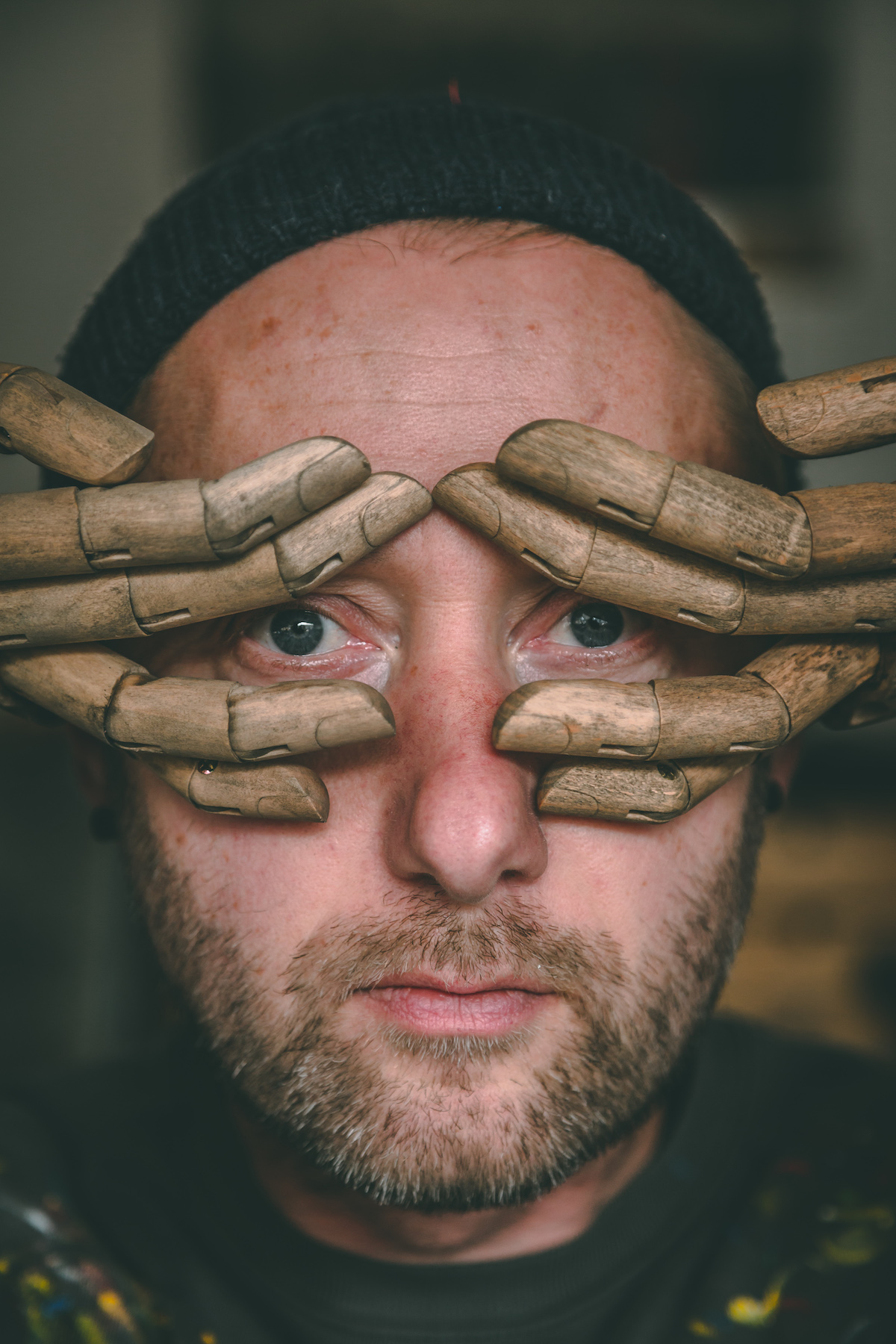
This complete GraffitiStreet guide traces the development of My Dog Sighs’ practice through Free Art Friday, monumental public murals, painted cans, the immersive project Inside, LOOK UP Portsmouth and his continuing transformation of discarded materials into intimate portraits.
My Dog Sighs at a Glance
Artist: My Dog Sighs
Name: Paul Stone
Based in: Portsmouth, England
Known for: Reflective eyes, painted cans, melancholic portraiture and found-object works
Early movement: Free Art Friday
Recurring figures: Everyman and the Quiet Little Voices
Major immersive project: Inside
Documentary: We Shelter Here Sometimes
Festival: Founder and creative force behind LOOK UP Portsmouth
Materials: Spray paint, acrylic, reclaimed aluminium, discarded cans, concrete, canvas, paper and sculpture
Key themes: Vulnerability, reflection, community, memory, loss, discovery and transformation
From Free Art Friday to an International Practice
My Dog Sighs is the pioneer of Free Art Friday, an artist-led movement in which original works were left in public spaces for strangers to discover and keep. For approximately ten years, he gave away artworks through this exchange, allowing chance rather than the conventional gallery system to determine who encountered and owned them.
The approach established several principles that continue to shape his work. Art could be freely encountered. An overlooked corner of a city could become an exhibition space. An object without obvious monetary value could acquire emotional significance through the act of being found.
Free Art Friday was therefore more than a means of distributing work. It changed the relationship between artist, artwork and audience. The recipient did not enter a gallery intending to make a purchase. Instead, they encountered something unexpected in the street, stopped, looked and chose to engage with it, before ultimately taking the artwork home as a freely given piece of art. In that simple exchange, art moved directly from the artist into someone’s life, without a gallery, transaction or traditional barrier between them.
That moment of attention remains central to My Dog Sighs’ practice. Whether the work appears on a monumental wall, a sheet of paper or a crushed food can, it often begins with something that might otherwise have been passed by.
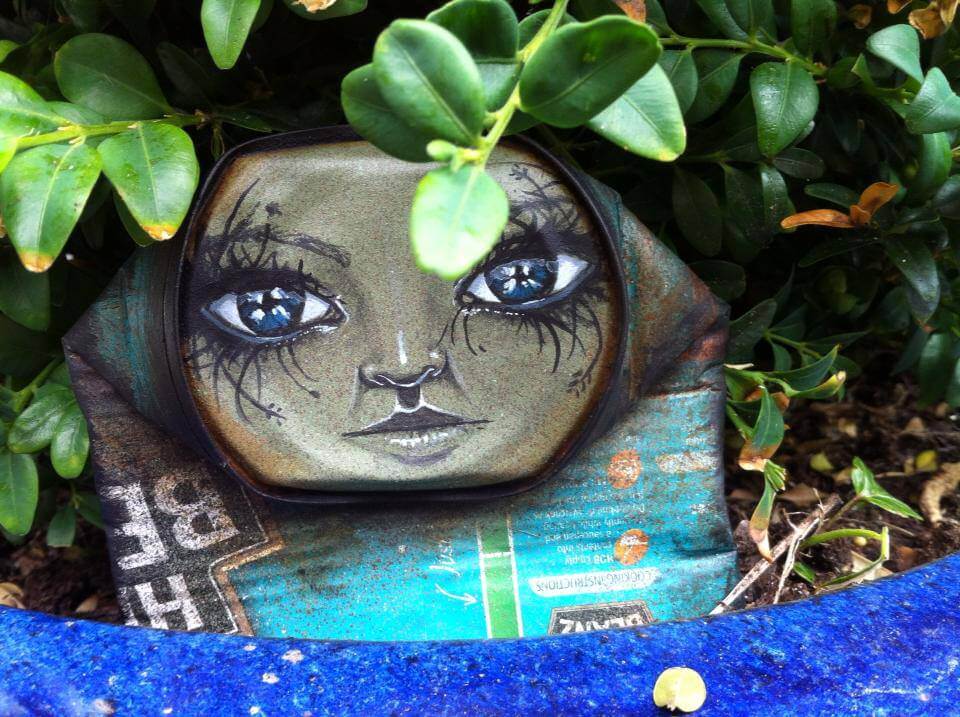
My Dog Sighs, Free Art Friday, Image copyright MDS
As My Dog Sighs’ practice developed internationally, moving across street interventions, large-scale murals, exhibitions, studio works and immersive projects, those early ideas remained remarkably consistent. The scale changed, the audiences widened and the settings became increasingly ambitious, yet the underlying invitation remained the same: to notice, to pause and to form a personal connection with something encountered unexpectedly.
That moment of attention remains central to My Dog Sighs’ practice. Whether the work appears on a monumental wall, a sheet of paper or a crushed food can, it often begins with something that might otherwise have been passed by.
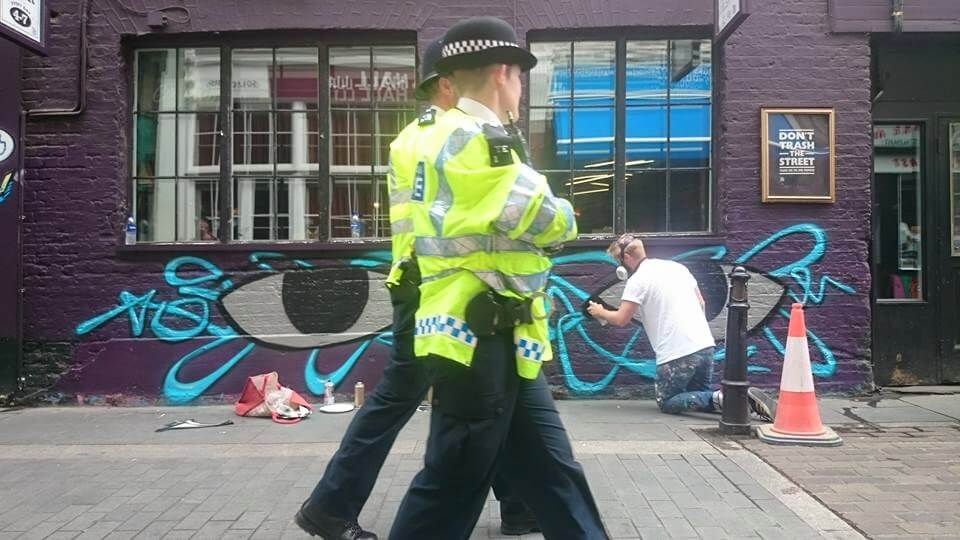
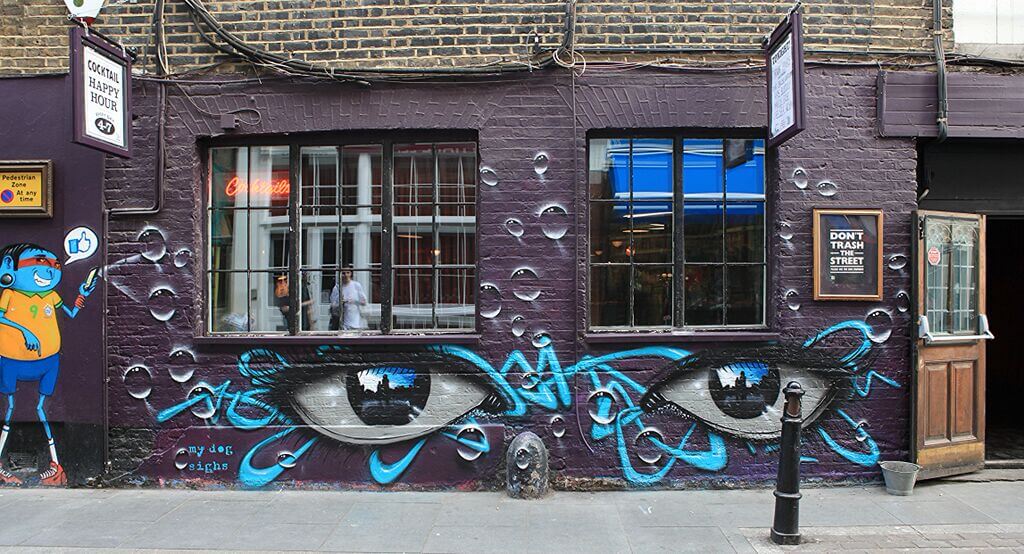
My Dog Sighs, Shoreditch 2015 for GraffitiStreet Underground Exhibition. Image copyright (upper) Mikey Dread, and (lower) Nelly.
For further background on the artist’s murals throughout the years, read GraffitiStreet’s feature, Street Artist in the Spotlight: My Dog Sighs.
Inside The DogHouse: 2016 studio visit and Lost and Found
My Dog Sighs’ Portsmouth studio is affectionately known as The DogHouse. During our visit in 2016, My Dog Sighs reflected on his early ambition to become a gallery artist, the repeated rejection that led him back to teaching and the moment street art offered a different route. He identified a Banksy rat seen in London in 2002 as a catalyst, demonstrating that art could exist outside the conventional gallery system and still challenge, provoke and connect with an audience.
The studio visit also revealed the origins of his found-object language. Searching for affordable materials for Free Art Friday, he began working on doors, timber, cardboard and discarded metal. A flattened baked-bean tin found in the street became especially significant: after painting a small face onto it, the object appeared to mirror his own experience of being lost, recovered and given a new direction.
My Dog Sighs TEDxWarwick talk Lost and Found helps explain why reclaimed materials remain central to My Dog Sighs’ work. The cans are not selected simply for visual novelty. They carry histories of use, rejection and rediscovery that closely reflect the artist’s own account of his creative development.
Read GraffitiStreet’s original studio visit, Lost and Found: My Dog Sighs in The DogHouse.
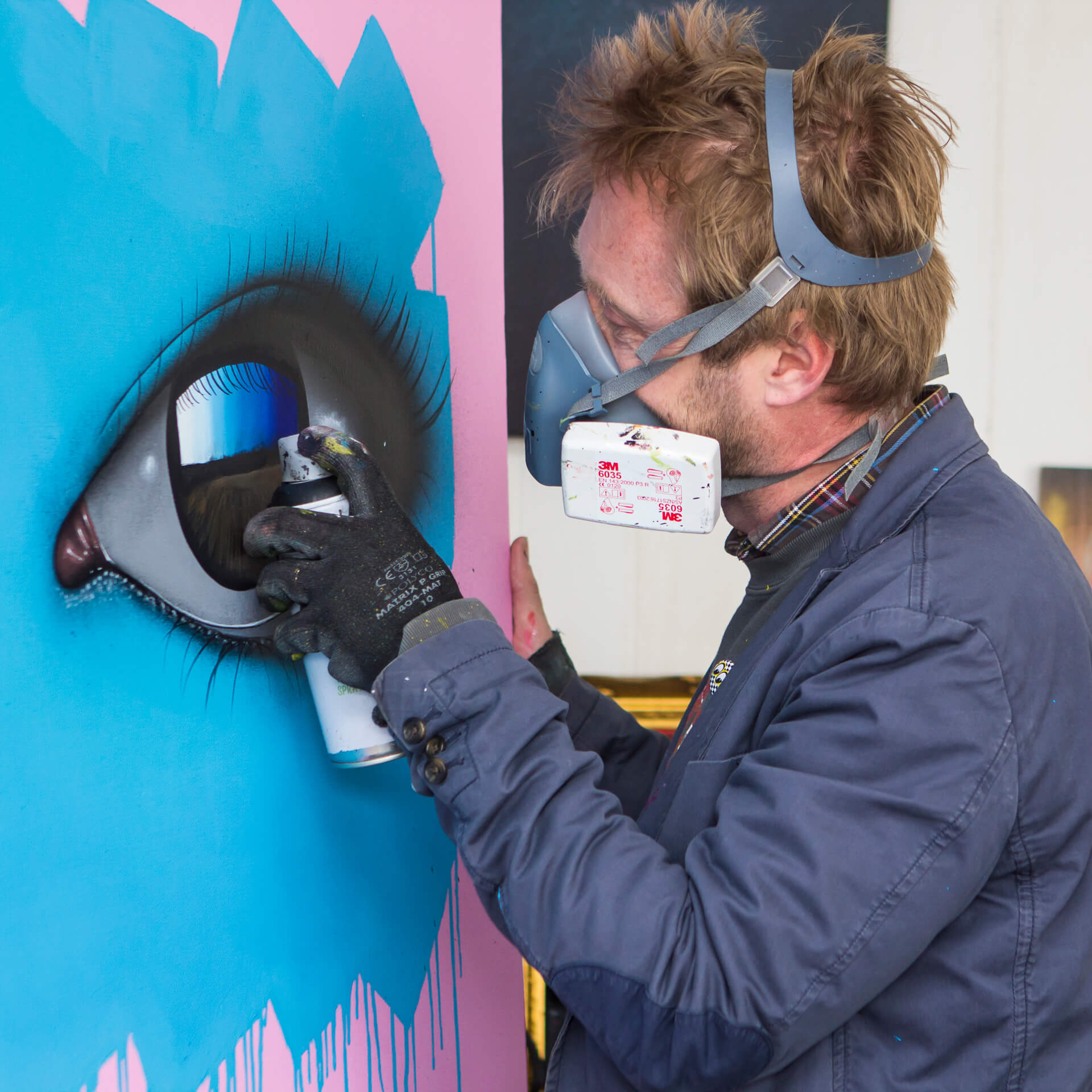
My Dog Sighs at his studio 2016. Photography Alex Stanhope. Image copyright GraffitiStreet
Why Does My Dog Sighs Paint on Discarded Cans?
Discarded cans and reclaimed objects are among the most recognisable materials in My Dog Sighs’ work. Their previous lives are not concealed; dents, scratches, folds and traces of use remain part of the finished artwork.
The artist’s official biography connects these materials with experiences of loss and rediscovery. Food cans once held something necessary, were emptied and rejected, and are then recovered and given a new identity through painting.
That transformation is both physical and symbolic. By painting a face into the opening of a crushed can, My Dog Sighs turns anonymous waste into an individual presence. The damaged metal can appear to shelter the figure while also leaving it exposed, creating a tension between protection and vulnerability.
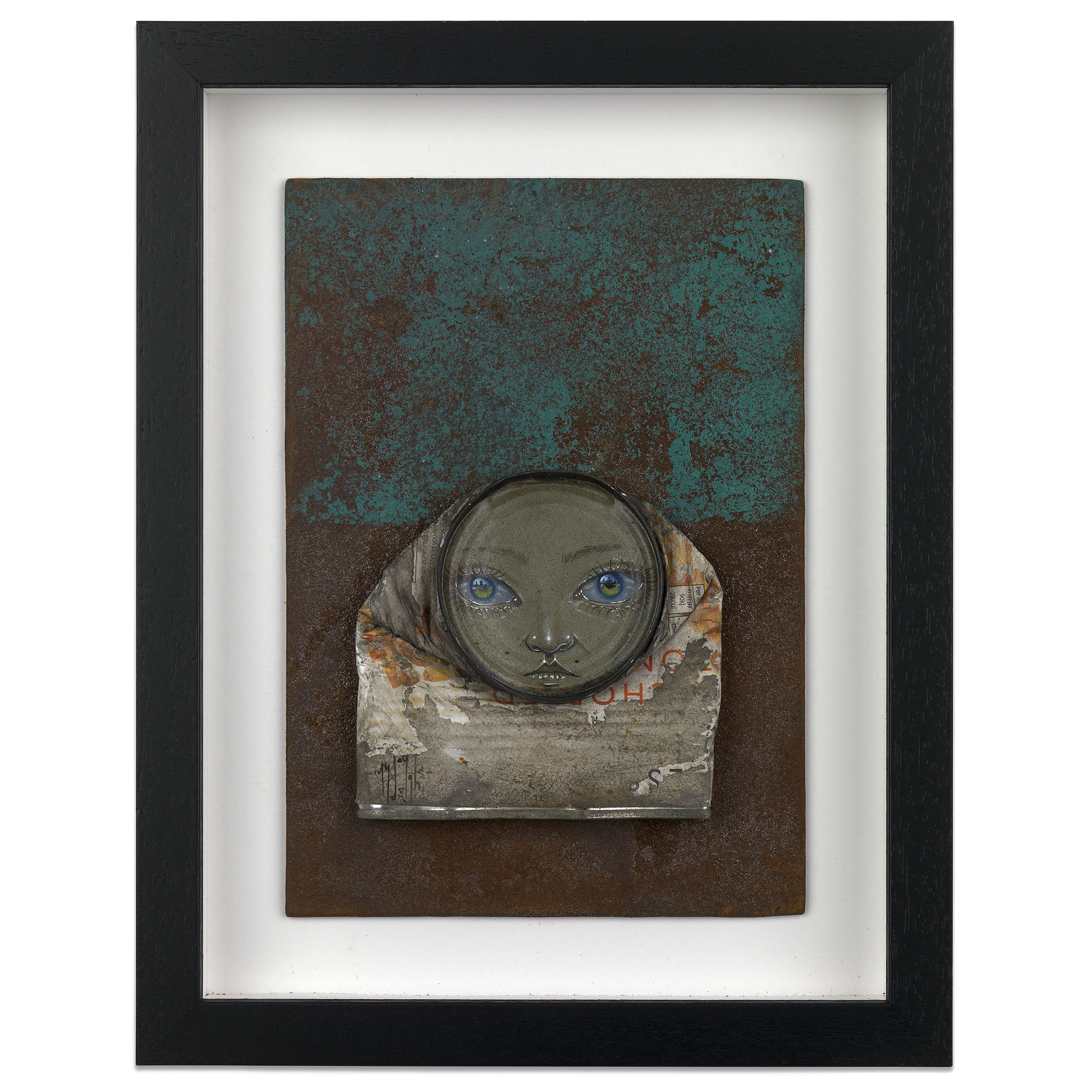
In Essential, presented by GraffitiStreet as part of Urban Equinox, the existing dents and folds of a reclaimed aluminium can remain clearly visible.
Elsewhere, change is built directly into the artwork. Aspects of Fragility incorporates fragile tape intended to crack and deteriorate over time. Rather than treating alteration as damage, the work makes physical change part of its continuing meaning.
The found surface is therefore never merely a substitute for canvas. Its history, irregularity and vulnerability help determine the character of the final work.
The Reflective Eyes of My Dog Sighs
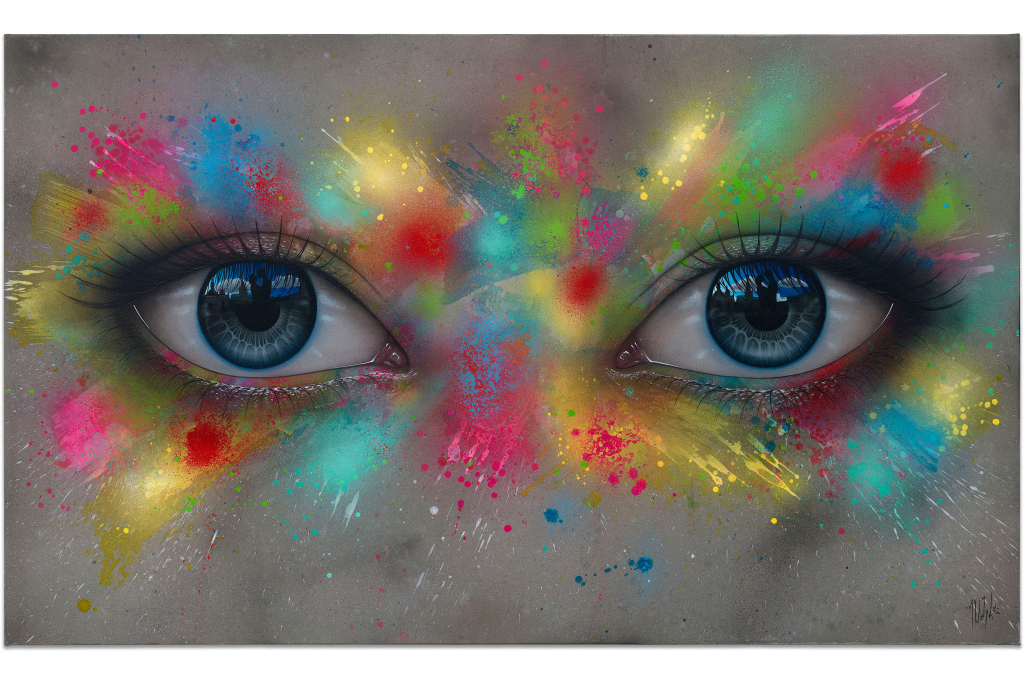
My Dog Sighs is particularly recognised for large, photorealistic eyes containing detailed reflected scenes. These reflections may show buildings, landscapes, memories, figures or fragments of local history, connecting each image to the place in which it appears.
The eye operates simultaneously as portrait and environment. Viewers are drawn towards a private emotional space, only to discover another image reflected back at them. In the 2023 Hilsea Lines project, the reflection responds directly to Portsmouth’s northern landscape and wider regeneration, incorporating references to Hilsea Lido and Foxes Forest while acknowledging improvements to local walking and cycling routes. Through these details, the artwork becomes more than a monumental gaze; it also records the identity, movement and evolving character of the surrounding area.
Read the full GraffitiStreet feature, Street Artist My Dog Sighs and Friends Paint Hilsea Lido as Part of Levelling Up Portsmouth, 2023.
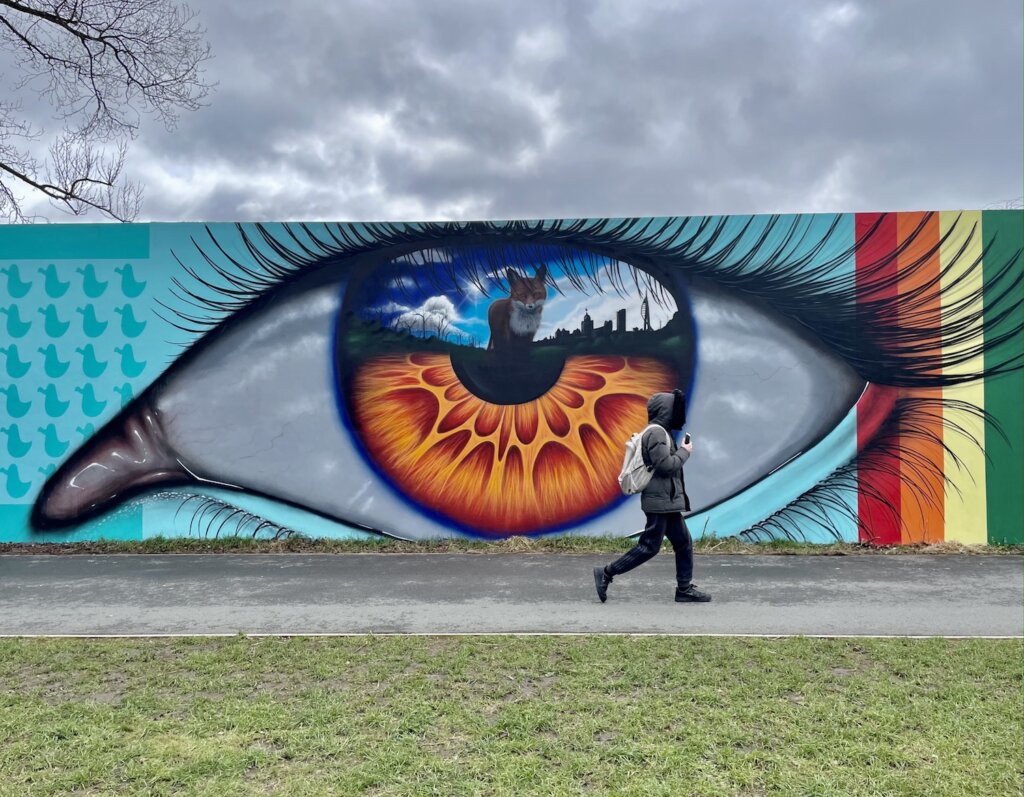
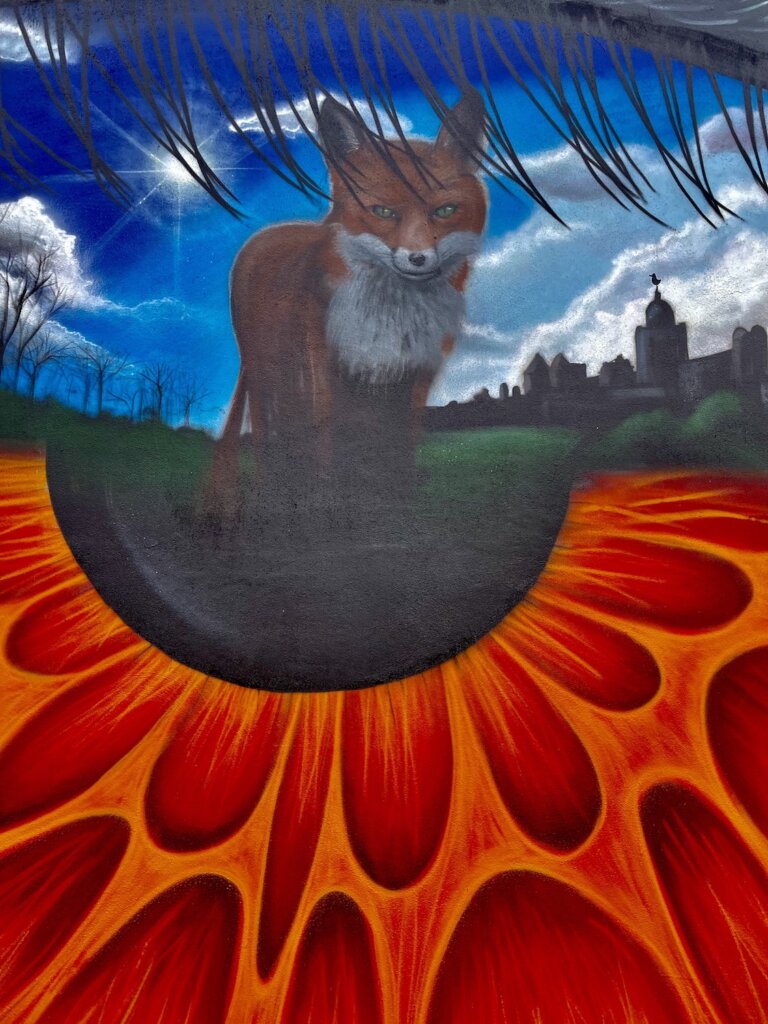
Street Artist My Dog Sighs and Friends paint Hilsea Lido as part of levelling up Portsmouth, 2023. Image copyright GraffitiStreet
In his studio practice, I Live in the Moment, Just Not This One (2024) makes that reflection especially personal. Within the green eye appears a self-portrait of My Dog Sighs himself, giving the work a particular intimacy because the artist more often uses these reflections to hold the presence of others, including families, friends, local figures and surrounding scenery. Here, the gaze turns inward, allowing the artist to become both observer and subject.
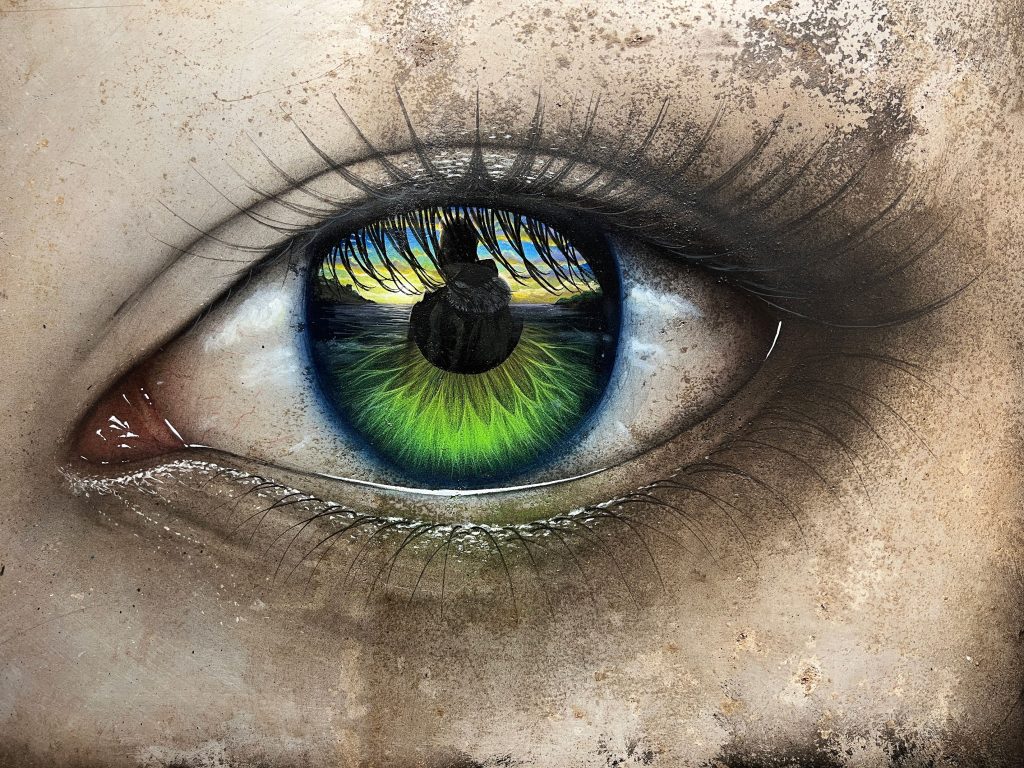
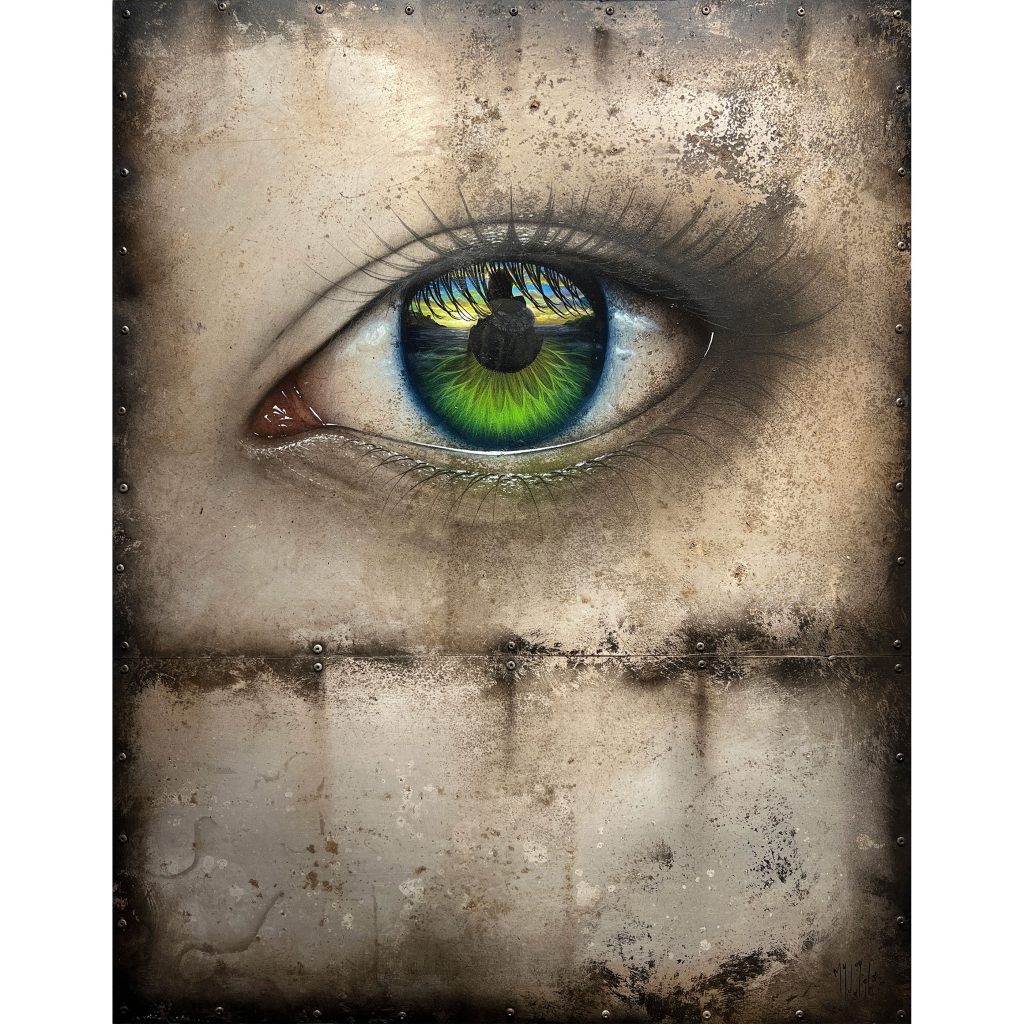
My Dog Sighs – I live in the Moment, Just not this one (2024) available via GraffitiStreet
Murals Shaped by Place and Community
My Dog Sighs has developed a highly recognisable visual language, yet the location of each mural often determines its reflections, palette and narrative. Local histories may appear within an eye. Existing architecture can be incorporated into the image. Community members may contribute stories or photographs that shape the final composition.
This responsiveness distinguishes the work from murals that treat architecture as a neutral support. Brick, concrete, windows, pipes and street furniture can all influence how the image is composed and read.
The scale of a mural also changes the relationship between artwork and viewer. A face painted on a can asks for close attention; a vast eye painted across a building becomes part of the surrounding environment. It can be seen from a distance, yet its reflections reward closer inspection.
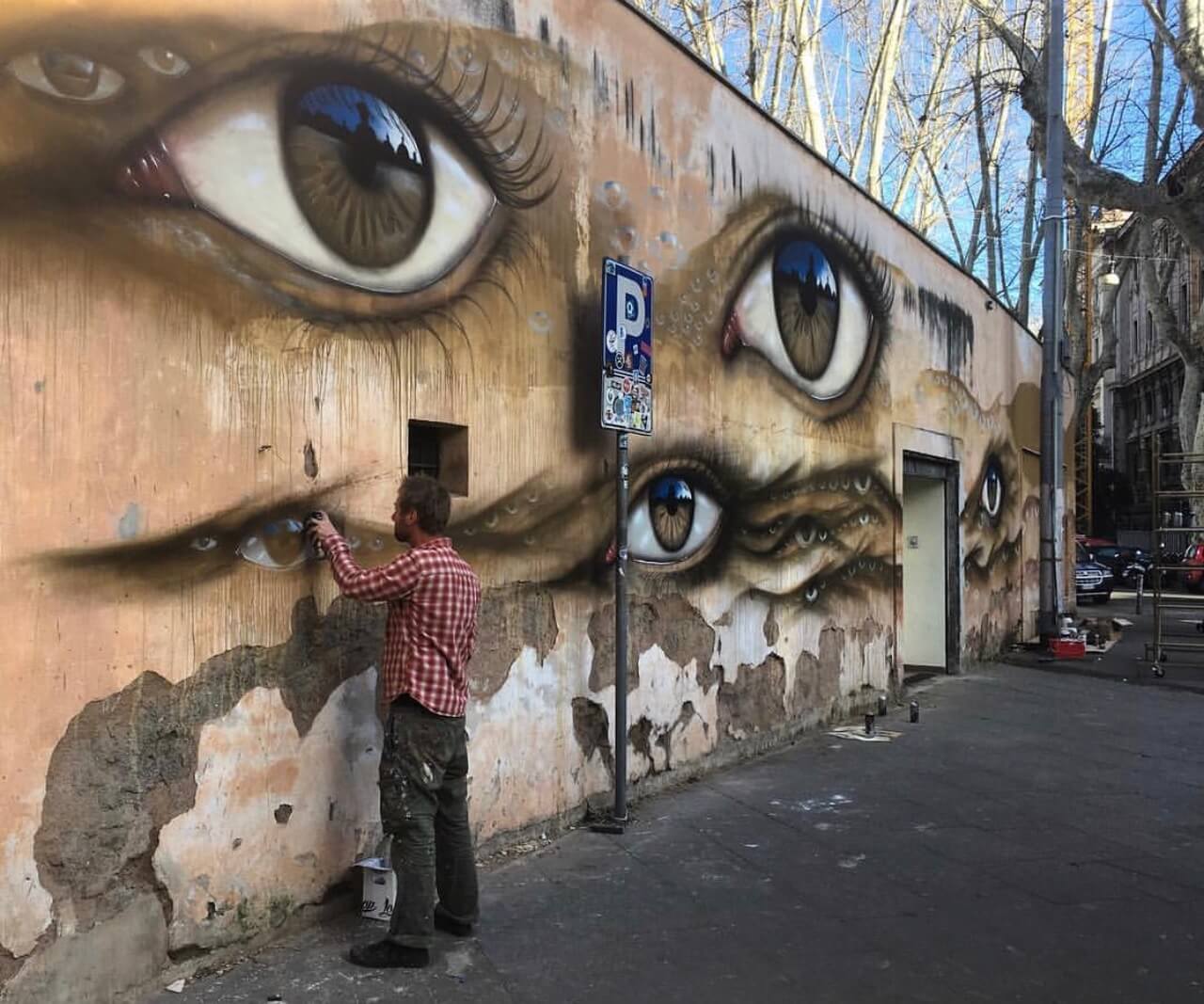
In Rome, his 2018 mural for the Forgotten Project covered a hospital wall with 540 eyes. The reflected imagery included the Rome skyline and silhouettes connected to people who had personal histories with the building, turning the façade into a collective record of memory and place. Read the full story in My Dog Sighs Paints in Rome for the Forgotten Project.
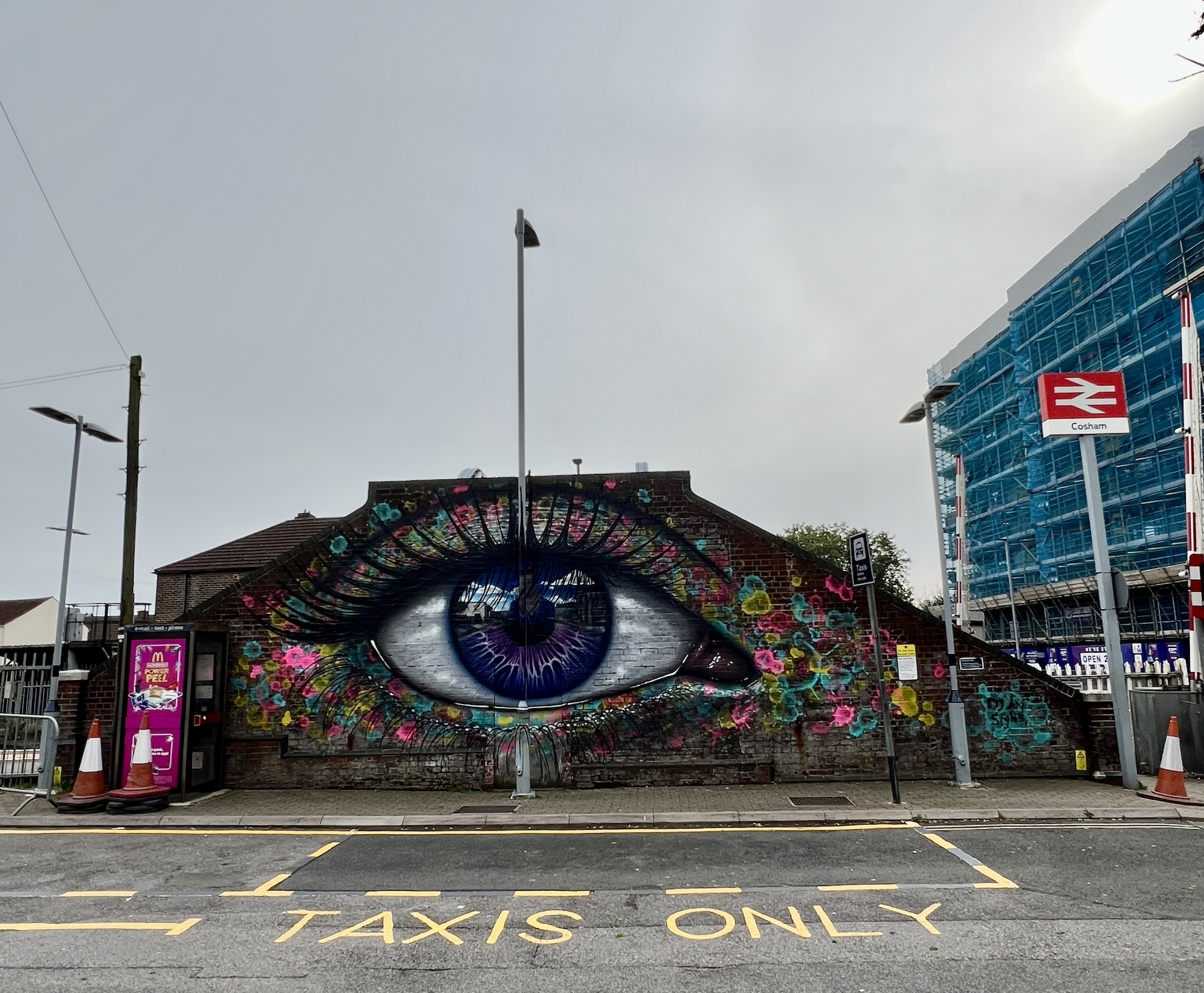
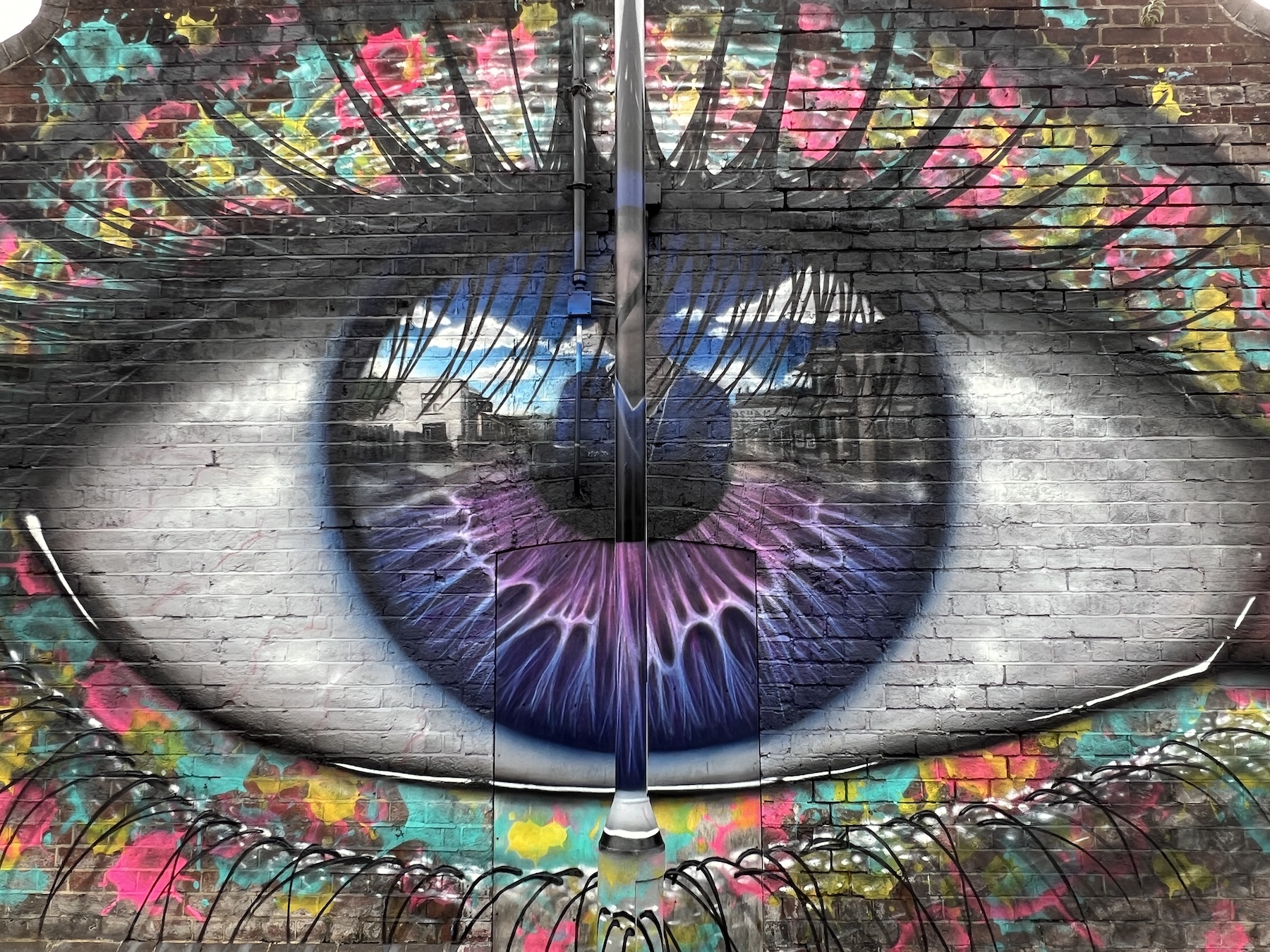
For the 2024 LOOK UP festival, My Dog Sighs painted a signature eye mural at Cosham Railway in Portsmouth. Its reflection incorporated a historic view of Cosham High Street and a tribute to Jax Davies, a midwife from the nearby Queen Alexandra Hospital. An existing lamppost was incorporated into the composition rather than treated as an obstruction. Read the full story in My Dog Sighs’ Tribute to Cosham’s History and Community.
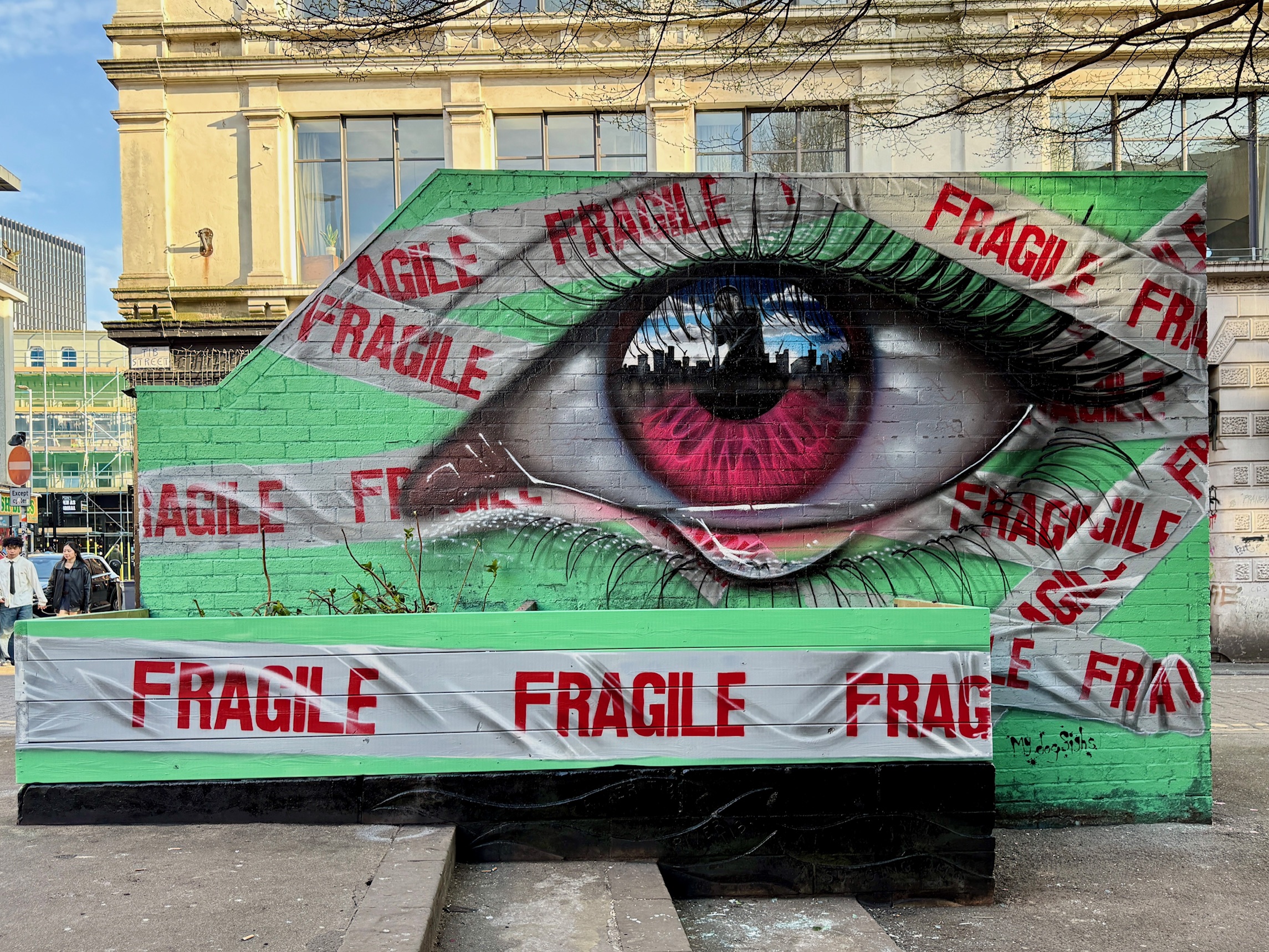
In Manchester’s Northern Quarter, My Dog Sighs created Fragile (2025), an eye mural containing a tribute to Joy Division singer Ian Curtis. The reflection connects the artist’s personal relationship with Manchester’s music to the wider cultural identity of the city, while fragile tape introduces a visual language of emotional vulnerability. Read the GraffitiStreet feature on the Manchester mural.
His murals consistently move between private emotion and shared history. They may begin with one artist’s memory, one resident’s story or one architectural detail, but they are placed into public space where their meaning continues to expand.
This exchange between internal feeling and external place gives the murals much of their power. The gaze appears personal, yet its contents frequently belong to an entire community.
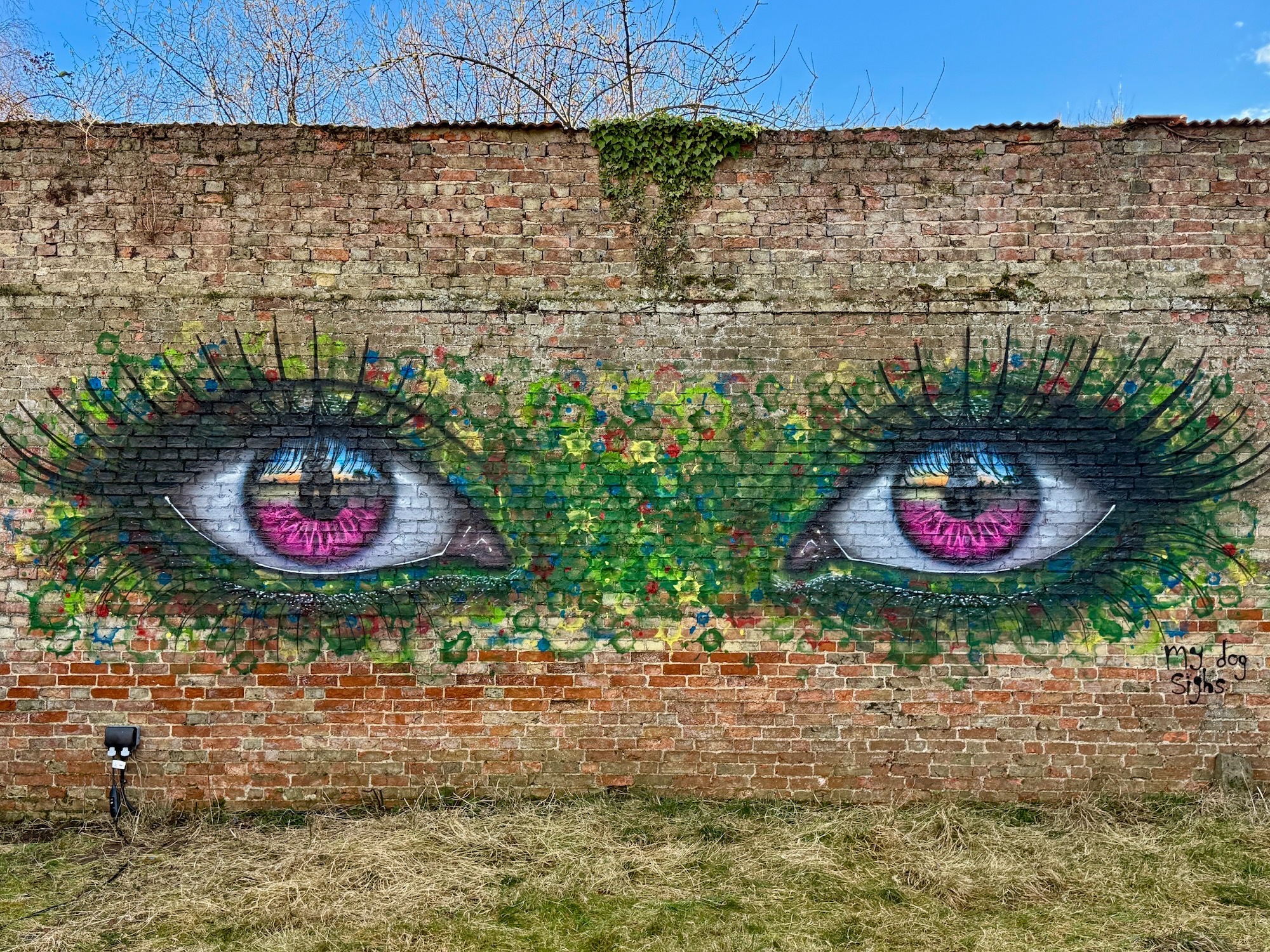
In March 2025, a garden mural in Cambridgeshire drew its palette from the wildflower garden surrounding the wall. Here, the reflected gaze responded not to an urban history but to the changing colours of the landscape. Explore the project in Unveiling Beauty with Nature’s Palette.
Across these works, the eye does more than watch. It absorbs the identity of its setting and asks the viewer to consider what a place remembers.
Faces, Everyman and the Quiet Little Voices
The reflective eyes form only one part of My Dog Sighs’ visual language. His wider population includes intimate painted faces, recurring Everyman figures and characters known as the Quiet Little Voices.
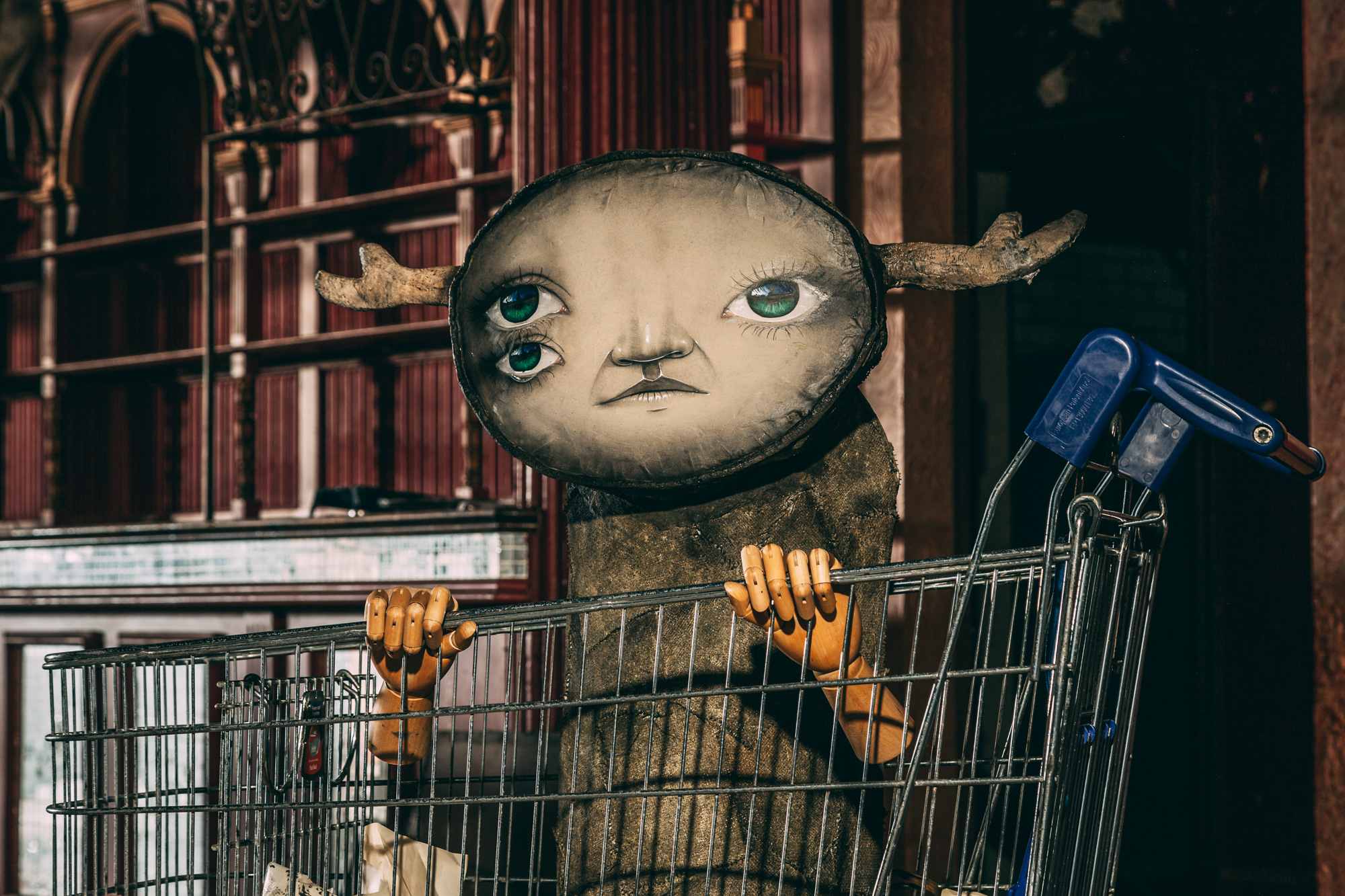
These figures often appear uncertain, introspective or emotionally exposed. Some occupy discarded objects; others emerge from walls or inhabit the environments created for his immersive work. Their identities remain open enough for viewers to project their own memories and emotions onto them.
The Everyman figure suggests a shared rather than individual experience. It is not intended as a portrait of a single named person, but as a vessel for feelings that can be broadly recognised.
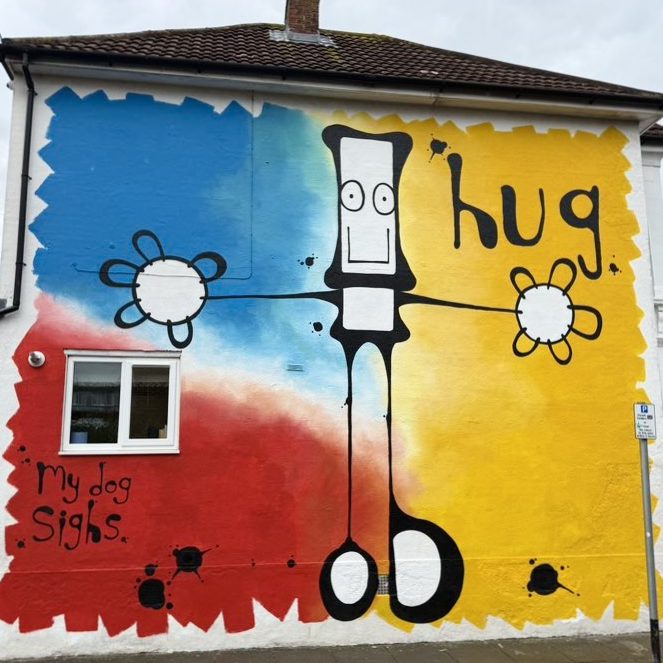
The Quiet Little Voices operate in a similar way. They embody fragments of internal experience: fear, protection, hesitation, resilience, isolation or hope. Their apparent simplicity allows them to communicate complex states without relying upon a fixed narrative.
Across these figures, vulnerability operates less as weakness than as a point of recognition between the artwork and its viewer. My Dog Sighs does not offer a complete explanation of what each character feels. Instead, he leaves enough emotional space for the audience to complete the encounter.
Inside: Building an Immersive World
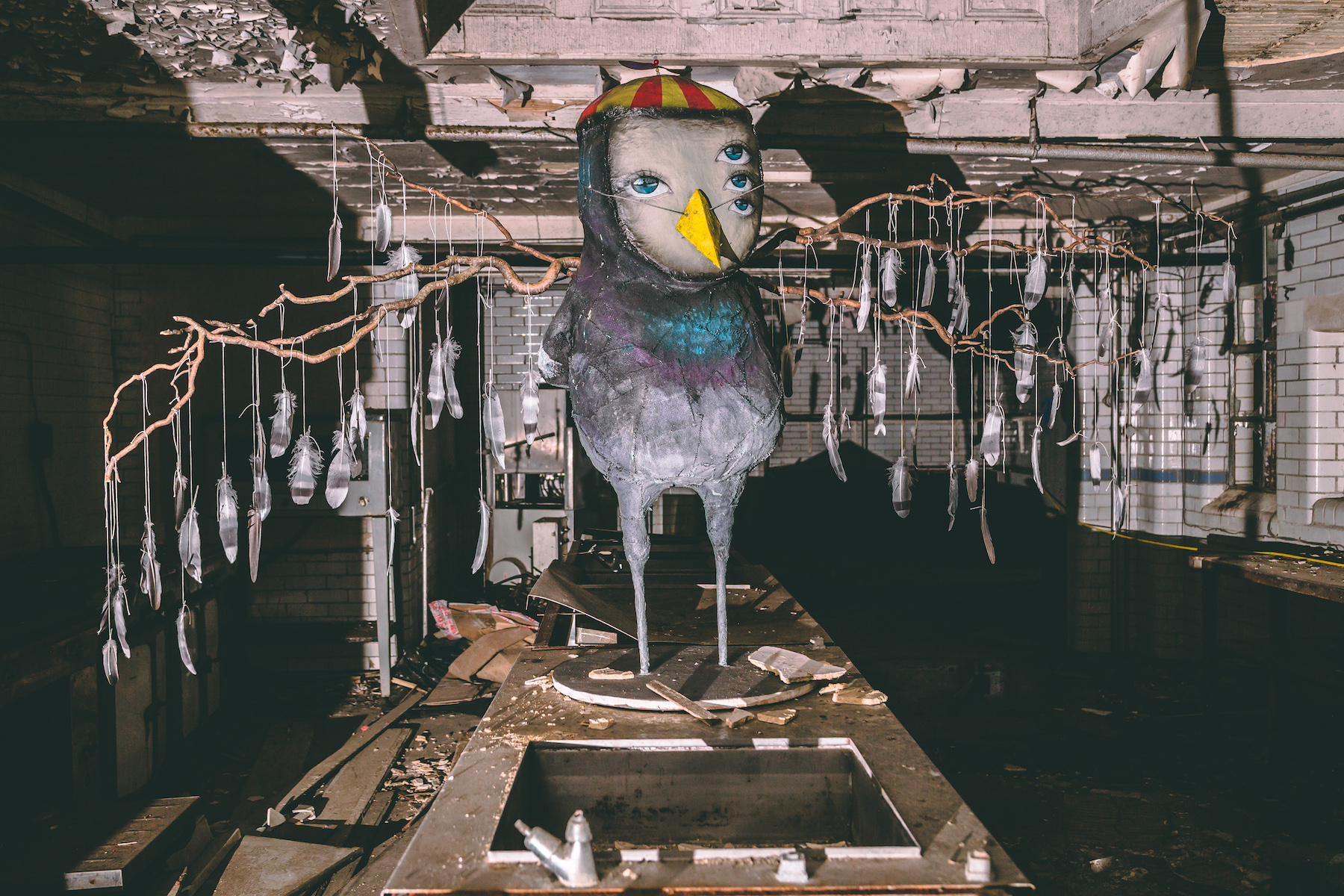
In 2021, My Dog Sighs opened Inside, an ambitious immersive environment created within a derelict building in Portsmouth.
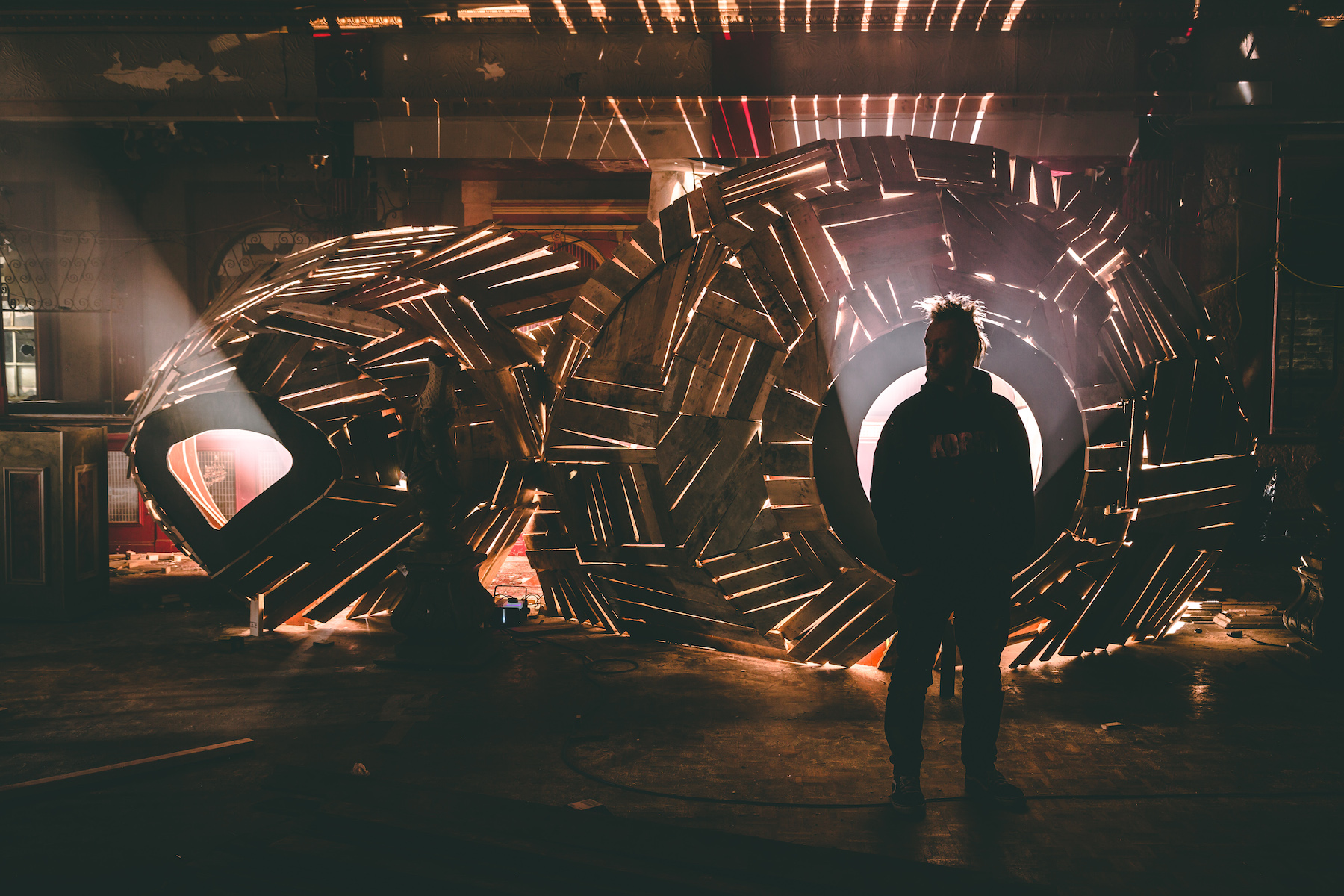
The project expanded his practice beyond individual paintings and murals into sculpture, sound, light and spatial storytelling. Visitors did not simply encounter works hung within a room; they entered an alternative world inhabited by the artist’s Quiet Little Voices.
The damaged architecture became part of the work. Painted walls, sculptural figures, altered surfaces, sound and controlled lighting formed a connected environment through which the audience moved.
The transition was significant but not disconnected from his street practice. A street artist is already accustomed to responding to existing architecture, weathered surfaces and uncontrolled surroundings. With Inside, My Dog Sighs extended that thinking until the complete building became the artwork.
The project also allowed the Quiet Little Voices to become more than painted characters. They occupied the space as physical presences, each suggesting a different aspect of human experience. The artist described the environment as a world in which the characters carried different elements of the human condition.
Read GraffitiStreet’s original interview with My Dog Sighs about the creation of Inside.
We Shelter Here Sometimes
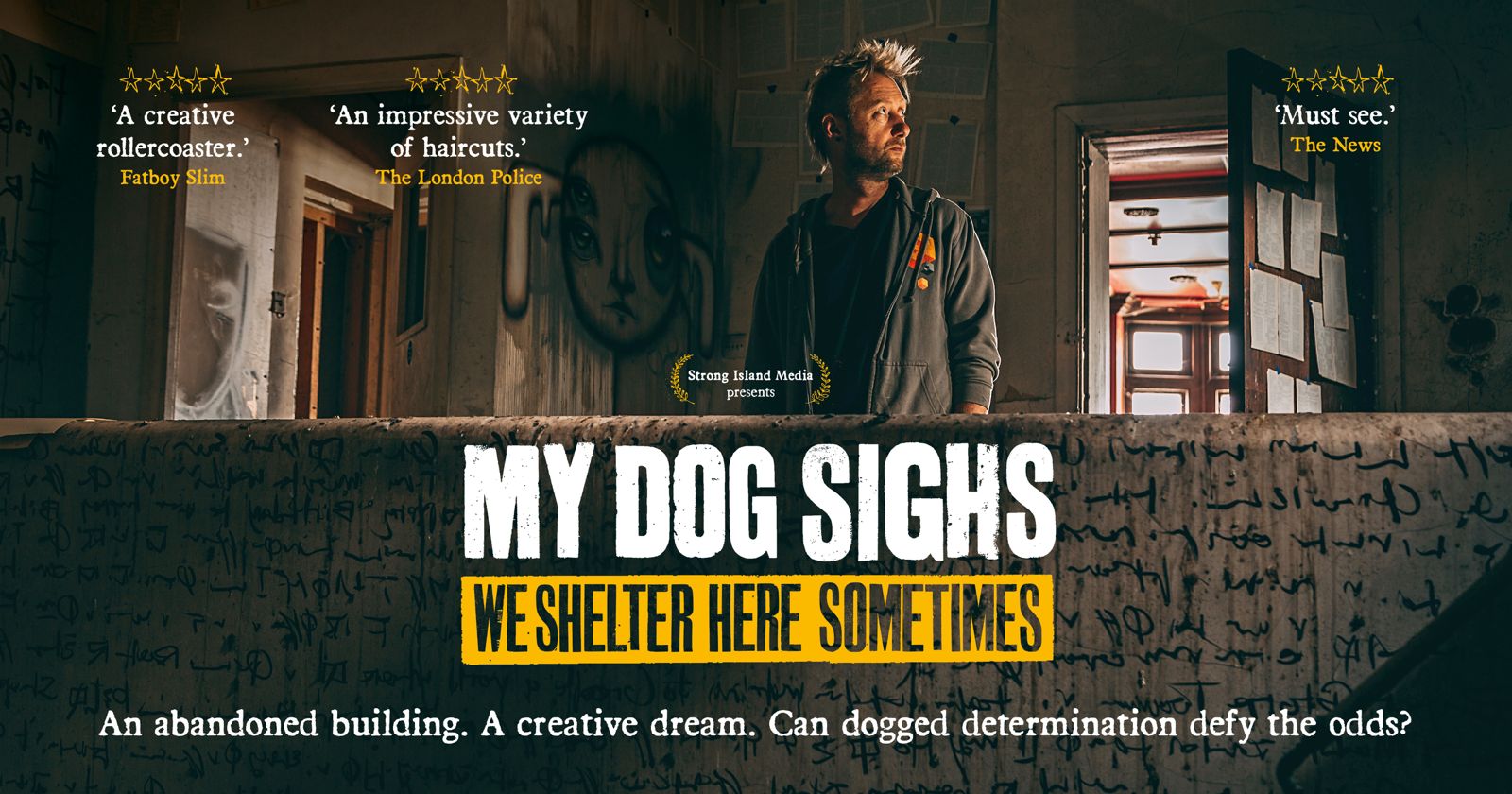
The creation of Inside became the subject of the documentary We Shelter Here Sometimes, directed by Paul Gonella of Strong Island Media.
The film documents the considerable challenges surrounding the project and looks beyond the completed exhibition to reveal the creative, practical and emotional demands involved in bringing the environment to life. It follows My Dog Sighs as he attempts to transform an abandoned ballroom into a controlled immersive world during a period marked by the disruption of the pandemic.
The title points towards one of the central ideas running through the project: shelter is never purely architectural. It can also be psychological, emotional or communal.
Within Inside, the building offered temporary shelter to the Quiet Little Voices. At the same time, the figures embodied the anxieties, coping mechanisms and emotional states through which people attempt to protect themselves.
The documentary adds another layer to the work by recording the fragility of the creative process itself. An ambitious public outcome emerged through uncertainty, persistence and the support of those who helped make the project possible.
Read GraffitiStreet’s feature, We Shelter Here Sometimes: A Documentary on My Dog Sighs.
LOOK UP Portsmouth
My Dog Sighs was the creative force behind LOOK UP Portsmouth, a public street-art festival that brings established and emerging artists into his home city.
The festival extends several principles already present in Free Art Friday. Work is encountered across streets and neighbourhoods rather than confined to a single venue. Residents, businesses, property owners and visitors become part of the process as familiar routes and overlooked walls are transformed.
The first LOOK UP festival in 2023 brought almost 100 local and international artists to Portsmouth, with My Dog Sighs acting as curator and lead artist. Read GraffitiStreet’s report on LOOK UP Portsmouth 2023.
During LOOK UP Portsmouth 2025, My Dog Sighs completed seven walls in seven days. The works moved across his wider visual vocabulary, including reflective eyes, Everyman figures and Quiet Little Voices. Together, they offered a concentrated view of a practice capable of moving between monumental spectacle and small, intimate interventions.
Explore the full story in My Dog Sighs at LOOK UP Portsmouth: Seven Walls in Seven Days.

My Dog Sigh, ‘Look Up’ Street Art Festival, Portsmouth 2023. Image copyright Graffitistreet.com
One of the works created for the 2025 festival, It’s Better When We’re Together, brought brightly coloured Everyman figures together across a Portsmouth wall as an image of community and belonging. Read the dedicated mural feature.
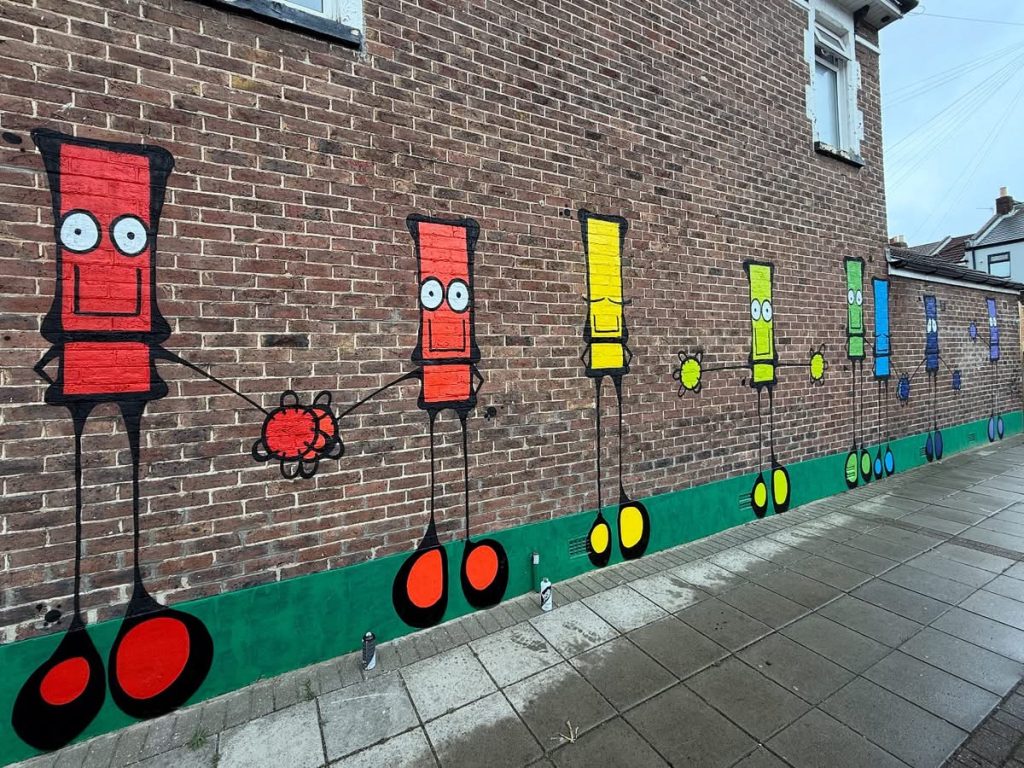
The festival demonstrates how his commitment to accessible art has developed in scale. What began with individual works left anonymously for strangers has grown into a city-wide programme capable of creating new connections between artists, neighbourhoods and audiences.
Easter Treasure Hunts and the Return to Free Art
My Dog Sighs’ Easter treasure hunts bring the principles of Free Art Friday back into the streets of Portsmouth on a city-wide scale. Rather than presenting artworks through a conventional exhibition, the artist hides original works, editions and collectable objects across public spaces, releasing clues and allowing chance, persistence and discovery to determine who finds them.
In 2023, the artist marked twenty years of working on the street with a three-day Easter treasure hunt across Portsea Island. More than £45,000 worth of art was placed throughout Portsmouth, including original hand-painted cans, painted pebbles, limited-edition prints, specially minted coins and smaller collectables.
The event returned My Dog Sighs to the foundations of his practice. Art was given away rather than placed behind a gallery threshold, while streets, beaches, cafés and overlooked corners became temporary exhibition spaces. The hunt also encouraged people to move through Portsmouth differently, creating an exchange between artwork, place and community.
Read GraffitiStreet’s original report, The My Dog Sighs £45,000 Easter Treasure Hunt, Portsmouth 2023

The Easter 2025 hunt continued this tradition, showing that Free Art Friday remains an active part of My Dog Sighs’ practice rather than a closed chapter in his career. That year, he raised the sense of anticipation even further by burying a piece of his jewellery, valued at several thousand pounds, beneath the beach for one participant to discover. The gesture brought together generosity, suspense and the possibility of unexpected ownership, while preserving the accessibility and spirit of discovery that have long defined his public work.
A US West Coast Journey Through Murals and Connection
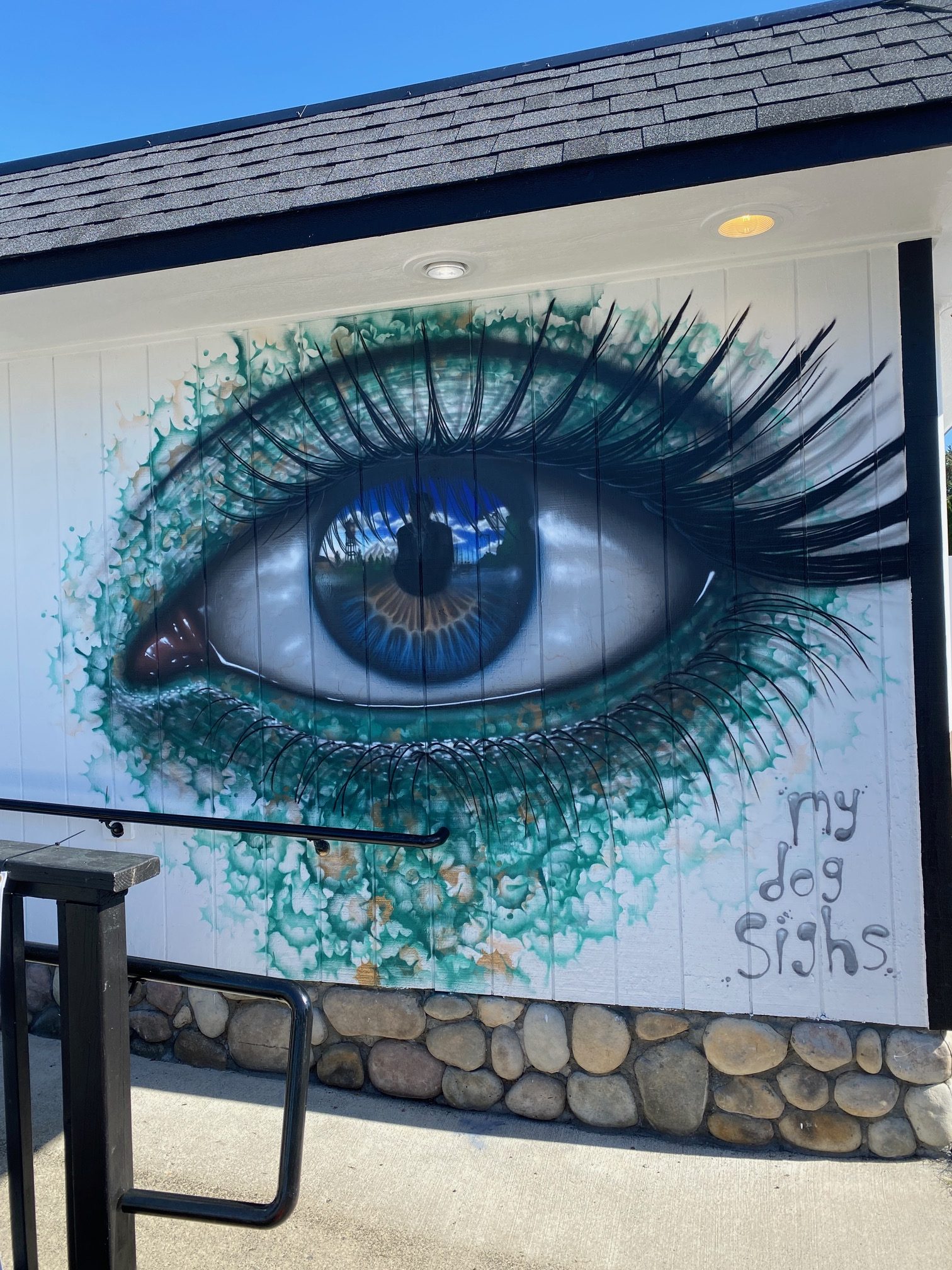
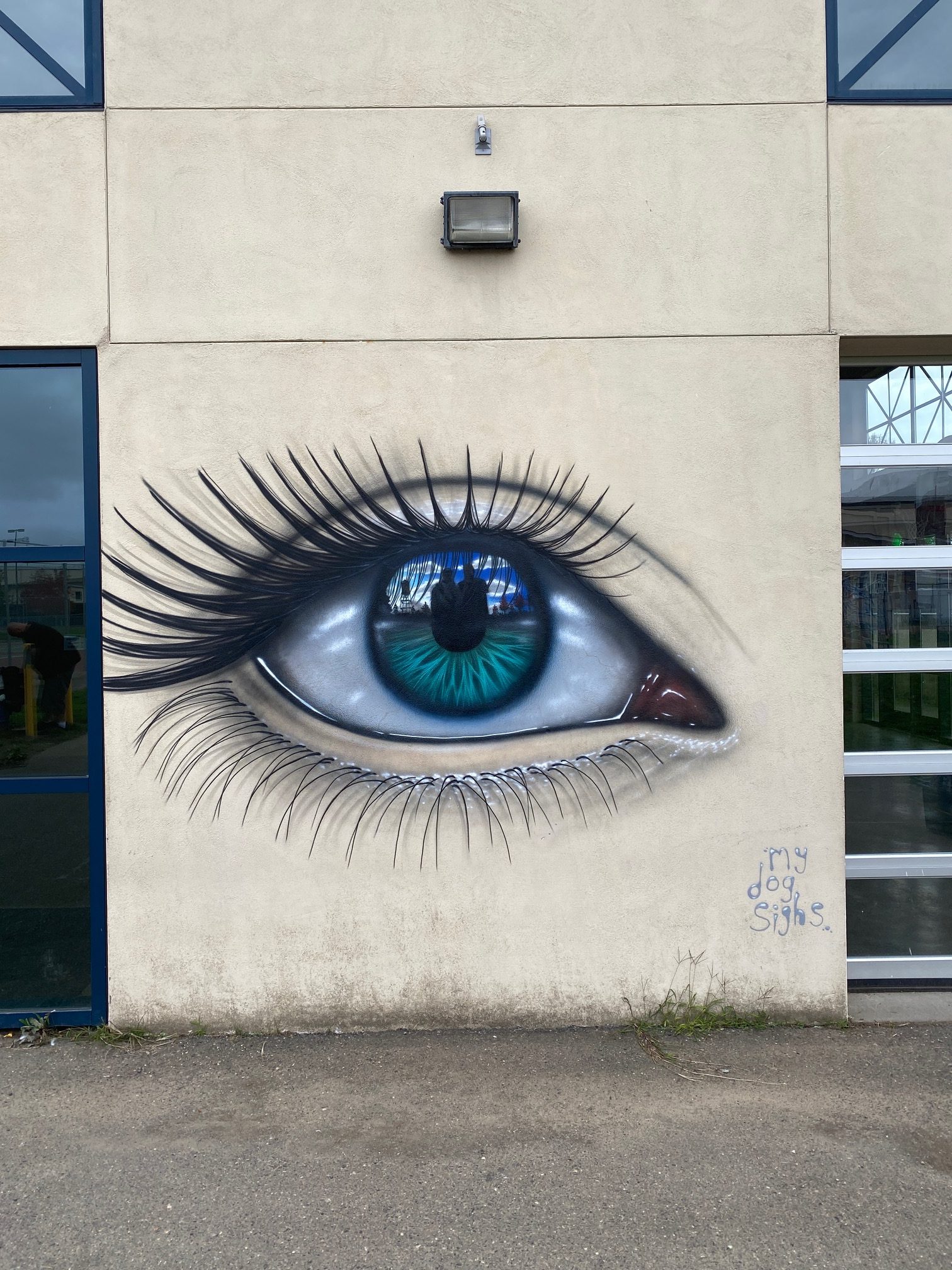
In early 2025, My Dog Sighs travelled along the West Coast of the United States, completing ten walls in two weeks across locations including Blaine, Washington, San Francisco and Sacramento. The journey brought together mural-making, travel and community exchange, allowing the artist to respond to a succession of places within an unusually concentrated period.
Rather than approaching the tour as a sequence of interchangeable commissions, My Dog Sighs used each wall to explore the people, atmosphere and visual identity of its setting. His reflective eyes and Everyman figures became points of connection between the artist and those he encountered, while the road trip itself created an evolving record of friendship, collaboration and place.
The project also demonstrated the adaptability of his visual language. Across different scales and surfaces, the familiar eyes continued to operate as containers for reflection, while the recurring figures carried ideas of vulnerability, belonging and shared experience from one city to the next.
The speed of the tour did not reduce the role of observation. Ten murals in two weeks required physical endurance and technical discipline, yet the resulting works remained rooted in the relationships and encounters surrounding their creation.

Read GraffitiStreet’s full interview, In Conversation with My Dog Sighs: A US West Coast Journey Through Murals, Community and Connection.
Art, Music and Community in Tanzania
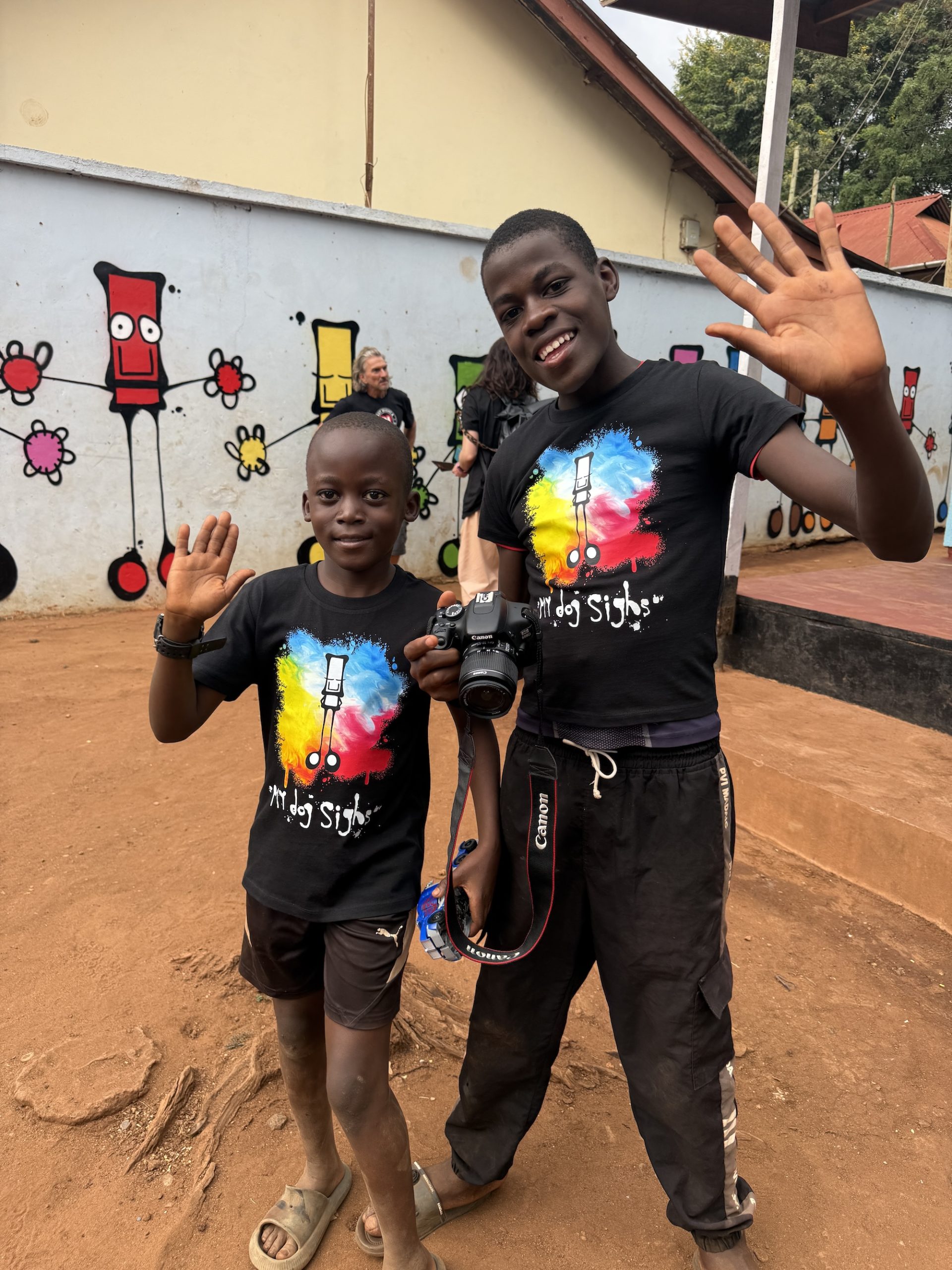
In 2026, My Dog Sighs travelled from Portsmouth to Moshi, Tanzania, with fellow artists Tamp2 and Peachzz as part of a project led by the charity Last Night A DJ Saved My Life. Working across centres supporting children with disabilities, former street-connected young people and men recovering from addiction, the artists used murals, music and creative workshops as a means of exchange rather than simply decoration.
My Dog Sighs created several of his signature eye murals, embedding the faces and stories of people he encountered within the reflections. At Feathers Gate, the first mural included eight-year-old Ebaneza, whose portrait came to represent children too often overlooked or underrepresented. At Angels Gate, the reflection honoured Ochu, a former street-connected young person who later became an art teacher after being inspired by visiting artists.
The Tanzania project reveals an important aspect of his practice: the reflective eye is not simply a recognisable motif applied to different locations. Its imagery develops through listening, chance encounters and relationships formed while the work is being made. The people placed within the reflections are not decorative details; they become part of how the mural belongs to its community.
Read GraffitiStreet’s full interview, In Conversation with My Dog Sighs: Art, Music and Community in Tanzania.
What Does My Dog Sighs’ Art Mean?
My Dog Sighs’ art explores vulnerability, reflection, human connection and the possibility of finding renewed value in what has been overlooked or discarded. Across his painted cans, reflective eyes, Everyman figures, Quiet Little Voices and immersive environments, the artist returns to the emotional states people often carry privately: uncertainty, loneliness, tenderness, resilience and the desire to be understood.
The reflective eye is central to this visual language. It operates simultaneously as portrait and environment, drawing viewers towards an apparently private emotional space before revealing another image within the gaze. These reflections may contain families, friends, local people, architecture or surrounding scenery, connecting an individual face with a wider community and place.
His use of crushed cans and reclaimed materials develops the same idea through physical form. Dents, scratches, folds and signs of previous use remain visible, allowing each object to retain its history. By introducing a carefully painted face, My Dog Sighs gives the discarded material a new presence without erasing what it has endured. The transformation suggests that damage, rejection and imperfection do not remove the possibility of meaning, dignity or emotional connection.
The Everyman figures and Quiet Little Voices extend this exploration into recurring characters. Their identities remain deliberately open, allowing them to carry emotions that viewers may recognise within themselves. They can appear hesitant, isolated or exposed, yet they also communicate endurance and companionship. Their vulnerability becomes a shared human language rather than a sign of helplessness.
Community is equally important to the meaning of My Dog Sighs’ work. From Free Art Friday and Portsmouth’s Easter treasure hunts to LOOK UP Portsmouth and international mural projects, his practice repeatedly moves art into public space and invites participation. Local people, personal histories and chance encounters often enter the imagery itself, particularly through the reflections within his eyes.
Ultimately, My Dog Sighs’ art asks what happens when we pause and look more carefully. A discarded object can become a portrait, a weathered wall can hold a community’s memories, and an uncertain figure can offer a moment of recognition. His work does not erase fragility; it gives fragility visibility, presence and quiet strength.

In 2026, My Dog Sighs travelled from Portsmouth to Moshi, Tanzania. Image copyright My Dog Sighs
My Dog Sighs at GraffitiStreet
GraffitiStreet’s relationship with My Dog Sighs extends across exhibitions, editorial coverage and original artworks. His work has appeared within GraffitiStreet projects including Underground, GraffitiStreet X: A DECADE, Concrete & Colour and Urban Equinox. Within Urban Equinox, Essential returned to one of the artist’s defining materials: a discarded aluminium can. In Concrete & Colour, Concrete Vision connected his reflective gaze directly to Chichester’s architecture and history. Seen together, the works demonstrate the consistency of his central concerns while revealing the range of surfaces through which they can be expressed.
Read the complete feature, My Dog Sighs Reflects Chichester Cathedral’s 950th Anniversary
Explore available My Dog Sighs artworks at GraffitiStreet.
Frequently Asked Questions
My Dog Sighs is the working name of British artist Paul Stone. Based in Portsmouth, he is known for reflective-eye murals, melancholic portraits, painted cans, reclaimed materials and immersive art environments.
He is particularly recognised for highly detailed eyes containing reflected scenes, faces painted onto discarded materials and his recurring Everyman characters.
Pioneered by My Dog sighs Free Art Friday is an artist-led practice in which original artworks are left in public places for strangers to find and keep. My Dog Sighs spent approximately ten years giving away work through the movement.
Found objects retain evidence of their earlier lives. By painting on damaged or rejected materials, My Dog Sighs explores loss, rediscovery, vulnerability and the way attention can change perceived value.
My Dog Sighs’ eyes often contain reflected architecture, people, landscapes or local histories. They connect private emotion with the surrounding place, encouraging viewers to consider both what the eye sees and what the location remembers.
The Quiet Little Voices are recurring characters within My Dog Sighs’ practice. They embody different emotional states and became central inhabitants of his immersive project Inside.
Inside was a 2021 immersive environment created in a derelict Portsmouth building. It combined painting, sculpture, sound, lighting and spatial storytelling in a world inhabited by the Quiet Little Voices
LOOK UP Portsmouth is a street-art festival founded by My Dog Sighs. It brings public murals, established artists, emerging practitioners and community participation into locations across Portsmouth.
Available original works and editions can be viewed through the My Dog Sighs artist page at GraffitiStreet or in person at GraffitiStreet Gallery in Chichester.
Continue Exploring My Dog Sighs
GraffitiStreet’s archive follows My Dog Sighs from the early development of his found-object practice in Portsmouth to the immersive world of Inside, his international mural journeys and his continuing commitment to art rooted in community, participation and human connection. Together, these stories reveal the breadth of a practice that continues to evolve across studio works, public walls and shared creative experiences.
Related Reading
Street Artist in the Spotlight: My Dog Sighs
Interview with My Dog Sighs: Inside Art Installation
My Dog Sighs Reflects Chichester Cathedral’s 950th Anniversary
We Shelter Here Sometimes: The Story Behind Inside
My Dog Sighs at LOOK UP Portsmouth: Seven Walls in Seven Days
My Dog Sighs’ Tribute to Cosham’s History and Community
My Dog Sighs Paints in Rome for the Forgotten Project
My Dog Sighs’ Fragile Mural in Manchester
Explore My Dog Sighs Artworks at GraffitiStreet
Lost and Found: My Dog Sighs in The DogHouse — Portsmouth Studio Visit
Sources
My Dog Sighs — Official Artist Biography
Paul Stone — University of Portsmouth
My Dog Sighs — Official Website and Inside Archive
GraffitiStreet Interview with My Dog Sighs about Inside