Banksy’s Soup Can: Meaning, Editions and the Tesco Value Motif
Banksy’s Soup Can is one of Banksy’s clearest responses to Pop Art, replacing Andy Warhol’s Campbell’s soup can with the language of Tesco Value branding. First released as a Pictures on Walls screen print in 2005, the work turns a supermarket staple into a sharp reflection on value, class, consumption and the way everyday branding shapes contemporary culture.
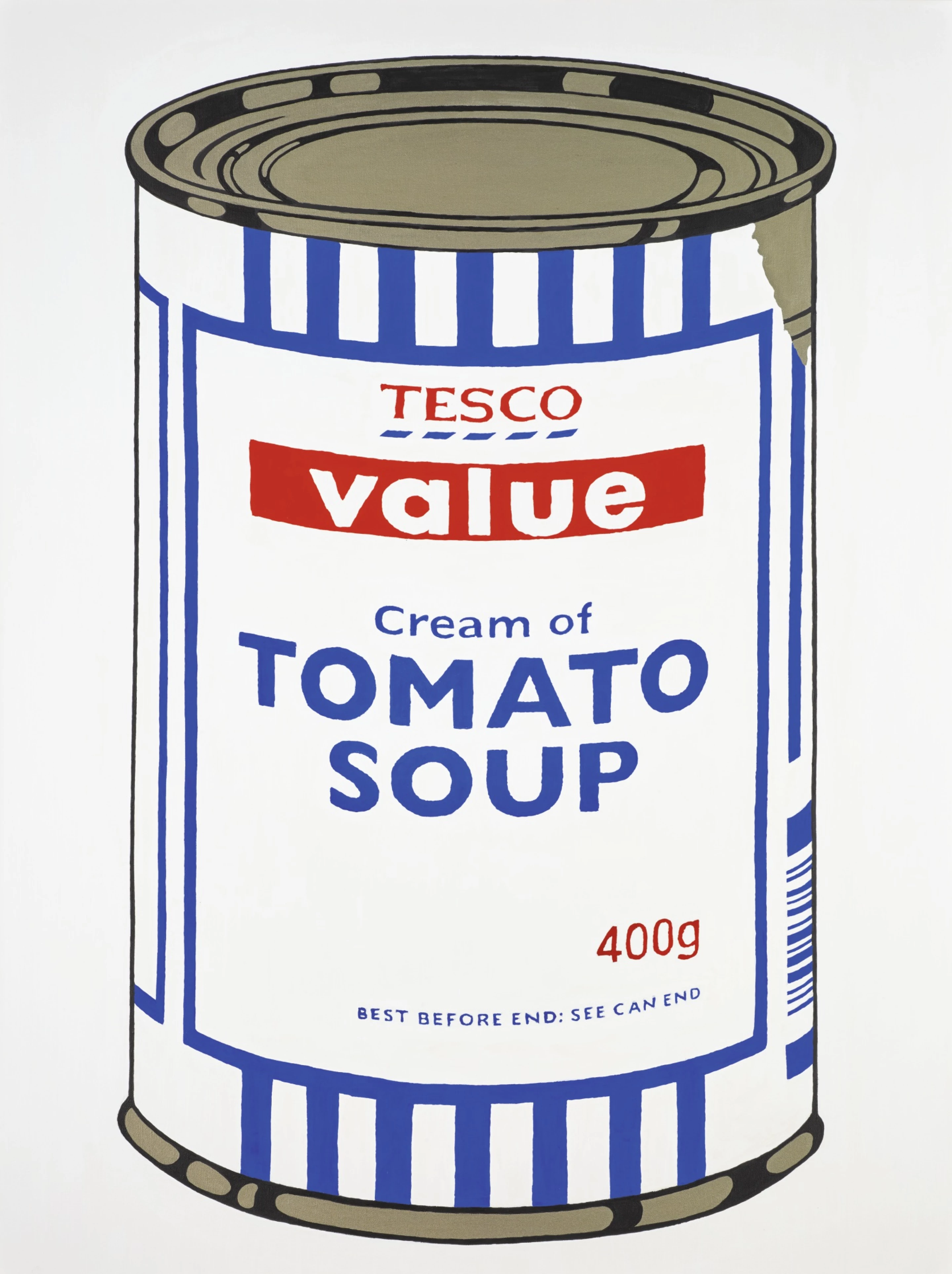
The 2004 oil on canvas, exhibited at Crude Oils in London in 2005, sold at Sotheby’s London in October 2017 for £392,750. Image copyright Sotheby’s Auction.
What Is Banksy Soup Can?
Banksy’s Soup Can reimagines one of the most recognisable images in modern art: the supermarket soup tin. Where Andy Warhol elevated Campbell’s Soup into an icon of American Pop Art, Banksy turns instead to Tesco Value, the budget supermarket range familiar to British shoppers.
The shift is simple, but it changes everything. Campbell’s was glossy, aspirational and deeply tied to post-war American consumer culture. Tesco Value was plain, functional and designed around affordability. Banksy takes the visual logic of Pop Art and replaces glamour with economy, turning a mass-market object into a sharper reflection of class, branding and everyday life in Britain.
This is why Soup Can remains one of Banksy’s most intelligent print images. It is funny, direct and visually clean, but beneath its humour sits a precise critique of how value is constructed.

Banksy – Soup Can Print (Unsigned). Image copyright GraffitiStreet
The Meaning Behind Banksy’s Tesco Value Motif
The power of Soup Can lies in its restraint. Banksy does not need to add slogans, figures or overt political symbols. The Tesco Value label does the work. It carries associations of price, efficiency, mass distribution and social positioning. In the context of an artwork, that language becomes quietly loaded.
The image can be read as a comment on consumer culture, but also on the art market itself. Warhol blurred the boundary between consumer goods and art. Banksy pushes that idea into a British context, where the object is not the polished Campbell’s tin, but a budget supermarket product associated with austerity, everyday necessity and the economics of getting by.
There is humour in the substitution, but there is also resilience. Soup Can recognises a world shaped by branding and price, yet it refuses to treat the everyday as insignificant. Banksy gives the supermarket shelf the weight of art history and, in doing so, turns a familiar object into something capable of asking deeper questions about taste, class and cultural value.
The 2004 oil on canvas, exhibited at Crude Oils in London in 2005, sold at Sotheby’s London in October 2017 for £392,750. Image copyright Sotheby’s Auction.
Banksy, Warhol and the Language of Pop Art
Banksy’s Soup Can cannot be separated from Warhol’s Campbell’s Soup Cans. Warhol’s 1962 series helped define Pop Art by presenting mass-produced consumer imagery as fine art. Banksy enters that conversation decades later with a distinctly British twist, replacing the American brand icon with Tesco’s no-frills Value range.
The result is both homage and critique. Banksy acknowledges Warhol’s importance, but he also undercuts the glamour of Pop by choosing a product associated with budget shopping rather than consumer aspiration. Where Warhol’s soup cans reflected the rise of mass media, repetition and commercial imagery, Banksy’s version speaks to a later culture defined by supermarket dominance, cost-conscious branding and the quiet politics of everyday consumption.
This is part of what gives Soup Can its longevity. It is immediately understandable as a Pop Art reference, yet it also belongs unmistakably to Banksy’s world: satirical, British, class-aware and visually economical.
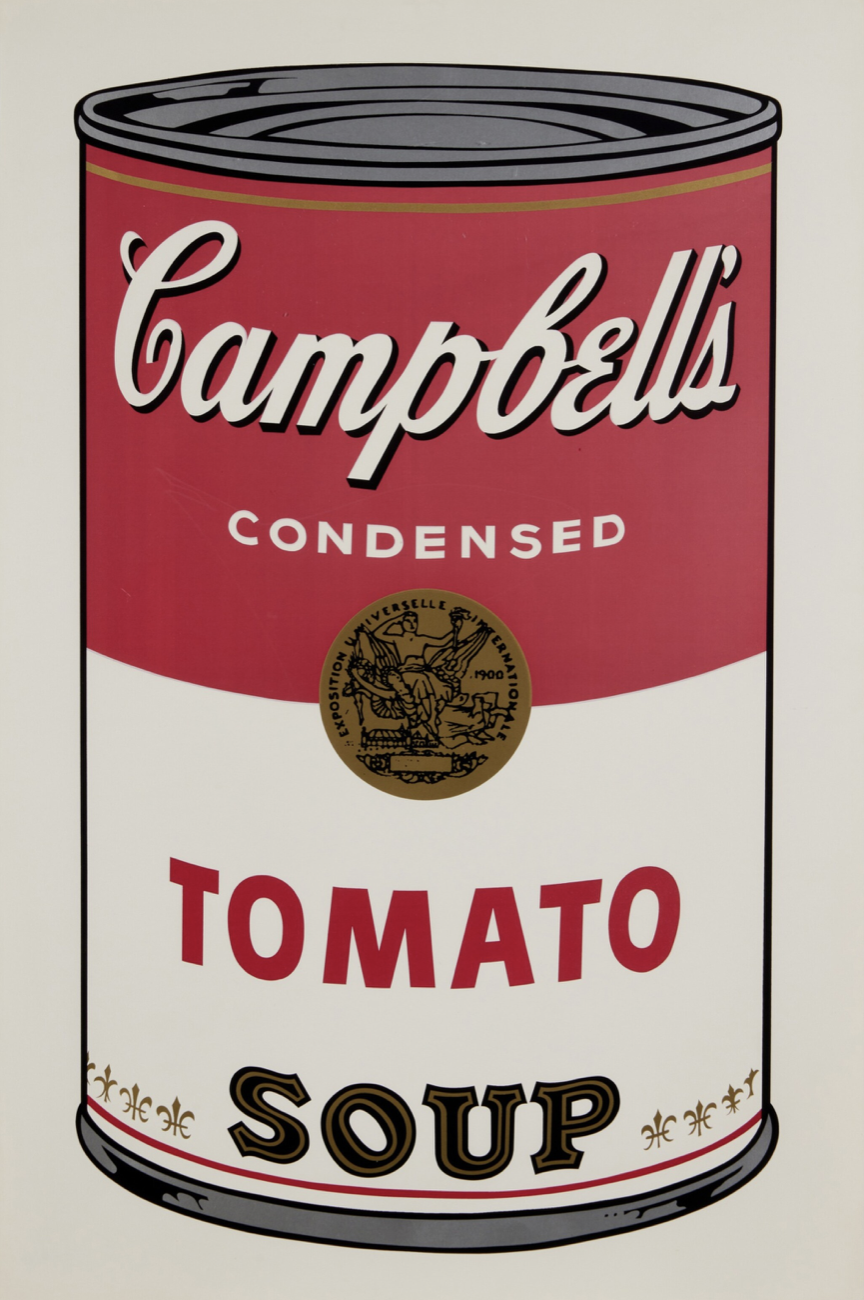
Andy Warhol, Tomato Soup, from Campbell’s Soup I (Feldman & Schellmann II.46). Image copyright Sothebys’s
Soup Can Editions and Colourways
Banksy released Soup Can in 2005 as a screenprint published by Pictures on Walls, London. The original Tesco blue, red and white colourway was produced as an edition of 50 signed prints and 250 unsigned prints.
Alongside the original Tesco Value colourway, Banksy released a group of rare 2005 Soup Can colour variations, each reworking the same single-can motif through different Pop-inflected palettes. These included combinations such as Banana/Lime/Purple, Banana/Cherry/Dark Blue, Purple/Orange/Blue, Yellow/Emerald/Sky Blue, Lilac/Emerald/Purple, Mint/Orange/Brown and Violet/Blue/Tan, among others. Produced in small edition structures, these colourways sit in a more specialised collecting category than the standard signed and unsigned original colourway editions, while remaining firmly connected to the central Tesco Value image.
These colour variations are important because they deepen the series without diluting the clarity of the image. The motif remains constant, but the mood shifts. Some combinations feel bright and playful, while others heighten the graphic tension between supermarket plainness and Pop Art colour. For collectors, the edition of 10 structure gives these works a different level of rarity from both the signed and unsigned original colourway editions.
Condition, colour saturation, paper quality, provenance and Pest Control certification remain central when assessing any Soup Can print. With the rarer colourways, these details become even more important because so few examples exist in each variation.
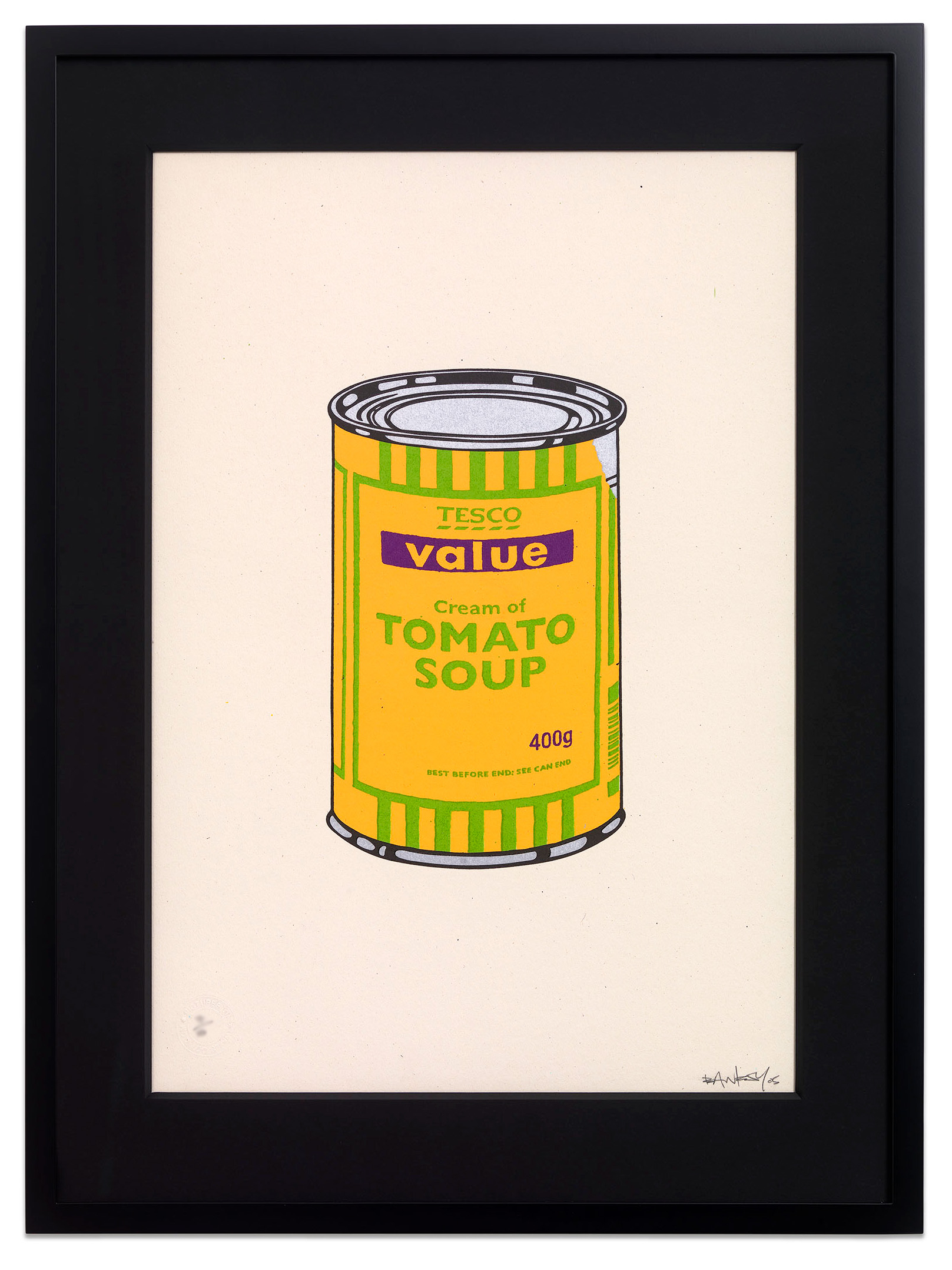
Museum Framed Banksy – Soup Can (Banana/Lime/Purple). Image copyright GraffitiStreet.
View details via GraffitiStreet.
In 2006, Banksy extended the motif with Four Soup Cans, a screenprint in colours on wove paper published by Pictures on Walls, London. Rather than isolating a single Tesco Value-style can, the composition repeats the image in a grid-like arrangement, bringing the work even closer to the visual rhythm of Warhol while retaining Banksy’s distinctly British supermarket reference. The edition was released across four signed colourways: Gold on Cream in an edition of 54, Gold on Grey in an edition of 12, Blue and Red on Cream in an edition of 10, and Blue and Red on Grey in an edition of only 2. These smaller edition structures give Four Soup Cans a highly specialised place within the wider Soup Can family, particularly for collectors interested in Banksy’s dialogue with Pop Art, repetition and consumer branding.
GraffitiStreet Perspective
We have seen how Soup Can shifts in person, particularly in the rare colour variations where the familiar Tesco Value format becomes more playful, more graphic and more visibly connected to Pop Art’s legacy. The image is clean and immediate, yet the longer one spends with it, the more its humour gives way to questions about class, consumption and cultural worth.
GraffitiStreet has available Soup Can (Banana/Lime/Purple), a signed 2005 screen print from an edition of only 10, accompanied by a Pest Control Certificate of Authenticity. The work is framed to museum standard with Optium Museum Acrylic in a powder-coated metal frame by Matt Jones of CommonRoom Projects, continuing the respected John Jones London framing legacy. It was also featured in Banksy Editions Volume I at GraffitiStreet Gallery in Chichester.
The Banana/Lime/Purple colourway brings another dimension to that reading. Its palette is vivid and playful, yet the underlying image remains rooted in the plainness of budget supermarket branding. That tension between colour, class and cultural memory is part of what makes the rare colour variations especially compelling in person.
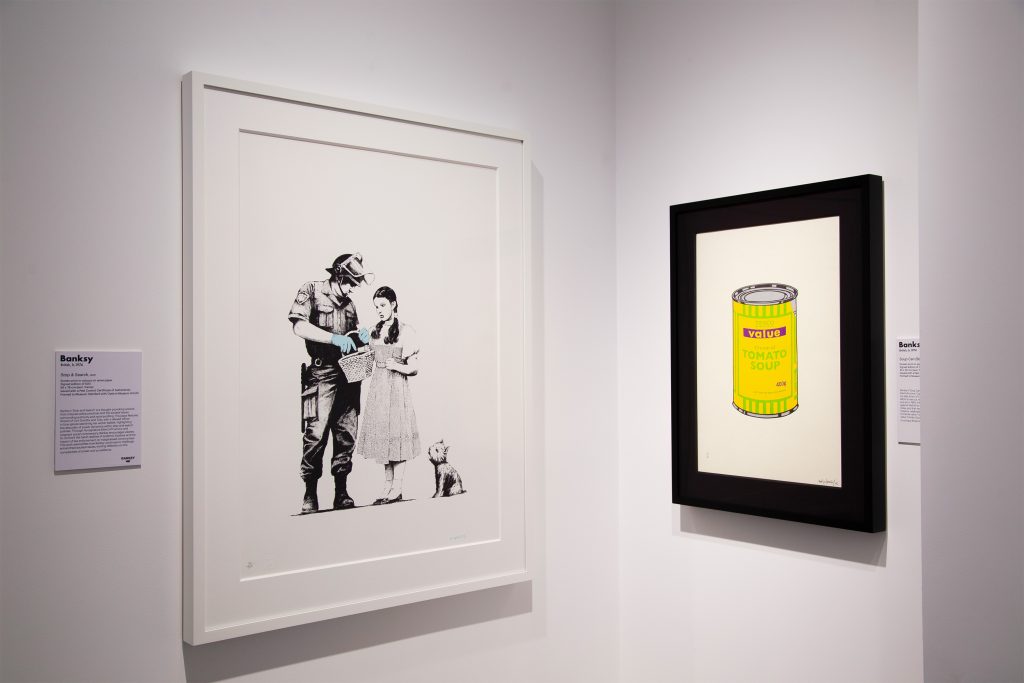
Banksy’s Soup Can (Banana/Lime/Purple), Image copyright GraffitiStreet
Banksy’s Soup Can (Banana/Lime/Purple), a rare signed 2005 edition of 10, previously featured in Banksy Editions Volume I. View details via GraffitiStreet.
Banksy Soup Can Market Context
Within Banksy’s print market, Soup Can occupies a distinctive position, connecting the artist’s early Pictures on Walls period with one of the most recognisable art-historical references of the twentieth century. It is a Banksy image, a Warhol conversation and a British consumer-culture critique in a single compact composition.
“Collectors are drawn to Soup Can because it sits at the intersection of Banksy’s print history, Pop Art and British social commentary,” says GraffitiStreet Co-Founder and Banksy specialist Rosh Boroumand. “The original signed edition of 50 has clear importance, and the rare colour variations bring another layer of depth. With works such as Soup Can (Banana/Lime/Purple), the edition of 10, Pest Control certification, condition and rare presentation all become central to how collectors understand the work.”
The strongest primary-source result verified for the standard signed Soup Can (Original Colourway) was achieved at SBI Art Auction on 4 July 2021, when an impression from the signed edition of 50 realised JPY 20,125,000, approximately USD 182,955 / GBP 131,622. For the standard unsigned edition of 250, SBI Art Auction records an unsigned Soup Can (Original Colourway) selling on 30 January 2021 for JPY 6,325,000, approximately USD 60,416 / GBP 44,080
Rare edition-of-10 colourways also performed strongly during the wider 2020–2021 surge across art and luxury collectibles, when recognisable works, scarce editions and culturally significant objects attracted exceptional demand. Soup Can: Banana / Cherry / Blue sold at Sotheby’s London on 18 March 2021 for GBP 94,500 / USD 131,545, Soup Can: Purple / Orange / Blue sold at Sotheby’s New York on 16 December 2020 for USD 126,000, and Soup Can: Yellow / Emerald / Sky Blue sold at Forum Auctions London on 27 October 2020 for GBP 80,400 / USD 104,865.
More recently, Christie’s London sold rare edition Soup Can: Banana Lime Purple on 30 September 2025 for GBP 60,960 / USD 81,930 against an estimate of GBP 25,000–35,000. That result is especially relevant to our available Soup Can (Banana/Lime/Purple) from the same rare edition, reflecting continued collector appetite for rare colourways in a more selective and mature market.
The 2004 oil on canvas Tesco Value Soup Can, exhibited at Crude Oils in London in 2005, sold at Sotheby’s London in October 2017 for £392,750 against an estimate of £200,000–£300,000.
Together, these results show the strength of Banksy’s Soup Can across the standard signed print, the standard unsigned print, rare edition-of-10 colourways and the unique canvas. The market today is more measured than it was during the 2020–2021 luxury collecting surge, with collectors placing greater emphasis on condition, Pest Control certification, edition type, colourway rarity, framing, provenance and long-term cultural relevance. For Soup Can, that more disciplined environment helps clarify the work’s enduring value rather than diminish it.
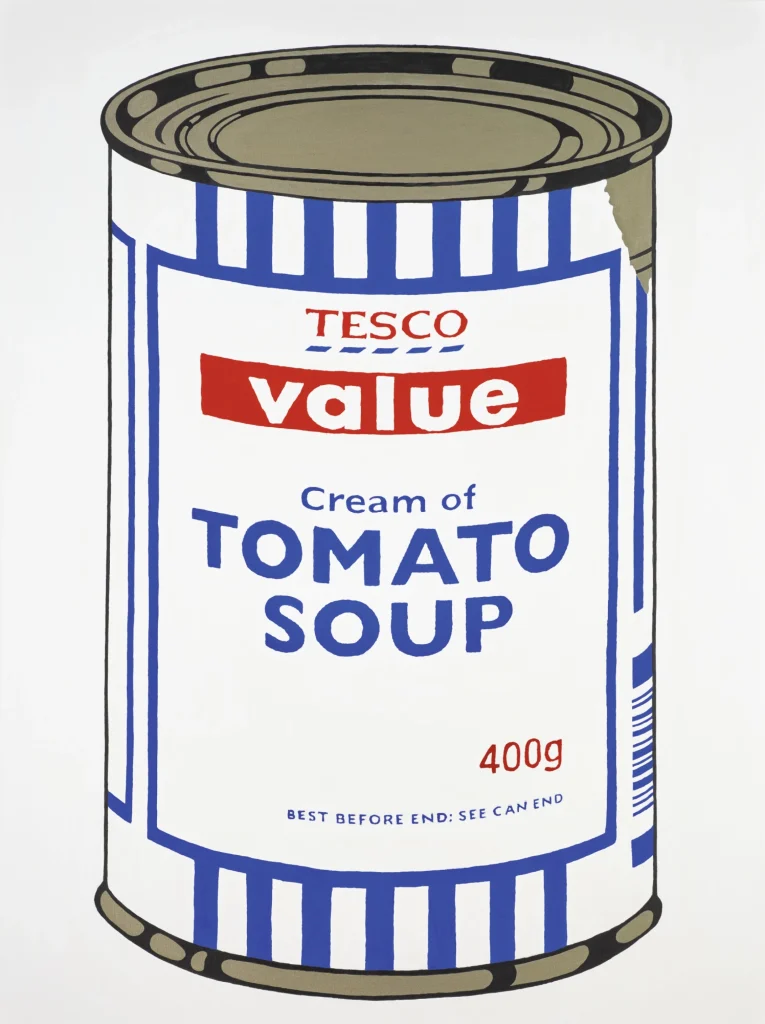
The 2004 oil on canvas, exhibited at Crude Oils in London in 2005, sold at Sotheby’s London in October 2017 for £392,750. Image copyright Sotheby’s Auction.
Frequently Asked Questions about Banksy’s Soup Can?
Banksy’s Soup Can is a 2005 screenprint that reimagines Andy Warhol’s Campbell’s Soup imagery through Tesco Value branding. It is one of Banksy’s clearest responses to Pop Art and British consumer culture.
Soup Can explores value, class, branding and consumption. By replacing Warhol’s Campbell’s soup can with Tesco Value packaging, Banksy shifts Pop Art from American consumer glamour to British supermarket economy.
Banksy released Soup Can in 2005 as a screen print published by Pictures on Walls, London.
The original colourway was released in an edition of 50 signed prints and 250 unsigned prints. Banksy also produced rare colour variations, including Soup Can (Banana/Lime/Purple), in editions of 10.
Soup Can (Banana/Lime/Purple) is a rare colour variation of Banksy’s Soup Can, produced in 2005 as a signed screenprint from an edition of 10. The work is part of the wider group of rare Pop colourway variations.
Yes. Banksy’s Soup Can directly references Andy Warhol’s Campbell’s Soup Cans, replacing the American Campbell’s brand with Tesco Value packaging to create a distinctly British critique of consumer culture and Pop Art.
Yes. Banksy created a related unique work, Tesco Value Soup Can, in 2004. The oil on canvas was exhibited at Crude Oils in London in 2005 and sold at Sotheby’s London in 2017 for £392,750.
Collectors should consider Pest Control certification, edition type, condition, colourway rarity, provenance, framing and whether the work belongs to the original colourway, an unsigned edition or one of the rare edition-of-10 colour variations.
Related Reading
Highest Banksy Auction Prices: The 5 Most Expensive Banksy Artworks Ever Sold
Where Can you Buy a Banksy? A Collector’s Guide to Authenticated Banksy Art
Banksy’s Girl and Balloon on Found Landscape Sells for $18 Million
What Is the Most Expensive Banksy Print Ever Sold at Auction?
Banksy’s Choose Your Weapon: Keith Haring, Queue Jumpers and the Print That Marked the End of an Era
Banksy’s Grin Reaper: Meaning, Editions and the Grim Reaper Motif
Sources & Further Reading
Pest Control Office
Banksy Official Website
Sotheby’s Auction
Sotheby’s Banksy Soup Can records
Pictures on Walls POW
Christie’s
Banksy Explained – Soup Can 2005
Discover Banksy at GraffitiStreet
For more than 13 years, GraffitiStreet has helped collectors discover, acquire, and better understand significant contemporary artworks, with a particular focus on Banksy and the evolving street art market.
Through our gallery, editorial platform, and collector resources, we provide guidance on authentication, provenance, condition, rarity, and market context, helping collectors make informed decisions with confidence.
If you are considering acquiring a Banksy and would like guidance on authentication, provenance, condition, market context, or exceptionally rare editions, we invite you to contact our co-Founder and Banksy specialist, Rosh Boroumand, for a confidential conversation.
GraffitiStreet Gallery
25A West Street
Chichester
West Sussex
England PO19 1QW
For Banksy availability, acquisitions, and private viewings, explore the collection online, contact us directly, or visit our gallery in the heart of Chichester, England.
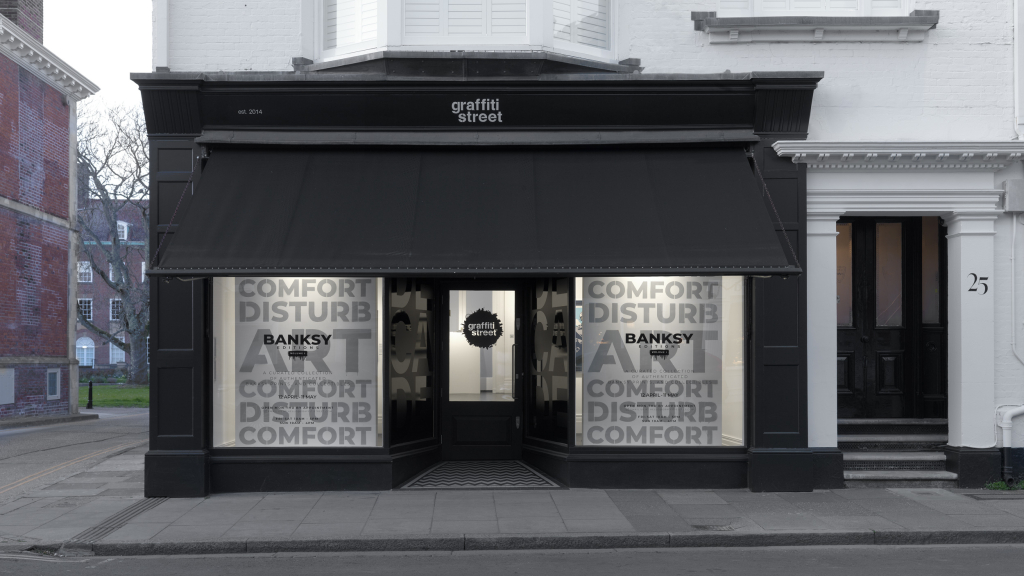
GraffitiStreet Presents Banksy Editions Volume I © GraffitiStreet