Lonac’s Memory Lane Turns Everyday Objects Into Monuments
Lonac’s Memory Lane is a mural created for Rexenera Fest in Carballo, Spain. Built from objects found at flea markets and in everyday life, the work reverses the hierarchy of the artist’s earlier murals: human figures are deliberately reduced in scale while ordinary possessions take control of the composition.
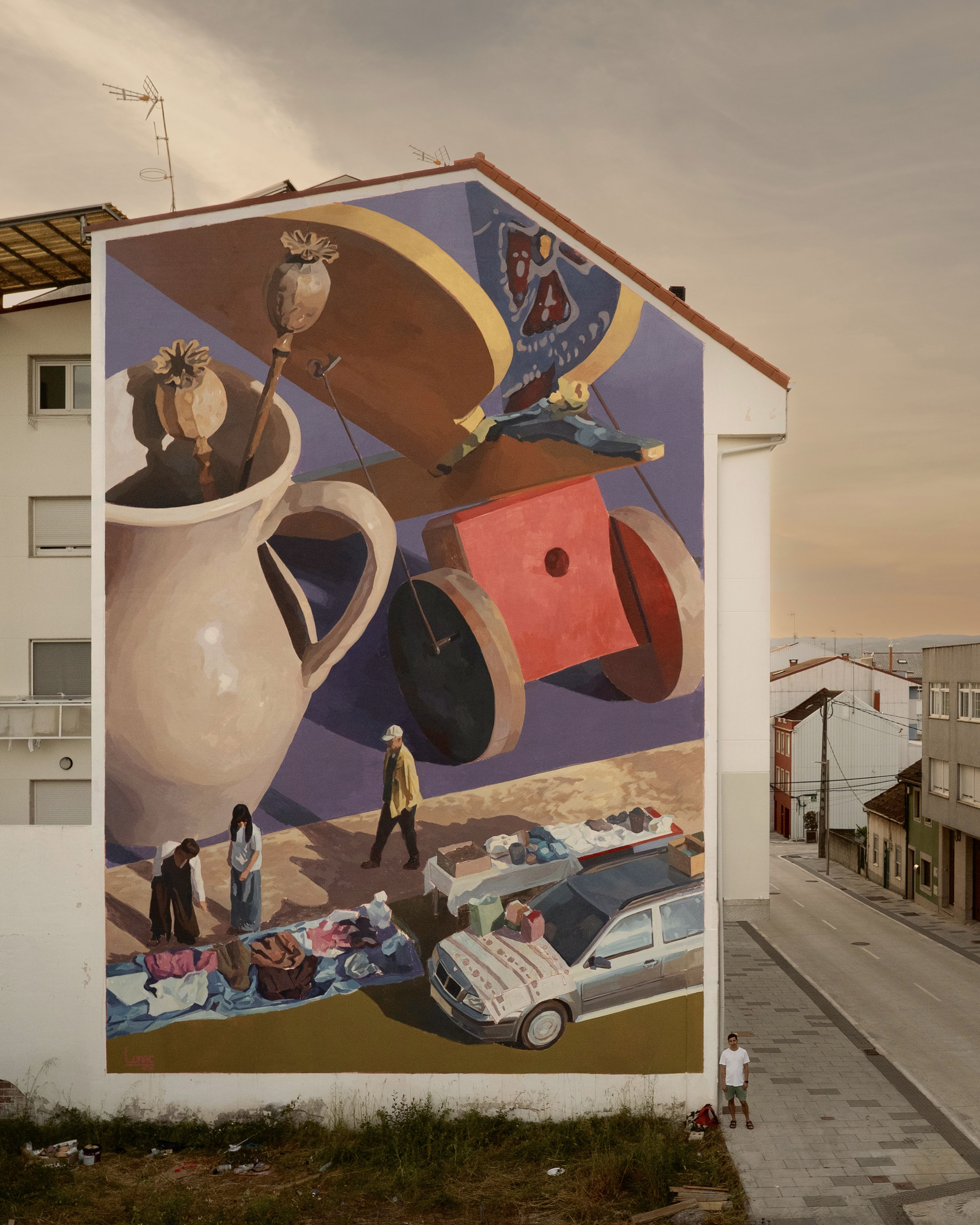
A ceramic jug towers over the street, its seed heads rising like monuments beside a red cart. Below, the composition shifts in scale to a car prepared for the flea market, surrounded by scattered clothing and small figures moving through the scene.
The objects are familiar, but their scale makes them strange. Removed from their original context, they no longer function as simple possessions. They become carriers of memory, sentiment and lived experience. Lonac explains:
“Unlike my earlier works, where human figures often dominated the scene, here they are intentionally diminished, allowing ordinary objects to take center stage.”
That reversal gives the mural its emotional force. The people do not disappear, but they become secondary to the things that surround them, suggesting how objects can outlast their original owners and continue carrying traces of the lives once attached to them.
Ordinary Objects, Enlarged Meaning
The composition was developed from items encountered at flea markets and in everyday life. These are not rare or luxurious objects, their value comes from use, association and time. Lonac describes them as:
“Vessels of personal and collective stories, carrying the emotional weight and sentimental value we attach to them over time.”
The mural never fixes those meanings. Instead, it leaves enough space for viewers to project their own memories onto the scene. That openness is central to the work. Memory Lane is about the way ordinary things gather emotional significance simply because we live with them.
A World Inspired by Isometric Video Games
The mural’s tilted perspective is inspired by classic isometric video games, whose nostalgic atmosphere and distinctive visual structure have had a lasting influence on Lonac’s work.
Rather than opening into a conventional realistic space, the composition feels staged like a game environment. Objects sit on different planes, scale shifts unexpectedly and the viewer is encouraged to move through the image as though exploring a level.
This gives the mural a second layer of nostalgia. The subject concerns objects from the past, but the perspective itself recalls an older form of digital image-making. Memory is carried not only by what Lonac paints, but by the visual language through which the scene is constructed.
Why Lonac Makes the Human Figures So Small
The tiny figures at the bottom of the wall are among the mural’s most important details. They walk between clothing, a parked vehicle and scattered belongings, yet they no longer dominate the image. Above them, the enlarged objects become almost architectural.
This inversion quietly suggests that possessions can remain present after the people connected to them have moved on. A practical object may lose its function, but continue to hold emotional weight long after its usefulness has faded.
In Memory Lane, the things appear permanent while the people seem temporary. That is what gives the mural its slightly melancholic tone.
Rexenera Fest and the Streets of Carballo
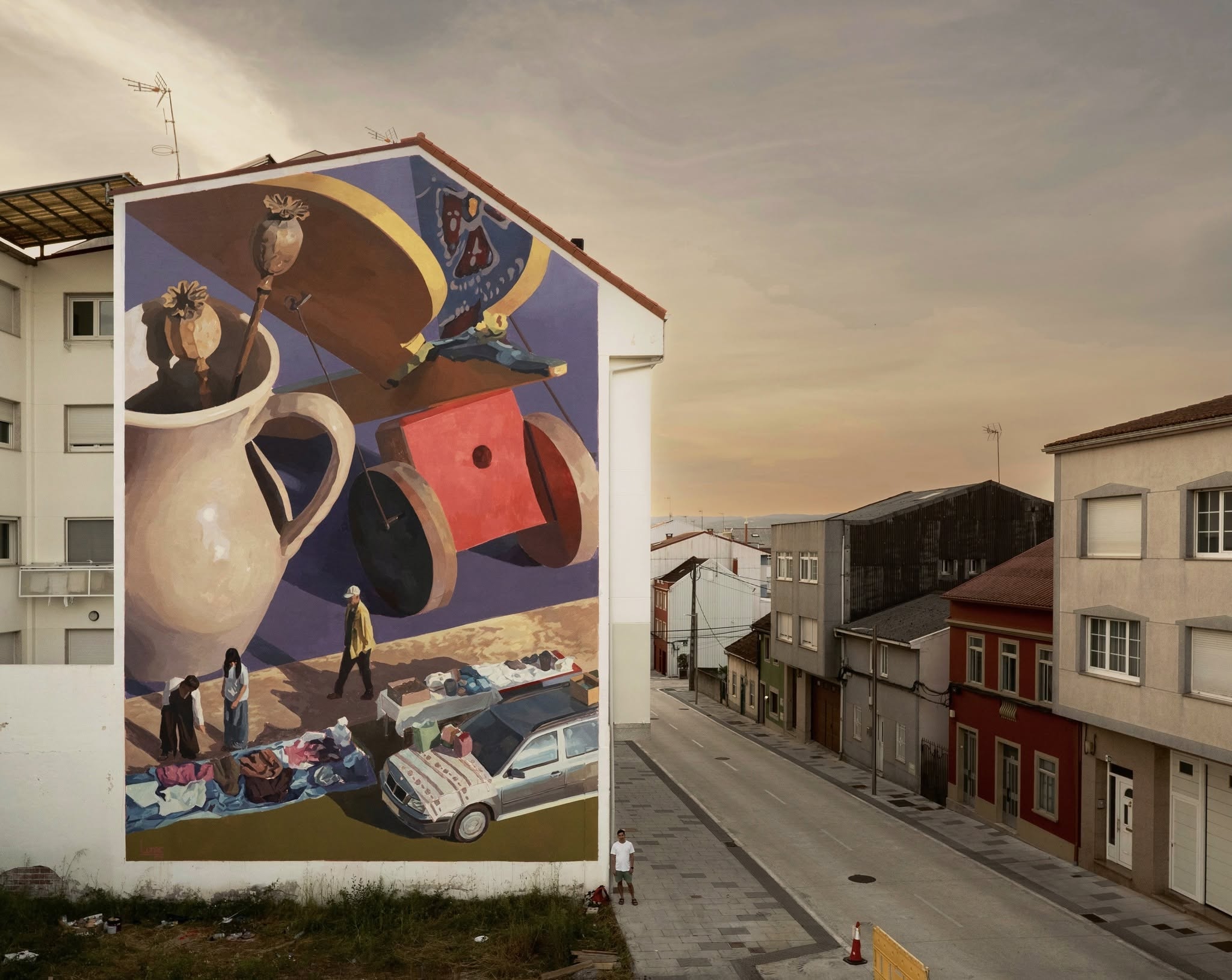
Created during the twelfth edition of Rexenera Fest, Memory Lane forms part of Carballo’s growing open-air collection of large-scale public art. The 2026 festival brought five artists to five walls across the town, continuing its use of murals as a means of cultural regeneration, public dialogue and urban transformation.
Lonac’s mural is located at Avenida das Flores, 100, on the side of a residential building in the Barrio das Flores. Its placement allows the composition to operate at architectural scale.
Lonac latest Memory Lane mural is not really about flea-market finds. It is about the stories that remain inside things long after their original purpose has disappeared.
Image copyright Lonac / Bastian Rodriguez