Street Artist in the Spotlight: Spidertag
Spanish urban artist Spidertag has developed a visual language in which geometry, architecture and technology converge through light. Active since 2008, his practice has moved from temporary interventions made with thread and early electroluminescent cable to monumental Interactive Neon Murals, where luminous lines stretch across buildings and, in selected works, respond to the people standing before them.
At the centre of Spidertag’s work is a deceptively simple vocabulary of lines, triangles, circles and directional forms. Enlarged across architecture and illuminated after dark, these elemental marks begin to resemble fragments of an unknown language, at once ancient and futuristic.

Spidertag, POW! WOW! Hawaii 2019. Photo Credit Ianny catches walls
Spidertag: From the Line to Light
Spidertag’s earliest interventions were shaped by geometry, abstraction and minimalism. Working across urban and rural environments, he used wool and thread to draw temporary lines through architecture, responding to corners, openings and irregular surfaces rather than treating the wall as a conventional rectangular canvas.
Technology gradually entered that language. Experiments with QR codes, ultraviolet light and small battery-powered electroluminescent cables opened the possibility of creating a line that did more than sit upon a surface: it could glow, connect physical space with a digital layer and fundamentally change after dark.
By the middle of the 2010s, Spidertag was experimenting with the possibilities of flexible neon at architectural scale. The breakthrough eventually developed into the project for which he is now best known, the Interactive Neon Murals, or INM#.
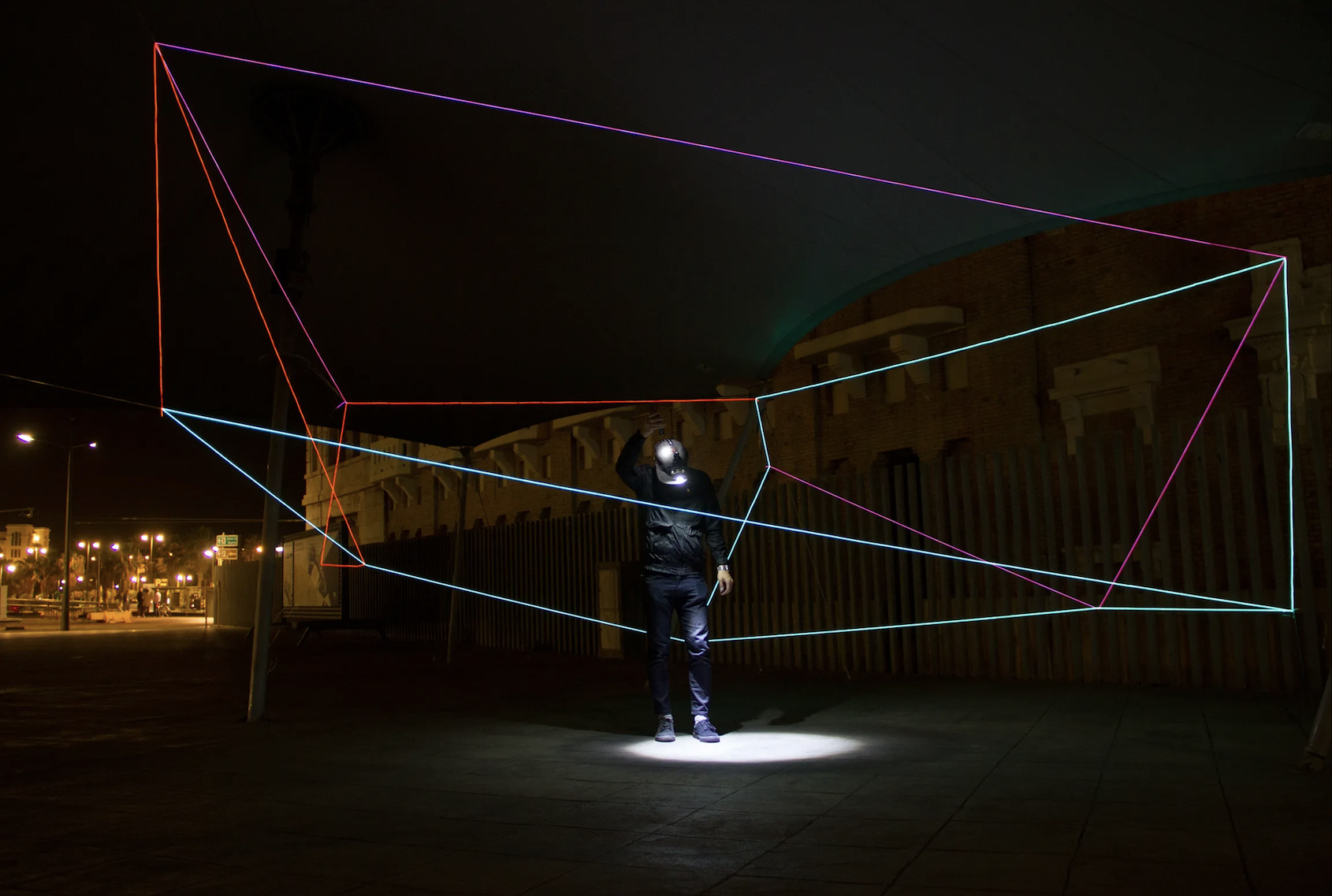
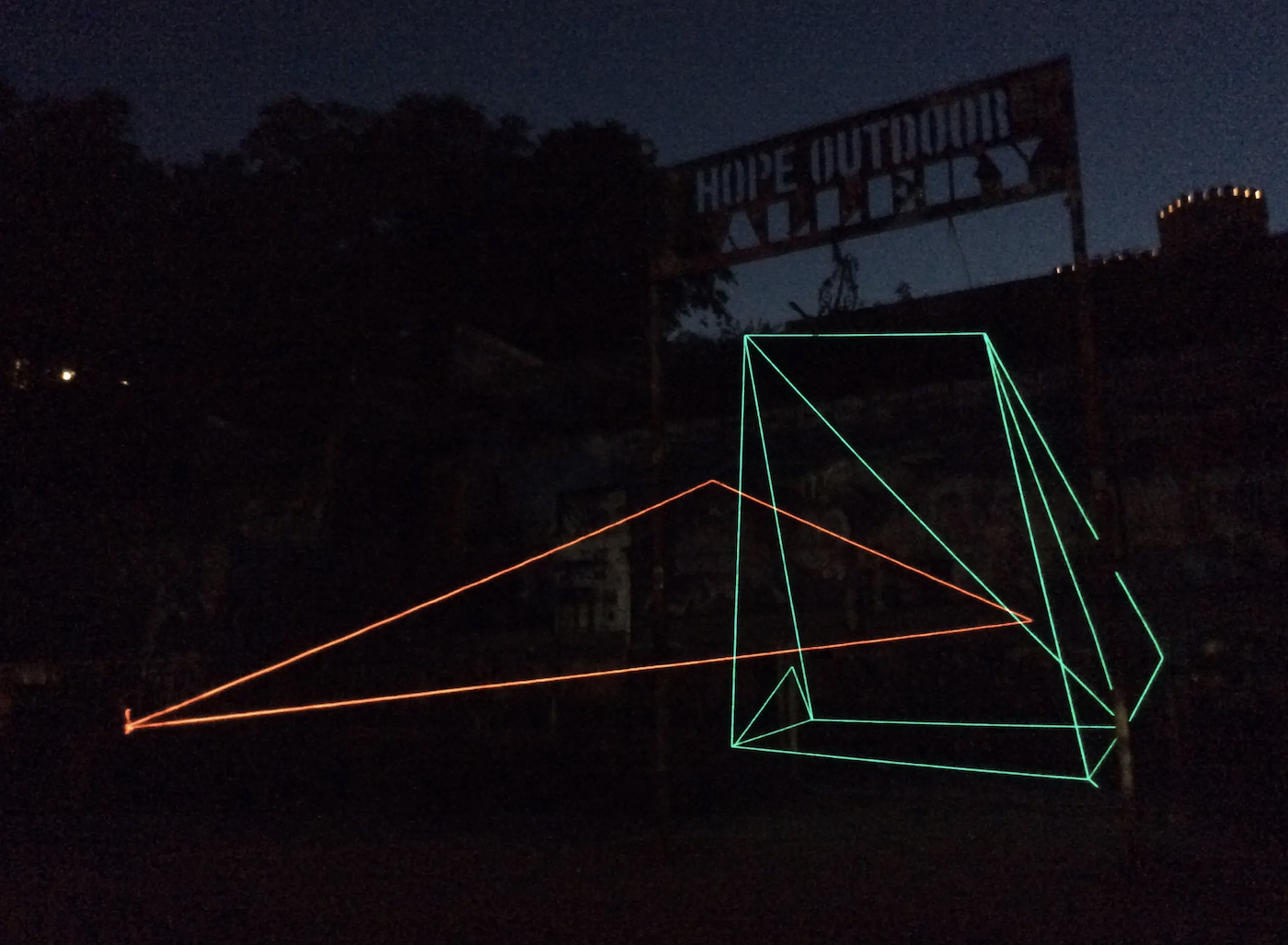
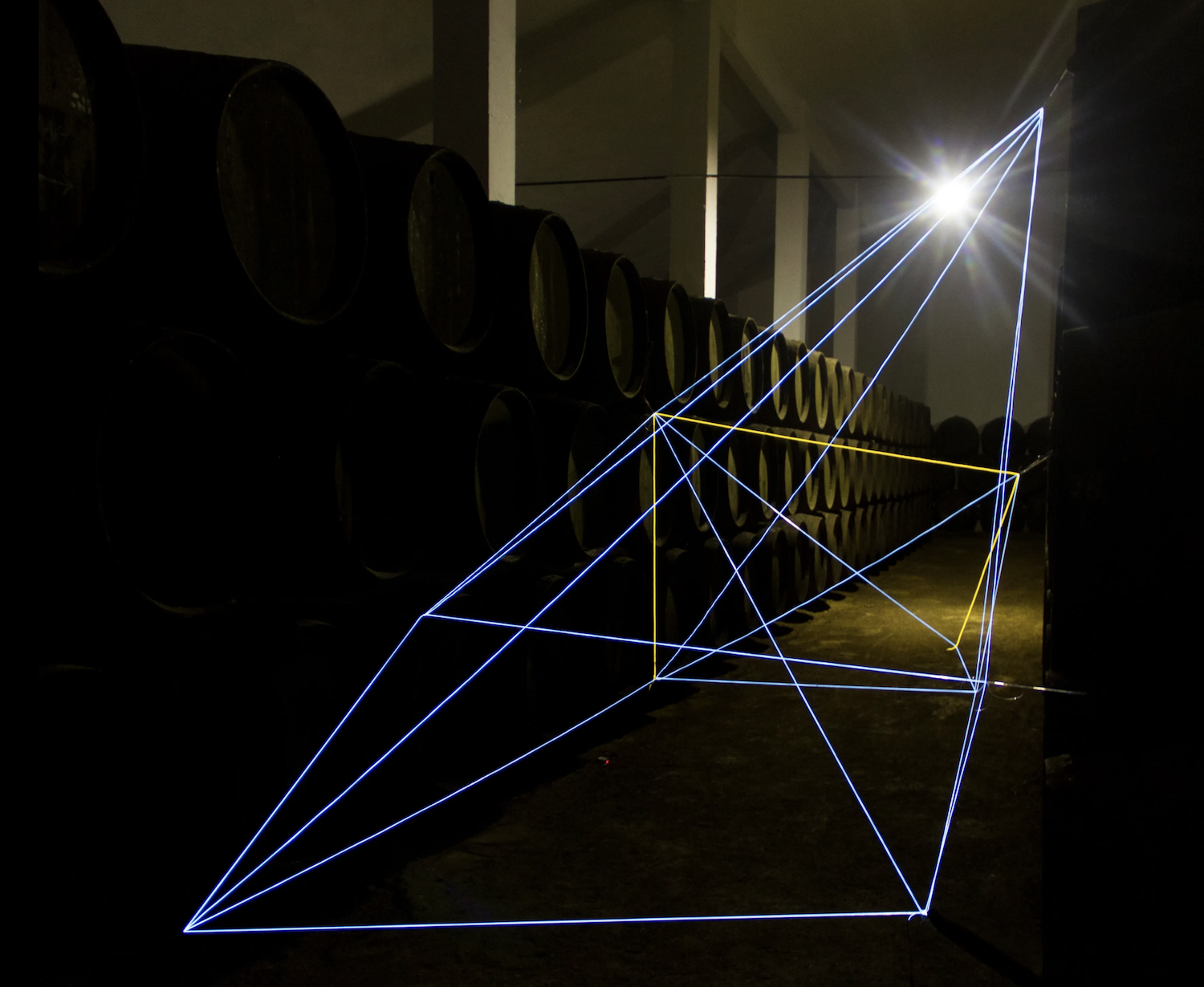
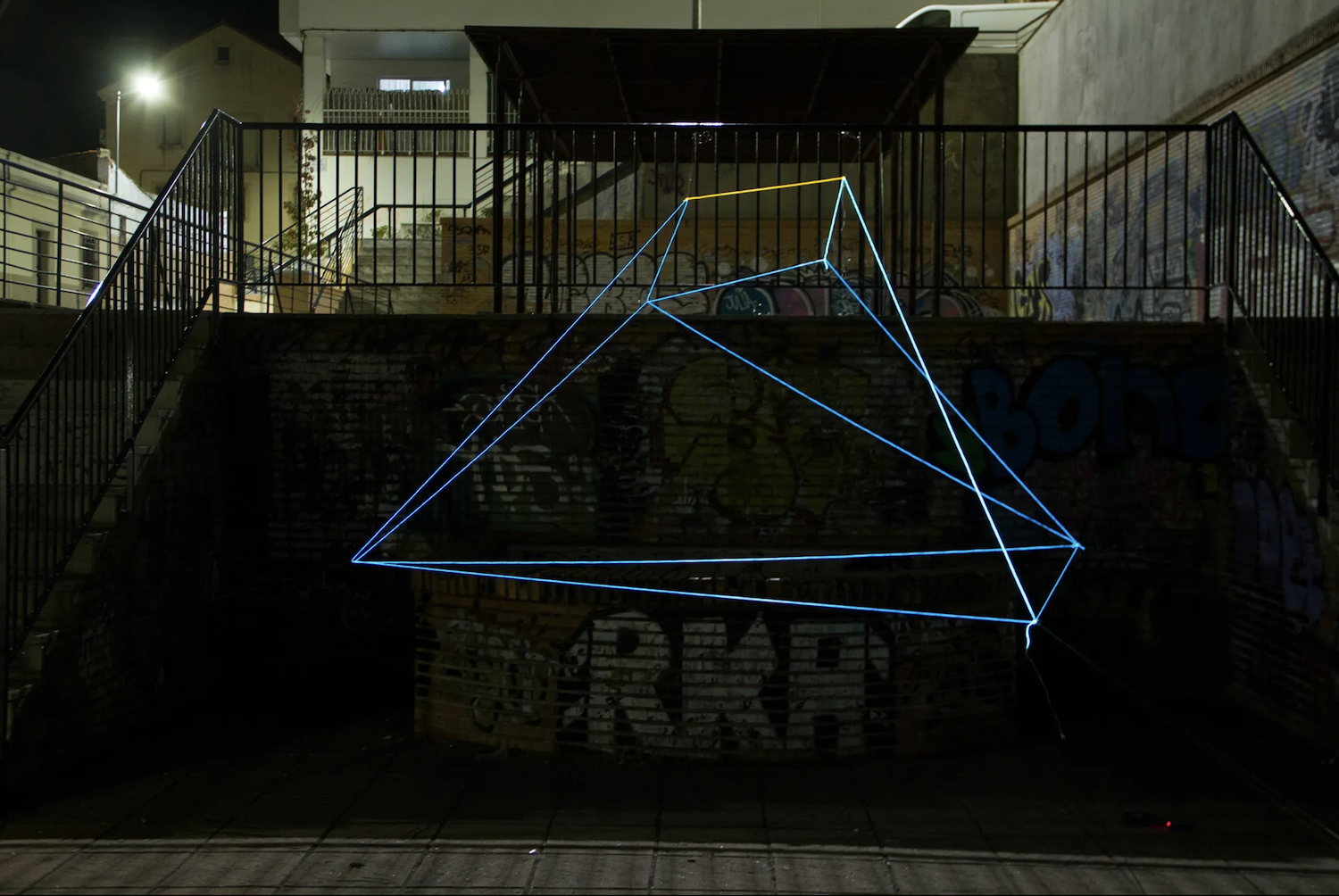
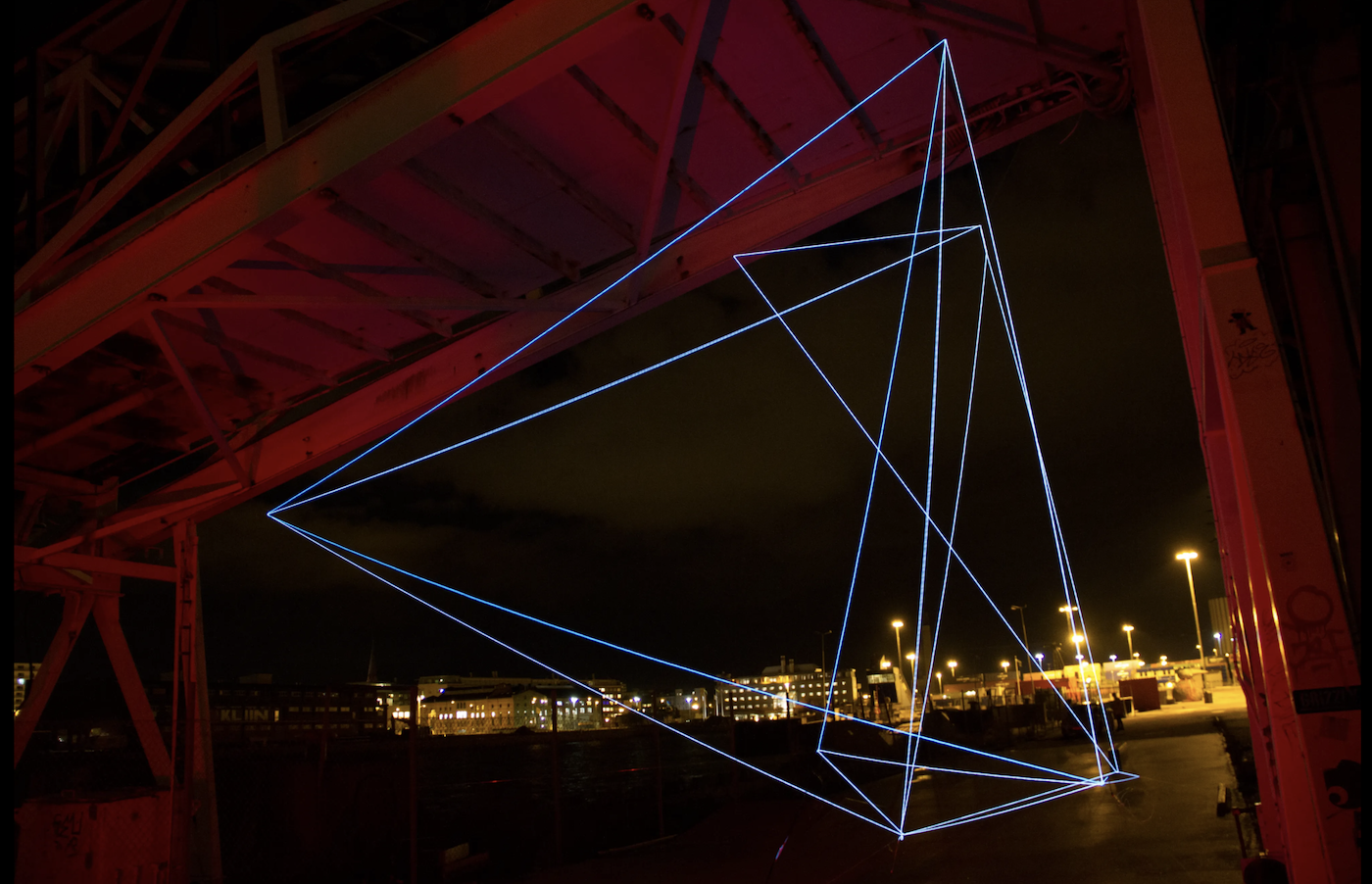
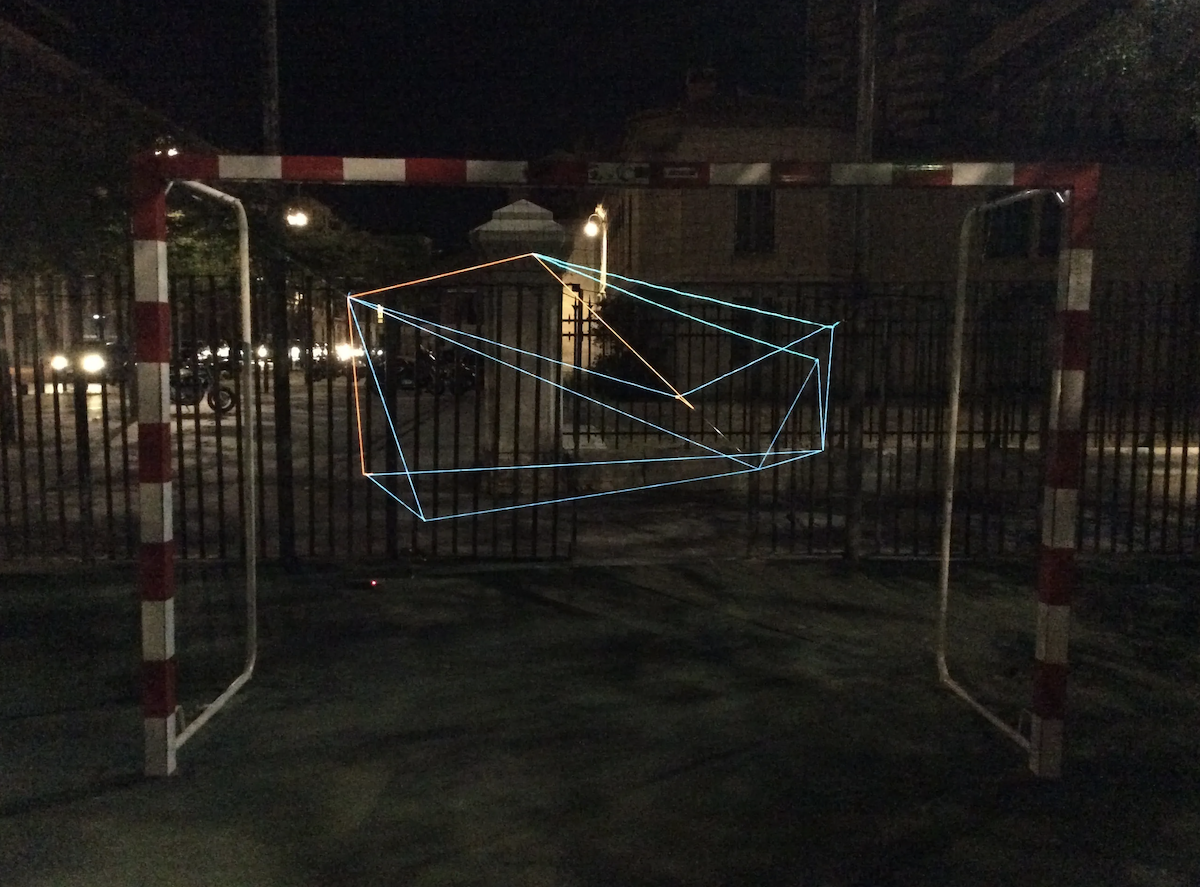
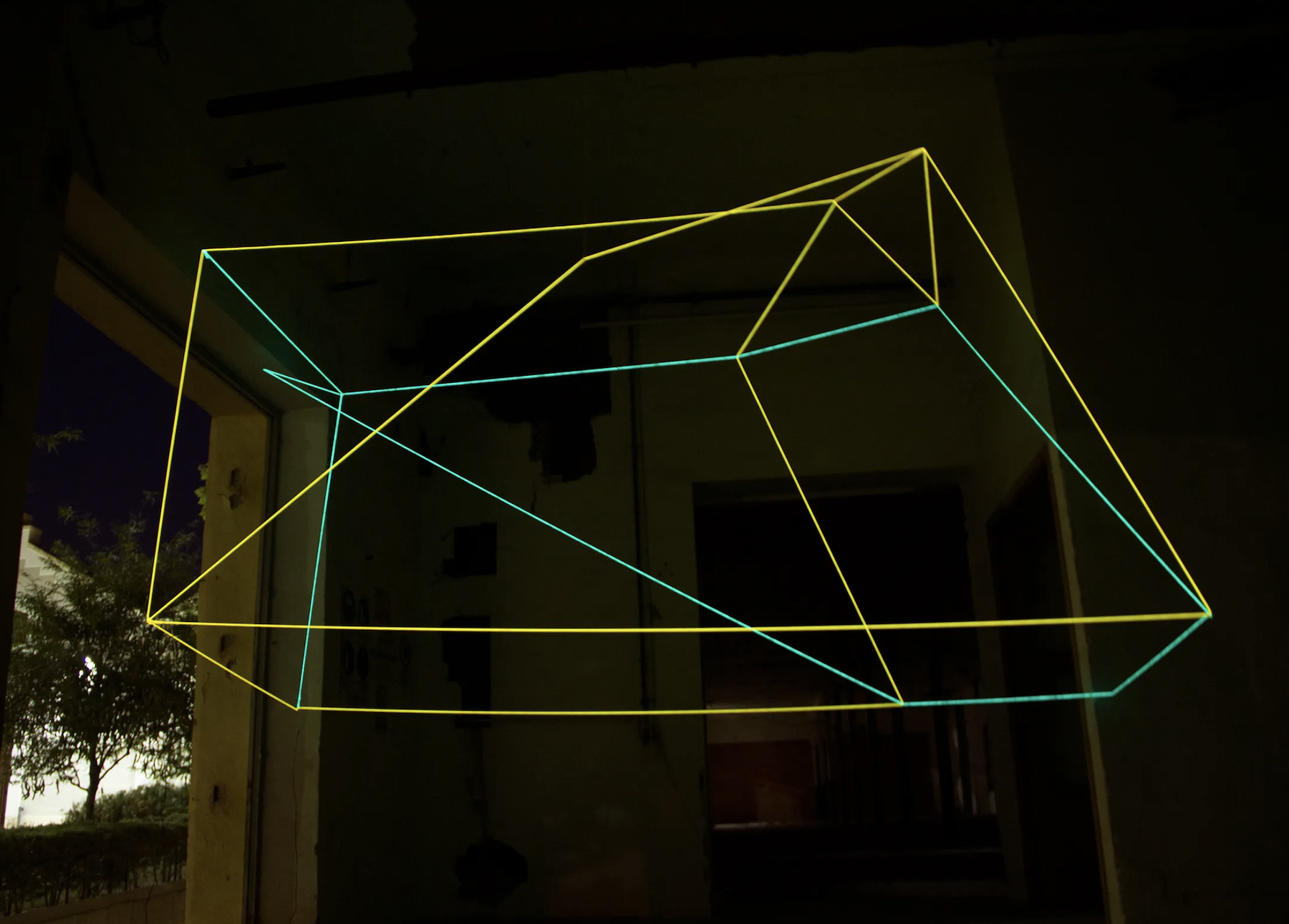
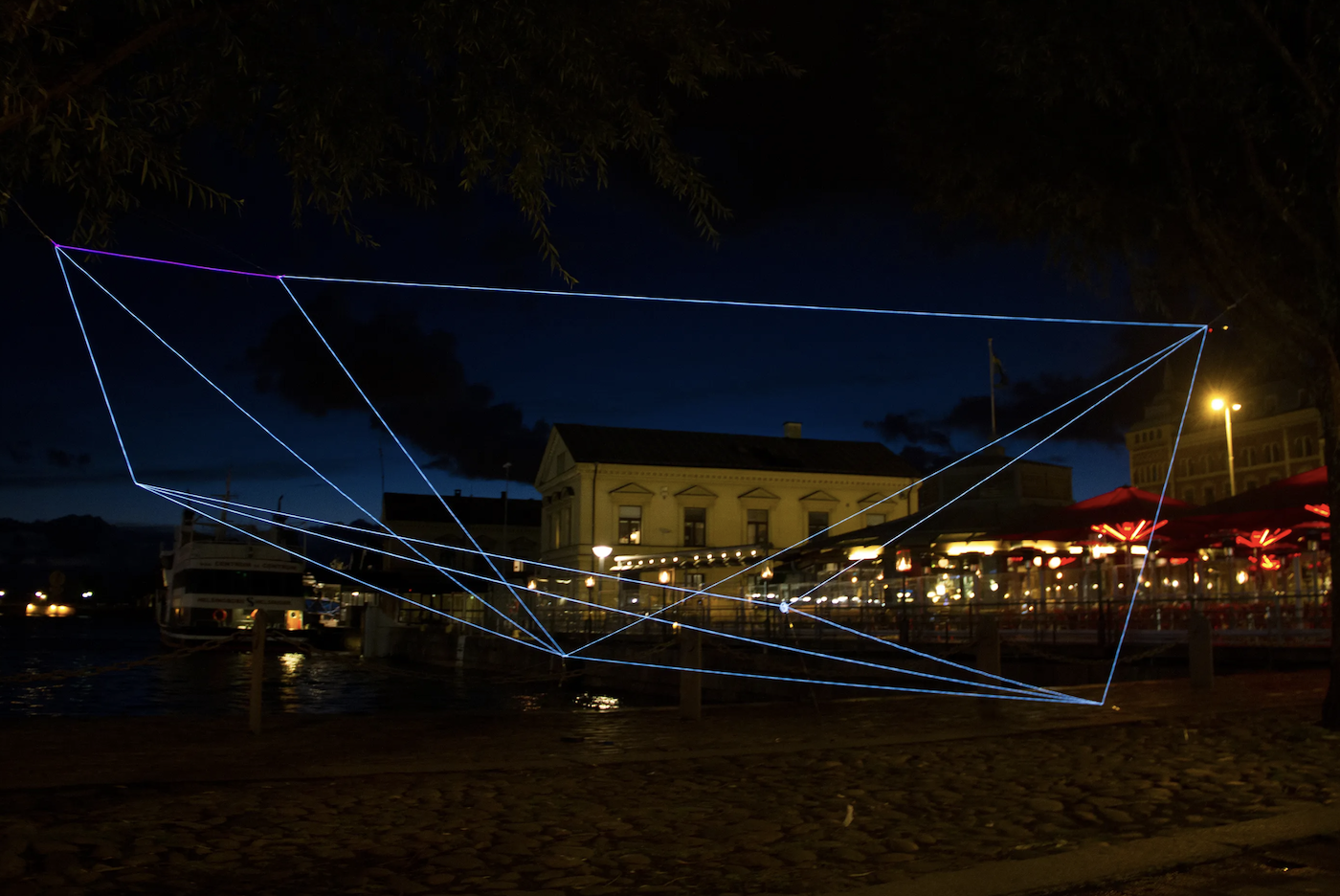


Spidertag’s earliest interventions were shaped by geometry, abstraction and minimalism. Image copyright Spidertag.
Spidertag and the Interactive Neon Murals
The first numbered Interactive Neon Mural, INM#1, was created for ESTAU Urban Art Festival in Estarreja, Portugal, in 2018.
Rather than using paint to suggest illumination, Spidertag uses light as the line itself. Flexible neon LED elements travel across façades, framing windows, turning corners and responding to architectural divisions so that the building becomes inseparable from the composition. The works possess two identities. During the day their structures remain visible across the architecture; after dark, the surrounding building recedes and the luminous geometry takes control.
Selected murals introduce another dimension through a dedicated mobile application, allowing viewers to alter colours and lighting sequences. The underlying composition remains Spidertag’s, but the public can temporarily change how the work appears, moving the mural beyond passive observation and into participation.
Explore the evolving project in GraffitiStreet’s complete Interactive Neon Murals INM# archive.
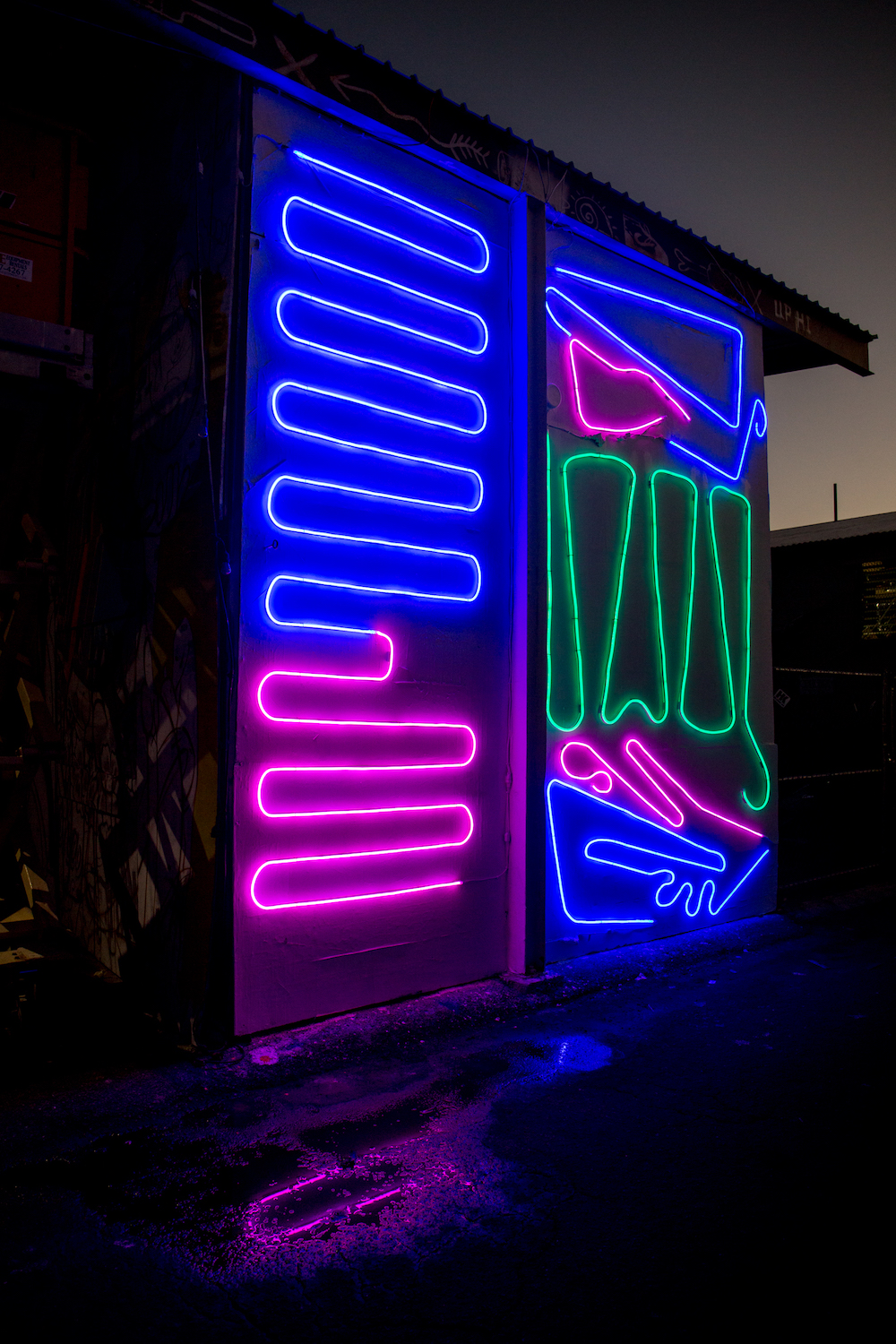
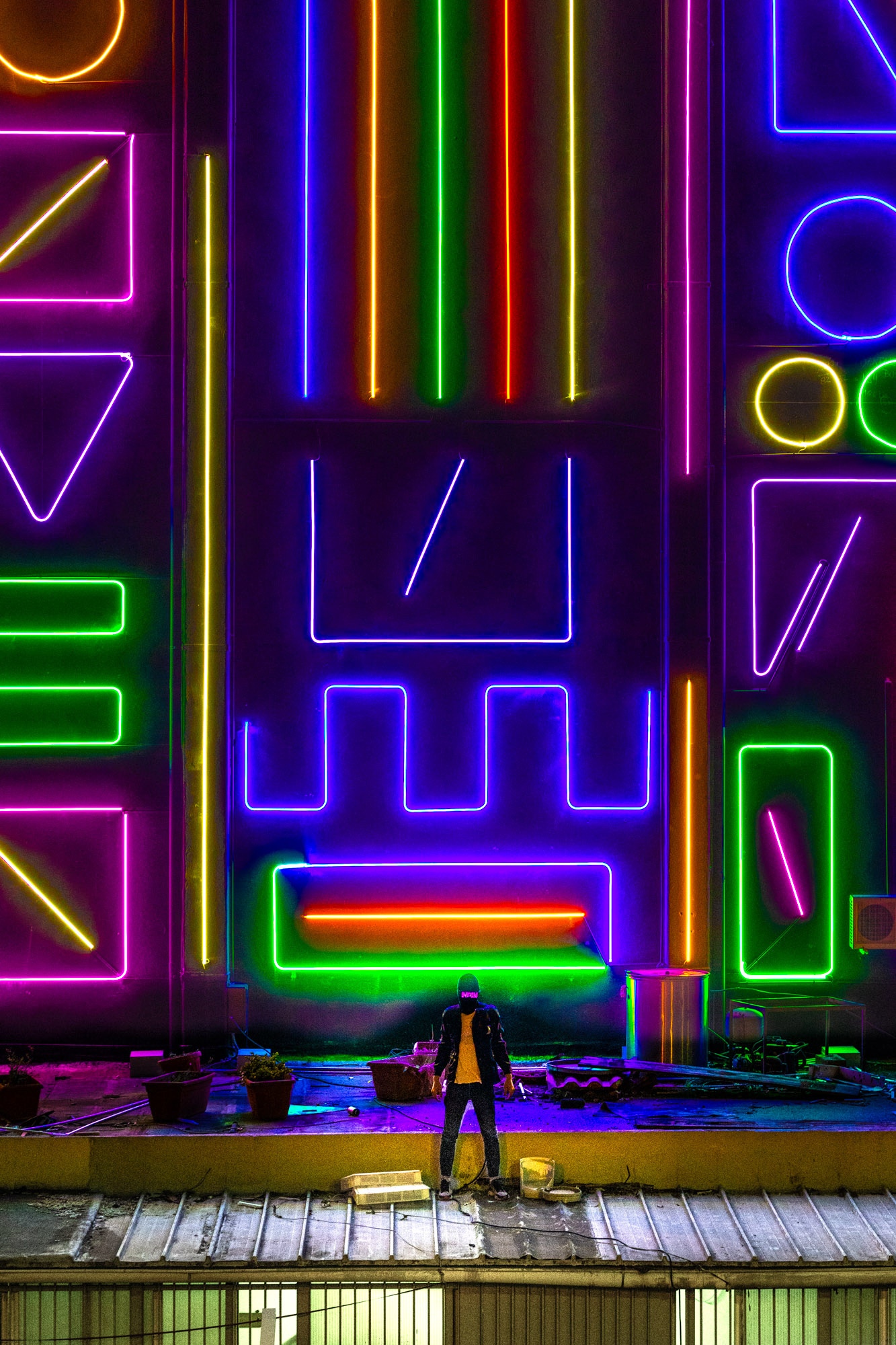
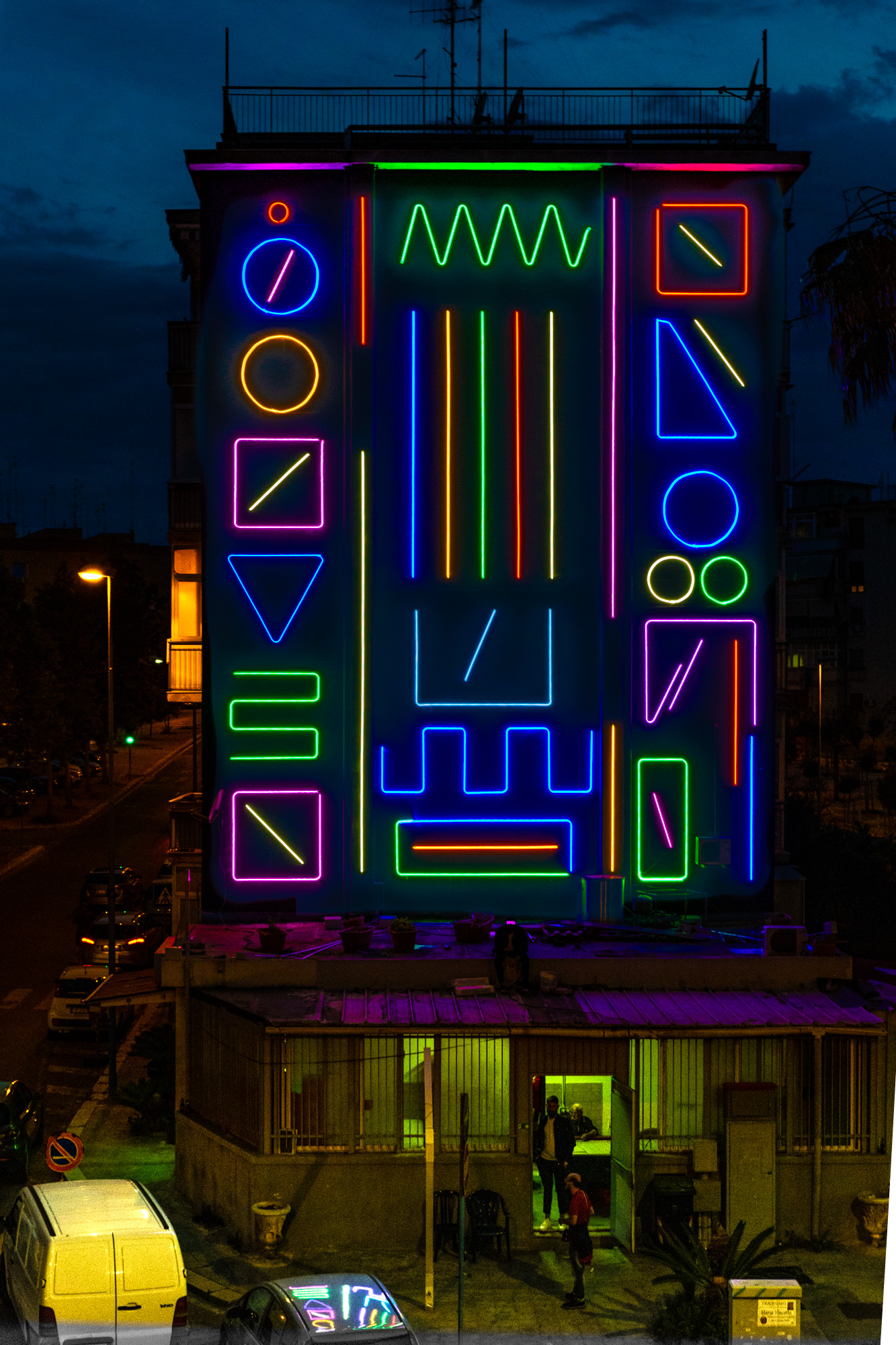
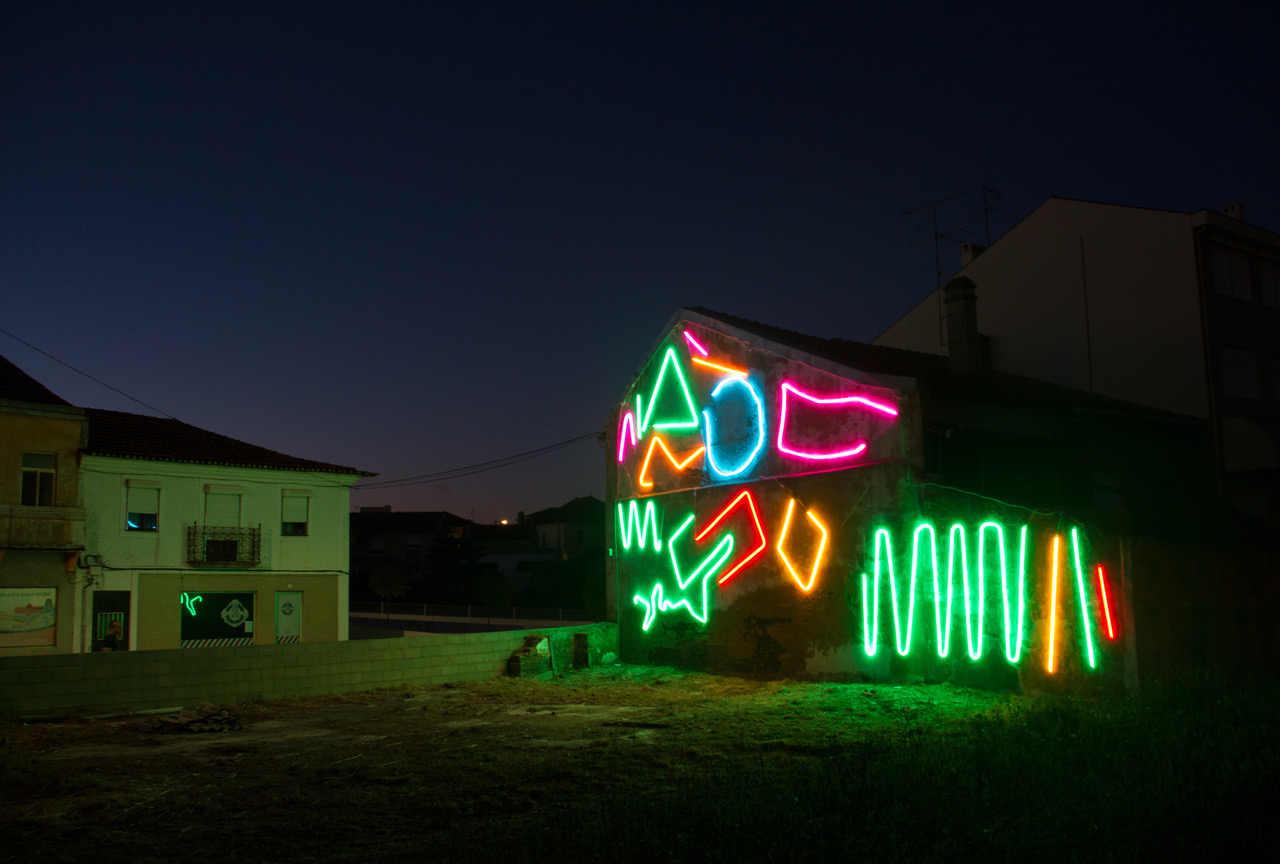
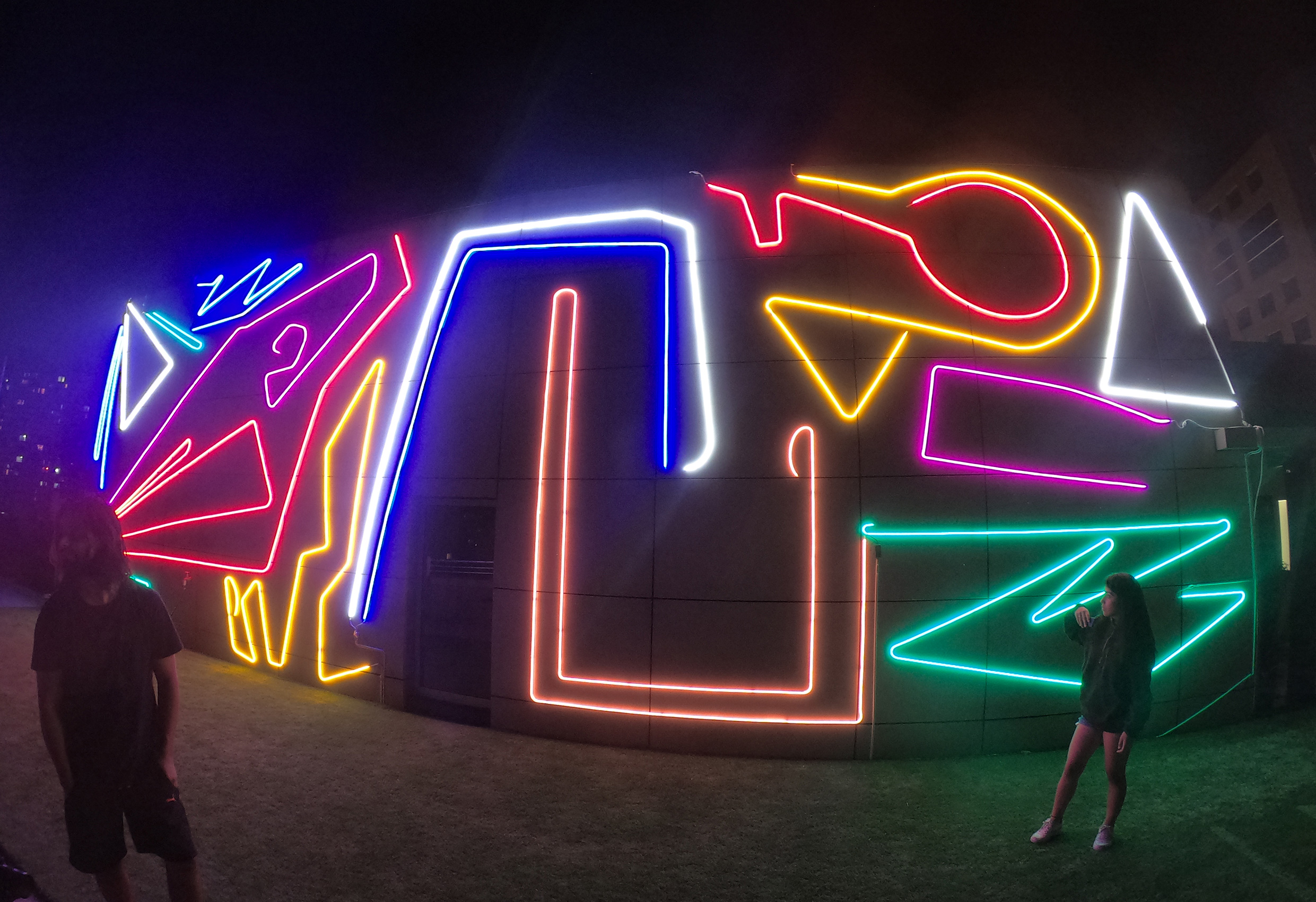
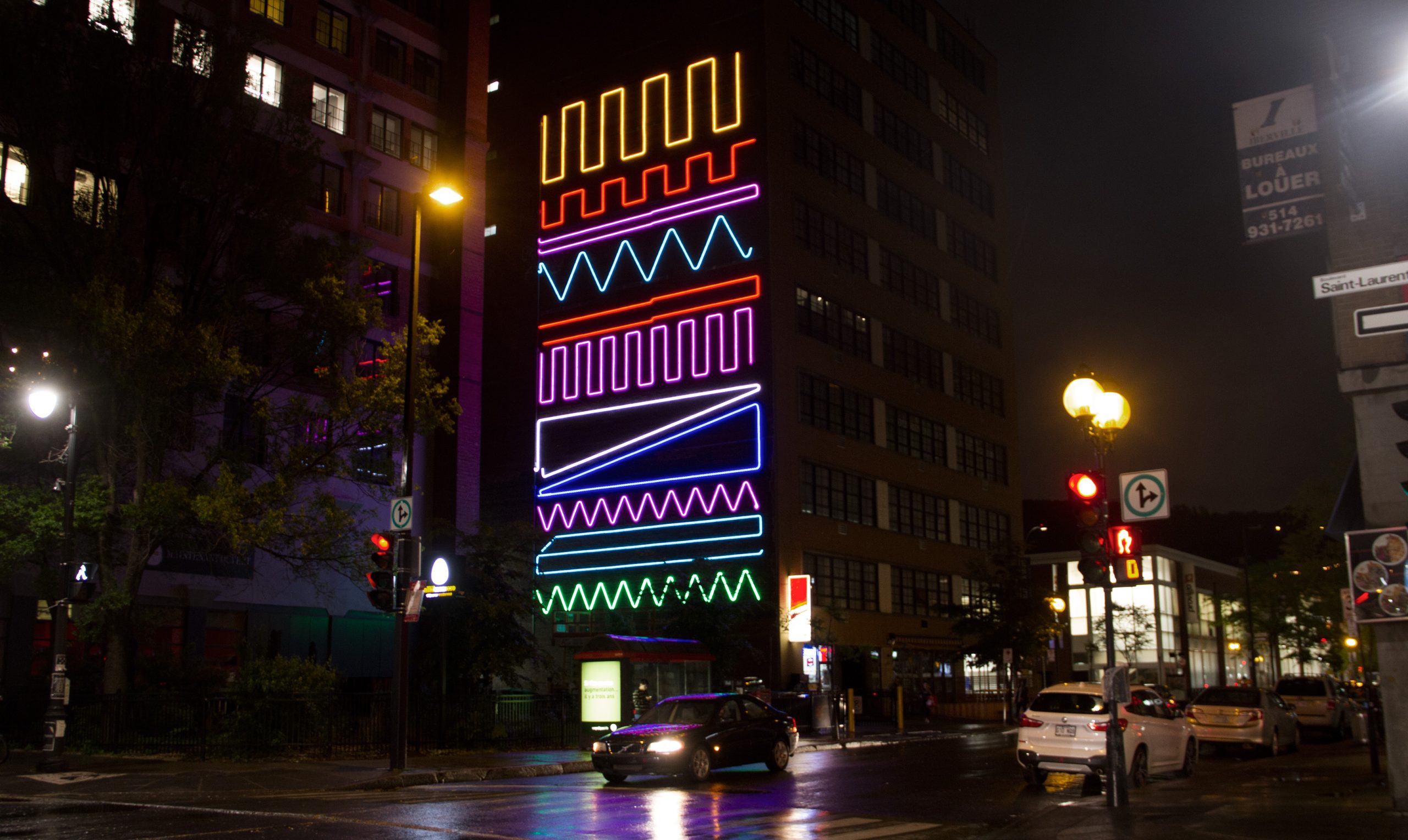
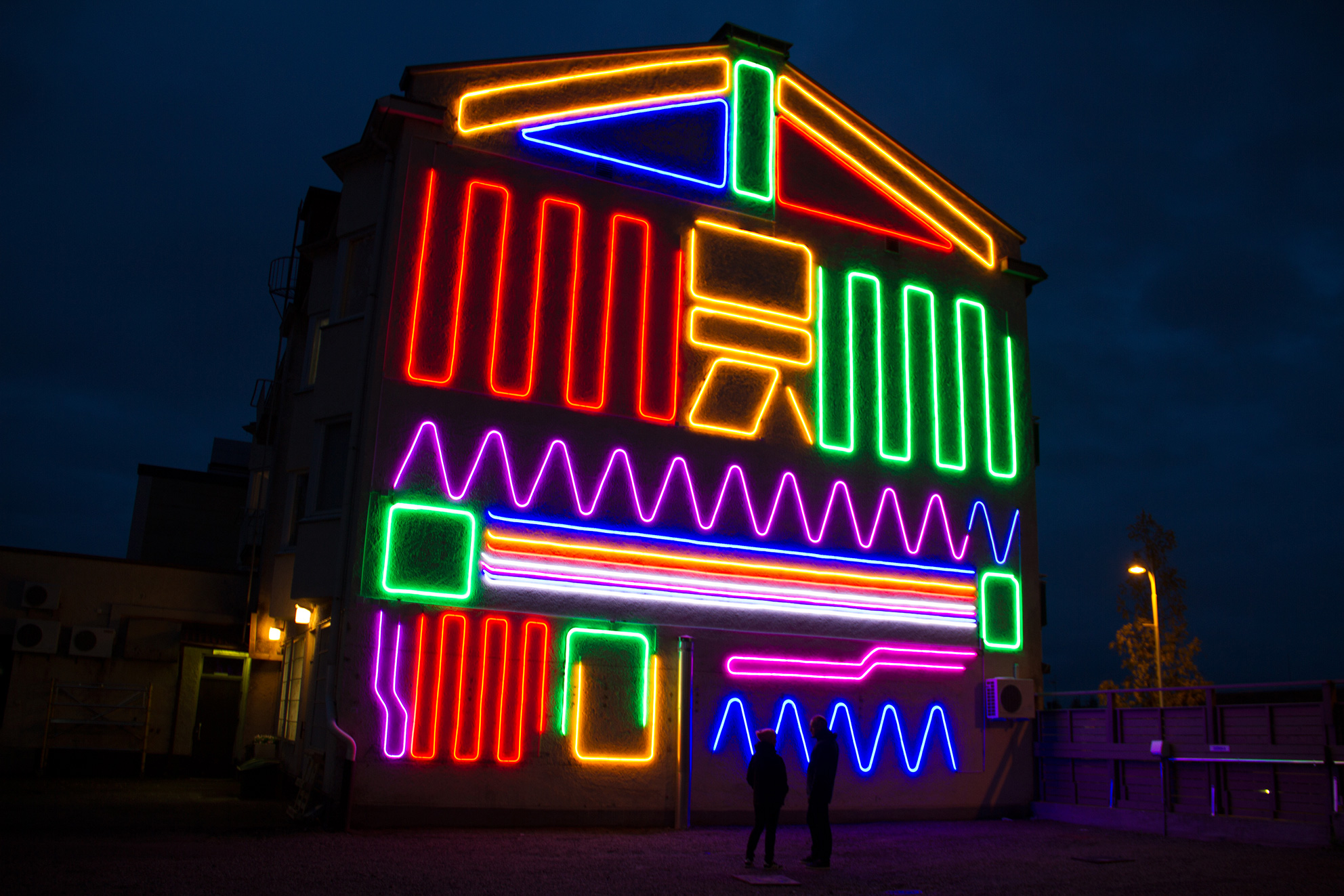
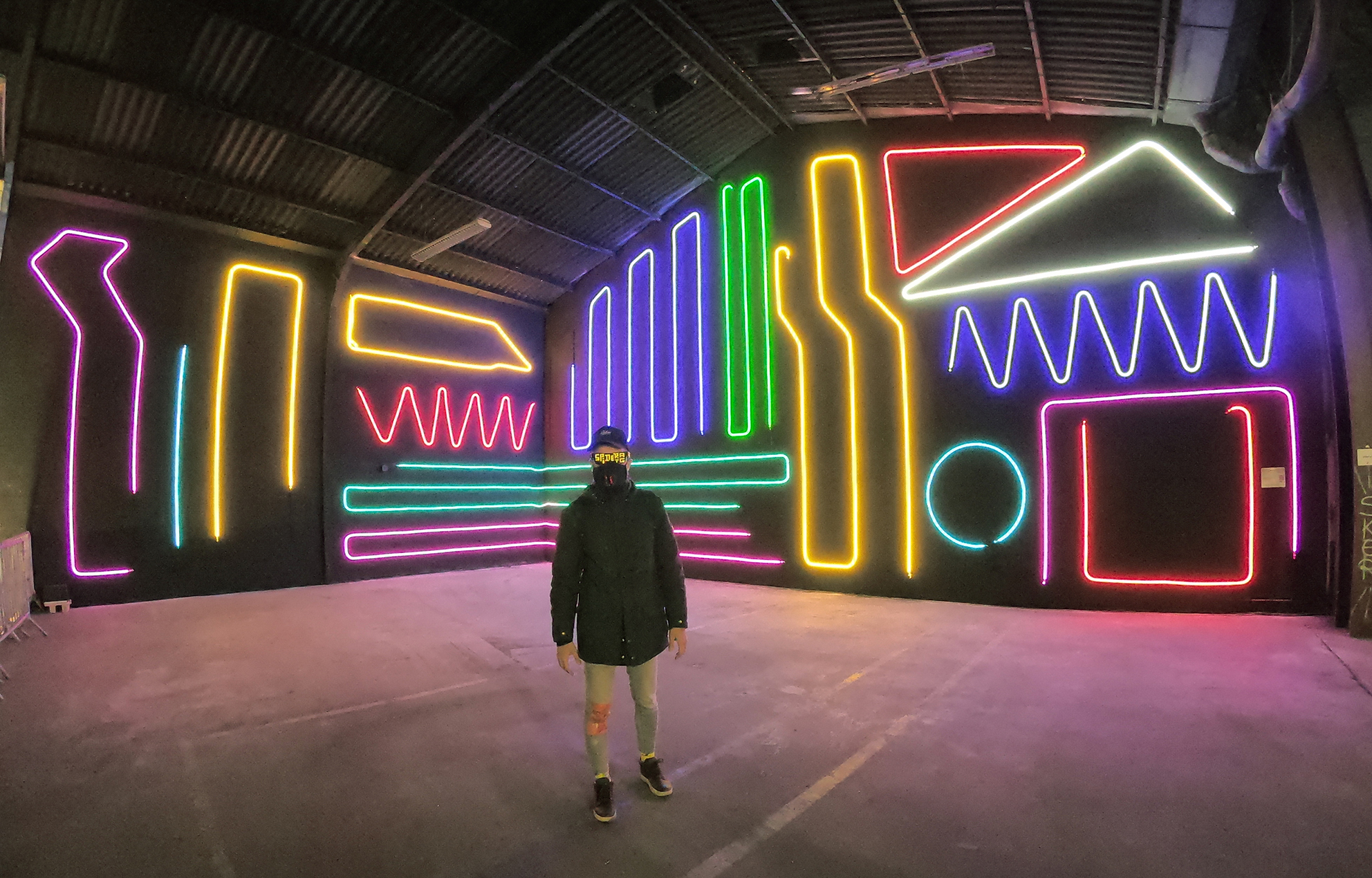
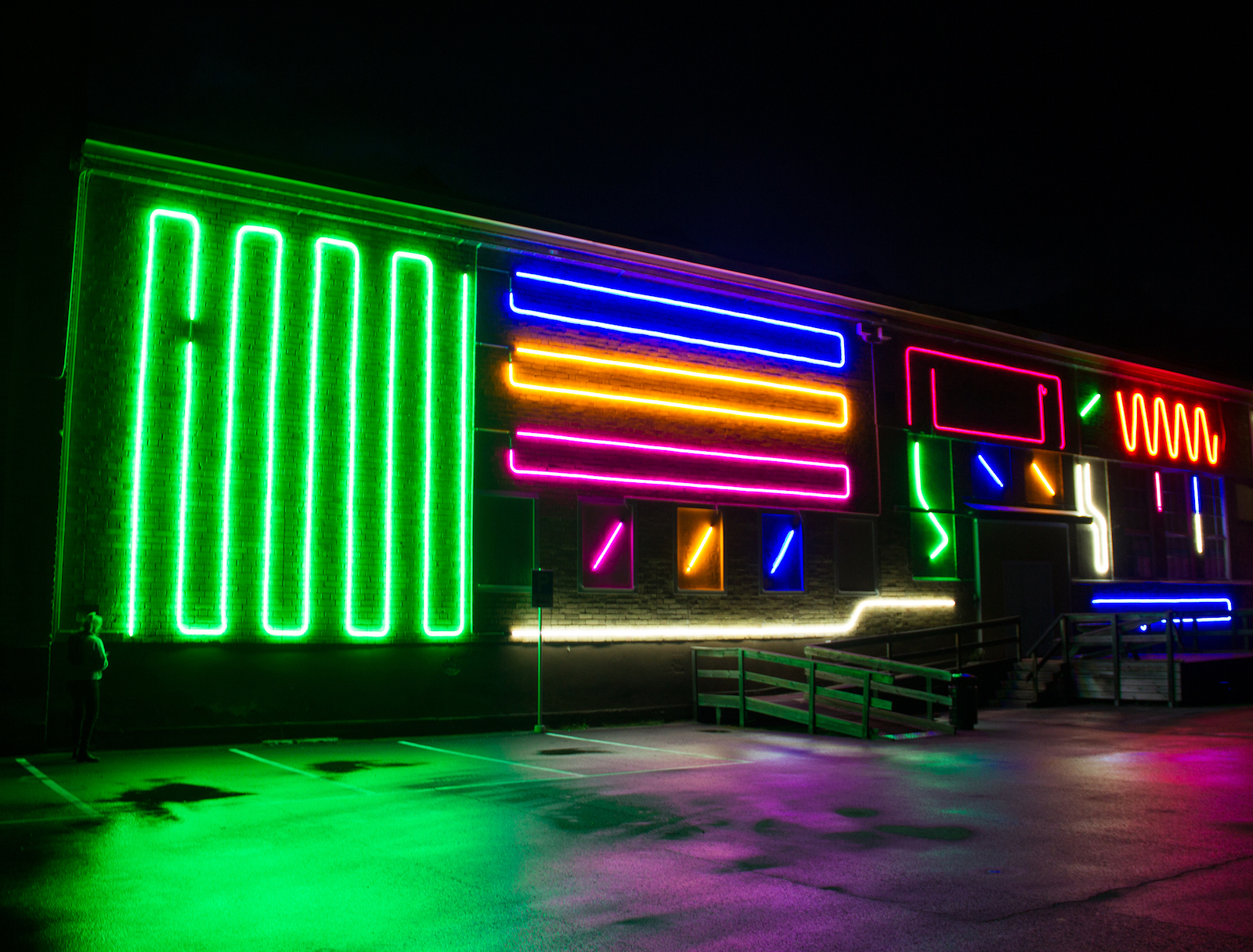
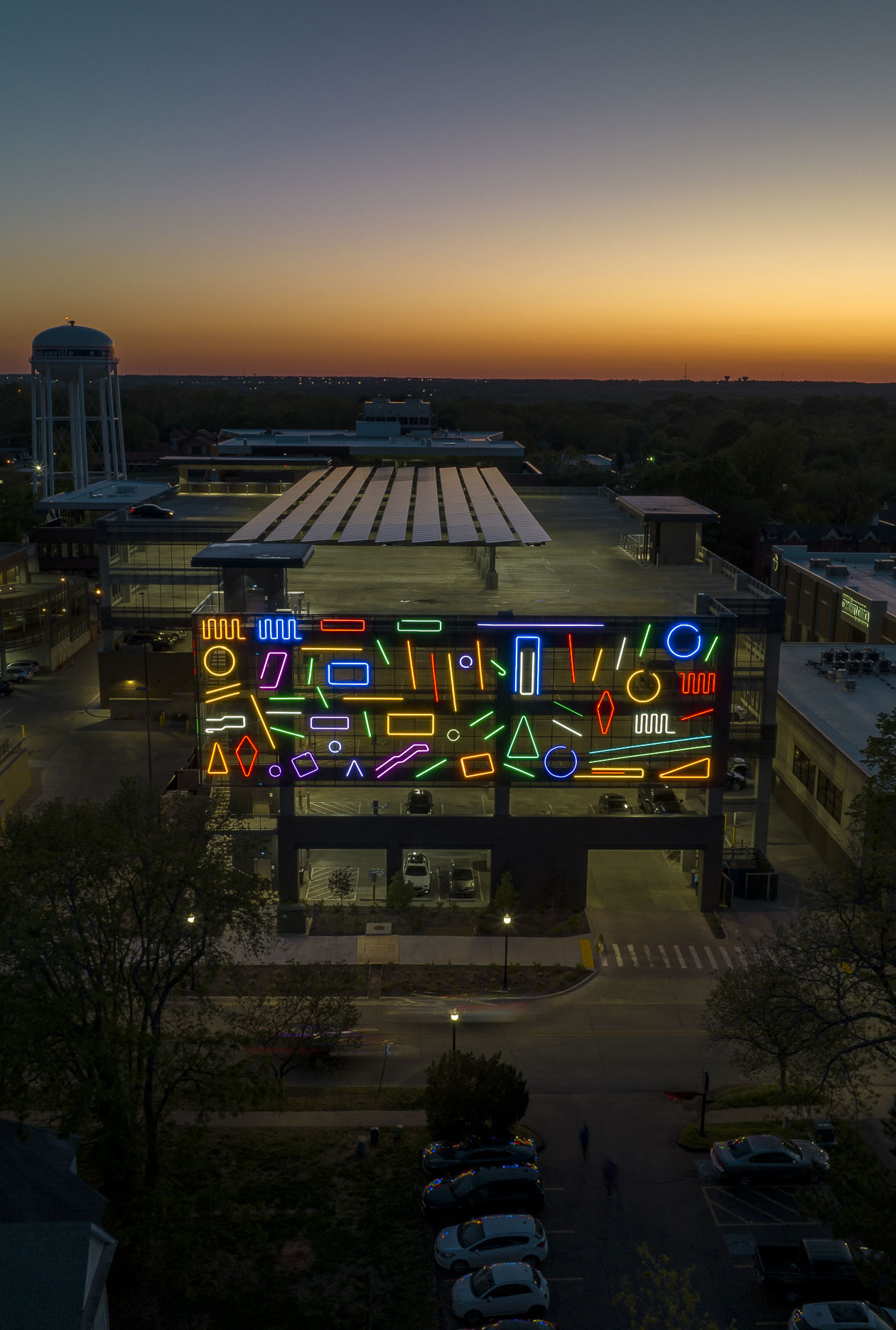


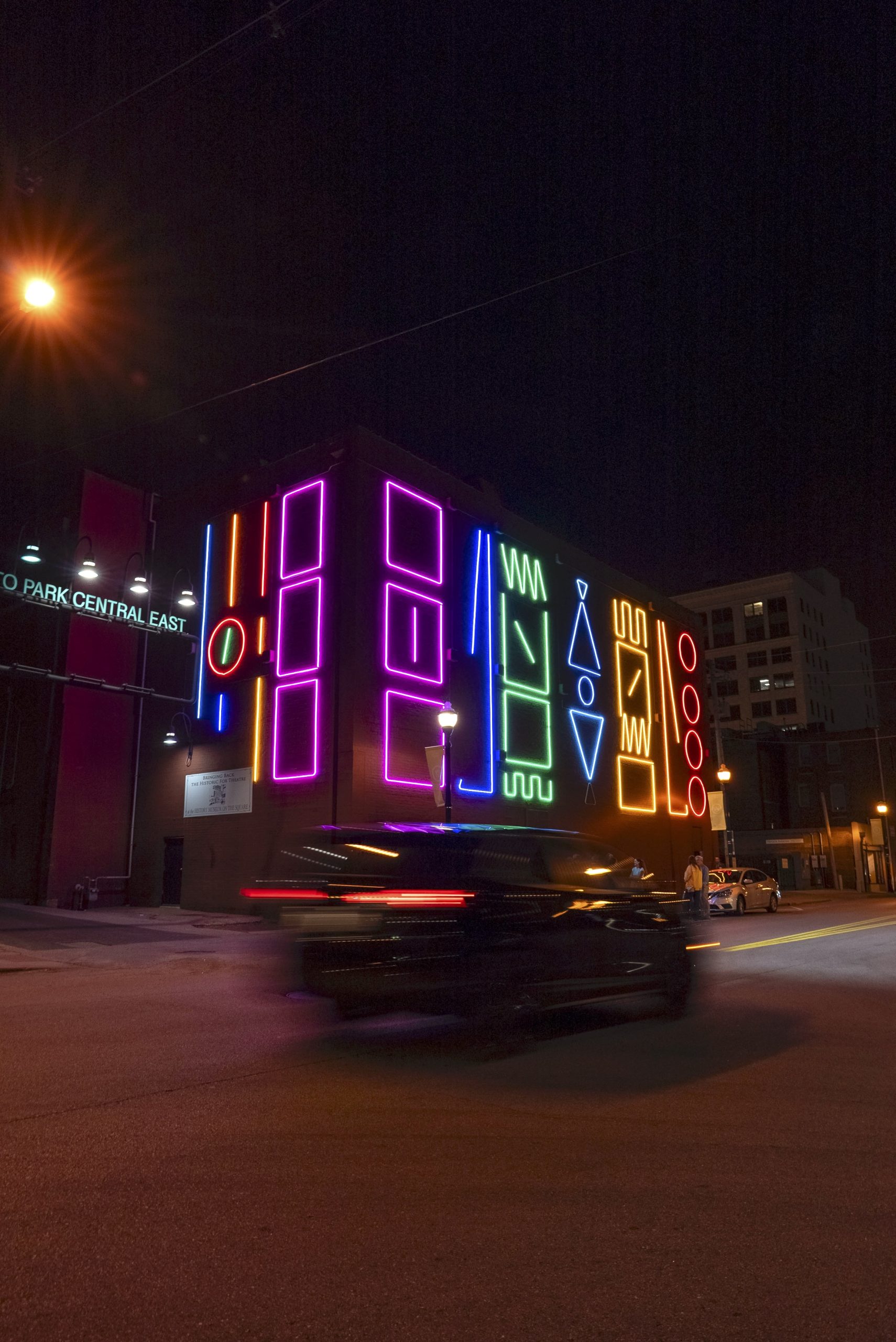
Image Copyright Spidertag
Explore the evolving project in GraffitiStreet’s complete Interactive Neon Murals INM# archive.
Futurism Primitivism
Spidertag describes his visual language as Futurism Primitivism, bringing together forms that belong to opposite ends of human history.
The line, triangle, square and circle are among the most elementary marks we make, appearing across early systems of communication, architecture and symbolism. Spidertag places these ancient forms into a technological present through neon, LEDs and digital interaction.
The result feels strangely familiar without offering a fixed translation. A triangle can appear archaeological and digital at the same time; a sequence of lines might suggest a primitive symbol, electronic circuitry or a direction through an imagined future.
His related concept of Neonmetry develops this relationship further, treating neon as a drawn line whose light extends beyond its own physical edge. Darkness becomes part of the work rather than simply its backdrop.

Spidertag’s global Language of Light
Since INM#1, Spidertag’s illuminated language has travelled across Europe, North America, South America, Asia and the Middle East, continually changing in response to architecture and place.
The series has included major works in Honolulu, Montréal, Las Vegas, Riyadh, Bari and Bayonne. In 2025, INM#25 extended across a 30 × 5 metre wall at Point de Vue Street Art Festival in Bayonne, turning his geometric symbols into an enormous illuminated sequence.
In October 2026, INM#26 brought that language to the clock tower of Post City in Linz, Austria. Created for Calle Libre, the 26 × 12 metre installation responds to a former postal logistics centre through ideas of time, communication and movement, continuing Spidertag’s expansion of muralism beyond the painted surface.


INM#25 and INM#26. Image Copyright Spidertag.
From the Street to the Gallery
The same visual language has increasingly moved into Spidertag’s studio practice without losing its architectural origins.
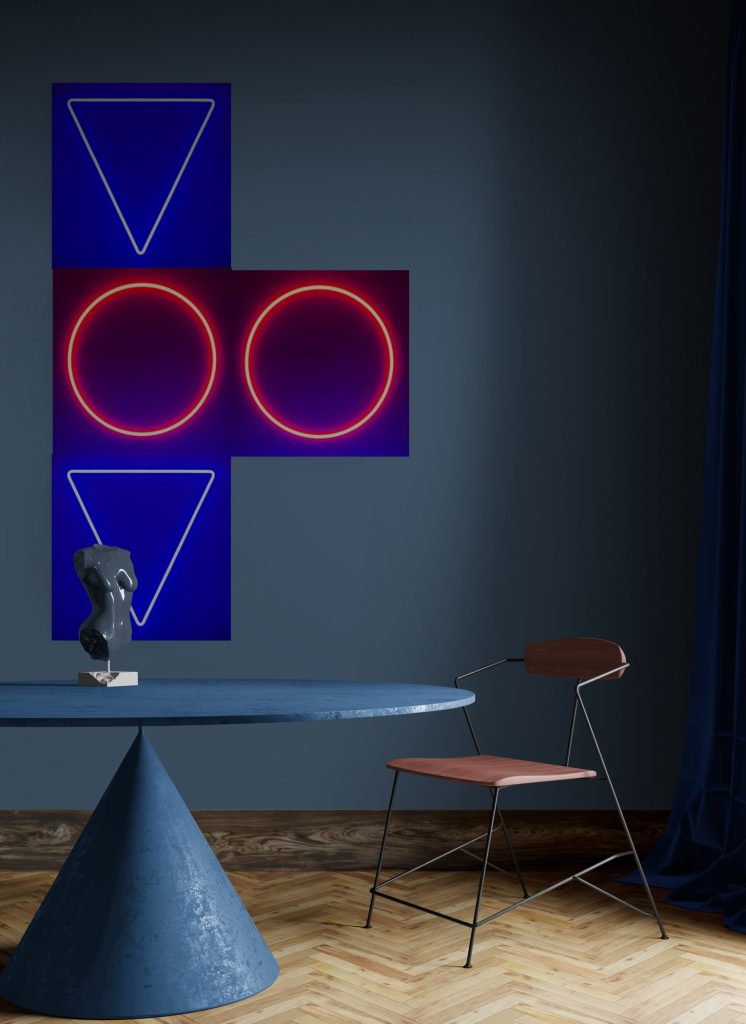
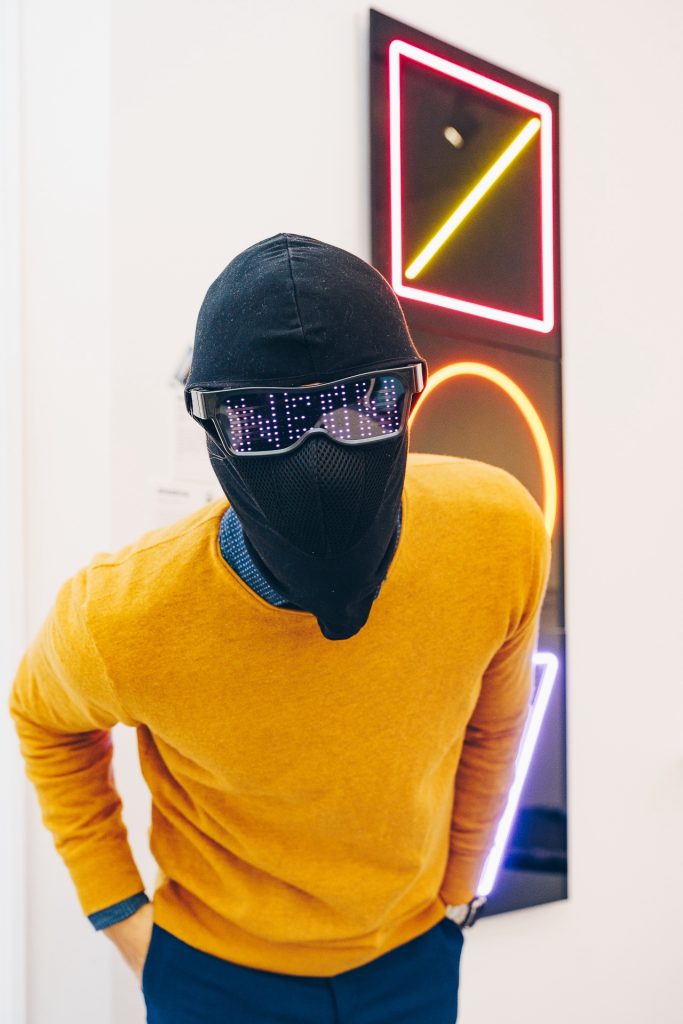
For GraffitiStreet’s X: A DECADE in 2024, Spidertag and GraffitiStreet developed the Futurism Primitivism Modular Sculpture, translating his illuminated symbols into a flexible interior system.
Built from 50 cm square acrylic modules, each carrying an individual light-based symbol, the concept allows separate units to be rearranged into changing compositions. A language developed across walls could now be assembled, expanded and reconfigured within architectural interiors.
Explore available works by Spidertag via GraffitiStreet.
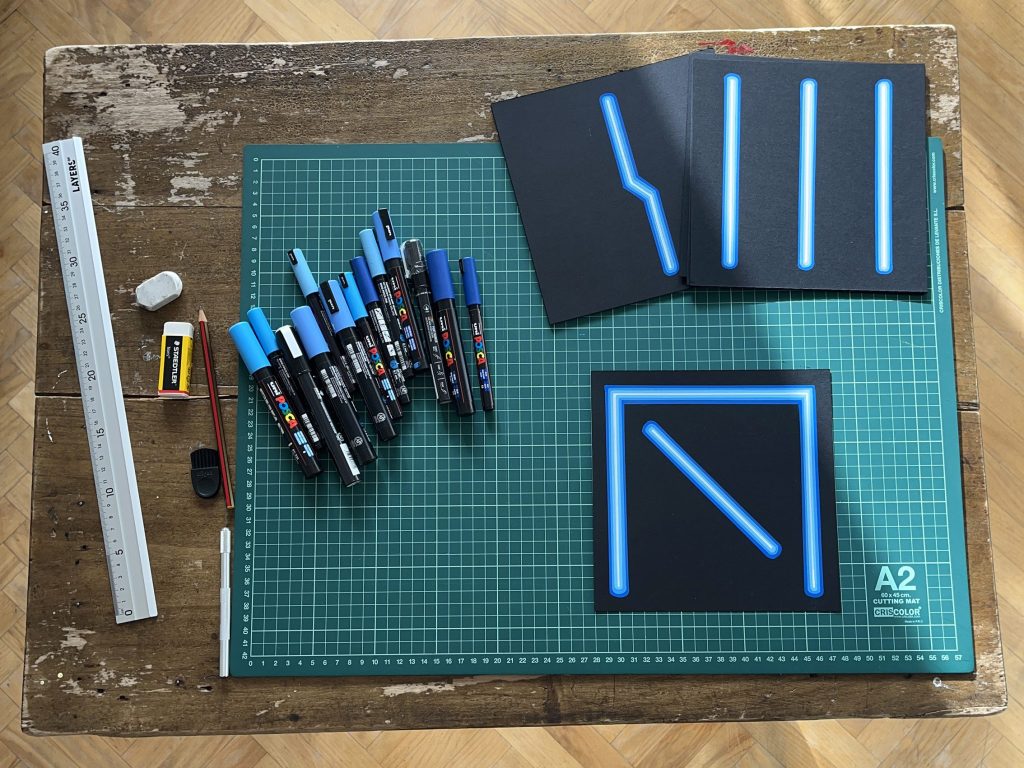
His 2025 works Triangle Line and Lines & Yellow brought neon into a more concentrated studio format for GraffitiStreet’s Concrete & Colour, while the 2026 series Blue Signal /26 reduced the language further still. Created with blue acrylic marker on black paper, these hand-drawn works retain the sensation of luminosity without using electrical light at all. Across each format, the line remains the constant.
Explore available works by Spidertag via GraffitiStreet.
Related Reading
Who Is Spidertag? The Complete Guide to His Art and Interactive Neon Murals traces the artist’s development from early thread interventions through the complete INM# project, Futurism Primitivism, Neonmetry and studio practice.
In Interview with Spidertag: Redefining the Concept of Muralism, Spidertag discusses the experimentation, technology and thinking behind his Interactive Neon Murals.
Explore the numbered series through the Complete INM# Archive, documenting the development of the project from Portugal to its international expansion.
Futurism Primitivism Modular Sculpture follows GraffitiStreet’s collaboration with Spidertag as his symbolic neon language moves from public architecture into modular sculpture.
More recently, Blue Signal /26 reveals what happens when that illuminated language is reduced to pigment, paper and the simplest geometric gesture.
More Artists in the Spotlight
Discover HOXXOH, whose abstract murals similarly use geometry, repetition and movement to transform architectural space.
Explore Futura, whose pioneering abstract graffiti helped establish the possibilities of line, gesture and non-figurative language within street culture.
You can also discover Pahnl, whose precise graphic language offers another approach to reducing urban art to carefully controlled signs, shapes and visual systems.
Discover Spidertag at GraffitiStreet
GraffitiStreet has followed Spidertag’s evolving practice from his illuminated public works into a growing body of studio pieces, including our collaborative Futurism Primitivism Modular Sculpture and works presented through Concrete & Colour and Urban Equinox.
Explore available works by Spidertag or contact GraffitiStreet for acquisitions, bespoke modular works, commissions and private viewings.
Visit GraffitiStreet Gallery, 25A West Street, Chichester, West Sussex, England PO19 1QW.