22 Banksy Works Still Surviving in London in 2026
Last updated: 23 July 2026 — revised and expanded from our original 2022 guide
Banksy has created more than 50 stencils, murals, installations and sculptural interventions across London. Most have disappeared. From a flag-blinded monument in St James’s and two children beneath the lights of Centre Point to faded rats, protected Shoreditch classics and remnants barely clinging to the city, GraffitiStreet maps 22 credible Banksy works still surviving across the capital.
Some images below show works as they first appeared rather than their current, often weathered condition, each entry’s “Status” line reflects the latest known state.
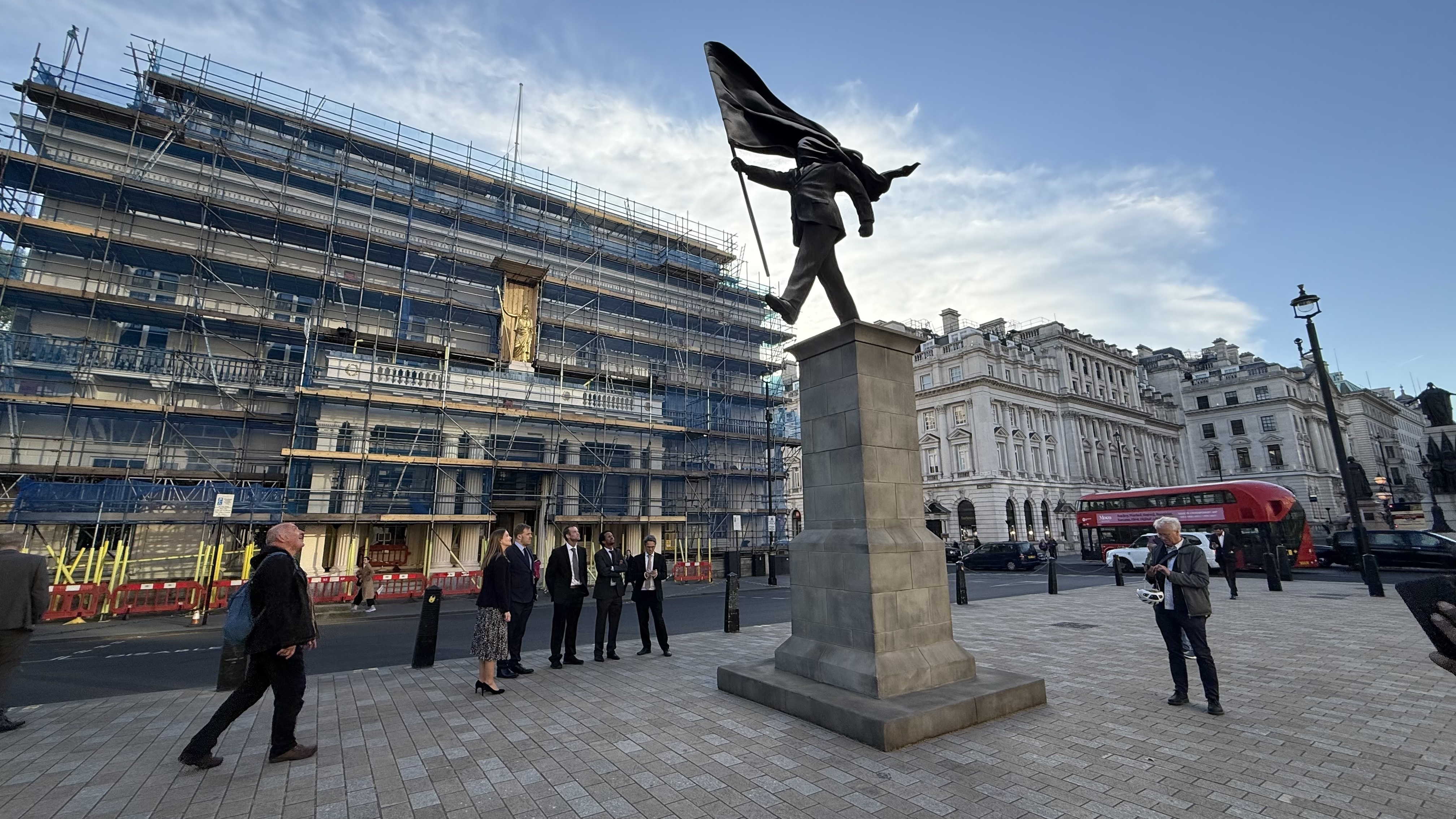
Banksy, Waterloo Place, St James’s, London 2026.Image copyright GraffitiStreet
The sculpture on Waterloo Place in St James’s is the latest chapter in a relationship between Banksy and London that now extends across more than 25 years.
During that time, the artist has used shopfronts, railway bridges, courtyards, cash machines, trees, vehicles and institutional façades to challenge authority, consumer culture, policing, war, environmental decline and the art establishment itself. Yet Banksy’s London history is also a history of disappearance.
Murals have been painted over by councils, cut from walls by property owners, altered by rival graffiti writers, stolen within hours or removed for institutional safekeeping. Even works protected behind perspex have faded, clouded or become almost impossible to see.
This GraffitiStreet guide brings together 22 credible Banksy works, preserved sections and recognisable remnants that still physically survive in various conditions across London.
Not every entry offers the same experience. Some remain clear and publicly visible. Others are damaged, obscured, relocated within new architecture, or widely attributed without having been officially claimed.
St James’s, Westminster and the Strand
1. Flag-Blinded Statue
Location: Waterloo Place, St James’s, London SW1Y Status: Confirmed by Banksy; standing behind barriers
A suited man marches forward while the flag he carries covers his face.
The symbolism is immediate, but its location prevents it from becoming simplistic. Waterloo Place is surrounded by monuments commemorating Britain’s military, political and imperial history. Banksy’s figure imitates their bronze authority while quietly reversing it. This leader is not looking towards a glorious future. He cannot see where he is going.
The statue appeared outside the Athenaeum Club on 29 April 2026 and was confirmed by Banksy on Instagram the following day. The artist’s footage showed the substantial sculpture and plinth being installed at night with the assistance of a crane.
Protective fencing was erected after approximately a day, but the sculpture remains standing as of this guide’s last update.
Read our full feature on the Waterloo Place statue, including further images and analysis from the day it appeared.
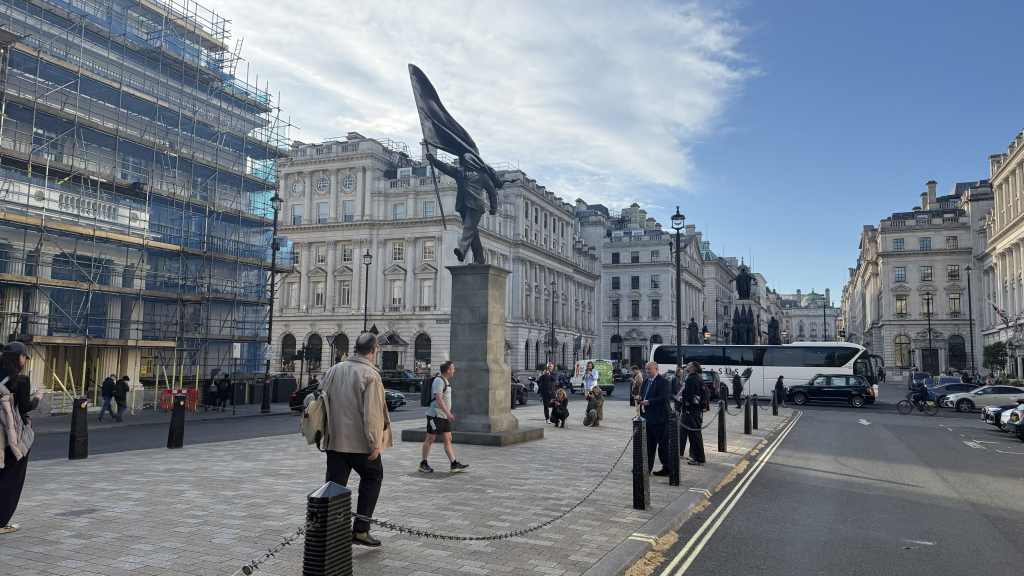
Banksy, Waterloo Place, St James’s, London 2026 .Image copyright GraffitiStreet
View location via google maps.
2. Royal Courts of Justice Protester
Location: Royal Courts of Justice, Strand, London WC2A Status: Confirmed by Banksy; original image removed, residual trace survives but is obscured.
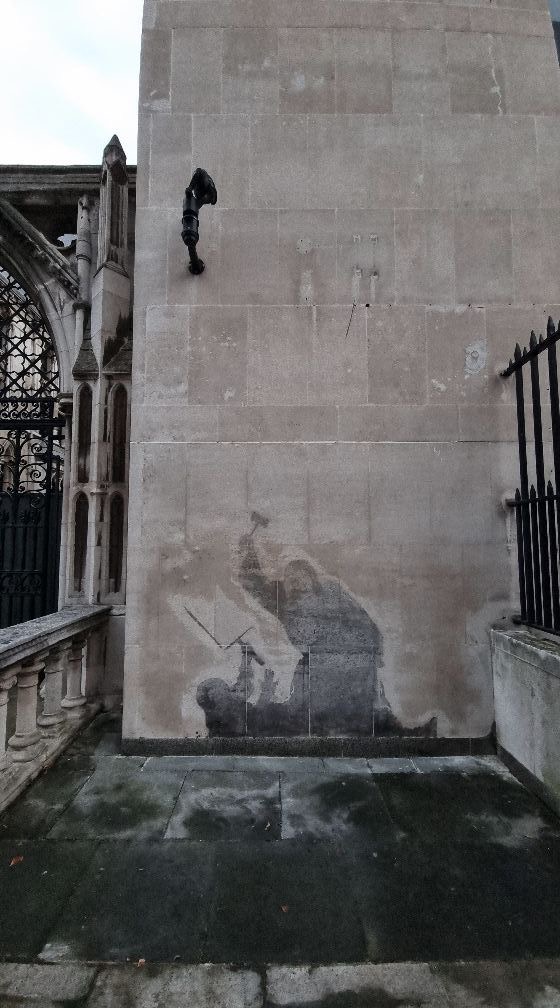
Banksy’s September 2025 intervention depicted a judge in ceremonial wig and gown striking a protester lying on the ground.
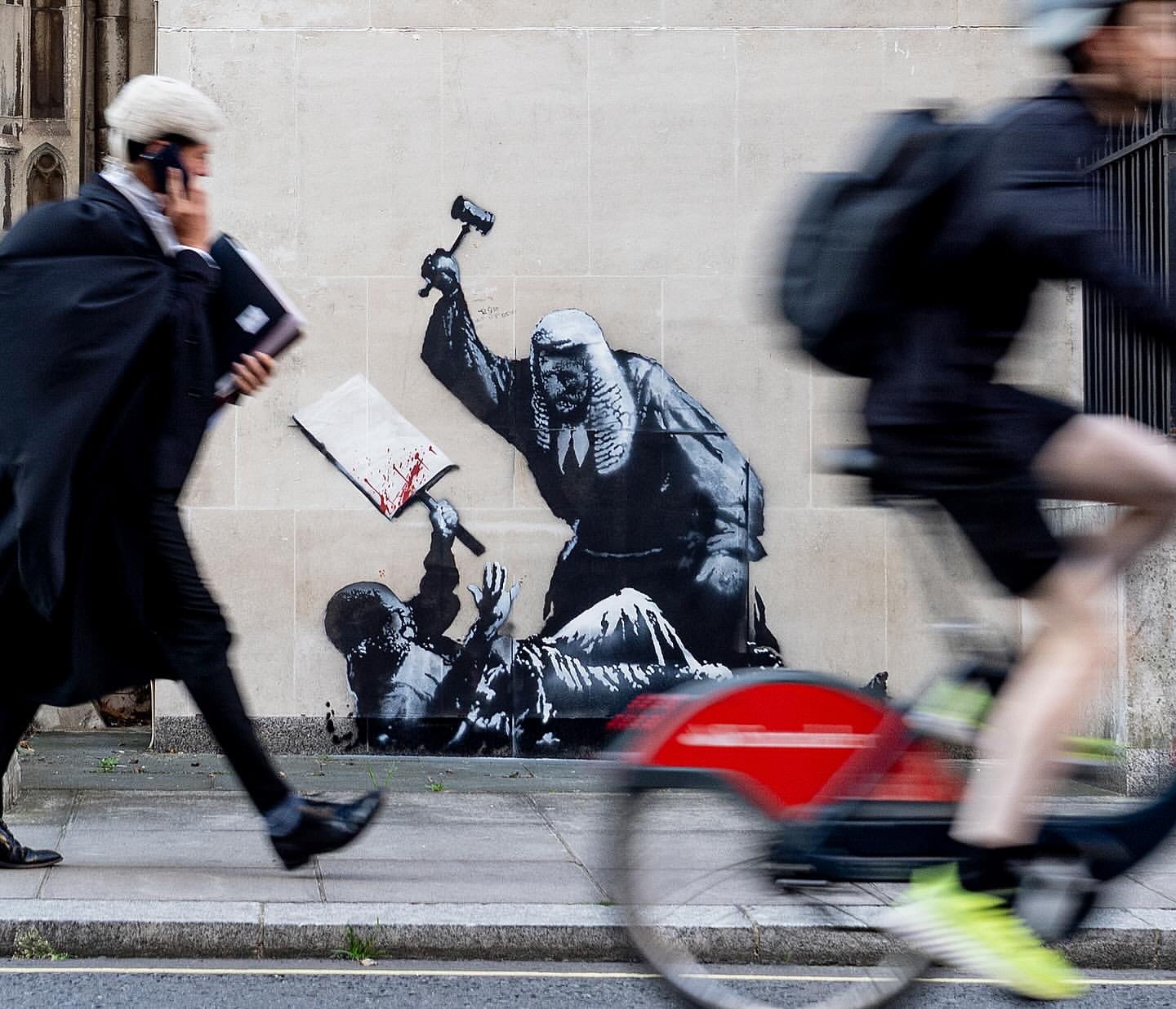
Banksy, Royal Courts of Justice, London, September 2025 — the mural shortly after it appeared.
The protester held a blood-marked placard. The judge’s raised gavel became less an instrument of legal judgment than a weapon of physical control.
The location was inseparable from the work. Banksy placed the image directly onto the Royal Courts of Justice, transforming the stone façade of British law into a scene of institutional violence. Read more on how Banksy managed to install the mural undetected at one of London’s most secure sites.
The mural appeared during a period of intense public debate about protest, policing and restrictions on political dissent. Banksy did not caption the image with a specific cause, allowing the relationship between law and suppression to remain deliberately broader. Our full analysis of the mural’s meaning covers this in more depth.
Authorities covered it almost immediately and removed most of the painted image from the protected stone. That removal was incomplete, leaving a pale shadow before the site was further obscured.
The remaining trace is no longer a conventional Banksy viewing experience. Yet its disappearance became part of the work’s meaning: an image about the silencing of protest was itself rapidly hidden and erased by the institution it confronted. See our earlier report on the ghostly trace left behind after the removal attempt.
If you peek through the protective screens, you can still see the ghost of the mural, though professional stone conservators are actively working to remove the remaining trace.
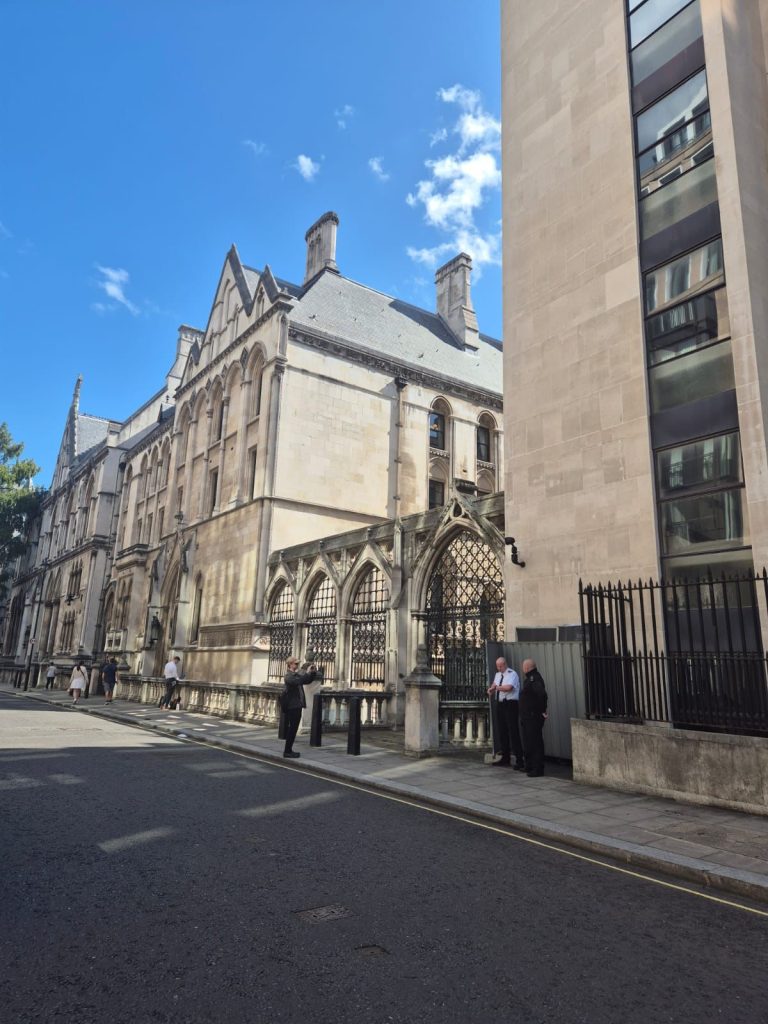
View location via google maps.
3. Stargazing Children at Centre Point
Location: St Giles Square, beneath Centre Point, London WC2 Status: Attributed to Banksy; protected but damaged
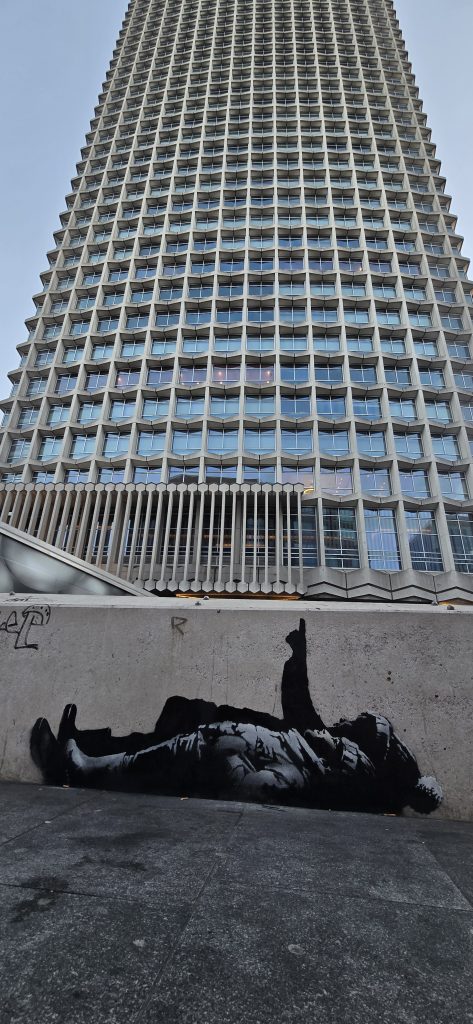
Two children lie on the cold pavement and point towards the sky. From one viewpoint, their gaze aligns with a polished seasonal advertisement filled with oversized Christmas baubles. Behind it rises Centre Point, the London landmark once left largely empty while homelessness remained visible around it, and later converted into luxury apartments.
The composition turns Christmas wonder into a study of exclusion. The children can see the imagery of celebration and abundance, but they remain physically outside it. Read our full feature on the mural’s meaning for a closer look at how the composition works.
Centre Point also carries a deeper connection to youth homelessness. The charity Centrepoint, established in 1969 by the Reverend Kenneth Leech, took its name from the building after Leech was struck by the contradiction between the tower’s empty floors and the young people sleeping rough around it.
It remains behind transparent protection, although subsequent paint damage has altered its appearance. The location and social context remain central to its force.
We covered the discovery of the second, confirmed mural at Queen’s Mews as this story developed.
Banksy’s Festive Baubles Mural, London 2025. Image Copyright @Marrossi
View location via google maps.
Bayswater, Marble Arch, Mayfair and Notting Hill
4. Stargazing Children
Location: Queen’s Mews, Bayswater, London W2 Status: Confirmed by Banksy; physically surviving but boarded over
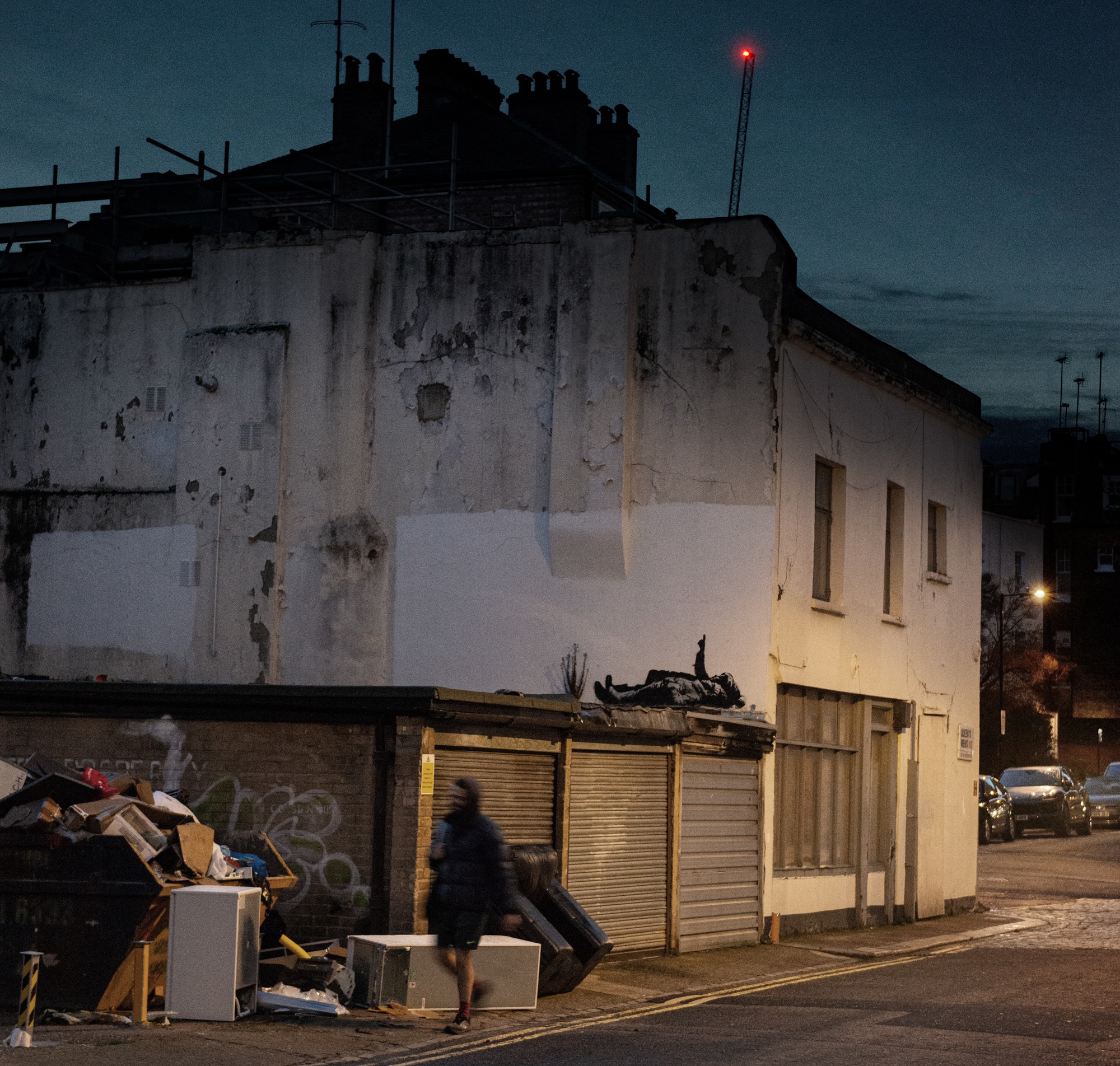
Banksy confirmed the Queen’s Mews mural in December 2025, sharing it as an identical companion piece to the earlier Centre Point mural. It depicts two children lying on the pavement beneath an imagined night sky. Wrapped against the cold, they retain the capacity for wonder, but their game unfolds without the shelter, security or comfort normally associated with childhood.
The work redirects the sentimental visual language of Christmas towards youth homelessness. There is no decorated home, pile of presents or festive meal. Imagination is the only abundance available to them.
The composition depends on its surroundings to complete itself. The children’s pointing gesture aligns with a single red light on nearby scaffolding, which after dark reads as a star, an effect achieved entirely through placement rather than paint.
The mural was covered soon after it appeared. It therefore remains physically present but cannot currently be viewed in the form Banksy originally intended. Read our full coverage of both murals together.
View location via google maps
5. Despair Ends and Tactics Begin
Location: Marble Arch, London W2 Status: Protected beneath perspex
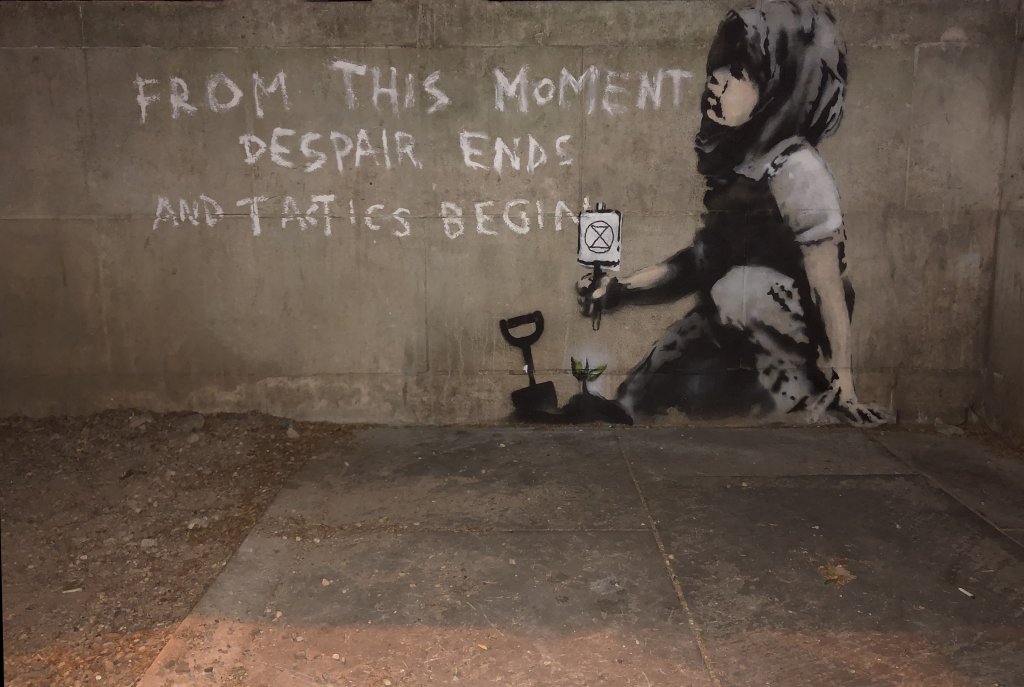
A child kneels beside a newly planted sapling beneath the Extinction Rebellion hourglass symbol. The accompanying declaration reads: “From this moment despair ends and tactics begin.”
The mural appeared during the Extinction Rebellion protests of April 2019, as the occupation around Marble Arch was being cleared. Its message turns environmental anxiety away from passive despair and towards organised action. The same child figure had appeared months earlier as a canvas piece inside Banksy’s Walled Off Hotel in Bethlehem, linking the London mural to the artist’s wider body of work. Read our original on-the-ground coverage from when the piece first appeared.
It remains protected beneath perspex, although grime make it difficult to view clearly.
Banksy Mural, Extinction Rebellion protests, Marble Arch, London 2019. Image copyright GraffitiStreet
View location via google maps.
6. Banksy Rat
The Banksy Rat on Tonbridge Street, on the rear wall of The Standard, London, formerly Camden Town Hall Annexe.
The remaining work is faded and remains in situ and is protected behind a framed clear screen and wooden frame to protect it.
View location via google maps
7. Graffiti Painter, or Velázquez
Location: Maramia Café – Taste of Palestine. Corner of Acklam Road and Portobello Road, Notting Hill, London W10 Status: Restored to public view
A figure resembling the seventeenth-century Spanish court painter Diego Velázquez stands before an easel. Instead of producing a royal portrait, he paints the name “Banksy” in large red graffiti lettering.
Created in 2008, the mural collapses the traditional distinction between sanctioned painting and illegal mark-making. The old master and anonymous graffiti writer occupy the same creative act.
The panel was concealed for years behind builders’ hoarding during redevelopment of the site before being uncovered and restored to view.
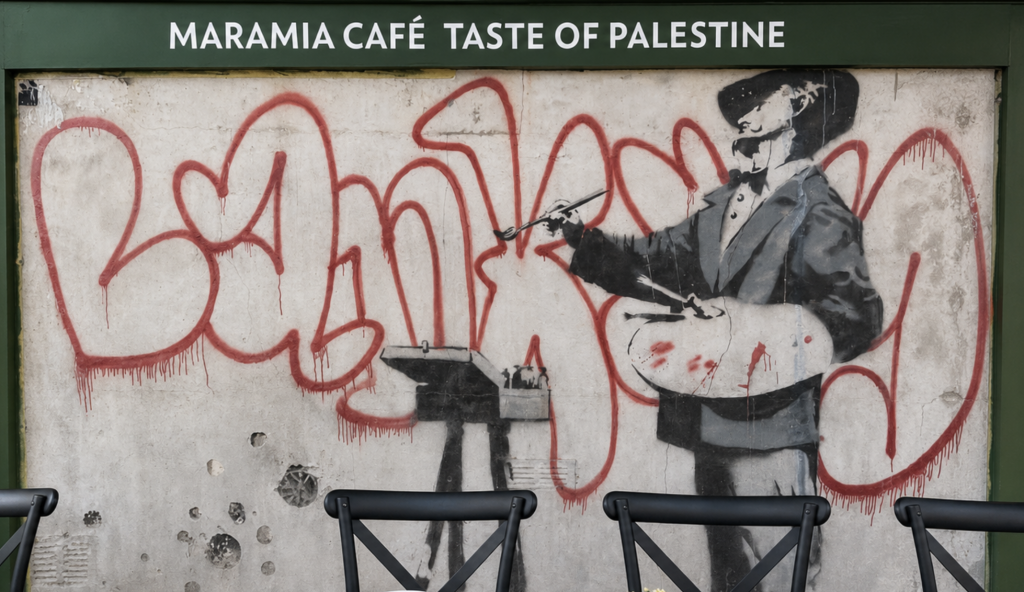
The Banksy work can be found where Acklam Road meets Portobello Road.
View location via google maps.
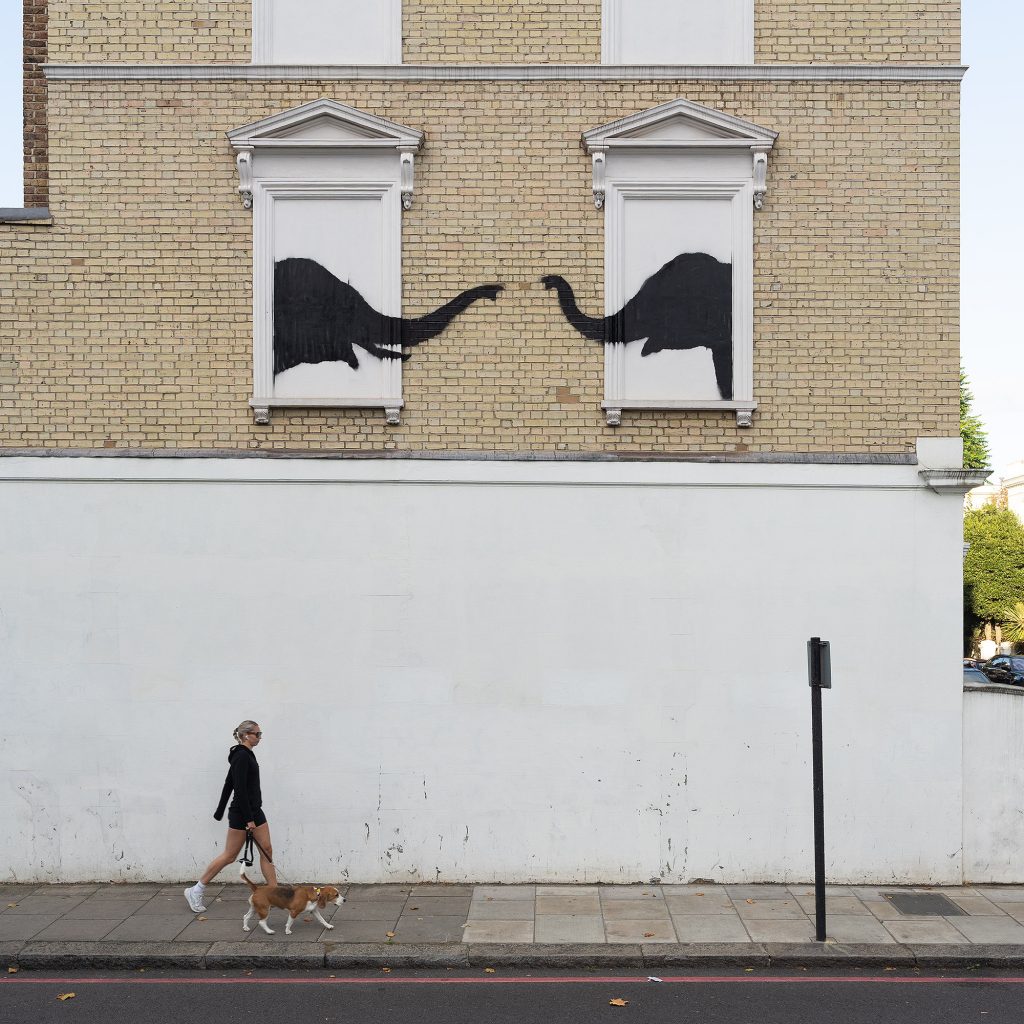
8. Elephants
Location: Corner of Edith Terrace and Edith Grove, Chelsea, London SW10 Status: Visible following defacement and repair
Two elephant heads reach towards one another from a pair of blocked windows. The mural appeared during Banksy’s nine-day London animal series in August 2024. Its use of sealed windows immediately suggested the familiar phrase “the elephant in the room”: an enormous truth visible to everyone but openly acknowledged by no one.
The architecture does most of the storytelling. Banksy uses the blocked openings to imply that the elephants inhabit an unseen space just behind the wall.
The work was defaced with white paint stripes across one elephant’s trunk within days of appearing. Kensington and Chelsea Council later removed the paint and applied an anti-graffiti coating to protect the surface. It remains recognisable on the original building and continues to be documented as a surviving part of the 2024 series.
View location via google maps.
Islington, Finsbury Park and Stoke Newington
9. Tree- Green Washing
Location: Hornsey Road, Finsbury Park, London N19 Status: Visible, protected and damaged
Banksy’s Tree appeared in March 2024 behind a severely pollarded cherry tree. A huge field of vivid green paint spreads across the wall like an artificial canopy. Beside it, a stencilled figure holding a pressure hose appears responsible for spraying the absent foliage into existence. From the correct viewpoint, the living tree and painted wall briefly become one composition.
The work has been interpreted as a warning about the treatment of urban nature, as a criticism of environmental greenwashing and as an image of artificial restoration standing in for genuine ecological care. Read our full feature on the mural, including our first-hand photography from the site.
It was splashed with white paint shortly after its appearance. Protective fencing and panels were subsequently installed, while the real tree has since produced foliage of its own.

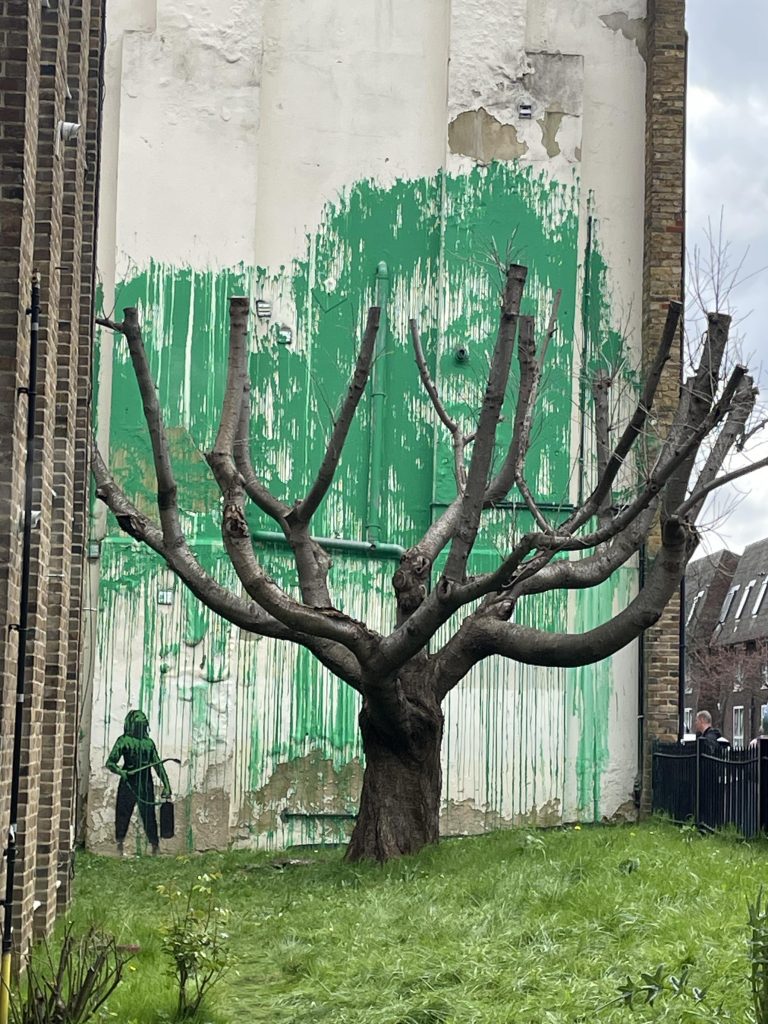
Banklsy “Eco Tree” mural, Hornsey Road 2024. Image Copyright Graffitistreet
View location via google maps.
Read our full feature of Banksy’s Hornsey Road tree mural, including GraffitiStreet’s first-hand reporting from the site and why the work may be understood as a powerful commentary on greenwashing.
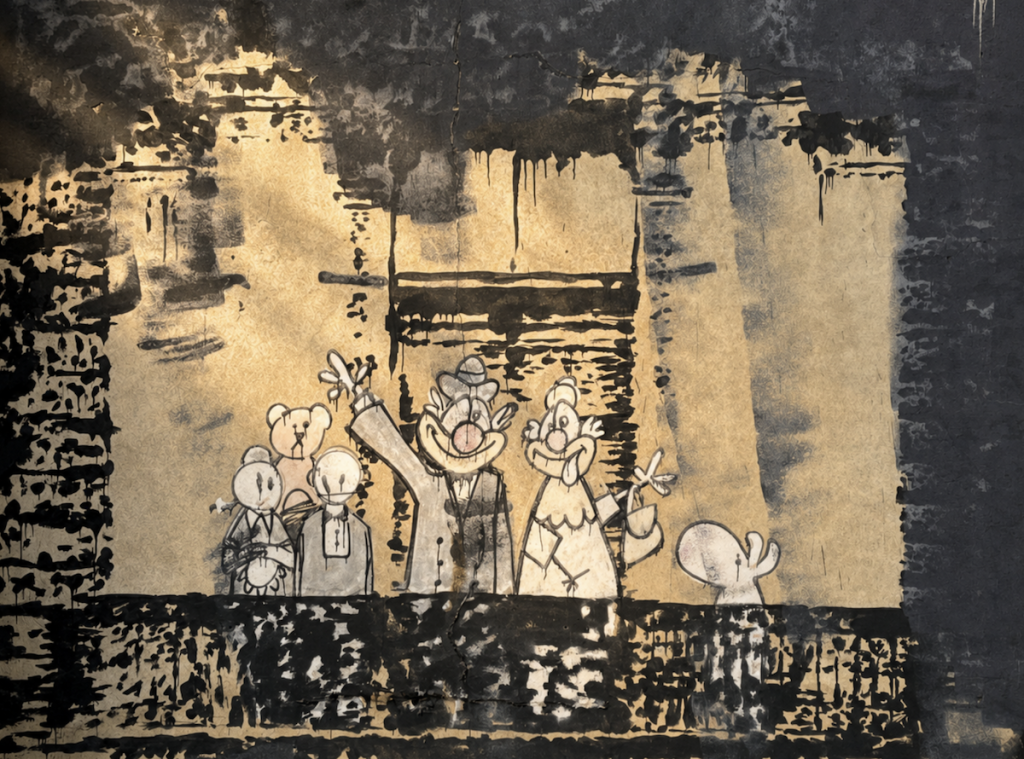
10. Royal Family, or Balcony Family
Location: Stoke Newington Church Street, London N16 Status: Weathered but recognisable
Banksy’s caricatured royal family has been waving from Stoke Newington Church Street since 2003, when the mural was created with the building owner’s permission and went on to feature on the cover of Blur’s single “Crazy Beat.” The group imitates a formal Buckingham Palace balcony appearance, but the exaggerated faces turn royal ceremony into something closer to a cartoon family spectacle.
The work belongs to an early phase in Banksy’s London practice. In August 2009, Hackney Council contractors began painting over the mural in black paint, after enforcement notices about the artwork had been sent to an outdated address for the building’s owner, Sofie Attrill, and went unanswered. Attrill and a crowd of local residents intervened and stopped the contractors before the central family group was completely erased, although much of the surrounding palace-like architecture was lost. Read local reporting on the incident from the Hackney Citizen.
View location via google maps.
The City and the Barbican
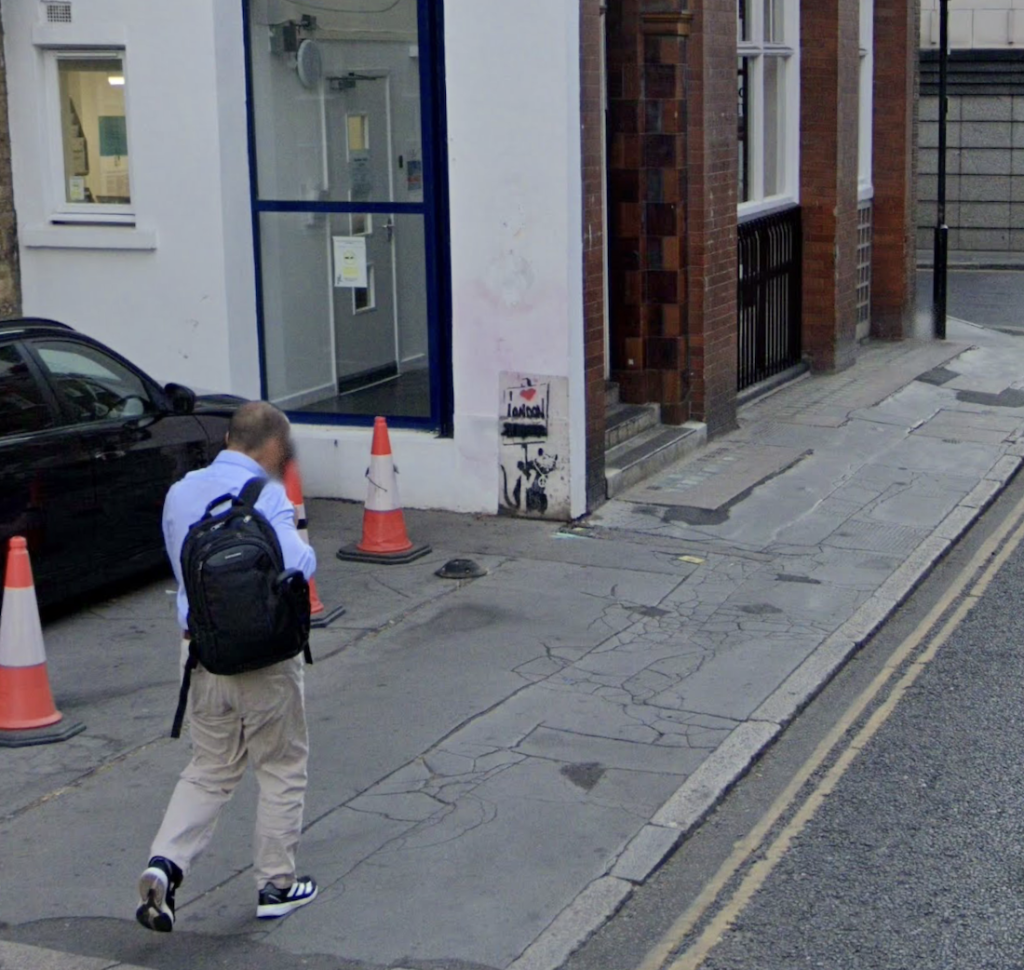
11. Robbo Rat
Location: Chiswell Street, London EC1 Status: Visible and weathered.
A medallion-wearing rat holds a placard originally reading “London doesn’t work.” The stencil became entangled in Banksy’s long-running feud with the late London graffiti writer King Robbo. Robbo reworked the placard’s text to read “I love Robbo,” adding his own tag and a heart. The altered wording has since faded and is no longer clearly legible, placing the stencil inside one of British graffiti’s most significant public rivalries.
View location via google maps.
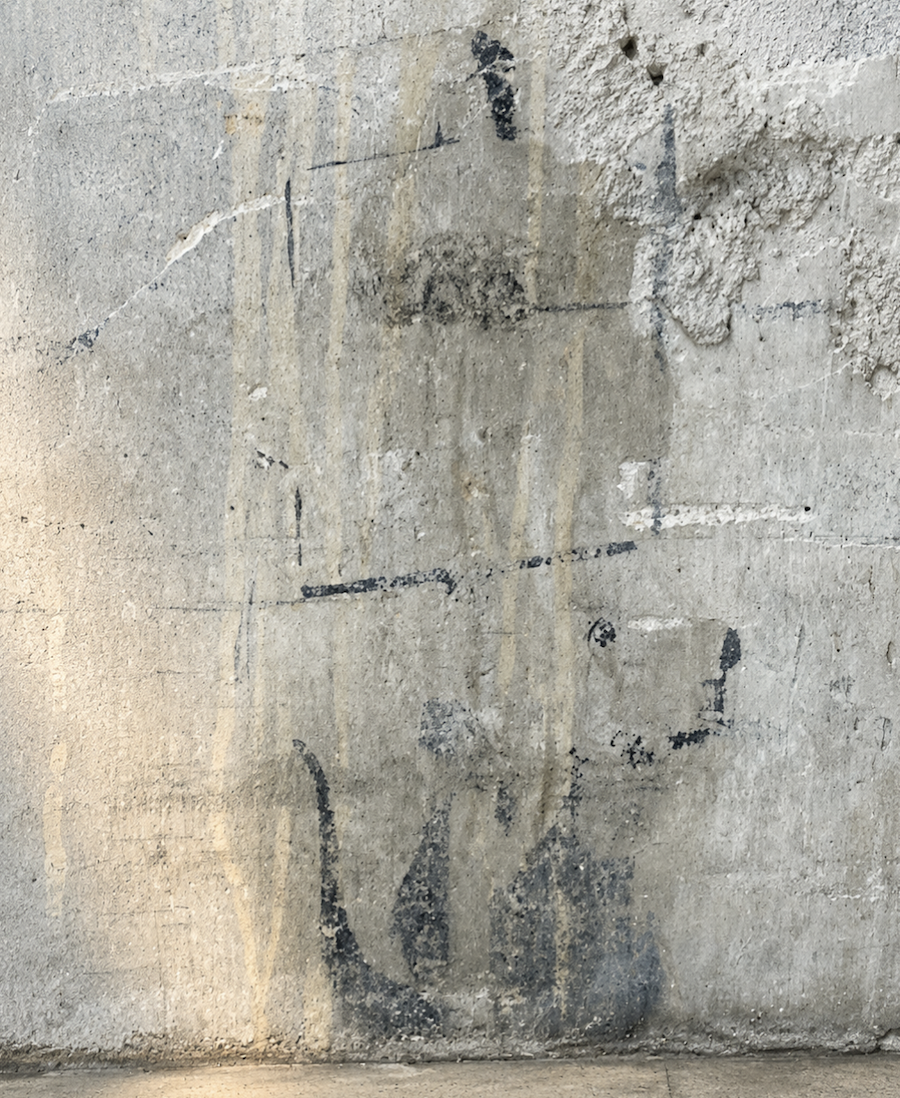
12. Cannon Street Rat
Location: Beneath Cannon Street railway bridge, London EC4 Status: Faded but visible
A small Banksy rat survives on a concrete support beneath the Cannon Street railway bridge, holding a placard reading “You Lose.” The stencil is badly faded and easily missed among the grime and visual noise of the city. It lacks the protection granted to several better-known Banksys and has remained exposed to weather, pollution and competing marks.
View location via google maps
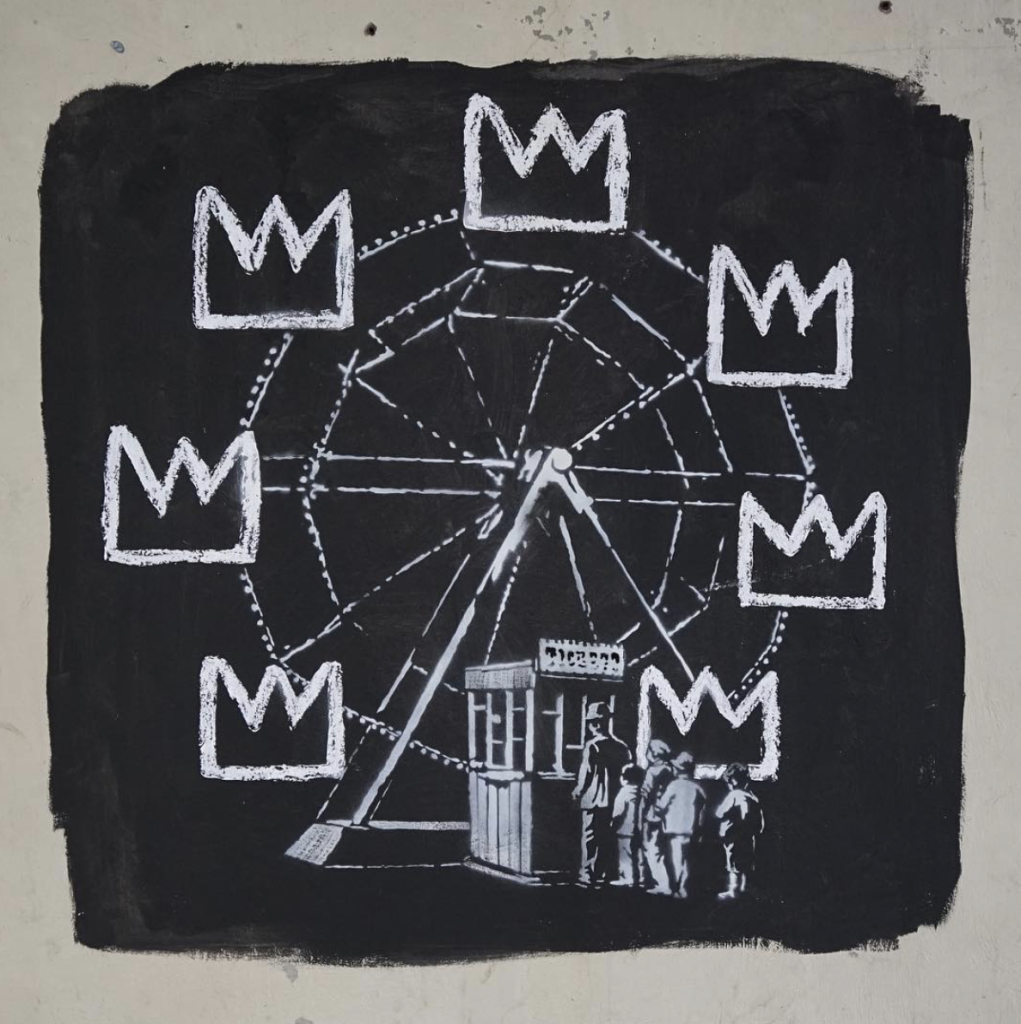
13. Basquiat Ferris Wheel
Location: Beech Street tunnel, Barbican, London EC1 Status: Protected and comparatively well preserved
Banksy installed two murals beside the Barbican Centre in September 2017, shortly before the opening of Basquiat: Boom for Real. It was his second unofficial tribute to the artist that year, following an earlier canvas titled “Banksquiat” at his Walled Off Hotel in Bethlehem.
“Major new Basquiat show opens at the Barbican — a place that is normally very keen to clean any graffiti from its walls.” Banksy
In the first, Jean-Michel Basquiat’s three-pointed crown becomes the structure of a Ferris wheel. Visitors queue beneath it as though Basquiat’s radical visual language has become a ticketed attraction. The mural is not a criticism of Basquiat. Its target is the institutional conversion of counterculture into cultural entertainment.
Banksy underlined the contradiction by noting that the Barbican was normally keen to remove graffiti from its walls, even as it prepared to celebrate an artist whose career had emerged from the streets of New York. Read our original coverage from 2017, including the companion “Stop and Search” mural and the earlier Banksquiat canvas.The work remains behind transparent protection near the Beech Street entrance.
View location via google maps.
14. Basquiat Stop and Search
Location: Beech Street tunnel, Barbican, London EC1 Status: Protected and comparatively well preserved
The second Barbican mural adapts the central figure from Basquiat’s Boy and Dog in a Johnnypump. Banksy places police officers on either side of the figure and subjects him to a stop and search. He introduced the work as a portrait of Basquiat being welcomed by the Metropolitan Police.
The mural contrasts two forms of institutional attention. Inside the gallery, Basquiat is celebrated as a major twentieth-century artist. Outside it, a grafffiti figure derived from his work is immediately treated as suspicious.
It survives behind perspex close to the Ferris Wheel mural. Read our original coverage of both Barbican murals from when they first appeared in 2017.

Banksy Basquiat Tribute, Barbican centre, London. Photo credit Banksy 2017
View location via google maps.
Shoreditch, Hoxton, Brick Lane and Bethnal Green
15. Guard Dog, or Designated Graffiti Area
Location: Former Cargo courtyard, Rivington Street, London EC2 Status: Surviving; access depends on the courtyard
Walk past the 2013 crocodile by Thierry Noir and you will see a uniformed guard beside a poodle and an official-looking notice designating the wall as a graffiti area.
The contradiction is pure Banksy. Graffiti, an art form defined by acting without institutional permission, has apparently been authorised by the authority expected to prevent it. The poodle further weakens the officer’s attempt to project intimidation.
The mural remains in the courtyard of the former Cargo nightclub. The site has changed use since the venue closed, and access depends on the courtyard being open. Also inside is ‘His Master’s Voice’ by Banksy. For a wider sense of the street art surrounding it, see our gallery of Shoreditch street art, which documents the neighbourhood’s wider scene.
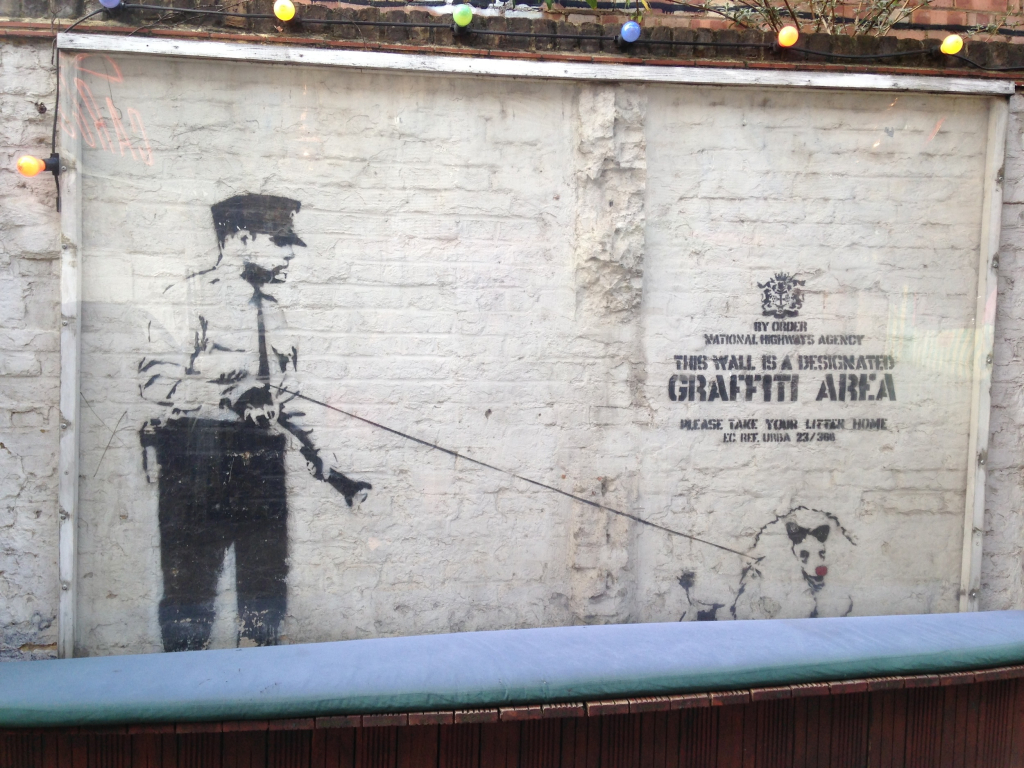
Former Cargo courtyard, Rivington Street, London. Image copyright GraffitiStreet
View location via google maps.
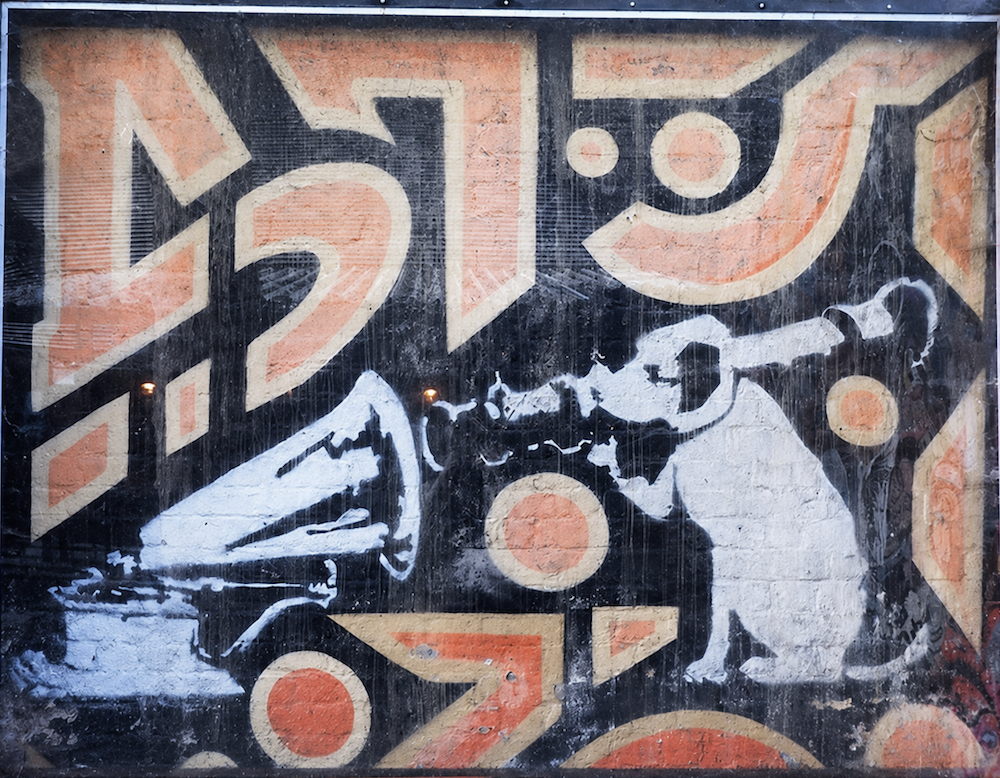
16. His Master’s Voice
Location: Former Cargo courtyard, Rivington Street, London EC2 Status: Surviving; access may vary
Banksy’s His Master’s Voice reverses one of Britain’s most familiar commercial images. In the original HMV emblem, the dog Nipper listens obediently to a gramophone. Banksy turns the listener against the machine, replacing passive attention with a bazooka aimed directly into its horn.
The image has often been understood as a rebellion against cultural gatekeeping and the traditional music industry’s control over production and distribution.
Banksy first developed the composition in Bristol before recreating it at Cargo in 2003. Street artist Stylo, of the VOP crew, was later permitted to contribute the energetic orange and black background surrounding the central stencil. The work survives in the same courtyard as the previous Guard Dog entry.
View location via google maps.
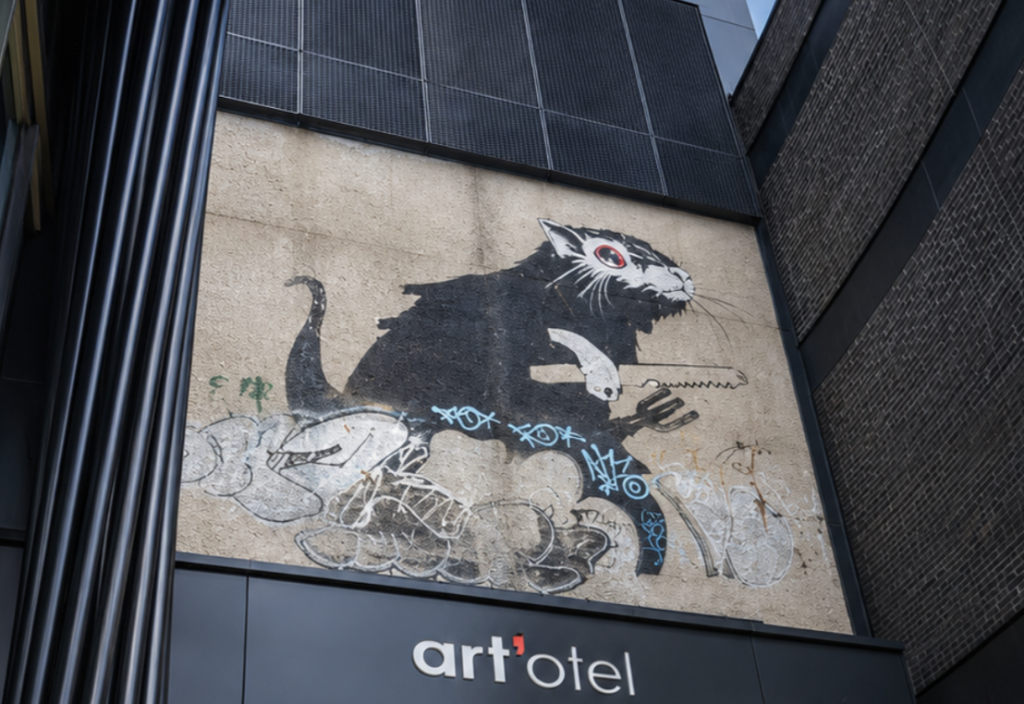
17. Knife-and-Fork Rat
Location: Art’otel London Hoxton, 1–3 Rivington Street, London EC2 Status: Preserved and visible from the street
Banksy’s largest London rat, standing around six metres tall, was painted in 2004 on the rear wall of The Foundry, a popular Shoreditch pub and cultural venue associated with the area’s early creative community. The rat holds a knife and fork as though waiting to consume the city.
Preserving the mural was made a condition of planning permission by Hackney Council when the site was first redeveloped, and the section of masonry carrying the image was later incorporated into the new Art’otel London Hoxton. Banksy himself objected to the principle at the time, writing in a 2010 email to BBC Newsnight: “It’s a bit like demolishing the Tate and preserving the ice cream van out the front.” Read more in the Hackney Citizen local paper.
The work can now be seen above the hotel entrance. It’s worth stepping inside too: the hotel’s interior is designed entirely around local Signature Artist D*Face, with murals, sculptures and a dedicated public art gallery running through every public space and guest room.
View location via google maps.
18. TV Out of the Window
Location: Art’otel London Hoxton Status: Preserved and visible from the street
A television is depicted flying through a window, as though thrown or ejected from the building.
The mural also originated on The Foundry and survived through the same specialist redevelopment process as the Knife-and-Fork Rat. Engineers retained the original wall section rather than reproducing or cutting away only the painted surface. The result is a rare example of street art preserved through architectural surgery.
The image now carries an irony Banksy could not have fully anticipated. A television once being expelled from a countercultural building is permanently suspended above a major hotel development. Feels very rock and roll!
View location via google maps.
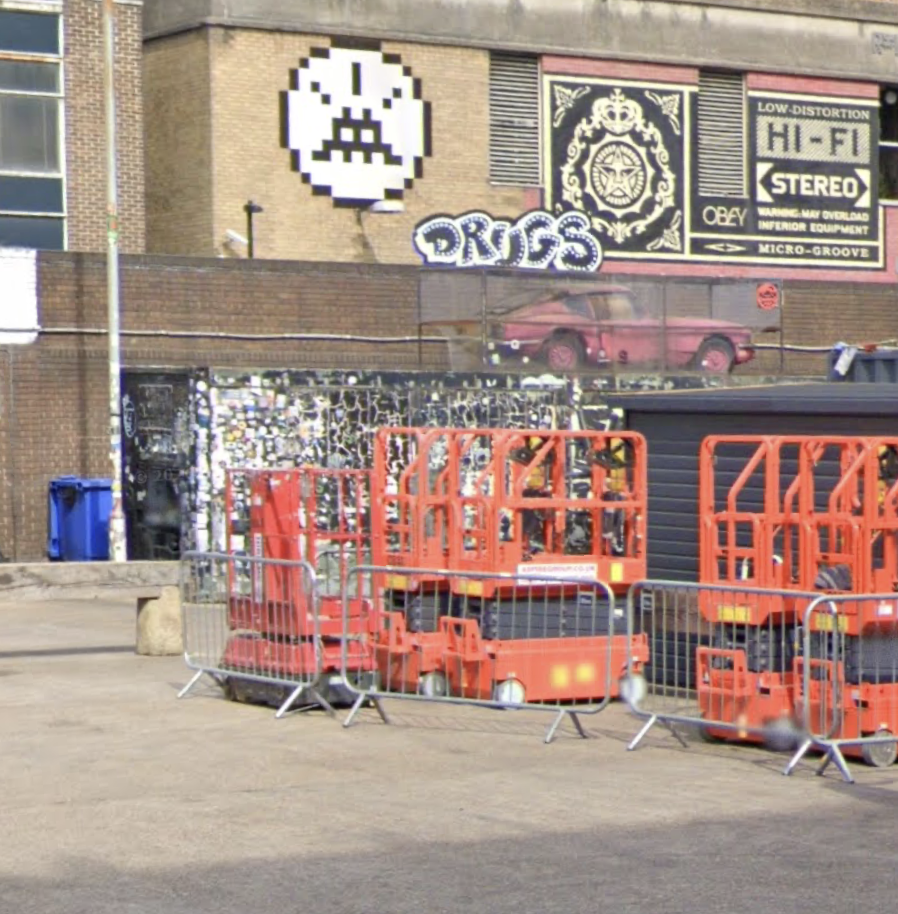
19. Pink Car
Location: Old Truman Brewery, Brick Lane, London E1 Status: Heavily deteriorated installation
A battered pink car sits inside a transparent enclosure in the Old Truman Brewery complex, in Ely’s Yard.
The composition originally included a skeletal grim reaper painted behind the wheel. That element was vandalised and removed around 2007–2008, and the car and its protective structure have deteriorated substantially since. It now resembles an archaeological relic more than an intact artwork.
We know the Old Truman Brewery well at GraffitiStreet, we held Joachim’s solo show, Born to Paint, there in March 2018, and have visited many times over the years. It’s always had a great atmosphere, with plenty of other street art dotted around the complex, including work from big names like Obey and Invader.
View location via google maps.
Walthamstow, Bermondsey and Charlton
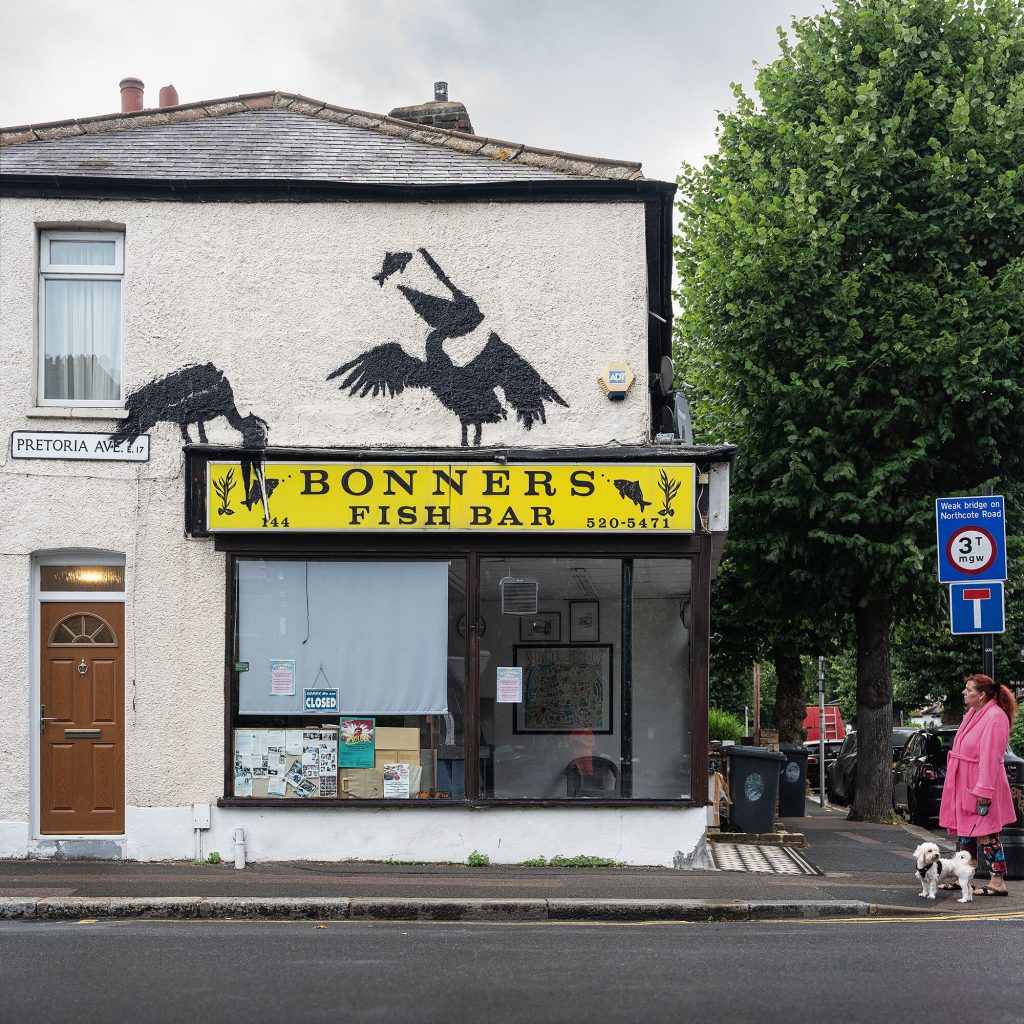
20. Pelicans Eating Fish
Location: Bonners Fish Bar, Pretoria Avenue, Walthamstow, London E17 Status: Visible and comparatively well preserved
Two pelicans have taken possession of a fish shop. One bends towards the sign and consumes a fish already incorporated into the shopfront. The other throws a second fish into the air.
The work succeeds because Banksy treats the existing building as part of the composition rather than as a neutral surface. Remove the Bonners Fish Bar sign and much of the image’s logic disappears.
Several works from Banksy’s 2024 animal series were stolen or removed within days. The Walthamstow pelicans survived largely because the local community organised to protect it: residents kept informal watch over the mural, and Wood Street Walls, a local street art collective, covered it with protective perspex panels while the shop’s owners were away on holiday. The Walthamstow pelicans remain attached to their original building and are among the clearest surviving works from the sequence. Read our original day-by-day coverage from when the mural first appeared.
View location via google maps
21. Fishing Boy
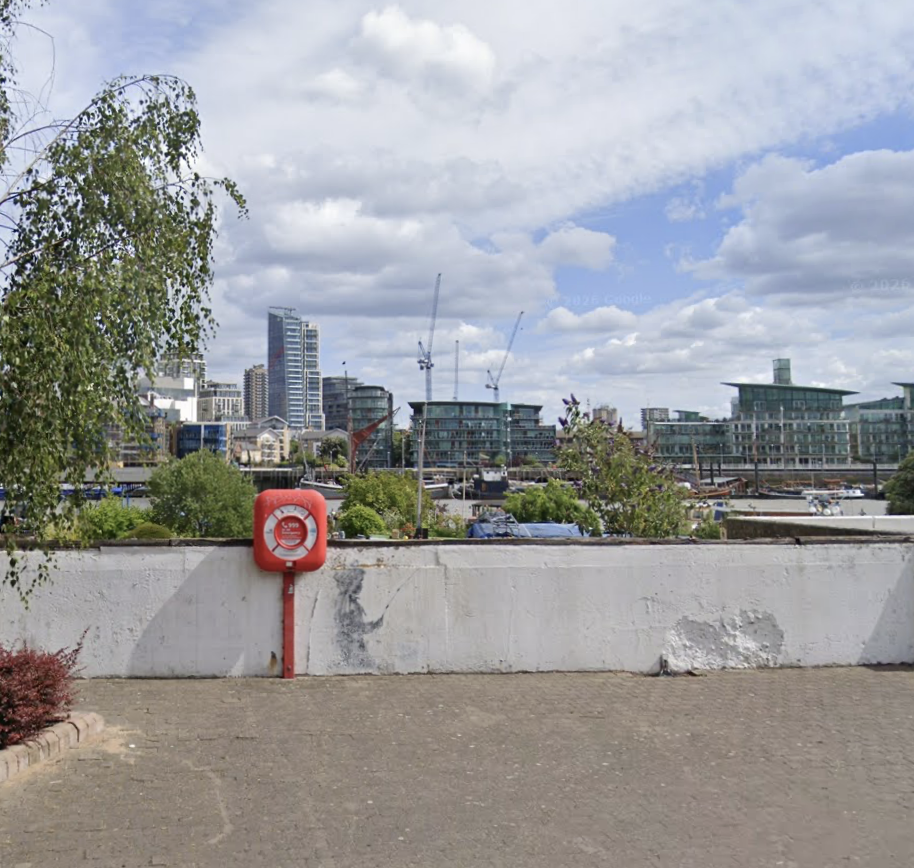
Location: Thames Path, Bermondsey Wall, London SE16 Status: Extremely faded
In 2008 Banksy painted a child sitting beside the Thames holding a fishing rod. At first, the image appears almost nostalgic. Its meaning changes when the catch is recognised: the boy has hooked a discarded syringe. The river becomes both picturesque and urban waste system.
The mural is now difficult to distinguish from the surrounding wall.
View location via google maps.
22. Rhino
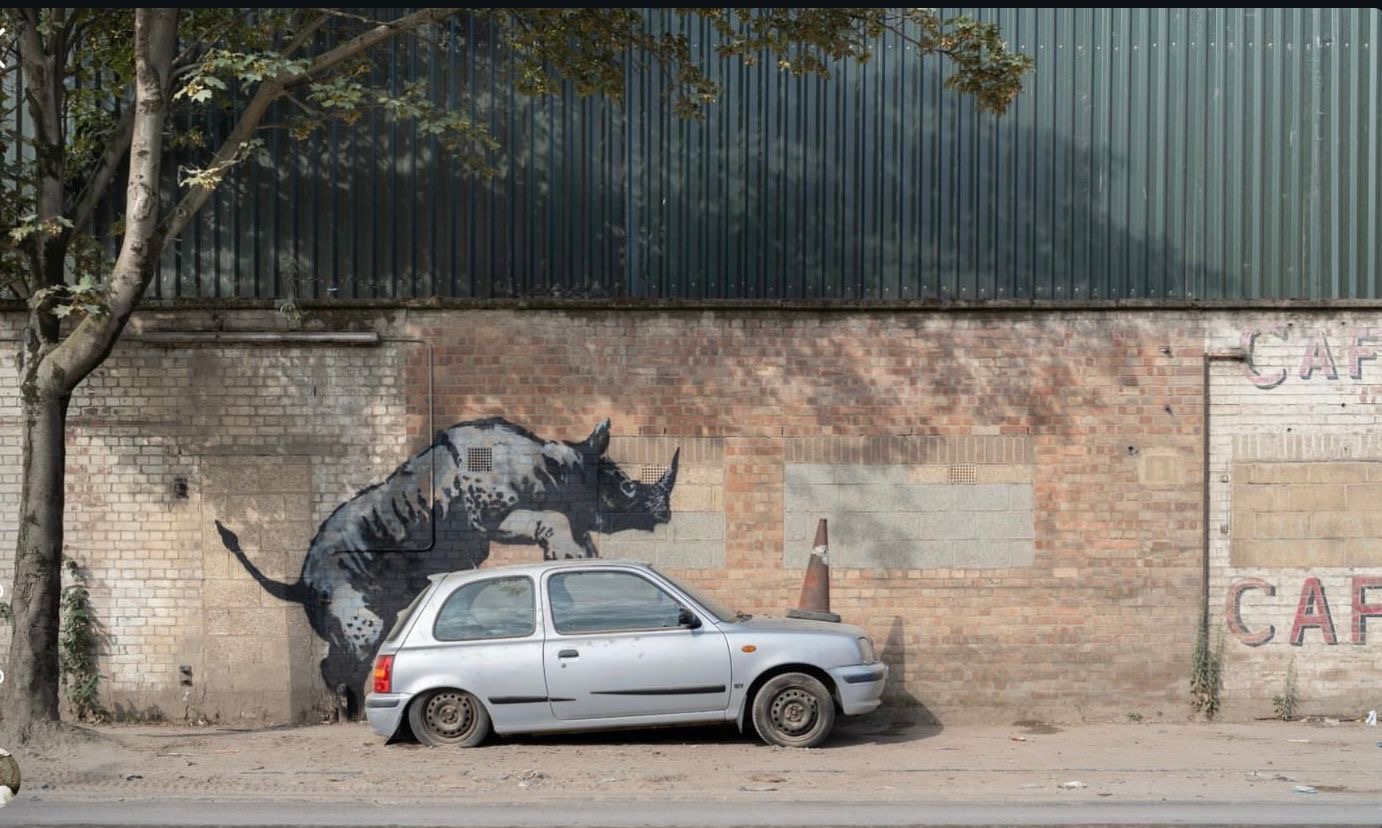
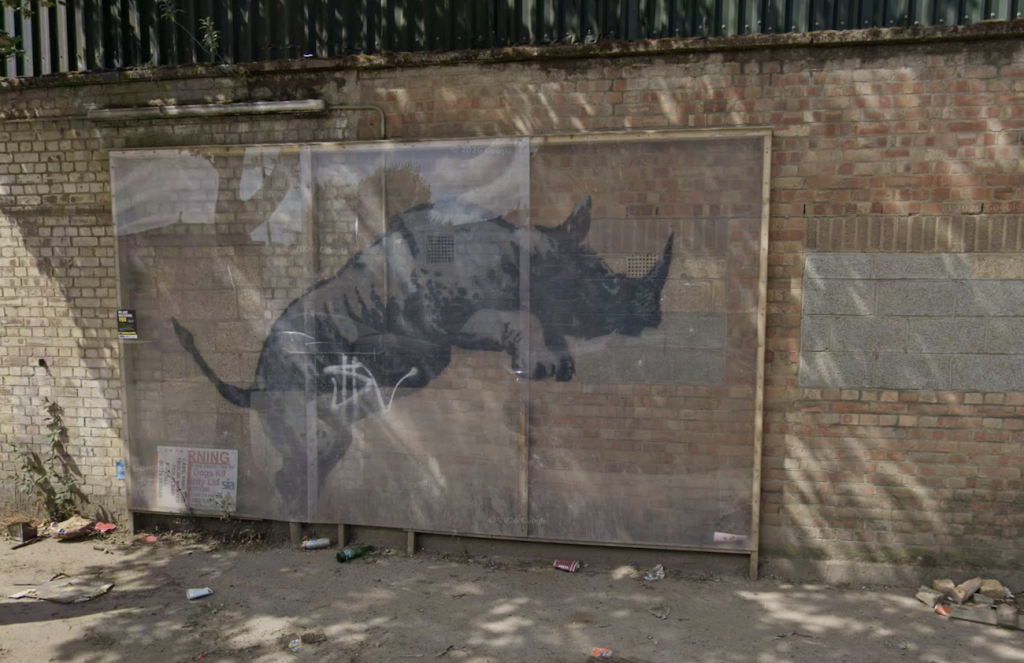
Location: Westmoor Street, Charlton, London SE7 Status: Wall stencil survives; original vehicle removed
Banksy painted a rhinoceros mounting a silver Nissan Micra during the August 2024 animal series. The car was not background scenery. It completed the installation, allowing the rhinoceros on the wall to interact with a physical object in the street.
The Micra was later removed and the stencil was tagged. The rhino itself remains, but the composition no longer operates with its original comic precision.
Its survival demonstrates the vulnerability of Banksy’s site-specific works. Protecting the painted element alone does not necessarily preserve the artwork when its meaning depends on an object, building or viewpoint that can disappear.
View location via google maps.
What Happened to Banksy’s Other London Zoo Animals?
Banksy produced nine animal interventions across London over nine consecutive days in August 2024. Only the Chelsea elephants, Walthamstow pelicans and Charlton rhinoceros remain meaningfully visible in their original locations.
The mountain goat in Kew was removed by the building’s owners for preservation ahead of construction work, with no confirmed plans yet for its return. The Brick Lane monkeys were deliberately washed off the bridge by Transport for London in December 2024, months after they appeared, with TfL citing concerns about attracting further graffiti. The wolf on a Peckham satellite dish was stolen almost immediately. The large Cricklewood cat was dismantled by contractors the same week it appeared. London Zoo removed its gorilla shutter for safekeeping, with no confirmed date or plan yet announced for its return to public display.
The piranha-filled police box has fared best of the relocated works: it’s currently in storage ahead of a permanent home at the new London Museum in Smithfield, which opens on 28 November 2026 and has confirmed the piece as one of its headline exhibits.
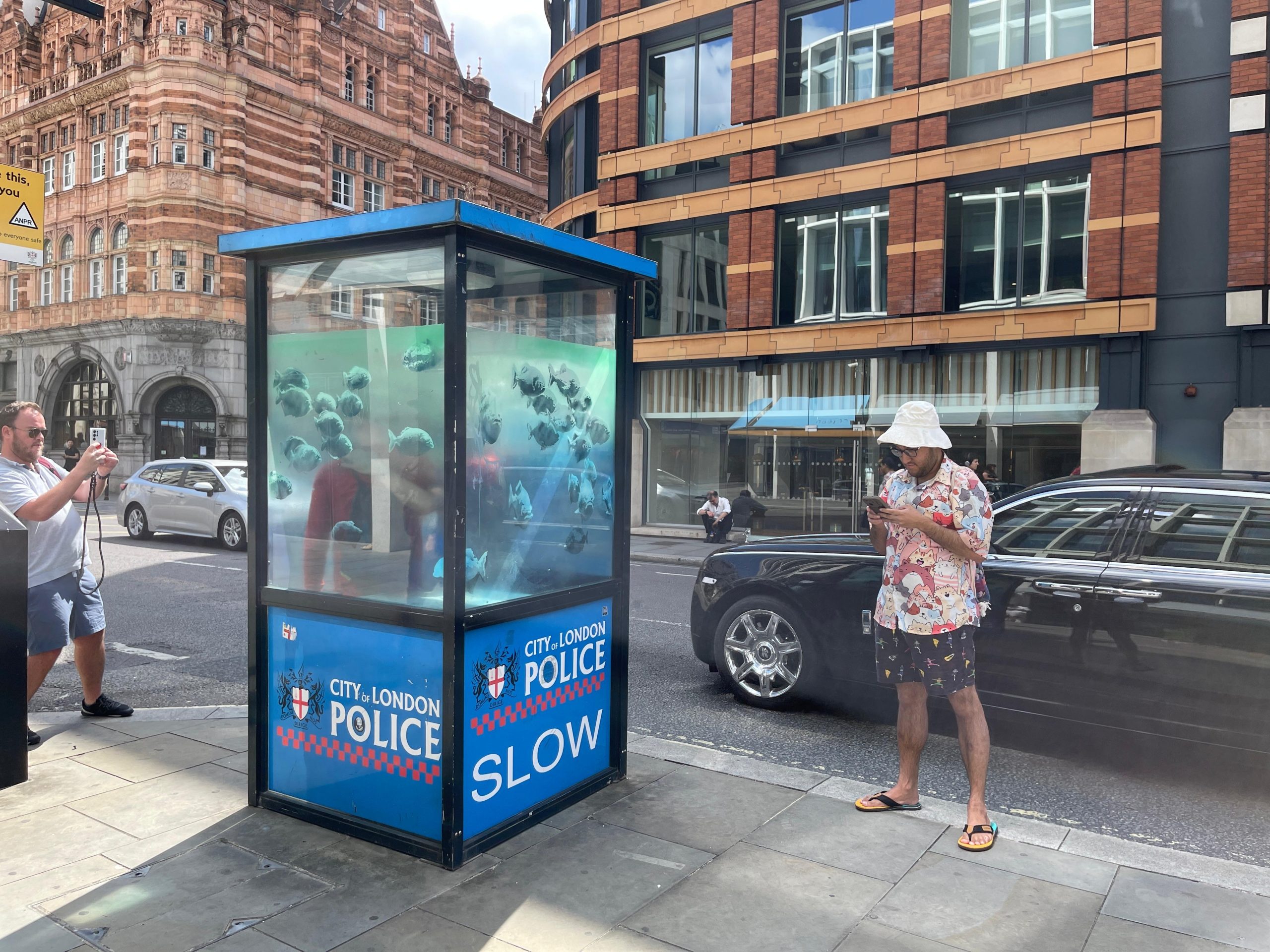
Banksy, Piranhas, City of London police box, Ludgate Hill, August 2024. Confirmed by the artist on Instagram; now in storage ahead of permanent display at the London Museum’s new Smithfield site, opening 28 November 2026. Image copyright GraffitiStreet.
The series became a concentrated demonstration of everything that can happen to a Banksy: theft, vandalism, removal, preservation, relocation and institutional acquisition.
Read about our coverage of Banksy’s London Zoo.
What Counts as a Surviving Banksy?
The 23 works in this guide do not all survive in the same way. The Barbican murals are protected and comparatively clear. Fishing Boy and the Rats are almost ghosts. The Art’otel works survive because entire sections of masonry were engineered into a new building. Queen’s Mews remains behind boarding. The Royal Courts intervention survives chiefly as a trace of deliberate removal.
Some works, for example ATM Girl on Rosebery Avenue and Tesco Flag Children on Essex Road, were excluded due to their severe deterioration. Even so, visiting their locations can be worthwhile in its own right: a chance to trace the fuller arc of Banksy’s presence in London, including the pieces that have almost disappeared entirely.
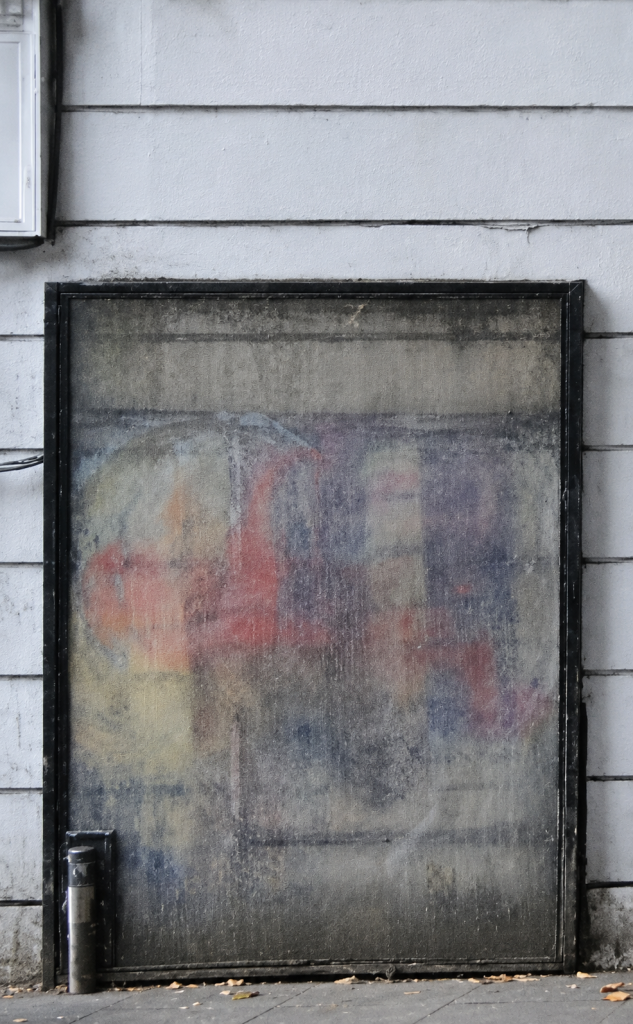
Banksy, ATM Girl, Rosebery Avenue, London 2025 — too degraded to feature as a full entry in this guide.
Planning a Route Between Banksy Locations in London
Planning to see all 22 works? We recommend breaking your journey into regional clusters, as tackling them all in one day is too exhausting. Keep in mind that time and the elements have taken their toll and some heavily degraded pieces mean part of your tour will be a journey through Banksy history rather than a straightforward viewing experience.
Central London: Waterloo Place, the Royal Courts of Justice, Centre Point, Chiswell Street, Cannon Street and the Barbican.
West London: Queen’s Mews, Marble Arch, Notting Hill and Chelsea.
North London: The Standard, London (King’s Cross), Hornsey Road and Stoke Newington Church Street.
East London: Rivington Street, Art’otel Hoxton, the Old Truman Brewery and Walthamstow.
South and southeast London: Bermondsey Wall and Charlton.
Check access before travelling, particularly at the former Cargo courtyard. Visit faded works during daylight.
Some images in this guide show works as they first appeared and may not reflect their current condition. We’ve noted each work’s present state in the “Status” line for that entry but conditions may have changed, so check before visiting in person.
Frequently Asked Questions About Banksy Locations in London
Banksy’s newest confirmed London work is the flag-blinded statue installed at Waterloo Place on 29 April 2026 and confirmed by the artist on 30 April 2026.
The two Basquiat murals beside the Barbican are among the best preserved because they were protected shortly after appearing. The Walthamstow pelicans and the works structurally preserved at Art’otel London Hoxton also remain clearly recognisable.
Yes. The elephants in Chelsea, pelicans in Walthamstow and rhinoceros in Charlton remain visible. The rhinoceros has lost the car that completed the original installation.
Yes. Guard Dog and His Master’s Voice remain in the former Cargo courtyard on Rivington Street, although access depends on the courtyard being open.
None of the original London Girl with Balloon street murals survives intact in its original public location.
Collecting Banksy Through GraffitiStreet
Street works remain vulnerable by definition. Authenticated Banksy editions offer a different relationship with the artist’s imagery: works created to exist beyond the wall, supported by a documented edition history.
GraffitiStreet has over a decade of experience with Banksy prints and collectors, from the artist’s earlier market years to authenticated editions now valued at several hundred thousand pounds.
Every Banksy artwork offered through GraffitiStreet is assessed for provenance and condition. All authenticated Banksys come with a Pest Control certificate of authenticity, alongside specialist advice on Museum Framing (Level 1), conservation, insurance and long-term collection care.
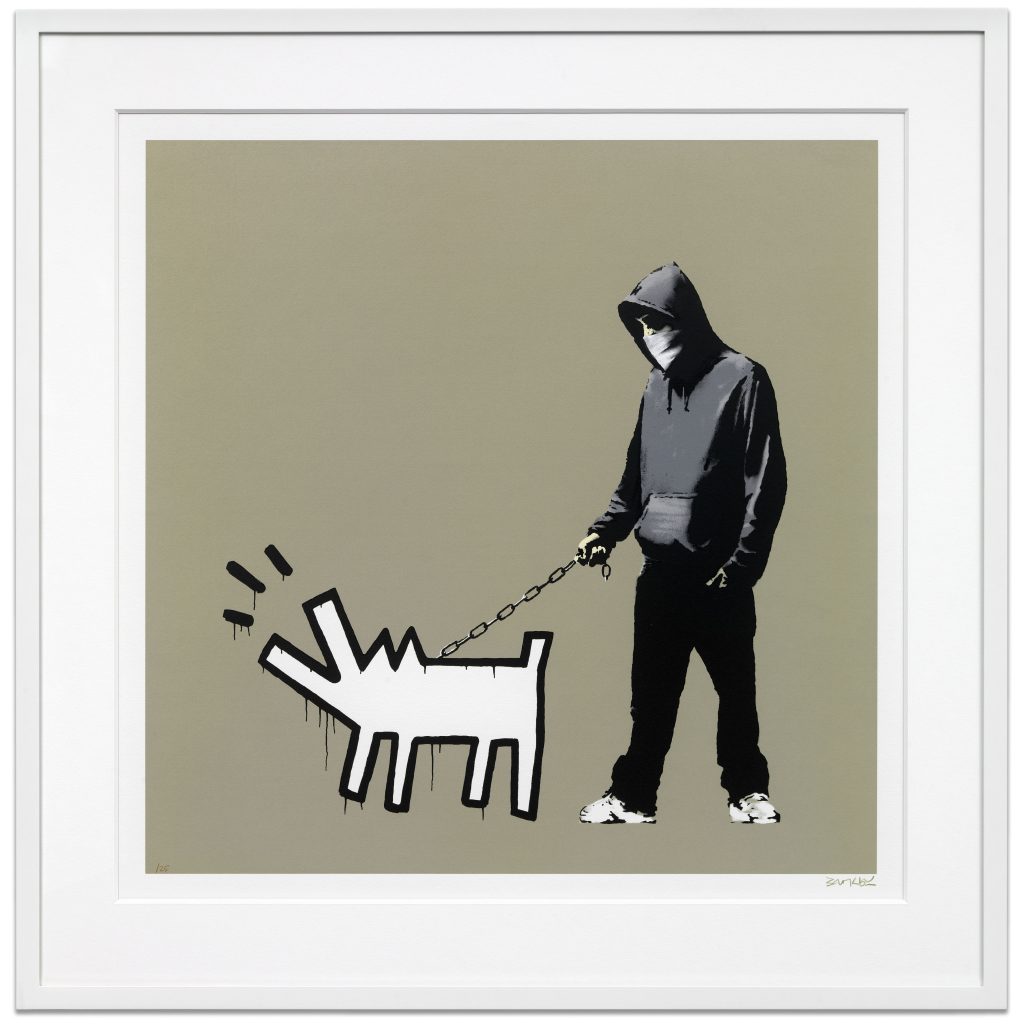
Banksy, Choose Your Weapon (Khaki), Museum framed Level 1. Pest Control authenticated. Image copyright GraffitiStreet.
Explore authenticated Banksy prints and collectables available through GraffitiStreet, or contact our Banksy specialist Rosh Boroumand for discreet acquisition and collection advice.