Banksy’s Gaza Kitty: Meaning, Mural and the Walled Off Hotel Sculpture
Banksy’s Gaza Kitty is one of the most profound works from the artist’s 2015 Gaza visit, showing a playful kitten with a bow pawing at a ball of twisted metal amid the ruins of a destroyed building. Released through Banksy’s satirical Gaza film Make this the year YOU discover a new destination, the mural used the internet’s appetite for cute animal imagery to redirect attention toward destruction, displacement and the fragile presence of play inside a landscape shaped by conflict.

Banksy’s Gaza Kitty transforms a playful kitten into a sharp reflection on attention, innocence and the ruins of Gaza. Image copyright Banksy
- What Is Banksy’s Gaza Kitty?
- The Meaning Behind Banksy’s Gaza Kitty
- Banksy’s Gaza Film and the Politics of Attention
- The Kitten, the Metal Ball and the Loss of Play
- Gaza Kitty and Banksy’s Palestine Works
- From Gaza Mural to Walled Off Hotel Sculpture
- The Walled Off Hotel and the Politics of the Souvenir
- GraffitiStreet Perspective
- Collector Context
- Why Banksy’s Gaza Kitty Still Matters
- Frequently Asked Questions About Banksy’s Gaza Kitty
- Discover Banksy
What Is Banksy’s Gaza Kitty?
Banksy’s Gaza Kitty is a 2015 mural painted in Gaza during the artist’s intervention in the territory following the devastation of the 2014 conflict. The work shows a large kitten, rendered with Banksy’s familiar economy of line, playing with a ball made from rusted or twisted metal.
The image appeared on the remains of a damaged building, a detail that is central to its meaning. The kitten is soft, familiar and almost absurdly disarming, while the architecture around it carries the visible evidence of destruction. Banksy places cuteness against ruin, turning the easiest kind of internet image into a political device.
At first glance, Gaza Kitty feels gentler than many of Banksy’s more confrontational works. Yet that accessibility is precisely what makes it so pointed. The kitten draws the viewer in before the setting forces a more difficult recognition. Banksy is exposing how attention works, and how easily the world can look away from human suffering unless it is framed through something instantly shareable.
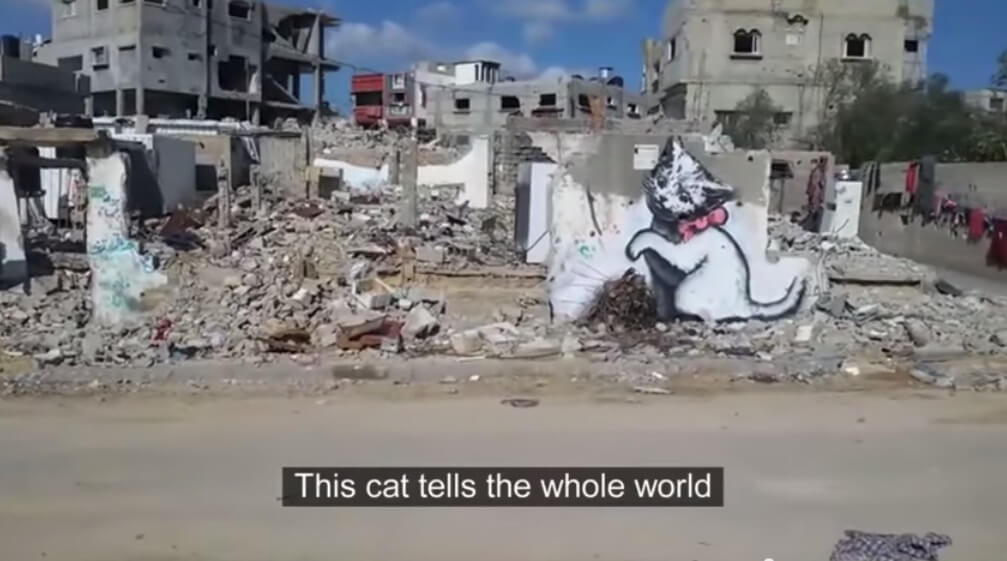
Still from Banksy’s 2015 film ‘Make this the year YOU discover a new destination‘, referenced here in the context of Banksy’s Gaza intervention. Image copyright Banksy
The Meaning Behind Banksy’s Gaza Kitty
The meaning of Gaza Kitty lies in the contrast between innocence and devastation. A kitten usually belongs to the language of domestic tenderness, comfort and online amusement. In Banksy’s mural, it plays inside a world where ordinary play has been replaced by debris.
The ball is one of the most important details. It is neither wool, rubber nor a child’s toy. It appears to be made from rusted metal, pulled from the damaged environment around it. Banksy turns wreckage into the object of play, suggesting how childhood, care and imagination survive in places where the material conditions of safety have been destroyed.
The work also asks a question about selective attention. Images of suffering can be difficult to process. Images of kittens, by contrast, circulate effortlessly. Banksy understood that contradiction and used it against the viewer. The kitten is both lure and accusation. It makes the internet look, then reveals what it has often chosen not to see.
This is why Gaza Kitty remains one of Banksy’s sharpest works from the Gaza intervention. Its emotional force is quiet, but its critique is precise. The mural is about Gaza, and it is also about us: our habits of looking, our preference for softened images, and the unsettling distance between attention and responsibility.

Still from Banksy’s 2015 film ‘Make this the year YOU discover a new destination‘, referenced here in the context of Banksy’s Gaza intervention. Image copyright Banksy
Banksy’s Gaza Film and the Politics of Attention
Banksy released the Gaza works through a short satirical film titled Make this the year YOU discover a new destination. The video borrows the language of tourism, using the promise of discovery and destination before revealing tunnels, rubble, destroyed homes and the aftermath of war.
This structure is typical of Banksy at his most effective. He borrows a familiar format and turns it against itself. A travel advert usually sells comfort, leisure and escape. Banksy’s version shows restriction, damage and the impossibility of ordinary movement. The contradiction gives the film its moral pressure.
Within that film, Gaza Kitty becomes one of the most memorable images because it understands the grammar of the internet. The mural does not ask the viewer to begin with geopolitical analysis. It begins with a kitten. That choice is disarming, then devastating.
Banksy later explained the logic behind the image with characteristic bluntness: ““A local man came up and said ‘Please – what does this mean?’ I explained I wanted to highlight the destruction in Gaza by posting photos on my website – but on the internet people only look at pictures of kittens.”
The work appeared alongside other Gaza interventions, including a grieving classical figure known as Bomb Damage and children swinging from what appears to be a military watchtower. Together, these works form a compact visual language of mourning, play, survival and political visibility.
The Kitten, the Metal Ball and the Loss of Play
Banksy has often used small visual details to carry the emotional weight of an image. In Girl With Balloon, the heart-shaped balloon holds the tension between hope and loss. In NOLA, the umbrella becomes a failed instrument of protection. In Gaza Kitty, the ball of metal becomes the measure of what has been taken from a child’s world.
The kitten’s play is not innocent in any simple sense. It is play made from wreckage. This is the mural’s quiet tragedy. The image does not show violence directly through bodies or explosions. It shows violence through substitution, through the way debris replaces the objects of ordinary life.
That makes Gaza Kitty more than a clever comment on the internet. It is also a work about childhood under conditions of damage. The mural suggests that imagination persists, although it should never have to make toys from ruins.
Banksy’s strength here is restraint. He does not overexplain the image. He lets the kitten remain playful while the wall around it does the harder work. The viewer is left with an uncomfortable double vision: the charm of the animal and the cruelty of the setting.
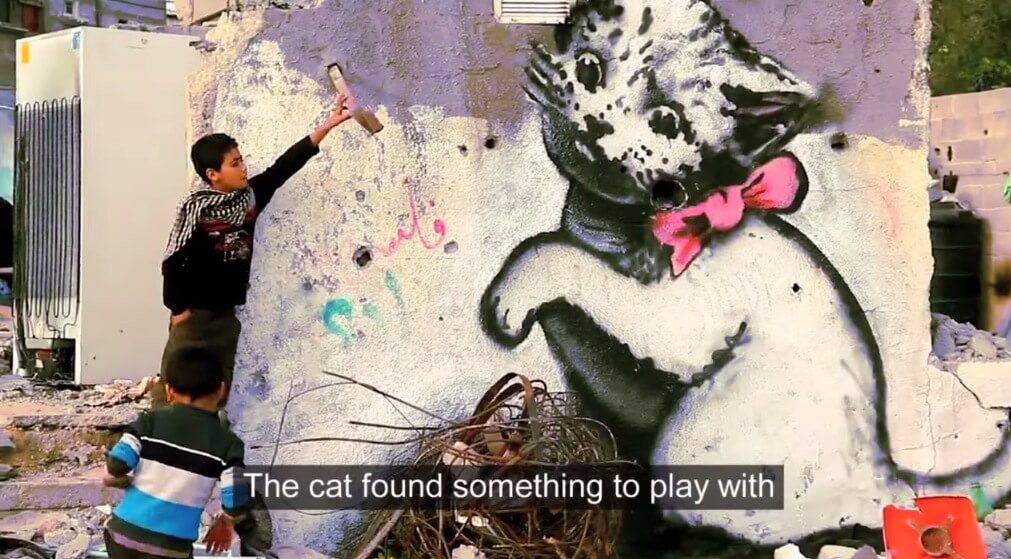
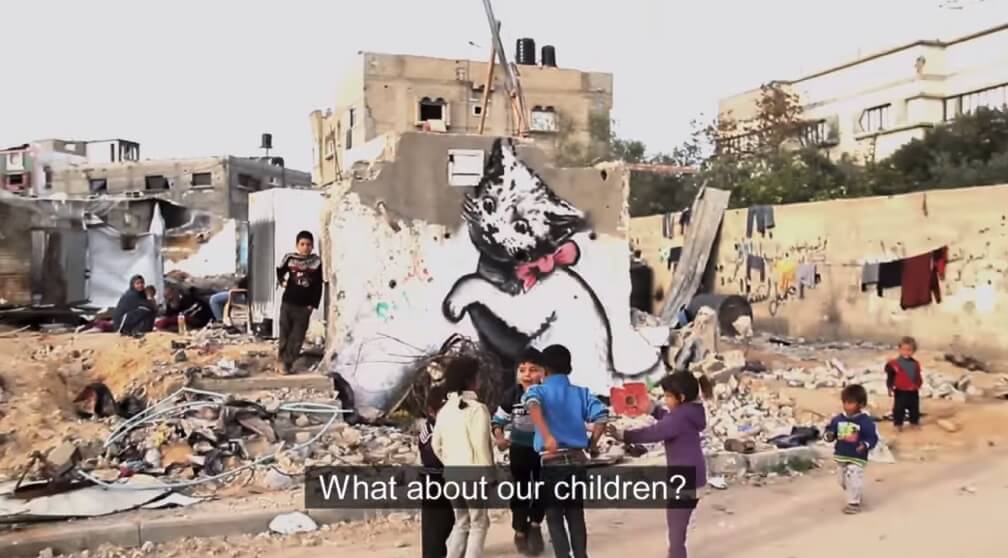
Stills from Banksy’s 2015 film ‘Make this the year YOU discover a new destination‘, referenced here in the context of Banksy’s Gaza intervention. Image copyright Banksy
Gaza Kitty and Banksy’s Palestine Works
Gaza Kitty belongs within Banksy’s wider engagement with Palestine, from his 2005 interventions on the West Bank barrier to the Walled Off Hotel in Bethlehem, which opened in 2017 opposite the separation wall. Across these projects, Banksy repeatedly uses visual wit to confront borders, occupation, restriction, surveillance and the politics of visibility.
In Gaza, the wall is not the only subject. The ruin itself becomes the surface. The broken building is part of the work, not a neutral background. This distinguishes Gaza Kitty from images that can be detached too easily from their location. The kitten only has its full meaning because of where it was painted.
The mural also sits in dialogue with Banksy’s recurring use of children, animals and play. These figures often appear gentle at first, but they rarely remain simple. Banksy uses them to expose failed systems of protection, distorted priorities and the vulnerability of those least responsible for political violence.
Gaza Kitty sits within a wider history of Banksy’s art in the region, from his early West Bank works to Bethlehem, Gaza and The Walled Off Hotel. Read the complete GraffitiStreet guide to Banksy in Palestine.

Banksy – Love is in the Air (Rage , Flower Thrower) Image copyright GraffitiStreet.com
From Gaza Mural to Walled Off Hotel Sculpture
The afterlife of Gaza Kitty continued through Banksy’s Walled Off Hotel project in Bethlehem. GraffitiStreet has held the rare Walled Off Hotel wall-section sculpture titled Gaza Kitty … I Want My Ball Back, a small painted concrete cast resin sculpture inspired by the 2015 Gaza mural.
The phrase I Want My Ball Back turns a simple childlike demand into a charged statement on displacement, return and the hope for peace. What first sounds playful becomes quietly devastating in context, because the “ball” is inseparable from the damaged world around it.
The work was purchased from the Walled Off Hotel and includes original hotel invoice provenance. The sculpture as uniquely numbered and unsigned, with an unknown limited edition size, no longer available through the hotel. The work measures approximately 13 × 12.7 × 8 cm and dates from the Walled Off Hotel period, circa 2018 to 2019.
This sculpture matters because it connects the Gaza mural to Banksy’s broader Walled Off Hotel language of political objects. Like the hotel’s other wall-section sculptures, it transforms a site-specific image into a small, portable work without removing the political tension that gave it meaning.
The phrase I Want My Ball Back gives the sculpture a further emotional charge. It sounds playful, almost childlike, yet in the context of Gaza it becomes a demand shaped by loss. The ball is no longer just an object of play. It becomes a sign of what has been broken, taken or made unsafe.
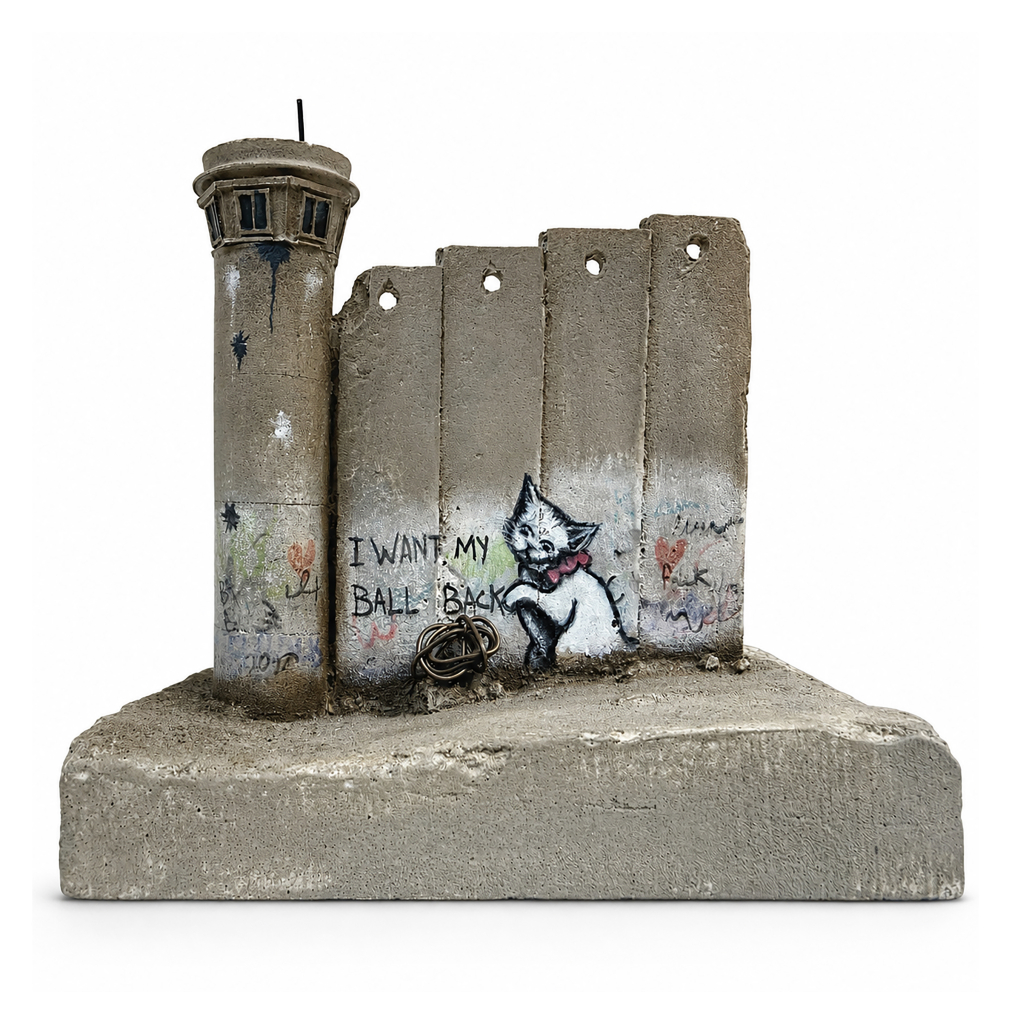
Banksy – Walled Off Hotel “Gaza Kitty” Sculpture. Available viaGraffitiStreet
Read about the Significance of Banksy’s Collectables at the Walled Off Hotel.
The Walled Off Hotel and the Politics of the Souvenir
The Walled Off Hotel opened in Bethlehem in 2017 as one of Banksy’s most ambitious site-specific projects. Positioned close to the separation wall, the hotel combined accommodation, installation, museum display, political commentary, local employment and dark humour. Its bleak joke, the claim of having the “worst view in the world,” turned the architecture of restriction into the centre of the visitor experience.
The hotel’s gift-shop objects and wall-section sculptures occupy a complicated place in Banksy’s practice. They are souvenirs, but they carry the opposite emotional charge of ordinary travel keepsakes. Instead of offering pleasant memory, they ask what it means to take an object away from a place shaped by political tension.
Gaza Kitty … I Want My Ball Back sits powerfully within that contradiction. It is small enough to be collected, displayed and held, yet its meaning is inseparable from the damaged building that inspired it. The object’s scale makes it intimate. Its subject makes it impossible to treat as merely decorative.
This is where Banksy’s Walled Off Hotel sculptures become especially interesting for collectors. They extend the artist’s public and political language into sculptural form, while retaining the uncomfortable wit that defines the original interventions. In Gaza Kitty, that wit is unusually tender, which makes the discomfort even sharper.

Banksy Walled off Hotel entrance, Bethlehem 2017. Image copyright GraffiitStreet
GraffitiStreet Perspective
The rare Gaza Kitty … I Want My Ball Back wall-section sculpture carries a different kind of presence from the mural. It is small enough to sit as an object, yet it points back to a much larger human and political reality.
The sculpture feels significant because it refuses to become merely cute. The kitten draws people in, while the rusted metal ball and Gaza context make the image difficult to leave in the realm of decoration. It is Banksy at his most precise, using tenderness as a way into discomfort.
Our own experience of the Walled Off Hotel in Bethlehem deepens that reading. The hotel was full of Banksy’s presence, from rooms and corridors to the museum, the piano bar and the gift-shop objects, while also rooted in hospitality, local warmth and the reality of the wall outside. In that context, Gaza Kitty … I Want My Ball Back feels less like a souvenir and more like an important statement.

Collector Context
The original Gaza Kitty mural belongs to the category of Banksy’s public and site-specific works. Its meaning is inseparable from Gaza, the damaged building on which it appeared and the 2015 video through which Banksy circulated the image internationally.
The Walled Off Hotel sculpture sits in a different collecting category. It is a project-based object, separate from Banksy’s numbered screenprint editions released through Pictures on Walls. Its significance comes from Walled Off Hotel provenance, connection to the Gaza mural, object rarity and documentation.
For collectors, original hotel invoice provenance is especially important. Walled Off Hotel objects can vary in form, scale, finish and release history, so purchase documentation, numbering, condition and known source all shape confidence. In the case of the GraffitiStreet Gaza Kitty … I Want My Ball Back sculpture, the original Walled Off Hotel invoice strengthens the work’s provenance and connects it directly to the hotel.
Their value is built differently, through context, provenance, scarcity, condition, documentation and their connection to Banksy’s wider political practice.
Read about the Significance of Banksy’s Collectables at the Walled Off Hotel.
Why Banksy’s Gaza Kitty Still Matters
Gaza Kitty still matters because its central critique has only become more urgent. Painted in 2015 in the aftermath of the 2014 conflict, the mural now carries an even heavier resonance after the devastation Gaza has endured since 2023. The work understands that attention is one of the defining political currencies of our time. It asks why some images move effortlessly through the world while others are avoided, softened or pushed out of view.
The kitten is the perfect vehicle for that question. It is charming enough to circulate, familiar enough to disarm and innocent enough to make the surrounding destruction feel more severe. Banksy does not simply create an image of Gaza. He creates an image about the conditions under which Gaza might be seen.
The Walled Off Hotel sculpture extends that conversation into object form. It allows the image to travel beyond the wall and beyond the screen, while keeping its discomfort intact. As a mural, Gaza Kitty belonged to a damaged site. As a sculpture, Gaza Kitty … I Want My Ball Back becomes a portable reminder of that site and of the attention economy Banksy was critiquing.
This is the enduring force of the work. It begins with a kitten, yet it refuses softness as an ending. It turns charm into witness, humour into indictment and a simple act of play into one of Banksy’s clearest reflections on how the world looks at suffering.
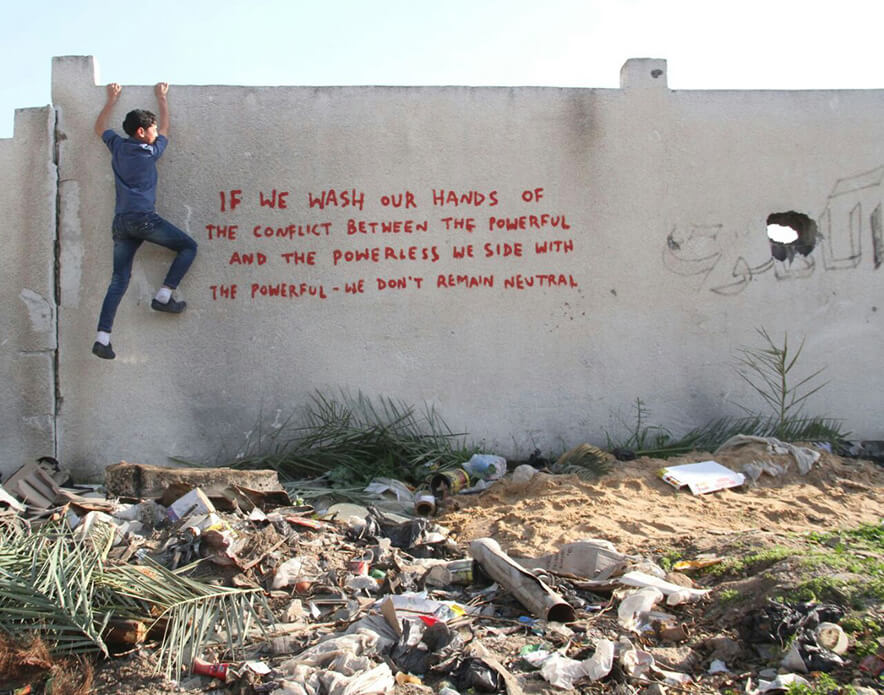
Still from Banksy’s 2015 film Make this the year YOU discover a new destination, referenced here in the context of Banksy’s Gaza intervention. Image copyright Banksy
Frequently Asked Questions About Banksy’s Gaza Kitty
Banksy’s Gaza Kitty is a mural painted in Gaza in 2015. It shows a kitten with a bow playing with a ball made from rusted or twisted metal on the remains of a destroyed building.
Banksy used the kitten to draw attention to destruction in Gaza in 2015 while commenting on the internet’s preference for cute animal imagery. The image uses online visual habits to make viewers look at a setting they might otherwise avoid.
The mural contrasts innocence, play and internet cuteness with destruction, displacement and conflict. It asks viewers to think about selective attention, empathy and the politics of looking.
Gaza Kitty … I Want My Ball Back is a Walled Off Hotel wall-section sculpture inspired by Banksy’s 2015 Gaza mural.
The mural was painted in Gaza during Banksy’s 2015 intervention in the territory, on the remains of a damaged or destroyed building.
It is important because it uses a simple and instantly shareable image to expose larger questions about war, childhood, media attention and the way digital audiences respond to human suffering.
Related Reading
GraffitiStreet, The Significance of Banksy’s Collectibles at the Walled Off Hotel, Bethlehem
Banksy’s Art at The Walled Off Hotel, Bethlehem
Banksy – Walled Off Hotel Defeated Wall Section ‘ Love Hurts’ (2018)
‘Welcome to Gaza’ by Banksy 2015
Sources & Further Reading
Banksy Official Website
Walled Off Hotel, Bethlehem Palestine
Discover Banksy
For more than 13 years, GraffitiStreet has helped collectors discover, acquire and better understand significant contemporary artworks, with a particular focus on Banksy and the evolving street art market.
GraffitiStreet currently holds a rare Gaza Kitty … I Want My Ball Back sculpture acquired from the Walled Off Hotel in Bethlehem. For availability, acquisitions, private viewings or guidance on authentication, provenance, condition and market context, please contact GraffitiStreet Co-Founder and Banksy specialist Rosh Boroumand.
Explore our collection of authenticated Banksy editions and collectables here