Bordalo II’s Re-Raccoon: From Belém to Chelas, Lisbon 2015–2025
Portuguese artist Bordalo II revived one of the defining early works of his Big Trash Animals, adapting his celebrated Big Raccoon from Belém and giving it a new home in Chelas, Lisbon. Titled Re-Raccoon, the work connects two moments in the artist’s career separated by a decade, while raising a wider question about what happens to public art when the architecture supporting it disappears.
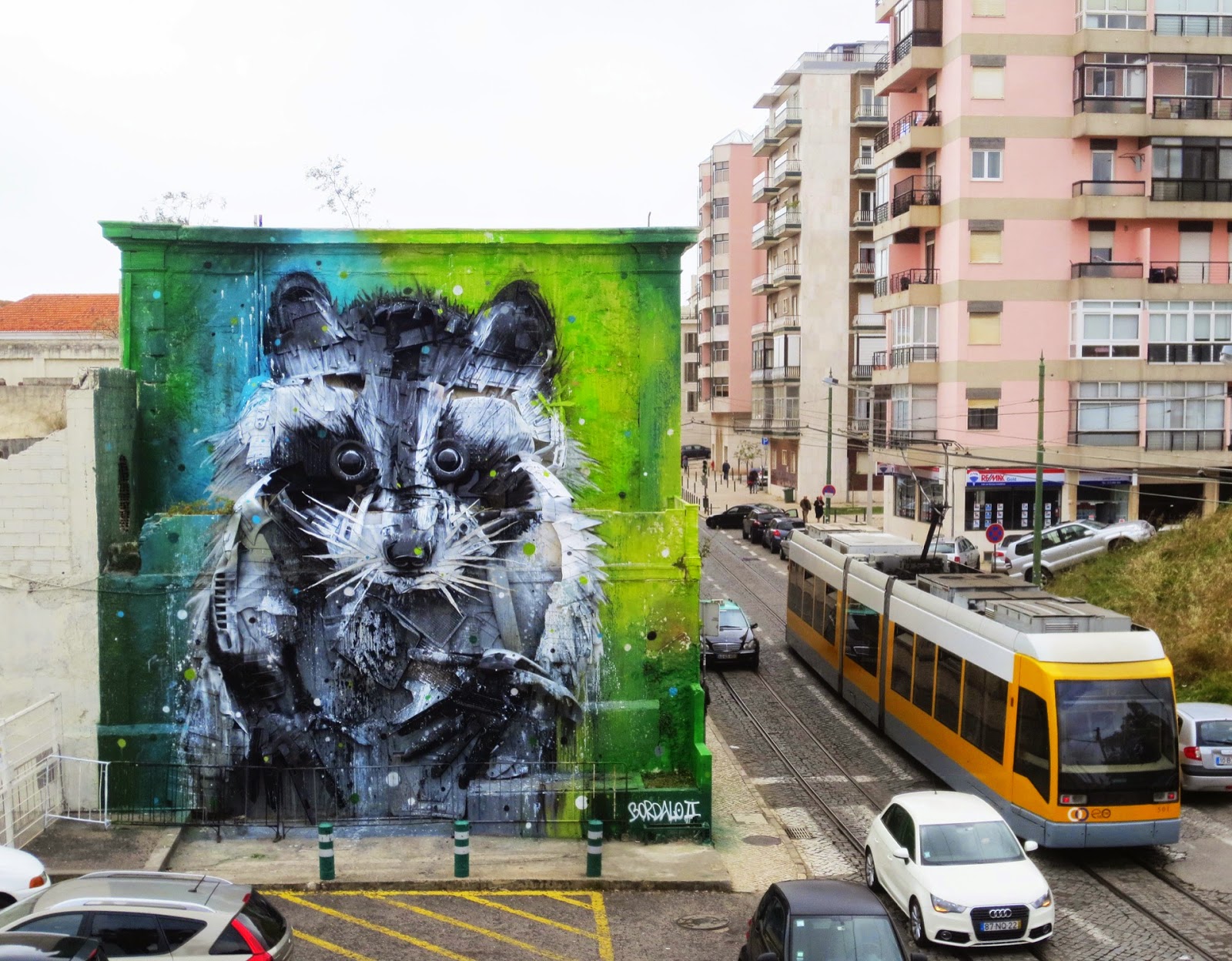
Big Trash Raccoon, Belém 2015. Image copyright Bordalo II.
The original raccoon was created in 2015 for Bordalo II’s solo exhibition at Arte Periférica Gallery in Lisbon’s CCB. Constructed from discarded materials and integrated into the stepped architecture of a building in Belém, it became one of his most recognisable early works and, according to the artist, the piece that brought him some of his greatest visibility at that stage of his career.
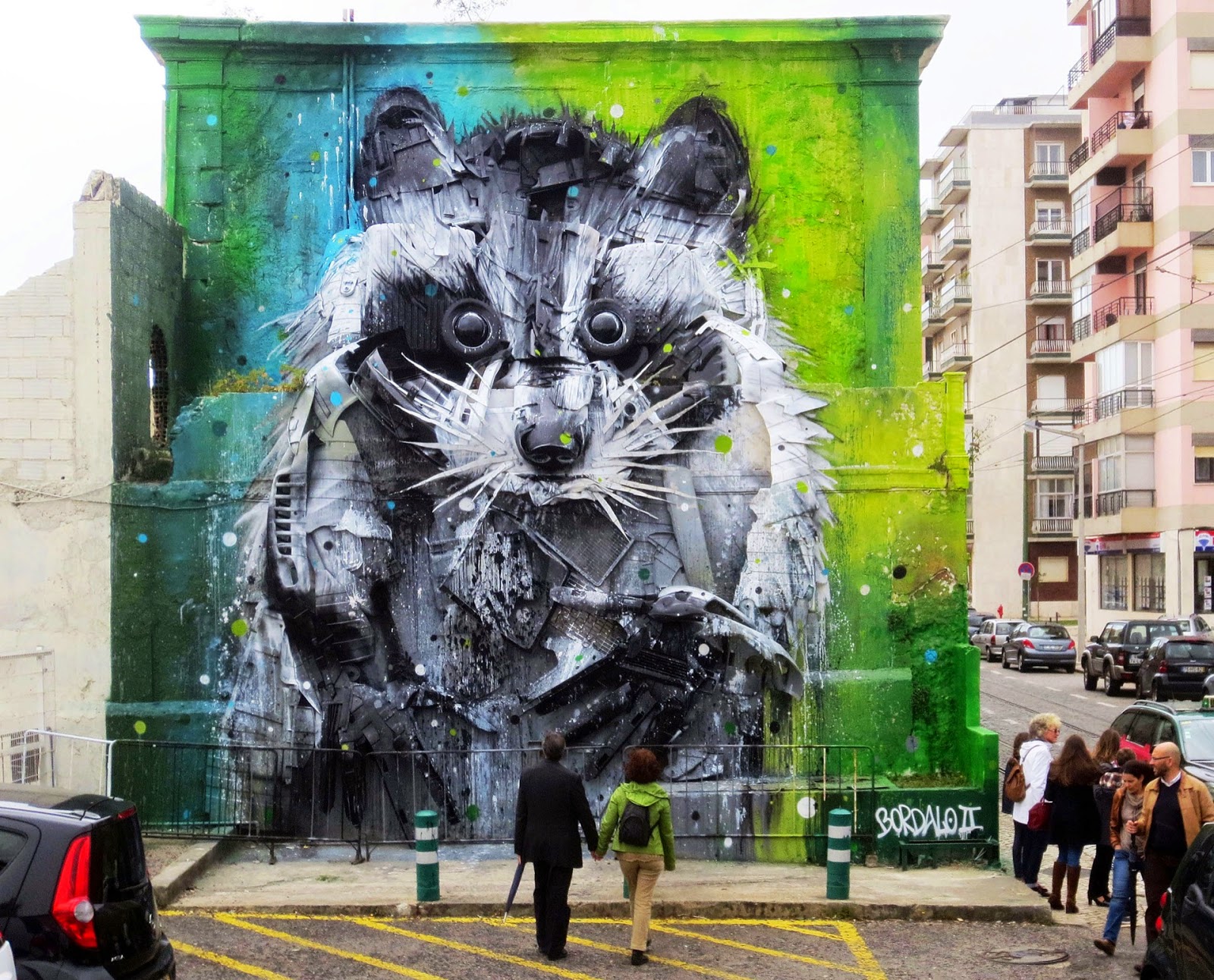
Constructed entirely from discarded materials, the 2015 Trash Raccoon, Belém. Image copyright Bordalo II.
From Bordalo II’s Big Raccoon to Re-Raccoon
GraffitiStreet first documented the Big Raccoon in Belém in April 2015, when the monumental animal was still a new addition to Bordalo II’s developing Big Trash Animals.
The architecture was fundamental to the work. Seen from an angle, the raccoon fragmented across different planes of the building; viewed directly from the front, those elements aligned and its face suddenly came into focus. The wall was therefore more than a backdrop. It became part of the sculpture itself.
Ten years later, the building was scheduled for demolition. Rather than allowing the artwork simply to disappear with it, Bordalo II chose to adapt the raccoon and reinstall it in Chelas.
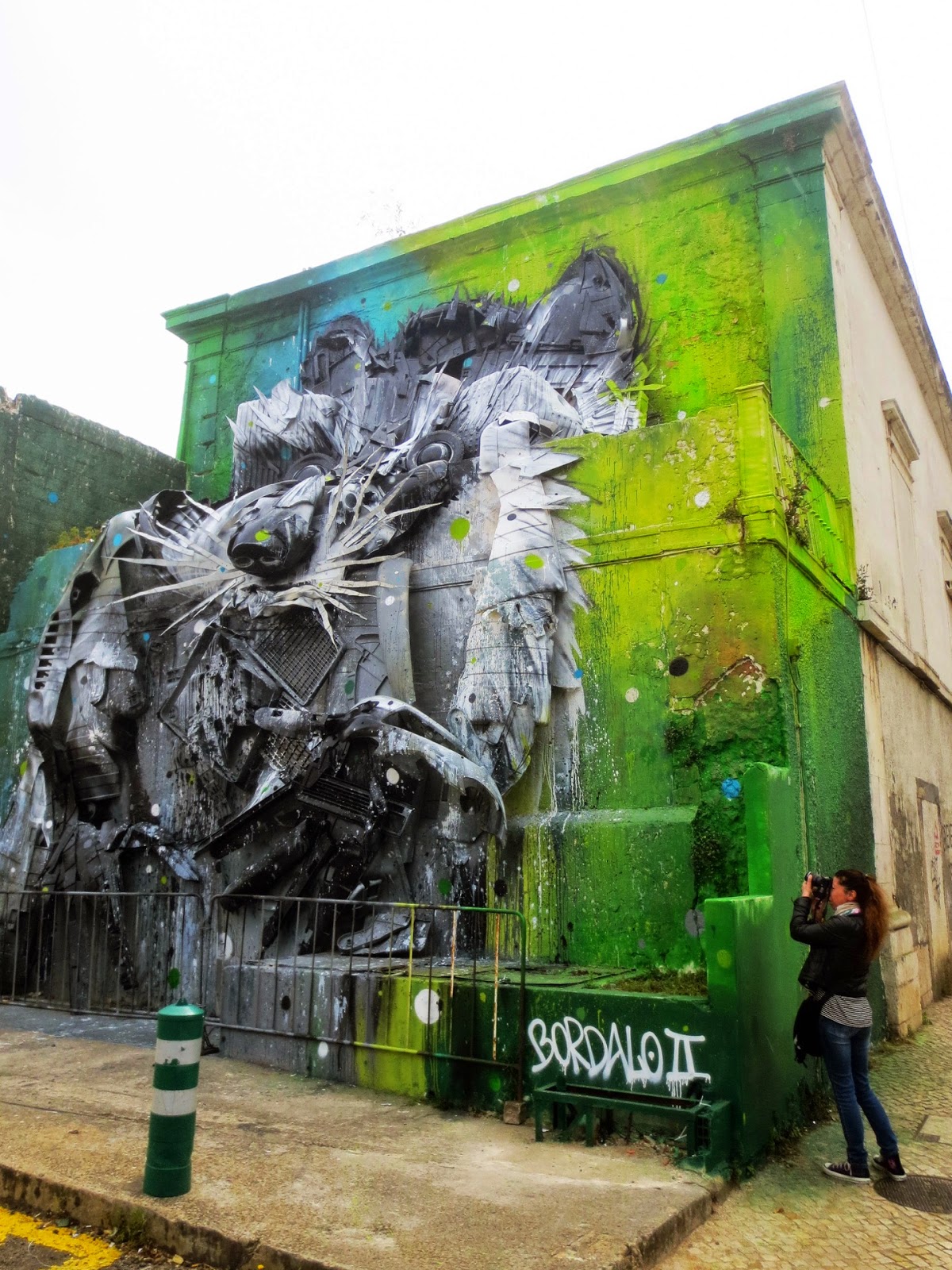
Constructed entirely from discarded materials, the 2015 raccoon in Belém embodied Bordalo II’s commitment to exposing the environmental cost of consumer culture. Image copyright Bordalo II.
Re-Raccoon Finds a New Home in Chelas
The new Re-Raccoon was installed along Estrada de Chelas, an area that has become increasingly associated with Lisbon’s contemporary urban-art landscape through Cor de Chelas.
The initiative has brought numerous artists and interventions into the neighbourhood, with Bordalo II closely connected to its development. By relocating the raccoon here, the artist moved a work associated with an earlier chapter of Lisbon street art into an environment where new public artworks continue to accumulate and reshape the streets.
Bordalo II creating Re-Raccoon in Chelas, Lisbon, 2025. Film © Bordalo II.
Bordalo II Reflects on a Decade of the Raccoon
Reflecting on the relocation, Bordalo II described the original Big Raccoon as one of his first Lisbon Big Trash Animals and recalled the visibility it brought his work in 2015. He also acknowledged the changing city around it. With the Belém building due to disappear, the raccoon was adapted for a very different neighbourhood where Cor de Chelas had been bringing new public art into the streets. His reflection ends with a particularly important question:
“Public art can be ephemeral, yes – but how ephemeral do we allow it to be?” Bordalo II
That question gives Re-Raccoon meaning beyond environmental sculpture. By recycling and adapting the original 2015 artwork rather than allowing it to disappear with the building, Bordalo II extends his philosophy of reuse to the artwork itself. Re-Raccoon becomes a meditation on memory, architecture, material reuse and the lifespan of public art.
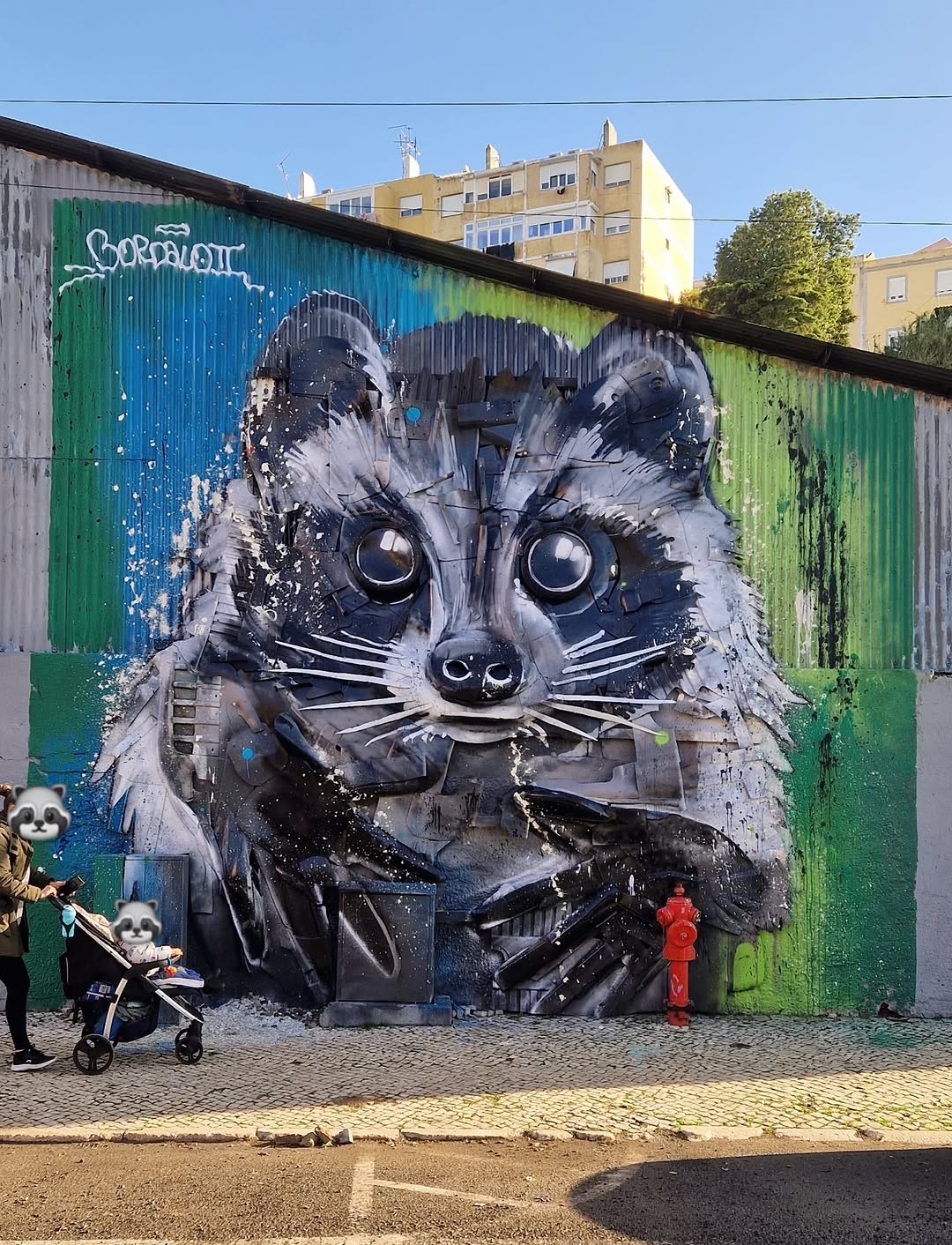
Re-Raccoon honours the spirit of the original, still built entirely from discarded materials, yet the world it re-emerges into has changed dramatically. Image copyright Bordalo II.
If anything, the urgency behind Bordalo’s Big Trash Animals has only intensified. Re-Raccoon’s return in 2025 arrives not as a nostalgic revival but as a reminder: a decade later, the crisis has grown, and so too has the need for voices and artworks that refuse to look away.
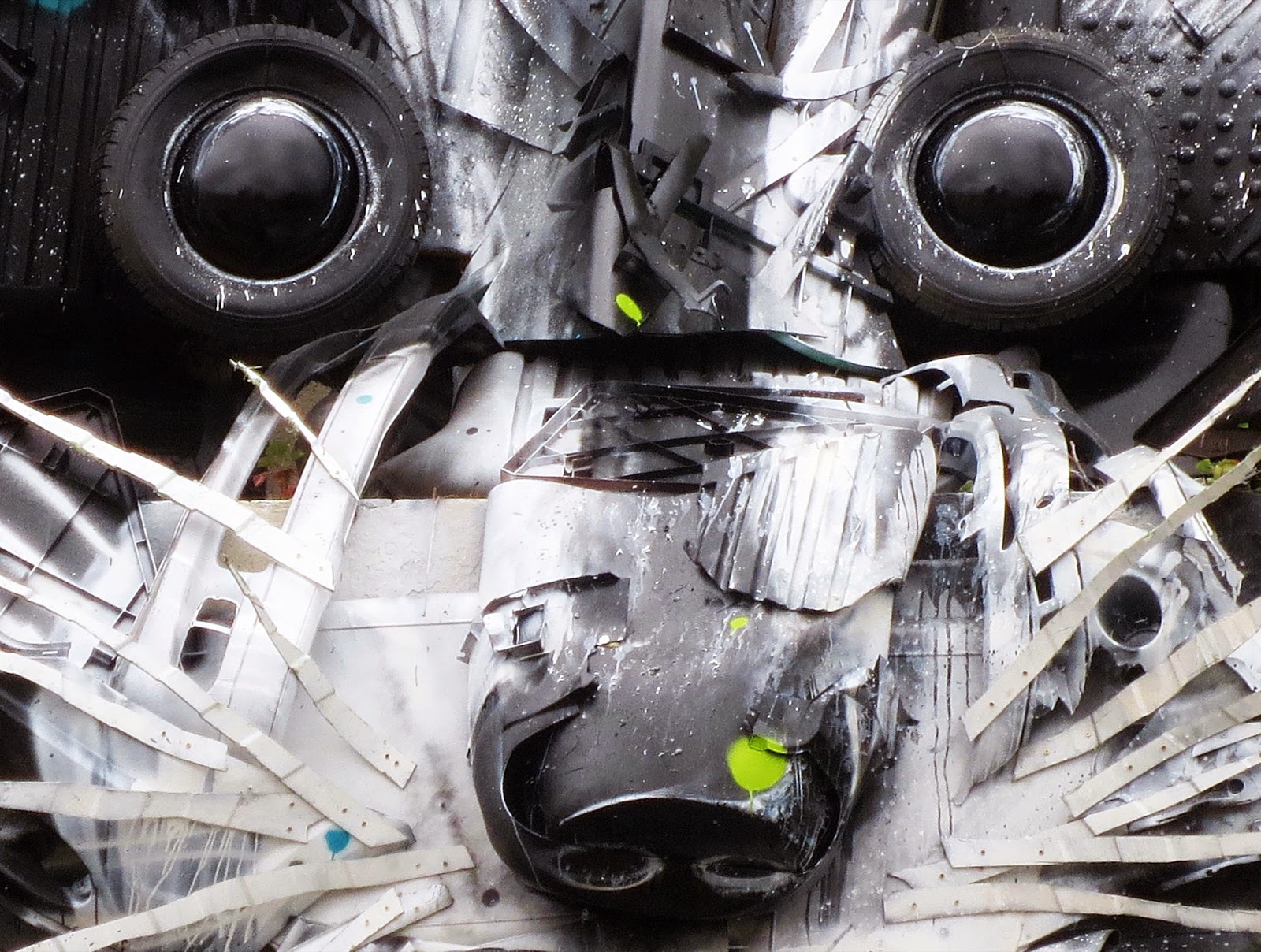
Big Trash Raccoon 2015 in detail. Image copyright Bordalo II.
Chelas: A Growing Hub for Lisbon’s Urban Art
Re-Raccoon also reconnects Bordalo II with Chelas as an evolving urban-art district, where Cor de Chelas has continued to bring large-scale public works into the neighbourhood. GraffitiStreet has also documented RESTLESS painting local worker Mateus for Cor de Chelas and the earlier Bordalo II and Vhils collaboration exploring Darwin and evolution. Together, these works show how Chelas has become an important setting for contemporary public art in Lisbon.
Discover Bordalo II at GraffitiStreet
Explore Bordalo II artworks at GraffitiStreet, including selected editions and collectible works, or contact GraffitiStreet for current availability, sourcing, acquisitions and private collector enquiries.
You can also visit GraffitiStreet Gallery, 25A West Street, Chichester, West Sussex, England PO19 1QW.