Bordalo II and Vhils Collaborative Mural Pays Tribute to Charles Darwin’s Theory of Evolution
Portuguese artists Bordalo II and Vhils, also known as Alexandre Farto, joined forces in Lisbon for their first collaborative mural, created for the Cor de Chelas Festival. Titled Origin, the work brings together a portrait of Charles Darwin and a chimpanzee to explore evolution, natural selection and humanity’s relationship with the wider animal world.
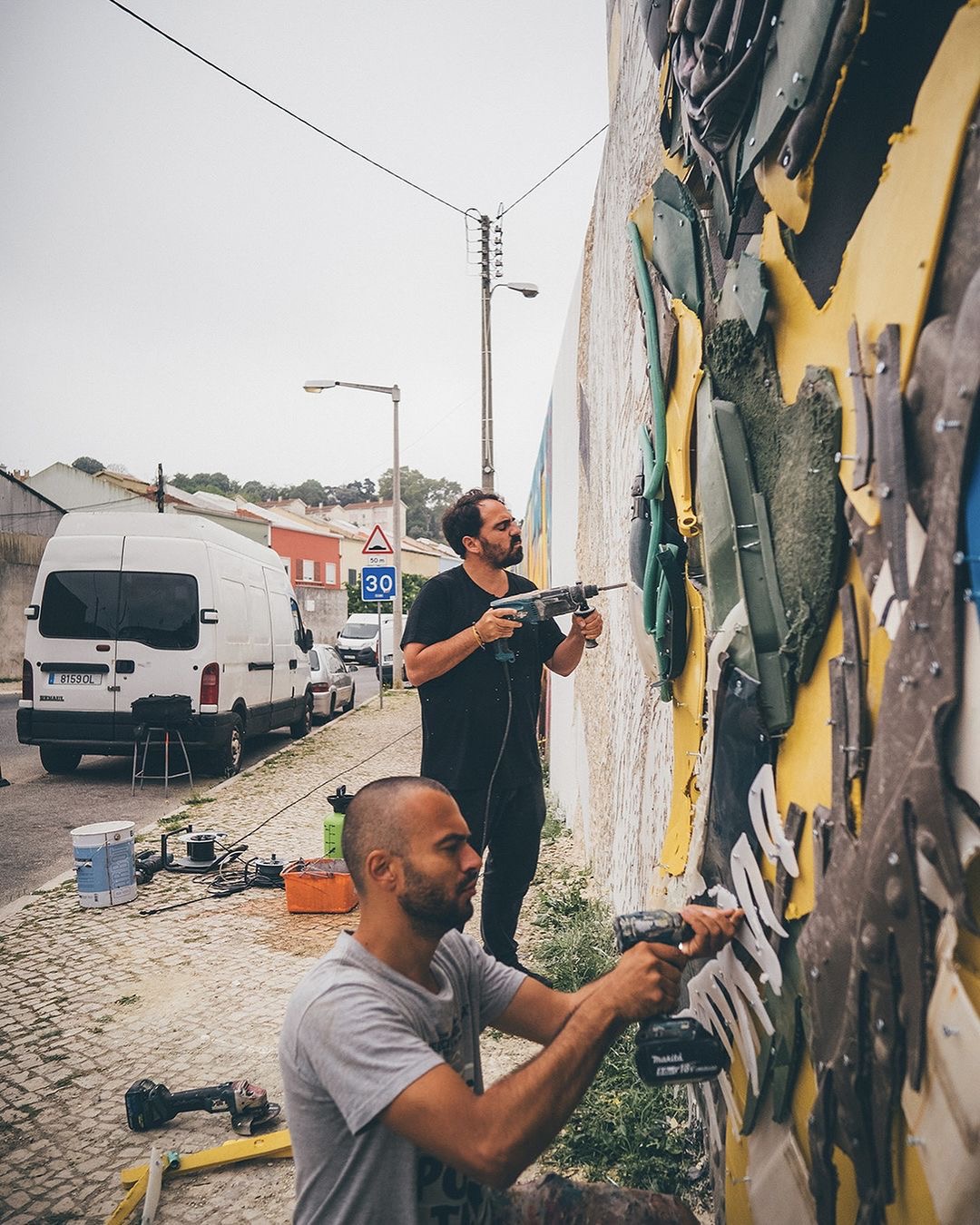
Bordalo II and Vhils, Origin, Cor de Chelas Festival, Lisbon, 2024. Image © Bordalo II and Vhils.
The collaboration is particularly striking because the artists work in opposite directions. Vhils removes material, carving Darwin’s face into the wall, while Bordalo II adds material, constructing the chimpanzee from discarded plastics, rubber and other found objects. The two halves align to form one image, bringing their distinctive techniques into an unusually seamless dialogue.
“We’ve been wanting to collaborate for some time, and creating a piece for the Cor de Chelas presented a great opportunity. When we saw the final result, we were pleased and decided to proceed with an edition. Vhils focuses on human portraits, while I often depict animals, so it provided a perfect context to explore the theory of evolution (Darwin).”
Bordalo II
Bordalo II and Vhils: Two Techniques, One Image
Bordalo II is known for three-dimensional assemblages constructed from discarded plastics, car parts and urban waste, while Vhils has developed a distinctive practice based on cutting, drilling and carving into architectural surfaces.
In Origin, those approaches meet directly. Vhils’ etched portrait of Darwin occupies one half of the wall, while Bordalo II’s sculptural chimpanzee emerges from the other, creating a visual transition between human and animal.
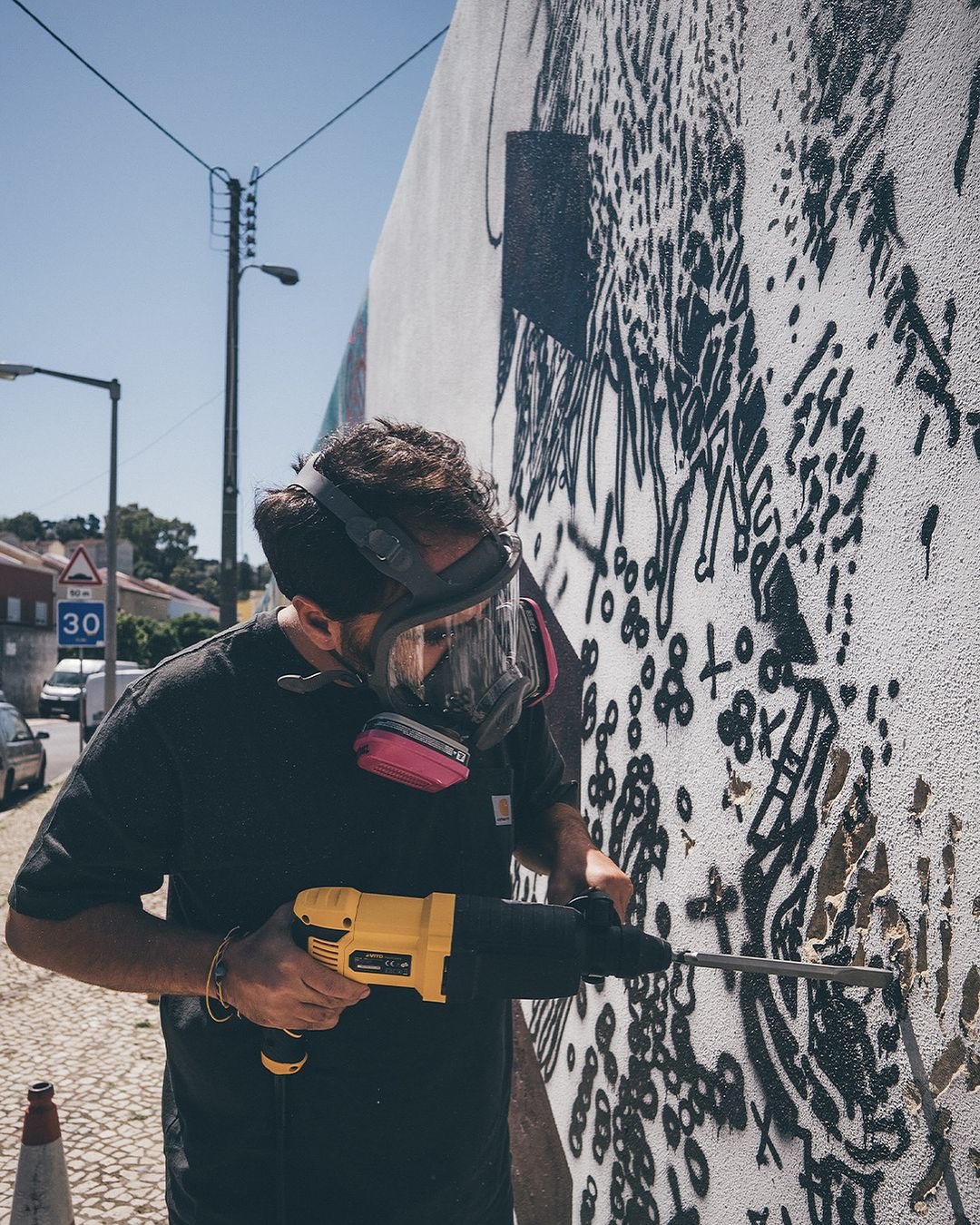
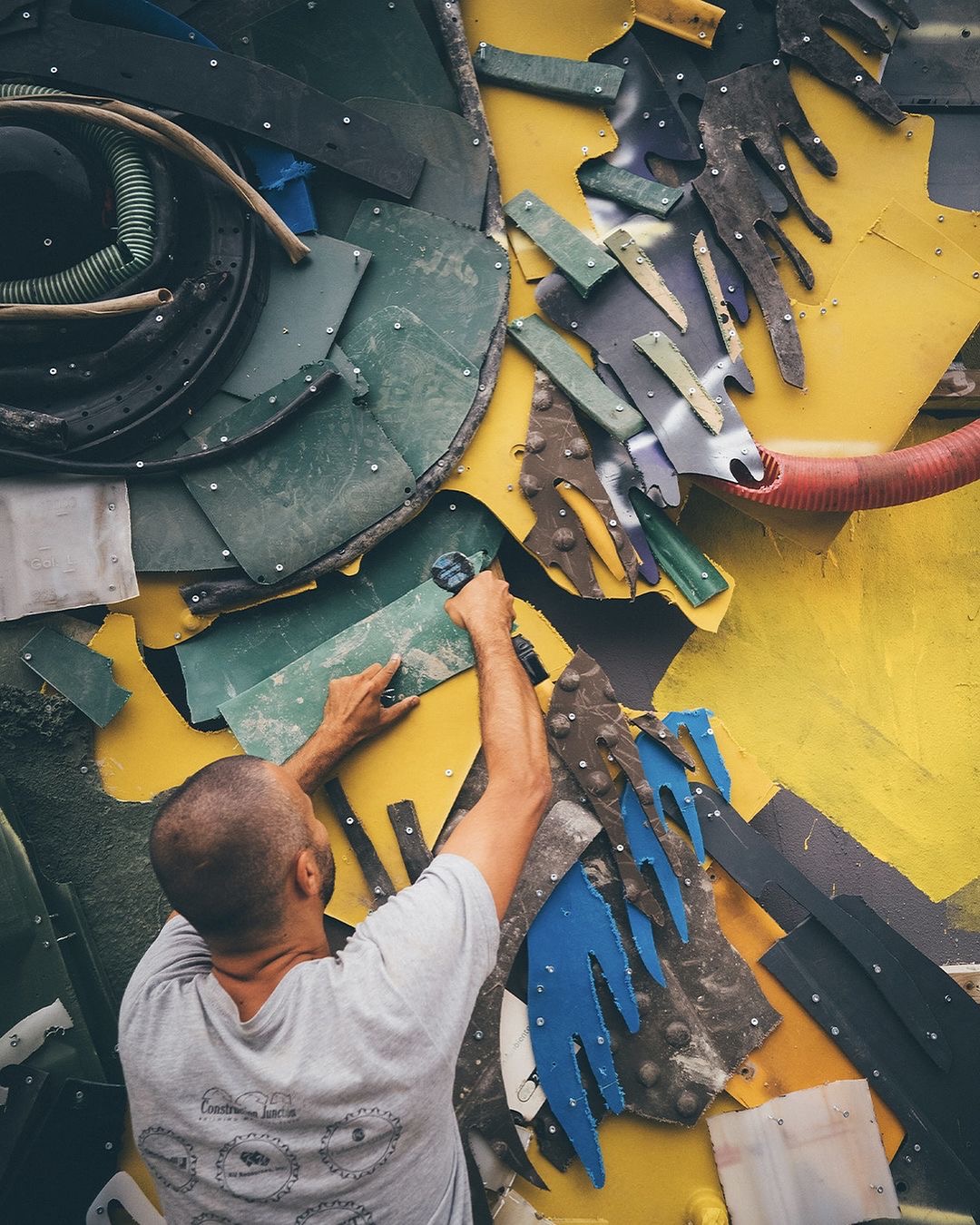
Bordalo II and Vhils, Origin, Cor de Chelas Festival, Lisbon, 2024. Image © Bordalo II and Vhils.
Why Charles Darwin?
Charles Darwin transformed scientific understanding of how species change over time through evolution by natural selection. His 1859 book On the Origin of Species established the idea that living organisms share evolutionary relationships and that populations gradually change as inherited characteristics affect survival and reproduction.
The mural uses Darwin and the chimpanzee as visual shorthand for that interconnected history. Humans did not evolve from modern chimpanzees; rather, humans and chimpanzees share a common evolutionary ancestor, making the split portrait particularly effective as an image of biological kinship.
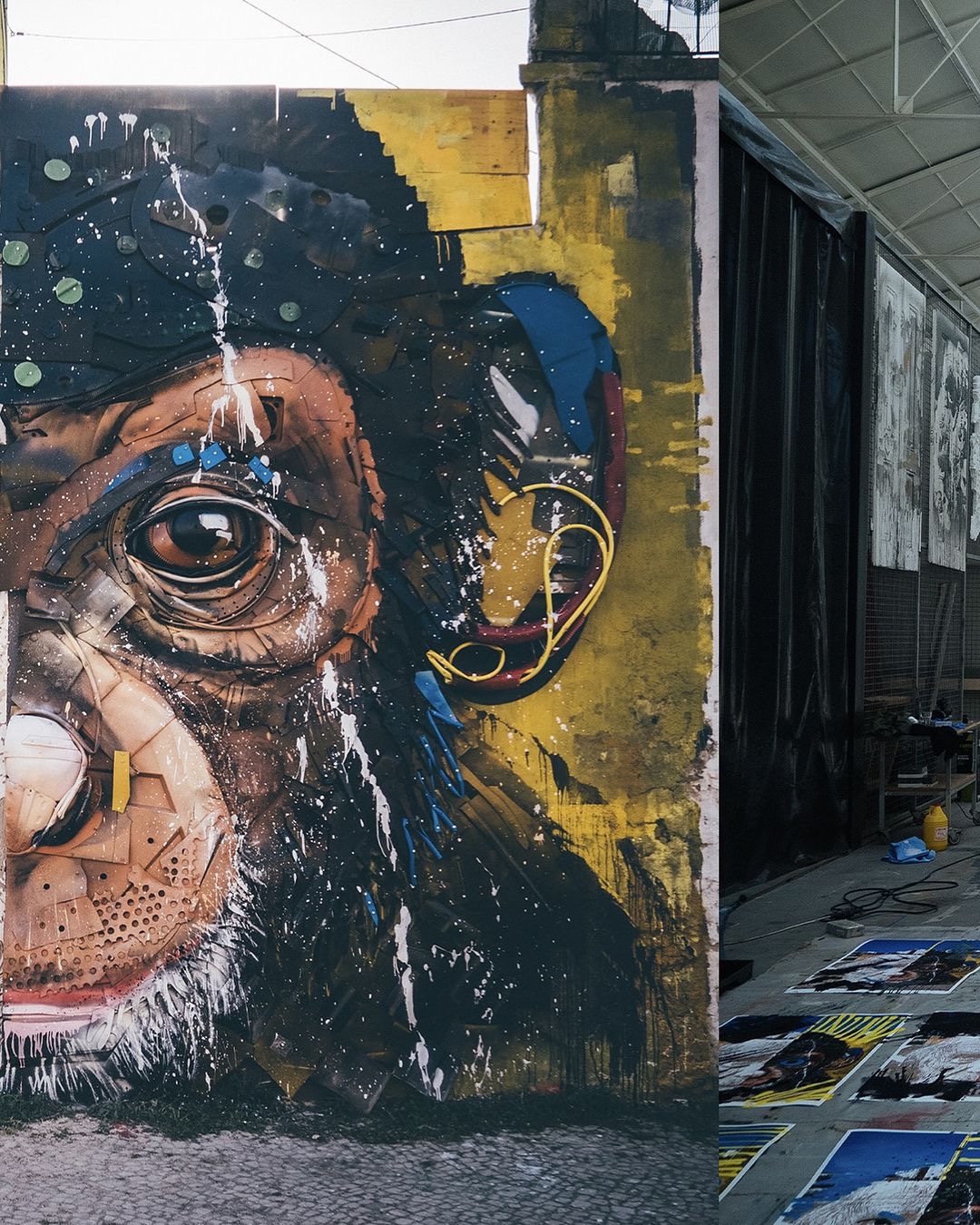
Image Copyright artists Bordalo II and Vhils
Survival of the Fittest
The phrase “survival of the fittest” is often closely associated with Darwin, although it was originally coined by philosopher Herbert Spencer. Darwin later adopted the expression in the fifth edition of On the Origin of Species in 1869 when discussing natural selection.
That distinction matters because Darwin’s theory concerns adaptation and reproductive success rather than simply physical strength. The organisms best suited to particular environmental conditions are more likely to survive and pass their traits to future generations.
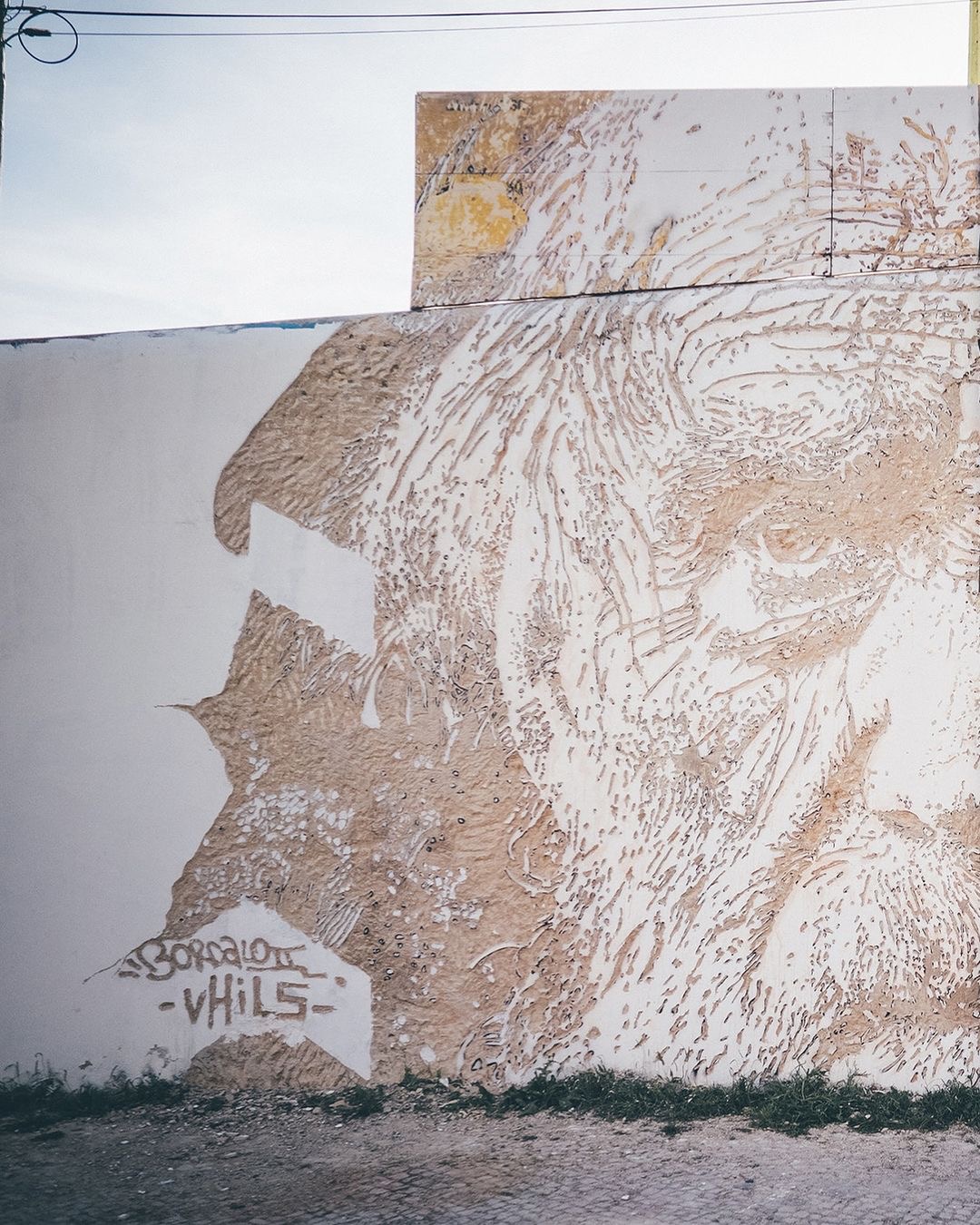
Image Copyright artists Bordalo II and Vhils
Evolution, Waste and the Natural World
Bordalo II’s half of the mural introduces another layer to the evolutionary theme. The chimpanzee is constructed from the discarded remnants of human consumption, connecting biological evolution with the environmental consequences of contemporary behaviour.
That material choice places Origin within the wider environmental language of Bordalo II’s Big Trash Animals, where animals are recreated from the materials contributing to pollution and ecological damage.
The mural therefore becomes more than an illustration of Darwin. It also asks how humanity’s actions are reshaping the environments in which other species must survive.
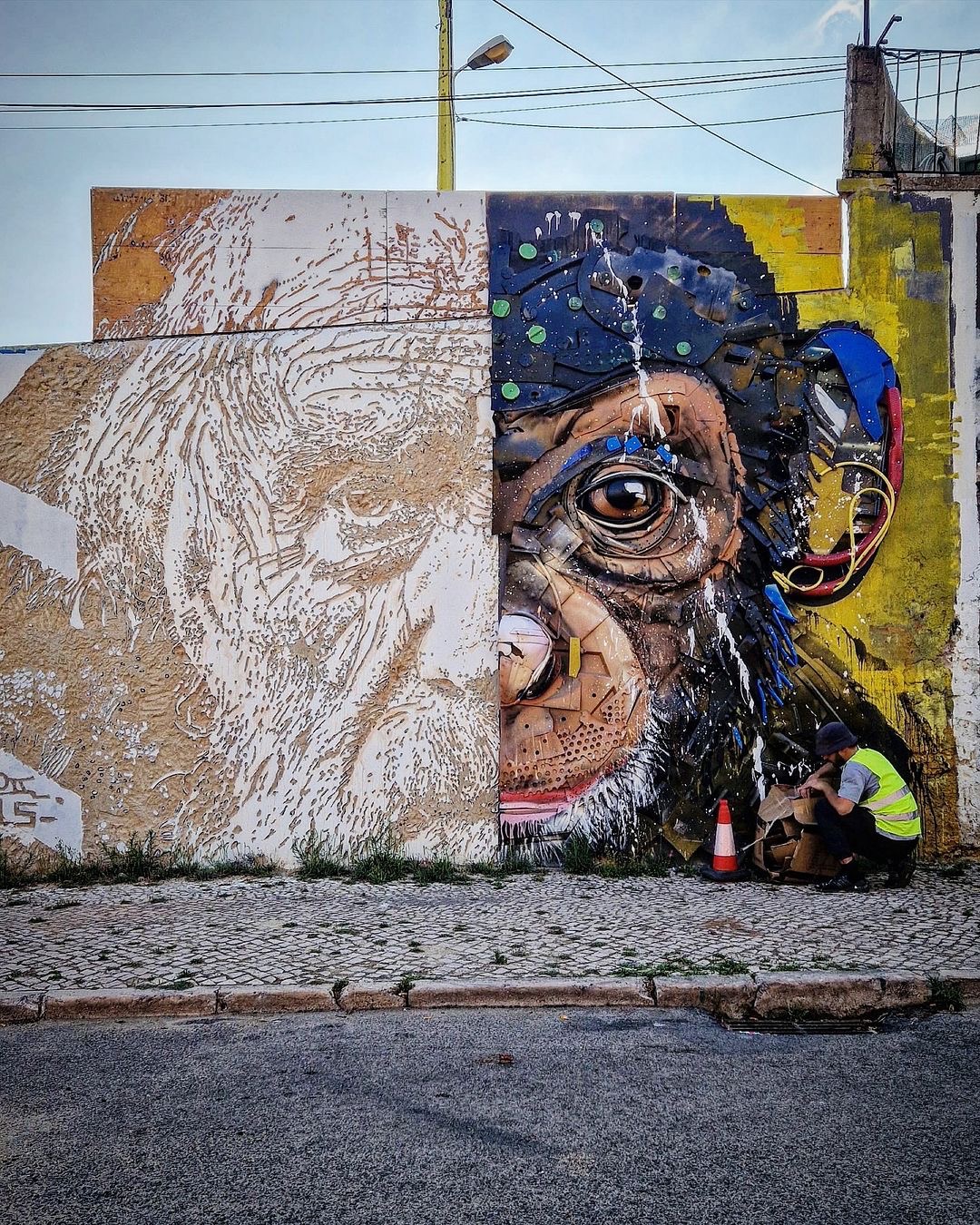
Image Copyright artists Bordalo II and Vhils
The split composition of the chimpanzee and Darwin in their mural serves as the perfect visual representation of the evolutionary concepts pioneered by Charles Darwin and also sparks conversations about the interconnectedness of all life forms and the impact of human activity on the natural world.
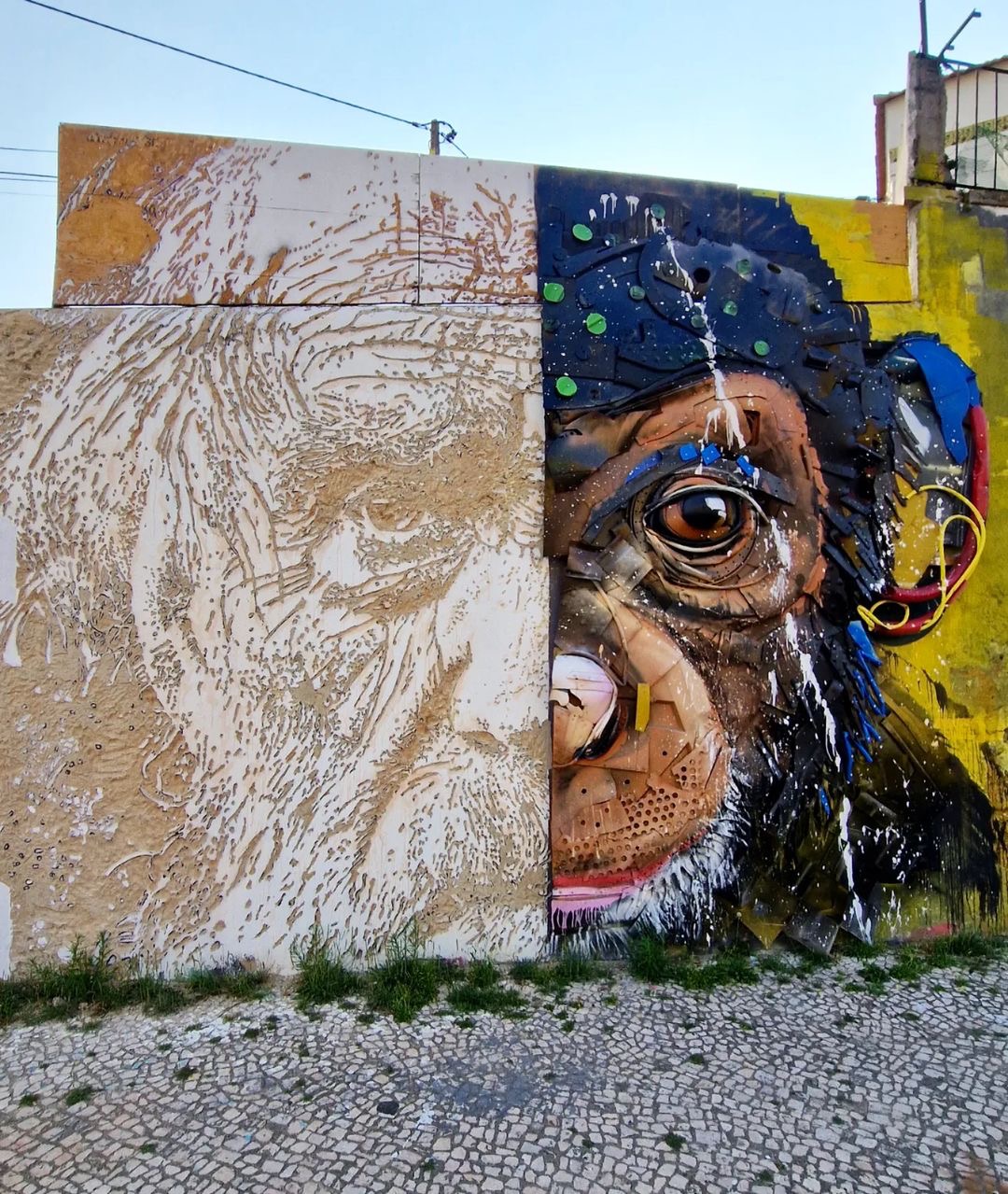
Image Copyright artists Bordalo II and Vhils
Bordalo II, Vhils and Lisbon’s Urban Art
Origin was created along Estrada de Chelas in Lisbon as part of Cor de Chelas, an urban-art initiative that has brought new interventions to the area.
For further context on Vhils’ subtractive approach to public portraiture, GraffitiStreet’s feature on his Brussels mural and Portugal’s Carnation Revolution explores how he uses the physical layers of architecture to reveal memory, identity and history.
For Bordalo II, the collaboration sits naturally alongside his broader Big Trash Animals and socially engaged Provoc practice, bringing environmental material, public space and cultural commentary together within a single image.
Images © Bordalo II and Vhils.