The Meaning Behind Banksy’s ‘Barcode’ – Explained
Banksy’s Barcode depicts a leopard stepping out from a wheeled cage formed by the rigid black lines of a commercial barcode. First seen within the artist’s Bristol street practice and later released as a Pictures on Walls screenprint in 2004, the image turns a familiar instrument of pricing and classification into a structure of confinement. Its meaning moves between wildlife exploitation, consumer culture and personal freedom, while a discreet numerical detail leaves the viewer with one final question
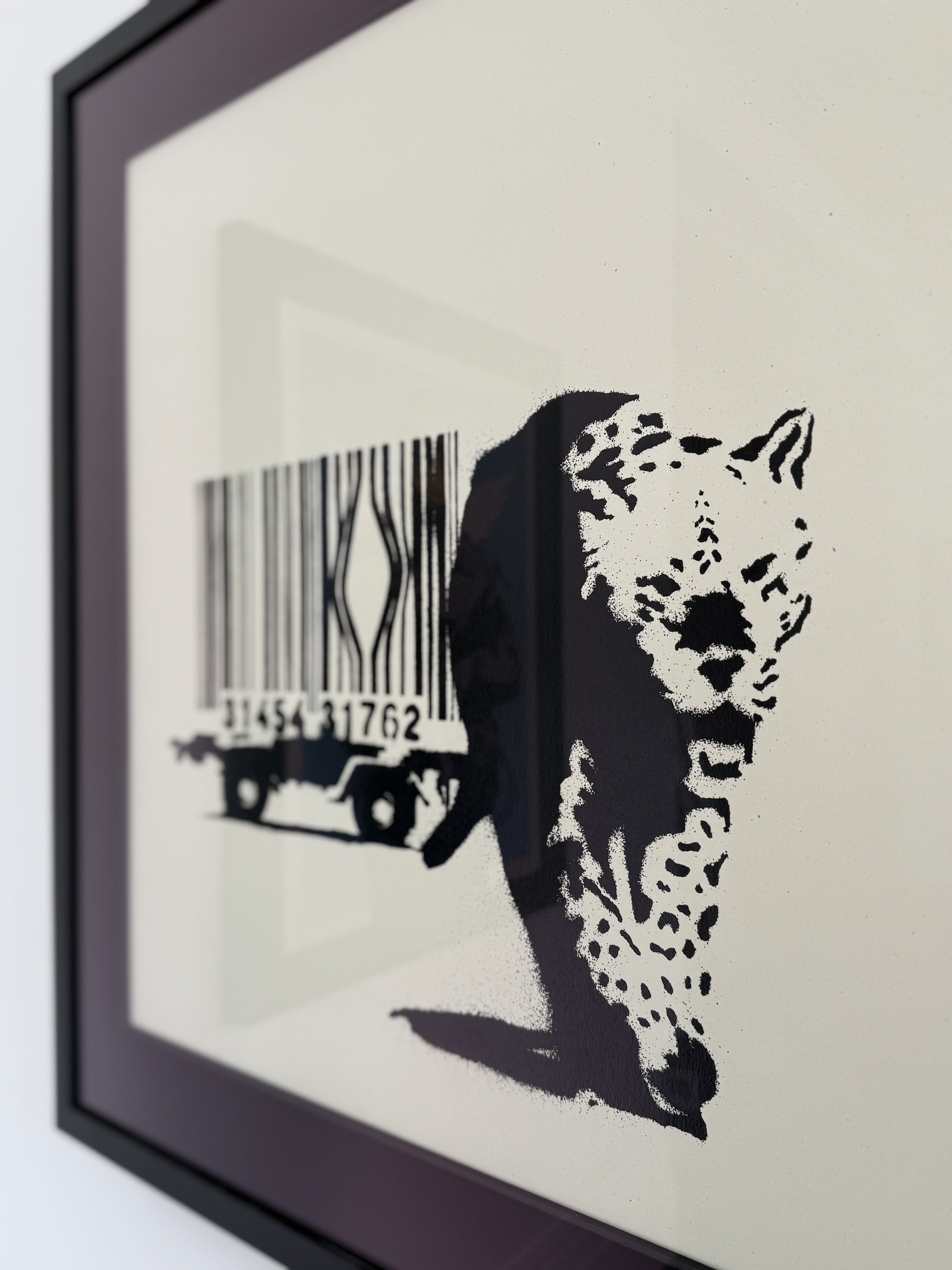
Banksy, Barcode (unsigned), image copyright GraffitiStreet.
A Cage Disguised as an Everyday Symbol
The first strength of Barcode lies in how quickly the image can be understood. A leopard is escaping. Behind it stands a cage. Yet the enclosure has no conventional bars, locks or keeper. Its bars belong to the visual language of retail, inventory and industrial distribution, transforming a tool designed to identify products into a mechanism that confines a living creature.
That transformation gives the work its precision. Barcodes usually sit quietly on the reverse of an object, presenting themselves as neutral and functional. Banksy brings the code forward until it becomes the dominant architecture of the image. What usually operates in the background becomes a façade, an ordered public face for a system built upon pricing, ownership and control.
The façade appears efficient and impersonal, although the leopard exposes what its clean geometry can conceal. Behind systems of classification lie living bodies, natural habitats and forms of value that refuse easy measurement. Banksy allows the mechanism to reveal itself through the simple act of escape.
The Leopard as Nature, Instinct and Resistance
Banksy could have placed a passive animal inside the cage, but the leopard is alert, muscular and already moving beyond its boundary. Its body curves away from the barcode’s vertical rigidity, creating a visual struggle between organic life and mechanical order. The cage is static. The leopard possesses momentum.
The animal therefore carries several connected meanings. It can be read as wildlife resisting captivity, nature pushing back against commercial exploitation, or the individual refusing to be reduced to a category.
This tension gives Barcode an emotional force that extends beyond a straightforward critique of zoos or animal entertainment. The leopard embodies everything that a code struggles to contain, including instinct, unpredictability, dignity and self-possession. Banksy freezes the image at the instant when confinement has failed, allowing the viewer to imagine what freedom might demand once the safety of the cage has been left behind.
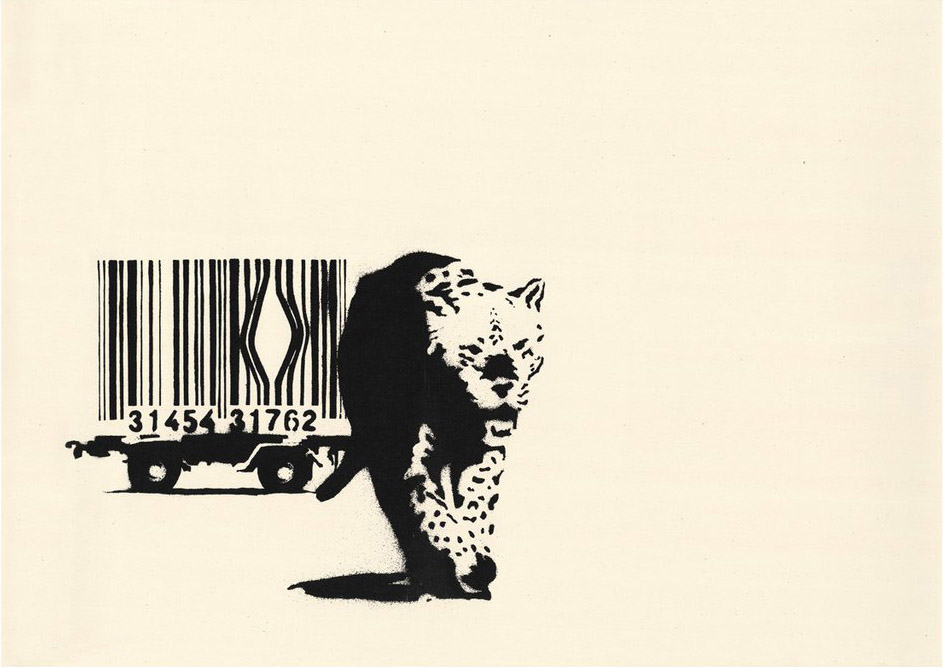
Banksy’s ‘Barcode’ unsigned screenprint
Wildlife in a World of Products
The barcode-cage offers an immediate critique of the way animals can be captured, traded, displayed and assigned monetary value. Wildlife trafficking, trophy culture, commercial breeding and forms of entertainment built around captivity all depend upon the conversion of living beings into assets. The image compresses that complex system into a single, sharply readable metaphor.
Banksy’s ‘Barcode’ unsigned screenprint. In detail
Consumer Culture and the Human Cage
The leopard can also operate as a mirror for the viewer. Modern consumer culture constantly classifies people through purchases, preferences, data and economic value. Identities become customer profiles, audiences become demographics, and private behaviour becomes material for systems that sort, predict and sell.
Seen through this lens, the barcode is a psychological cage as much as a physical one. It represents the pressure to become readable, measurable and marketable, with value determined by what can be counted. The leopard’s escape suggests a refusal of that flattening process, preserving a self that remains instinctive, unruly and resistant to complete definition.
This reading has grown more resonant as daily life has become increasingly organised through digital tracking and algorithmic classification. Although Barcode emerged before today’s culture of constant data capture reached its present scale, its central image now feels unusually prescient. Banksy recognised that a code can function as a façade of order while quietly deciding how bodies, objects and behaviours are seen.
Freedom, With the Cage Still in View
There is triumph in the leopard’s movement, although Banksy keeps the cage within the composition. The system has been breached, yet it has not disappeared. That choice prevents the work from becoming a simple fantasy of liberation. Freedom remains an active gesture, one that must be taken while the structures of control continue to occupy the same visual and social landscape.
The leopard also appears to be walking rather than fleeing in panic. Its movement carries composure and quiet authority, as if the animal is reclaiming a state that always belonged to it. This sense of dignity is central to the image. Resistance appears through presence, strength and the decision to move beyond an imposed boundary.
Banksy leaves open the possibility that the cage has always been partly illusory. A façade gains power when its order is accepted as permanent. Once the leopard passes through it, the vertical lines lose their authority and return to what they were: ink, code and convention.
Banksy’s ‘Barcode’ unsigned screenprint. In detail
From a Bristol Wall to a Pictures on Walls Edition
Barcode, one of Banksy’s celebrated early stencil works, is believed to have first appeared on the side of a house on Pembroke Road, Bristol, in 1999/2000. The stencil showed a leopard emerging from the rigid bars of a commercial barcode, as though escaping a cage constructed from classification, consumption and control. It went missing from the property in August 2010 during extensive building work, and its whereabouts remained unknown to art fans and local residents until it resurfaced four years later at a school exhibition in Nailsea, North Somerset.
Banksy developed the motif further at Existencilism, his debut Los Angeles exhibition, held at the 33⅓ Gallery from 19 July to 18 August 2002. Barcode Leopard appeared there alongside other works that would go on to define his early career, including Love Is In The Air and Laugh Now.
“At the centre of the composition, the leopard retains its ultimate power, and refuses to be labelled. Banksy’s image leaves us with a compelling proposition: freedom begins when the façade is recognised as a cage, and the first movement beyond it becomes possible.” Rosh Boroumand, Co-Founder & Banksy Specialist, GraffitiStreet
The image was adapted into a screenprint in 2004, published by Pictures on Walls. The edition consists of 150 signed prints and 600 unsigned, on wove paper, sheet size conventionally stated as 50 x 70 cm.
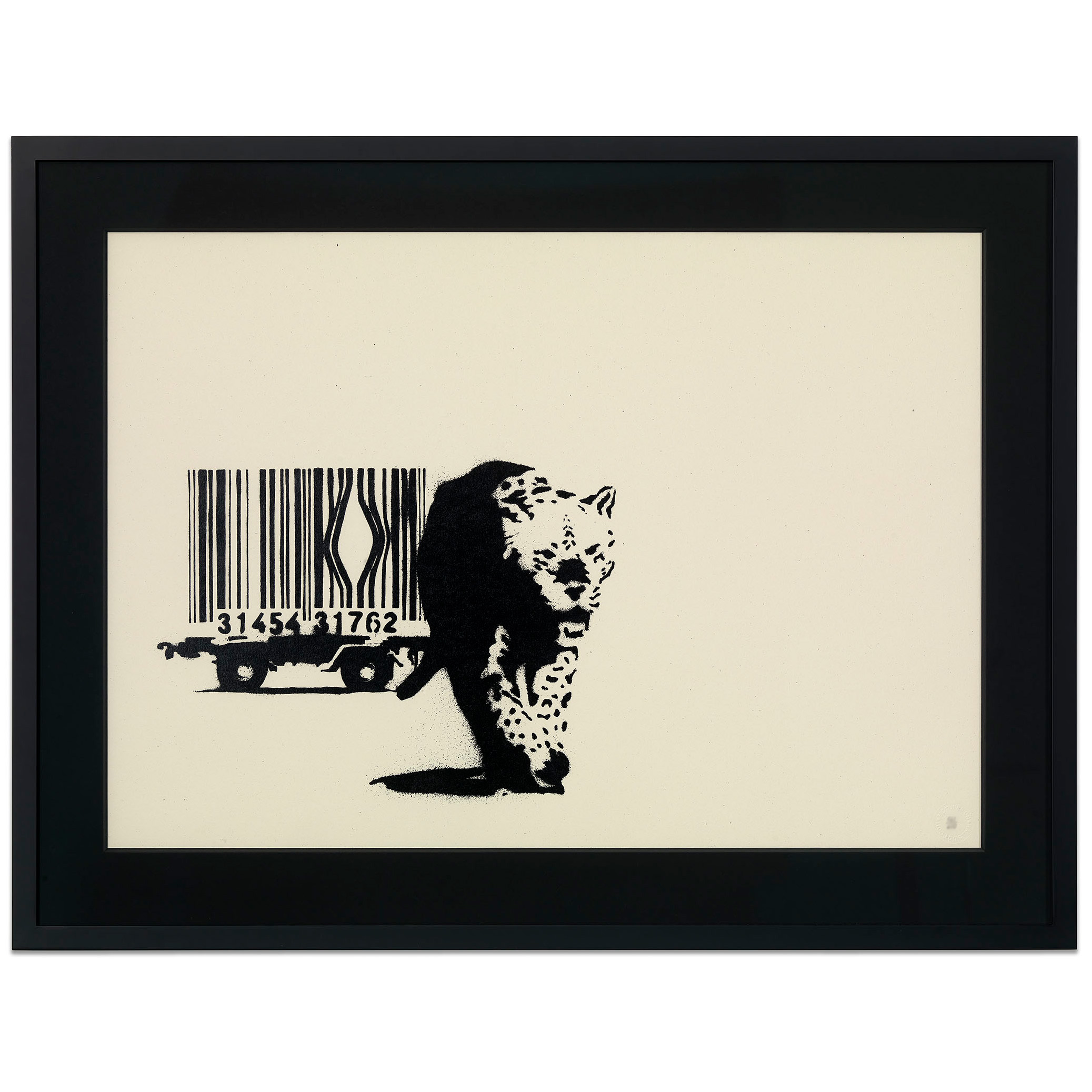
Banksy, Barcode (Unsigned), museum-level 1 framed. with Pest Control certificate. Part of “Banksy Editions” at GraffitiStreet Gallery.
Frequently Asked Questions about Banksy’s Barcode
Banksy’s Barcode is widely interpreted as a critique of wildlife commodification, captivity and consumer culture. Its escaping leopard can also represent nature, individuality and the refusal to be reduced to a number, category or price.
The barcode connects commercial classification with confinement. By turning its vertical lines into prison bars, Banksy reveals how apparently neutral systems of pricing and control can contain living beings and shape human identity.
Pictures on Walls published Barcode as a screenprint in 2004. The standard edition comprises 150 signed and 600 unsigned impressions on cream wove paper.
The image is documented as having first appeared on the side of a house on Pembroke Road in Bristol before its later release as a screenprint.
Banksy’s Barcode at GraffitiStreet
To purchase a Banksy Barcode screenprint, or explore other works by Banksy, visit our online store. Alternatively, contact GraffitiStreet co-founder and Banksy specialist Rosh Boroumand, or visit us at the GraffitiStreet Gallery, 25A West Street, Chichester.