10 Banksy Quotes from “Banging Your Head Against A Brick Wall” Book
Published in 2001, Banging Your Head Against a Brick Wall was Banksy’s first book: a pocket-sized collection of early stencil work, graffiti, photographs, statements, letters and observations from a period when his work was still emerging from the streets of Bristol and London.
Small, inexpensive and deliberately anti-establishment in character, the book captures Banksy before the museums, auction records and international exhibitions. Yet many of the ideas that would define his career are already there: authority, capitalism, surveillance, public space, obedience and the power of graffiti to communicate without permission.
Here are ten Banksy quotes from Banging Your Head Against a Brick Wall that reveal how much of his later philosophy was already in place.
1. Bombing
“People are fond of using military terms to describe what they do.
We call it bombing when we go out painting, when of course it’s more
like entertaining the troops in a neutral zone, during peacetime in a
country without an army.”
Banksy begins by dismantling the language surrounding graffiti itself. The word “bombing” sounds aggressive and destructive; his description is almost absurdly peaceful. It is an early example of a technique he would return to repeatedly: taking the language of authority and turning it against itself.
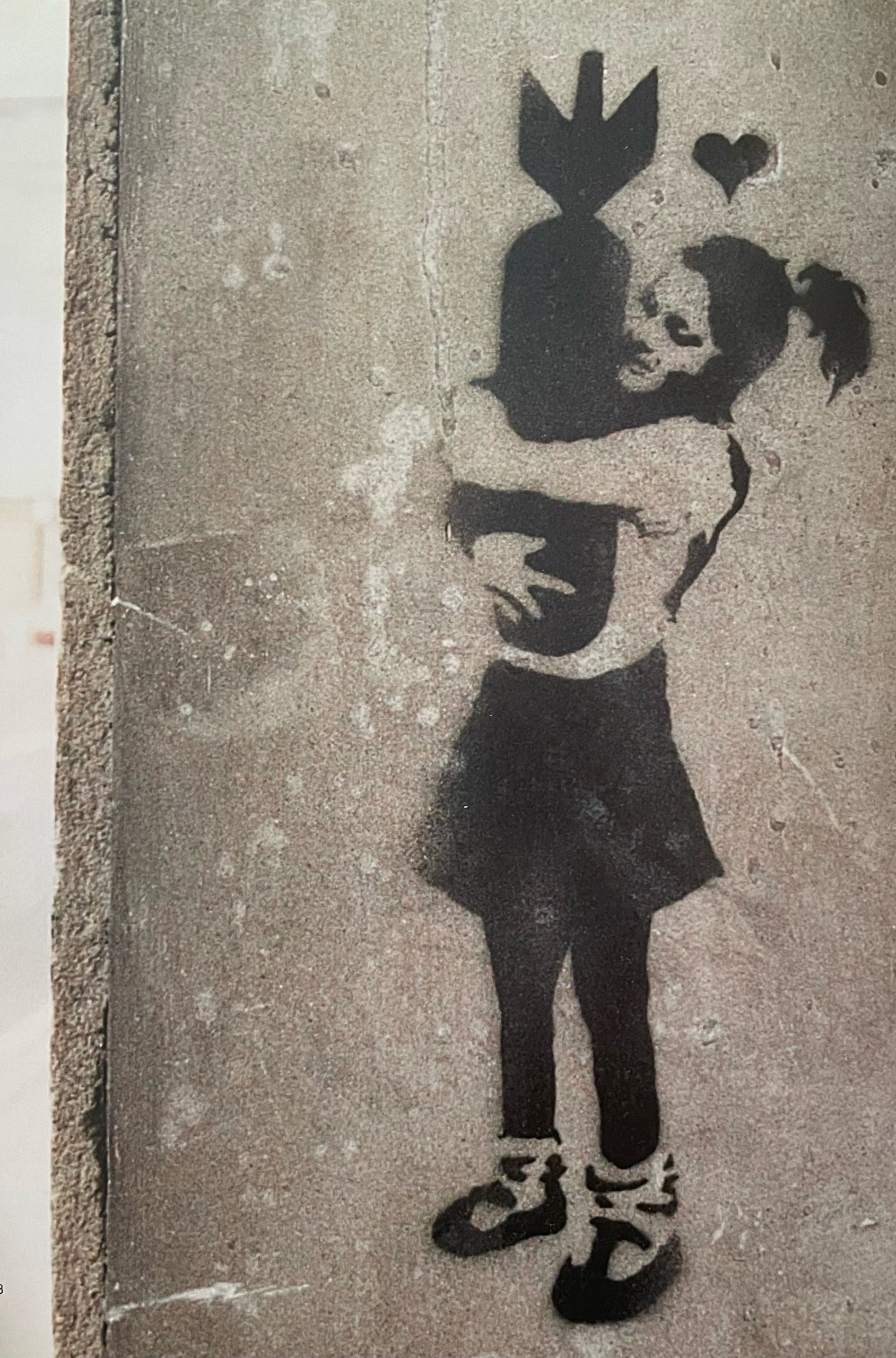
Explore Banksy – Bomb Hugger via GraffitiStreet
2. Paranoia
“Your mind is working at its best when you’re being paranoid.
You explore every avenue and possibility of your situation at high speed with total clarity. I’m not interested in looking at things made by people who aren’t paranoid, they’re not working to their full capacity.”
Read less as an endorsement of paranoia than a description of the heightened awareness required to work illegally. Graffiti demands an acute understanding of surroundings: entrances, exits, cameras, police, timing and opportunity. For Banksy, the conditions under which the work is made become part of the creative process.

3. Graffiti as a Tool
“Graffiti is one of the few tools you have if you have almost nothing.
And even if you don’t come up with a picture to cure world poverty
you can make someone smile while they’re having a piss.”
Behind the joke is one of Banksy’s clearest arguments for graffiti. It requires relatively little access, wealth or institutional approval. A wall and a can of paint can provide a public platform to somebody who has no gallery, advertising budget or conventional means of reaching an audience.

4. Graffiti as Part of the City
“Graffiti ultimately wins out over proper art because it becomes part of your city, it’s a tool;
‘I’ll meet you in that pub, you know, the one opposite that wall with a picture of a monkey holding a chainsaw’. I mean, how much more useful can a painting be than that?”
This is more than a joke about directions. Banksy argues for street art as something embedded within the memory and geography of a city. Unlike an artwork contained within a museum, graffiti can become a landmark: part of the way people recognise, describe and remember a place.

5. A Wall Is a Weapon
“A wall is a very big weapon.
It’s one of the nastiest things you can hit someone with.”
One of the shortest quotations in the book is also one of its most loaded. A wall can provide the surface for protest, but walls can also divide, exclude and control.
That dual meaning would become increasingly significant within Banksy’s work as he began making interventions on politically charged walls and borders.

6. The Rat Race
“Win the Rat Race and you’re still a Rat.”
The rat became one of Banksy’s earliest and most persistent symbols. Small, unwanted and remarkably difficult to eradicate, Banksy’s rats occupy the margins of the city while quietly outnumbering those who believe they control it.
Here, the rat becomes something else: a critique of the endless pursuit of status, money and success. Winning the system does not necessarily mean escaping it.

Explore Banksy Rat works via GraffitiStreet
7. Big Brother
“They say Big Brother is watching you.
But maybe Big Brother is watching Dutch girly videos on the next screen along.”
Surveillance is stripped of its apparent omnipotence. Banksy takes the intimidating idea of an all-seeing authority and replaces it with something fallible, distracted and unmistakably human.
The humour matters. Power becomes considerably less frightening once it can be made ridiculous.

8. Initiative
“A lot of people never use their initiative,
because no-one told them to.”
It is a perfect Banksy contradiction. The act of waiting to be told to think independently makes independent thought impossible.
That tension sits at the centre of much of Banksy’s practice. His work repeatedly questions who creates the rules, why we obey them and what might happen if somebody simply decides not to.

9. Obey
“Doing what you’re told is generally overrated.
In fact it’s been said that more crimes are committed in the name of obedience than disobedience. It’s those who follow any authority blindly who are the real danger.”
Banksy’s target here is not simply authority but unquestioning obedience to it. It is an idea repeated throughout his work, where police officers, soldiers, politicians and institutional figures frequently appear in situations that expose the absurdity or danger of automatic compliance.

10. Making and Destroying Art
“Someone famous once said: ‘It takes two people to make a piece of art. One person to make the art and another person to stop them from destroying it.’ Which is more poetic than saying: ‘It takes two people to make a piece of art. One person to make the art and another person to come round later from the council and sand-blast it off.’”
Written in 2001, the idea became strangely prophetic. In October 2018, immediately after Banksy’s Girl with Balloon sold at Sotheby’s London for £1.042 million, a shredder concealed within its frame activated and partially destroyed the canvas. Banksy subsequently renamed the transformed work Love is in the Bin.
Three years later, in October 2021, Love is in the Bin returned to the same auction room and sold for £18.582 million. Banksy had turned the destruction of an artwork into the creation of another. Read: Shred the Love — Banksy’s Sotheby’s Stunt Didn’t Go According to Plan

Banksy’s Official Books
Banging Your Head Against a Brick Wall was the first of Banksy’s three pocket-sized books, followed by Existencilism in 2002 and Cut It Out in 2004.
They were followed by the substantially larger Wall and Piece in 2005, which brought together material from the earlier publications alongside further photographs, interventions and writing.
Banksy returned to publishing in 2023 with Cut & Run, produced in connection with his major exhibition at Glasgow’s Gallery of Modern Art.
For more Banksy in his own words, continue through our series:
10 Banksy Quotes from Existencilism
10 Banksy Quotes from Cut It Out
10 Banksy Quotes from Wall and Piece
Inside Banksy’s CUT & RUN: 25 Years of Iconic Works
Read together, the books reveal something that Banksy’s murals alone cannot: the artist developing his ideas in his own words. The humour changes, the audience expands and the scale of the work grows, but the central questions, power, ownership, capitalism, authority and freedom, remain remarkably consistent.
Banging Your Head Against a Brick Wall
Title: Banging Your Head Against a Brick Wall
Artist / Author: Banksy
Published: 2001
Format: Pocket-sized softcover publication
Dimensions: approximately 145 × 105 mm
Contents: Early Banksy stencils and graffiti, black-and-white photographs, statements, letters, observations and a beginner’s guide to stencil-making.
Multiple impressions of the book circulated during Banksy’s early career, and bibliographic descriptions of the earliest copies vary. Rather than functioning as a conventional artist monograph, Banging Your Head Against a Brick Wall captures a particular moment in Banksy’s development, when the street remained his principal gallery and the books themselves were another inexpensive means of getting the work into people’s hands.
Today, surviving early copies have become collectible pieces of Banksy ephemera and an important record of the ideas that helped shape his later practice.
Explore Banksy works and editions available via GraffitiStreet
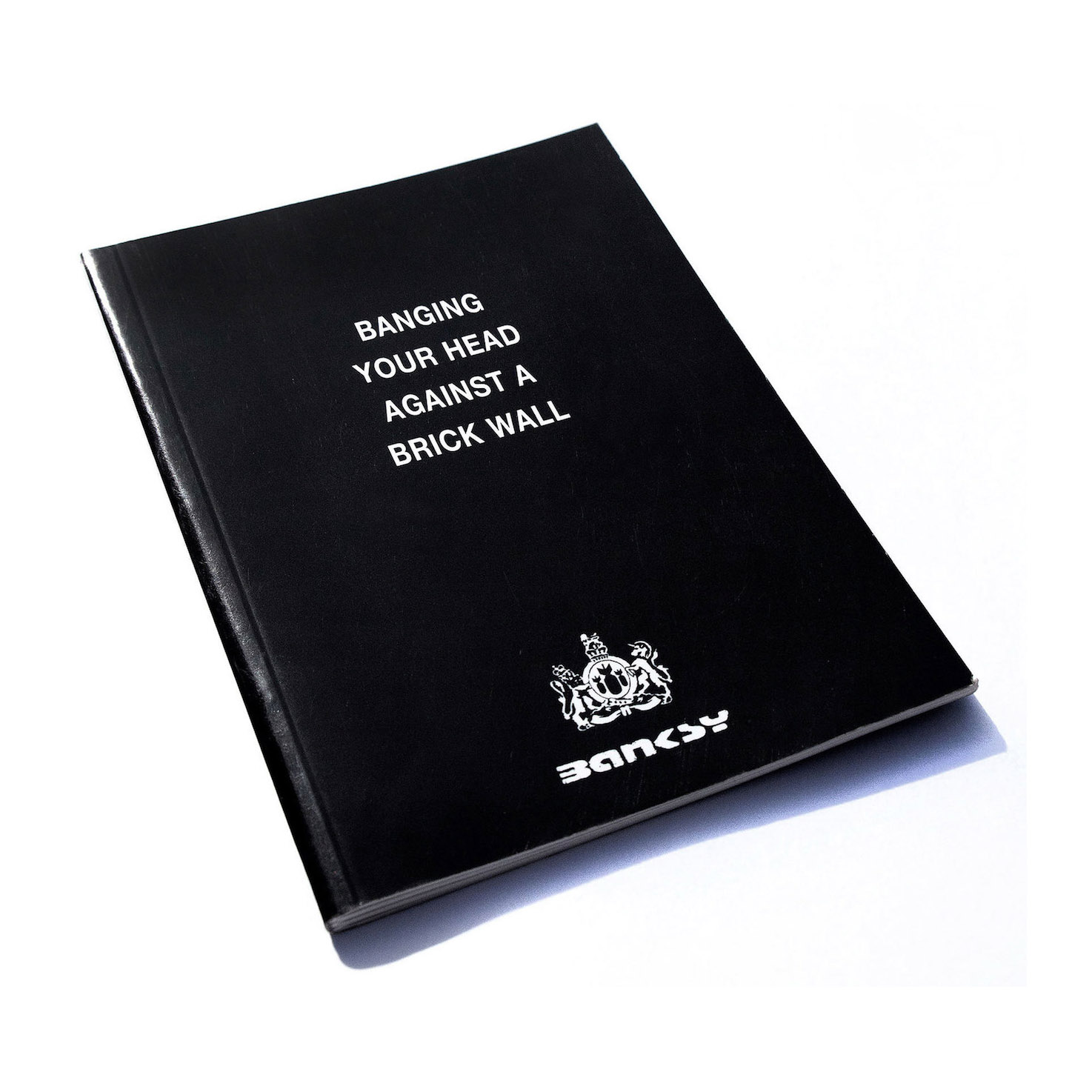
“Banging Your Head Against a Brick Wall” by Banksy. Image copyright EPM
Editions (x2): Two editions. First edition 2001 (inside the front cover copyright details and email address) Second edition (has the quotation and logo inside the front cover).
Purchase Banging Your Head Against A Brick Wall (Second Edition) here
Image Copyright Banksy