Want to keep up with the latest street art news and views?
Make The GraffitiStreet newsletter your first port of call, and leave the rest to us. We'll bring you a regularly-updated smörgåsbord of the most delicious morsels the urban art world has to offer direct to your Inbox.
https://graffitistreet.com/who-is-spidertag-the-complete-guide-to-his-art-and-interactive-neon-murals/https://graffitistreet.com/who-is-spidertag-the-complete-guide-to-his-art-and-interactive-neon-murals/ There's no Spam, and we'll never sell on your details. That's a promise!
Spidertag is a Spanish urban artist whose practice has expanded contemporary muralism through flexible neon, geometry and public participation. Active since 2008, he has developed a visual language across streets, architecture and studio works, moving from temporary interventions made with thread and electroluminescent cable to monumental Interactive Neon Murals that can be altered by viewers through a mobile application.
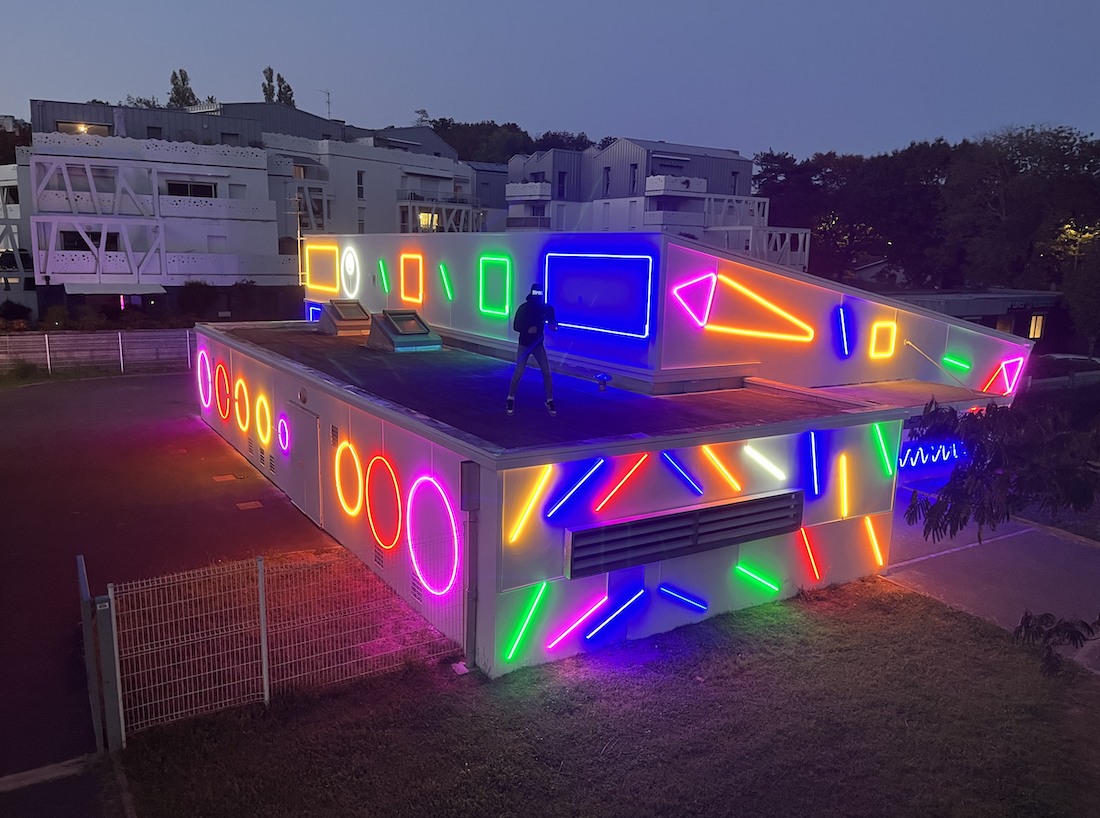
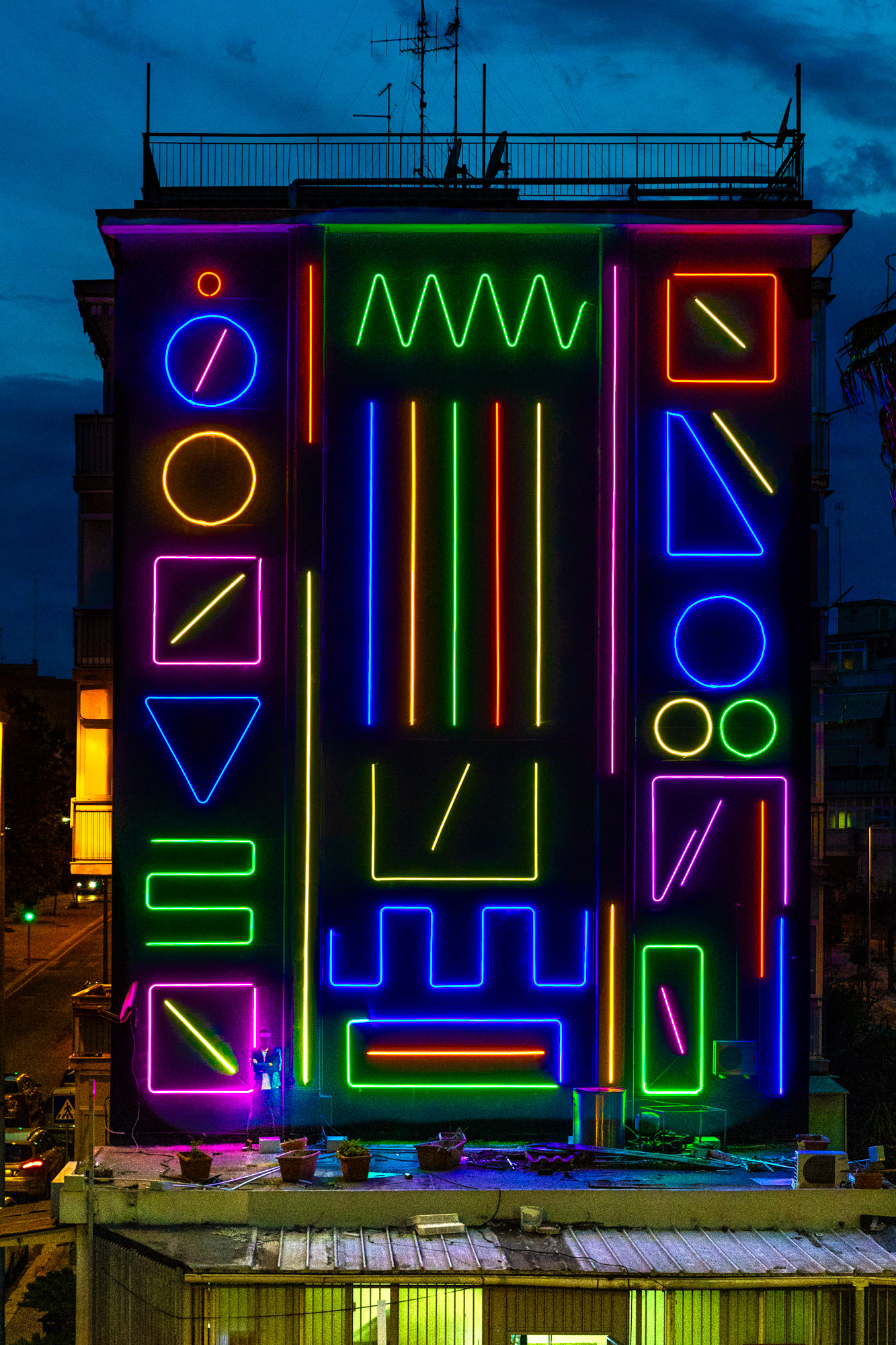
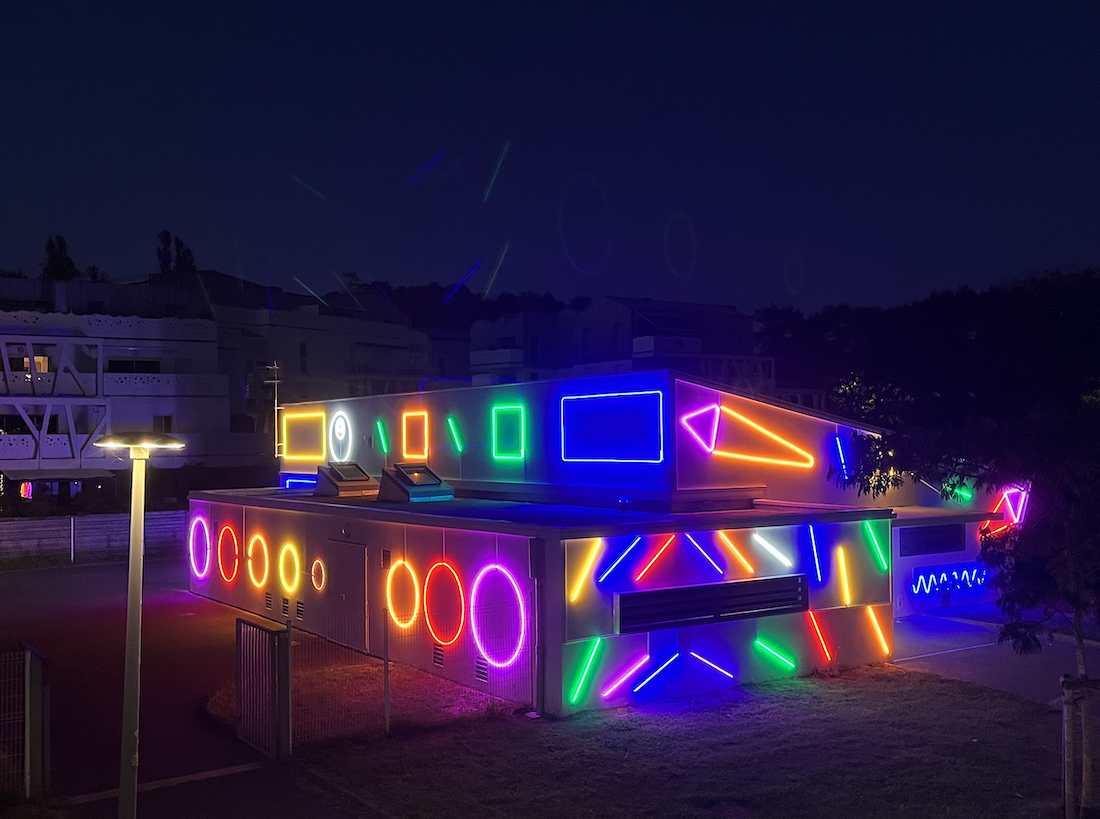
Spidertag, INM#25, Points de Vue Street Art Festival, Bayonne, France, 2025. Image courtesy of Spidertag.
His numbered INM# project began in Estarreja, Portugal, in 2018 and has since appeared across Europe, North America, South America, Asia and the Middle East. Rather than painting the appearance of illumination, Spidertag uses light as the line itself, drawing across façades with geometric signs that remain deliberately open to interpretation.
He describes this language as Futurism Primitivism: a meeting between elementary forms drawn from early human mark-making and the materials of contemporary technological culture. Lines, triangles, circles and directional signs appear at once ancient and digital, resembling fragments of an alphabet whose meaning has not been fixed.
Drawing on Spidertag’s extensive activity, original interviews and more than 25 project reports, this guide traces the development of Spidertag’s practice from his earliest street experiments to the Interactive Neon Murals, studio works and the 2026 drawing series Blue Signal /26.
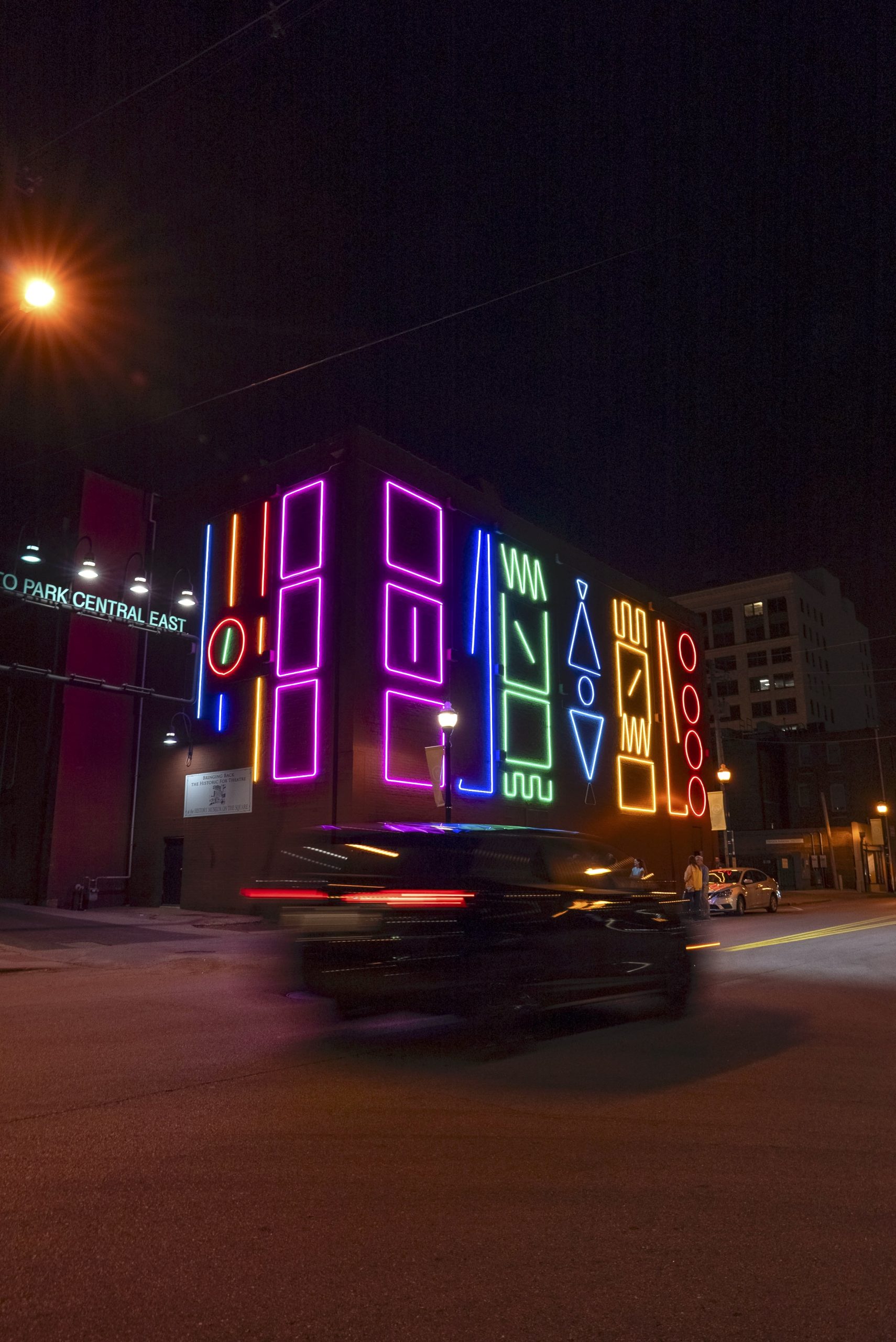
Spidertag, INM#23, Interactive Neon Mural across the History Museum on the Square and Historic Fox Theatre, Springfield, Missouri, 2024. Image courtesy of Justkids.
Artist: Spidertag Nationality: Spanish Active since: 2008 Known for: Interactive Neon Murals Project abbreviation: INM# First numbered mural: INM#1, Estarreja, Portugal, 2018 Artistic language: Futurism Primitivism Related concept: Neonmetry Principal materials: Flexible neon, LEDs, acrylic, thread and works on paper Public interaction: Selected murals can be altered through a mobile application
Early practice and the move towards light
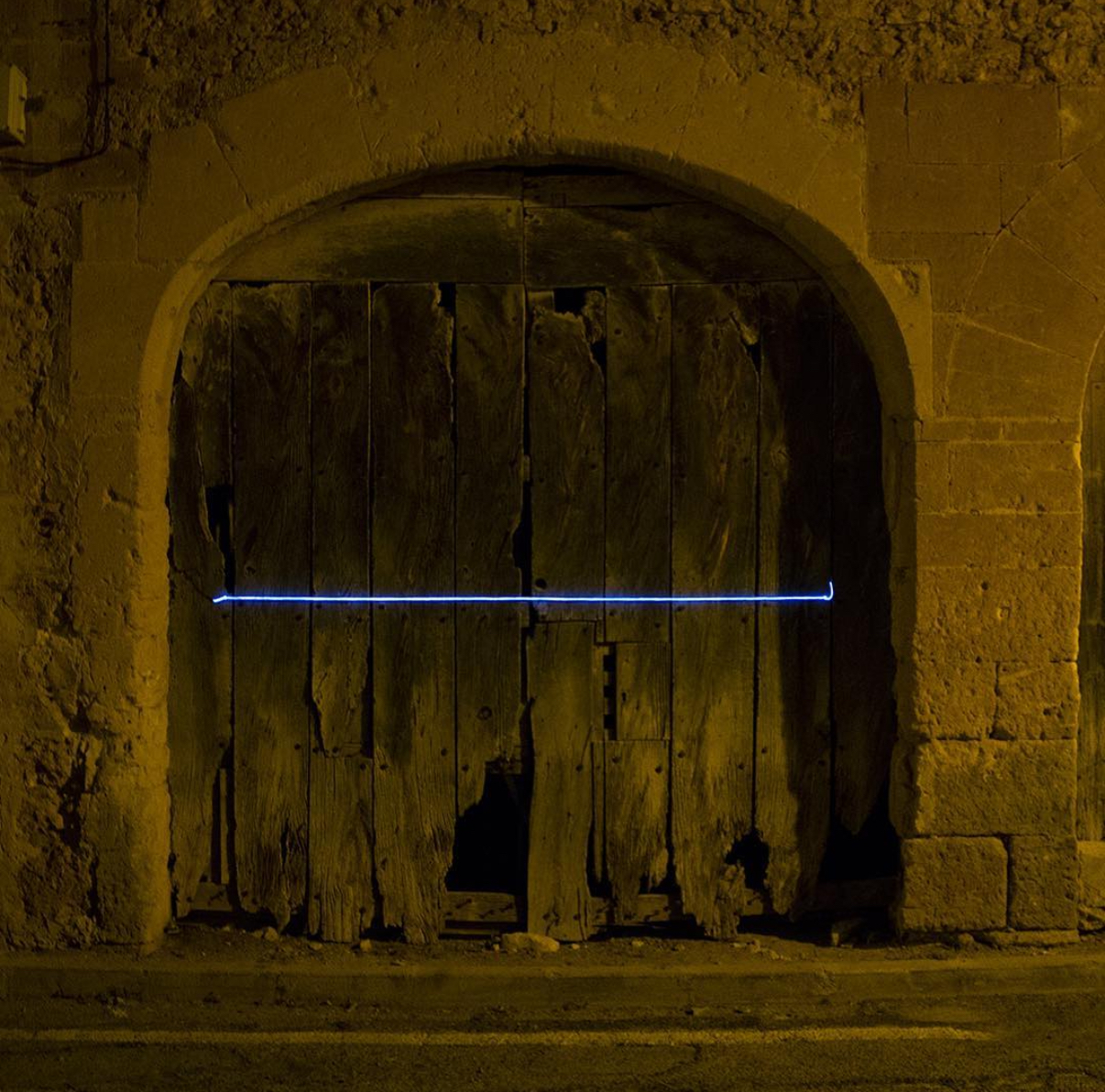
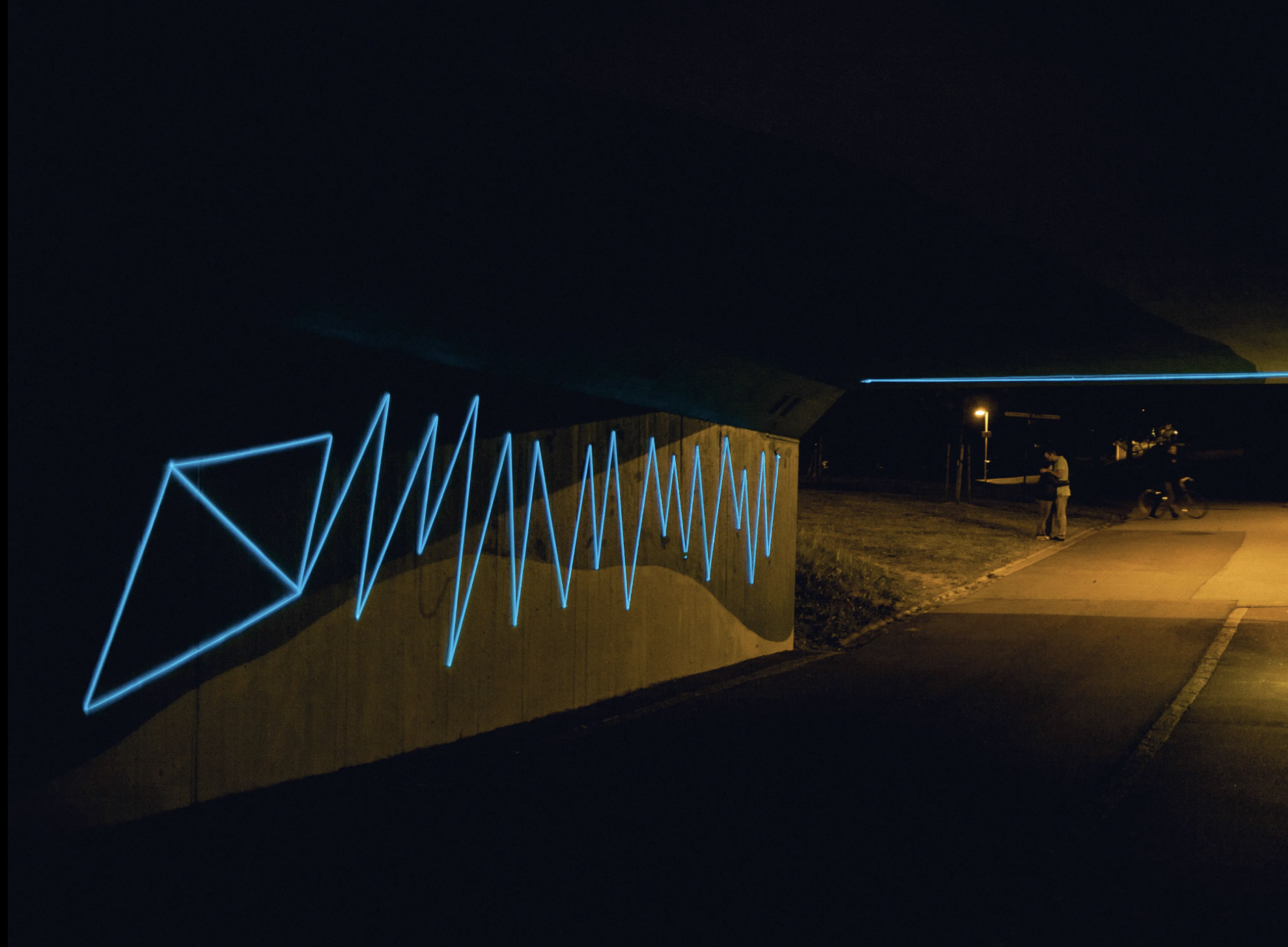
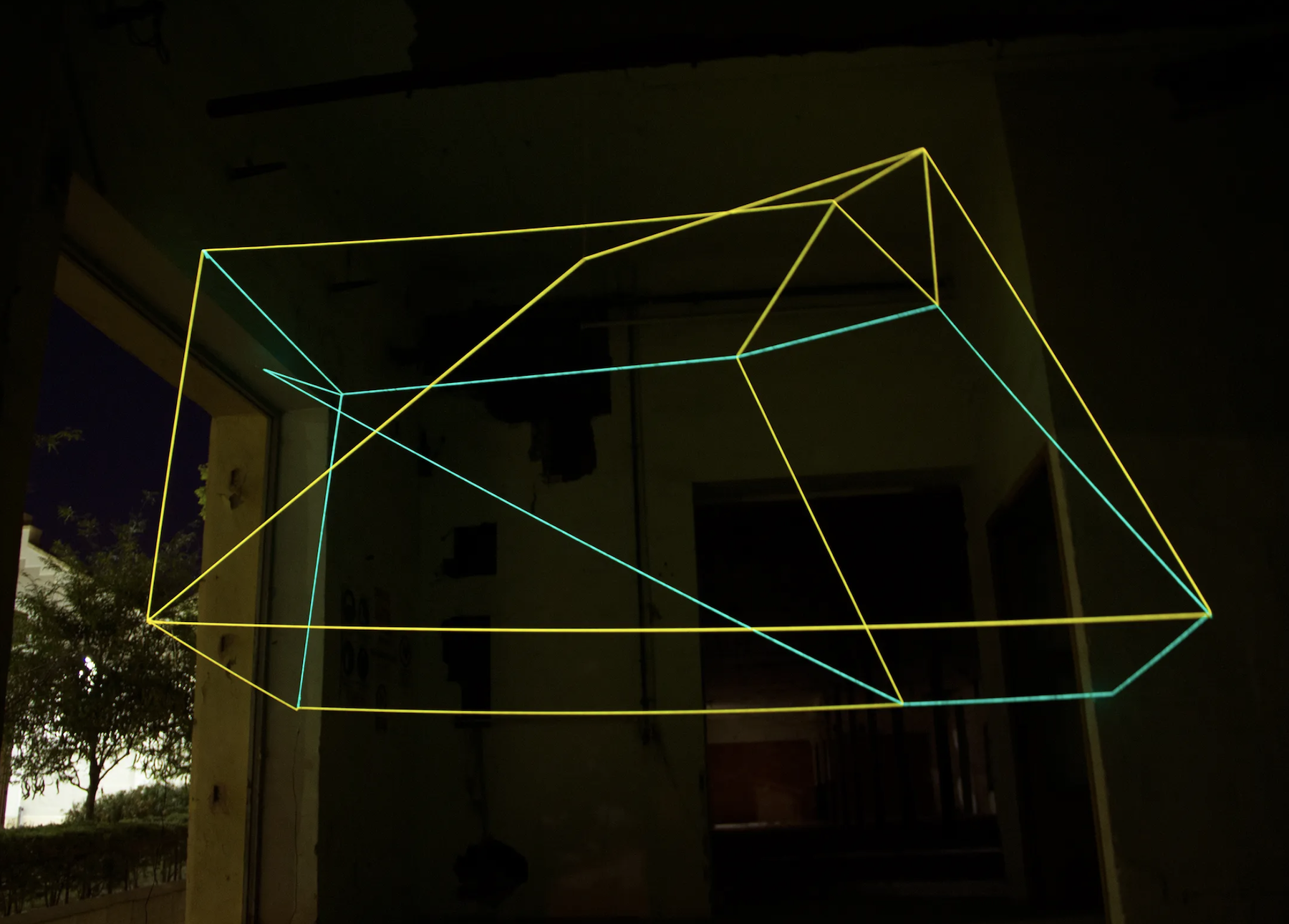
Spidertag began working in urban and rural environments in 2008. His early practice centred on geometry, abstraction and minimalism, using wool and thread to create temporary interventions across walls, abandoned buildings and landscapes.
These works already established a defining principle of his practice. Architecture was not treated as a neutral support, but as an active element within the composition. Lines responded to corners, openings, irregular surfaces and the surrounding environment, often extending beyond the conventional boundaries of a mural.
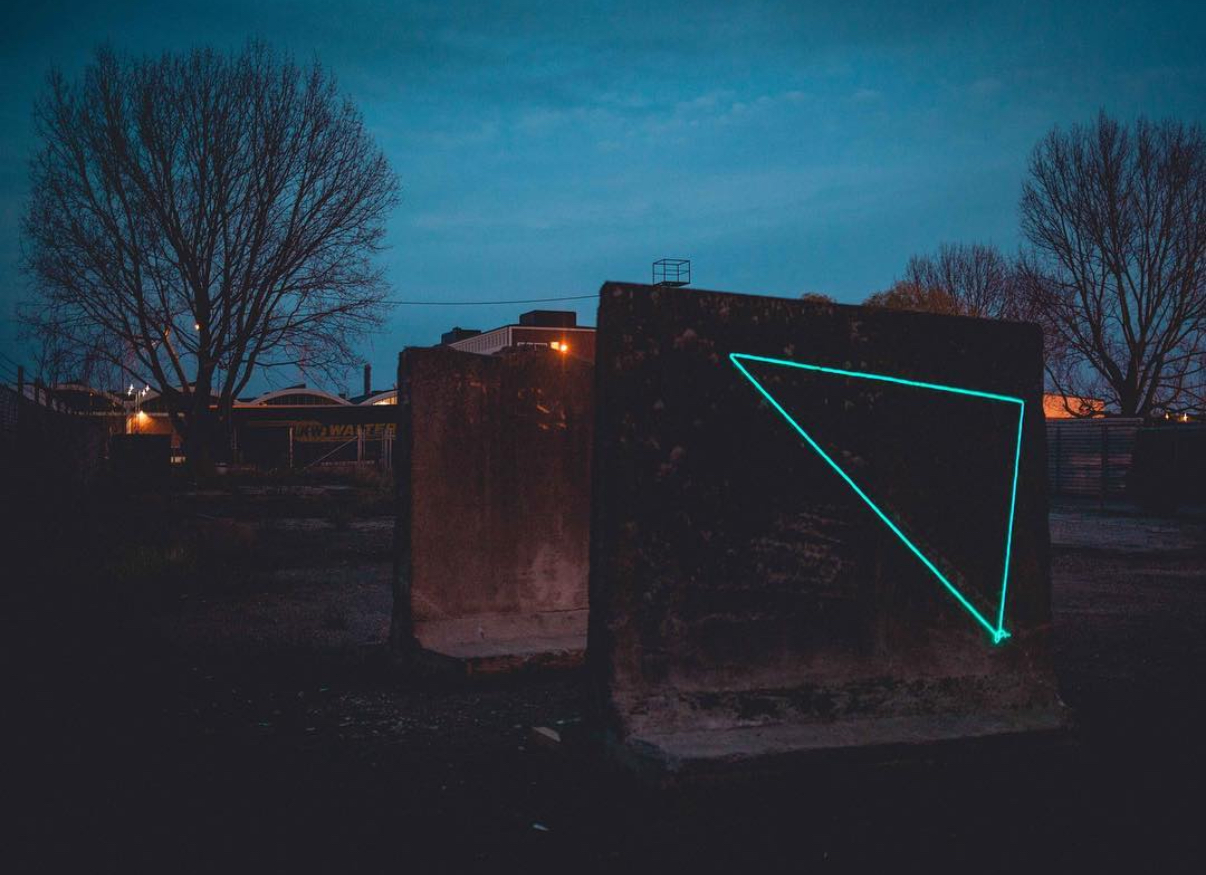
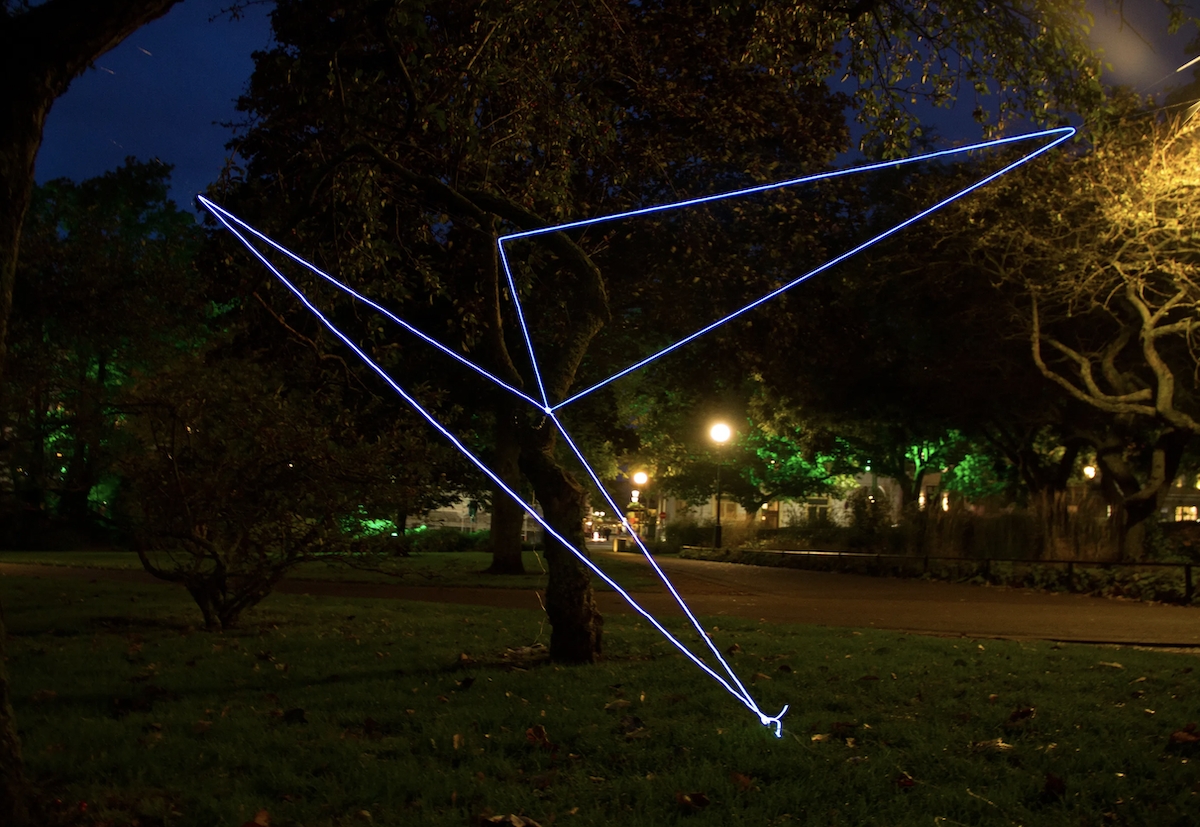
Spidertag, Triangle, Malmö, Sweden, April 2017. Photograph by Futuro Berg.
Technology entered his work at an early stage. Around 2010, Spidertag incorporated QR codes into paste-ups and later experimented with ultraviolet light in the Swiss Alps. Although different in scale and material, these projects anticipated the relationship between physical mark-making and digital participation that would later become central to his neon murals.
In late 2015, he began working with small battery-powered electroluminescent cables. The material allowed him to produce luminous geometric interventions without relying on painted or aerosol-based effects. As quoted from our original GraffitiStreet interview with Spidertag.
“I discovered a tiny tube that glows with batteries that I used to create interventions in the streets.”
The cable offered light and mobility, but its size limited its architectural potential. Spidertag continued searching for a material capable of producing the same visual effect across large walls.
The arrival of flexible neon designed for architectural and industrial use provided that possibility. What had begun as a temporary line of light could now be developed into a permanent form of muralism.
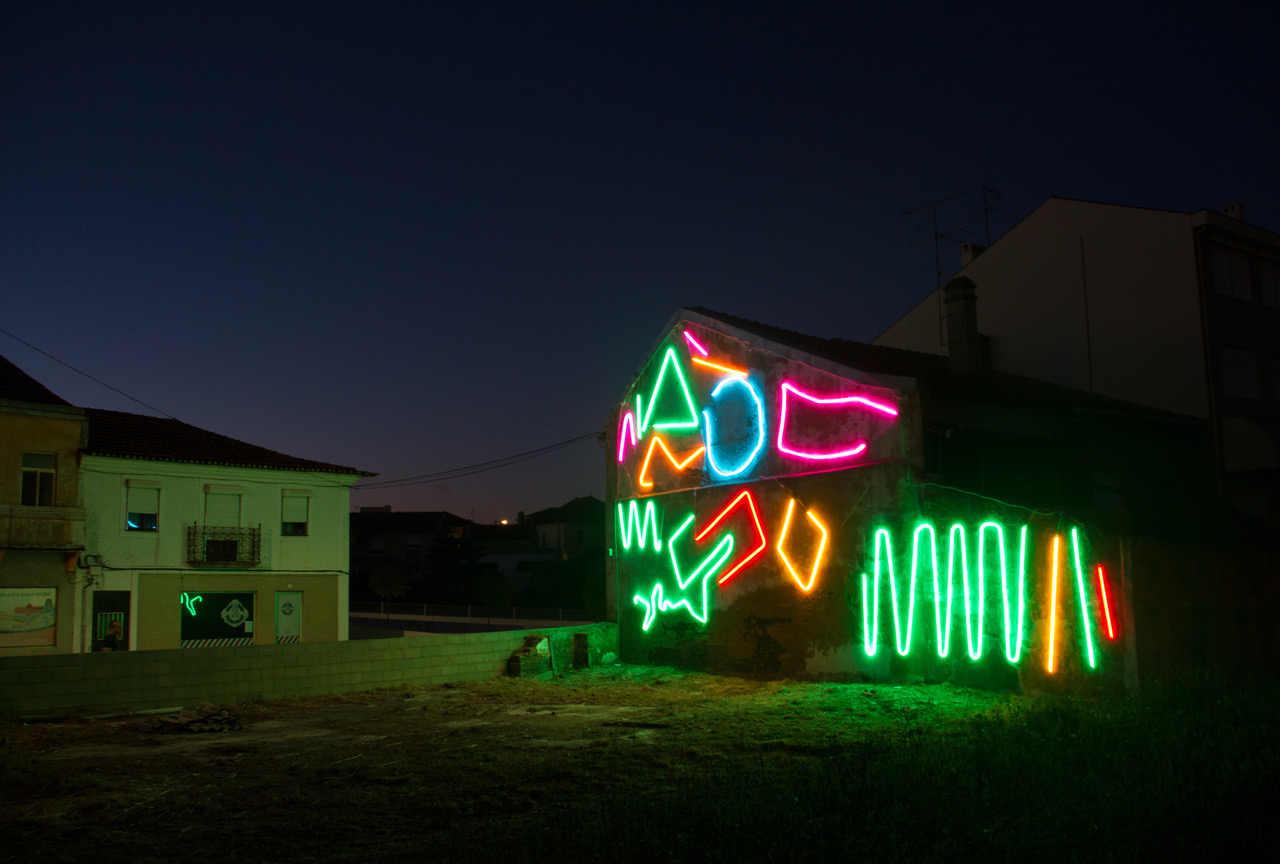
Spidertag created the first numbered Interactive Neon Mural, INM#1, for ESTAU Urban Art Festival in Estarreja, Portugal, in 2018.
The project established the central elements of the series: flexible neon, geometric abstraction, architecture, technical fabrication and public interaction.
Each work is identified by the abbreviation INM#, followed by its chronological number. The numbering connects murals created in different countries and architectural settings as parts of a single evolving project.
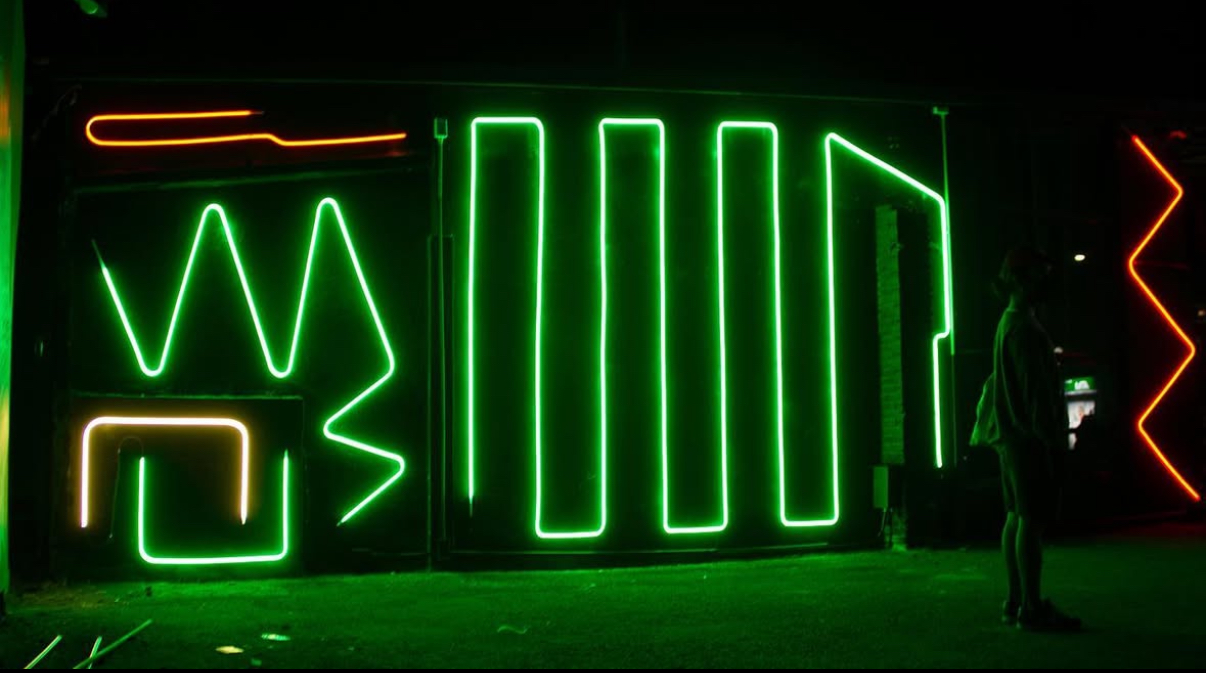
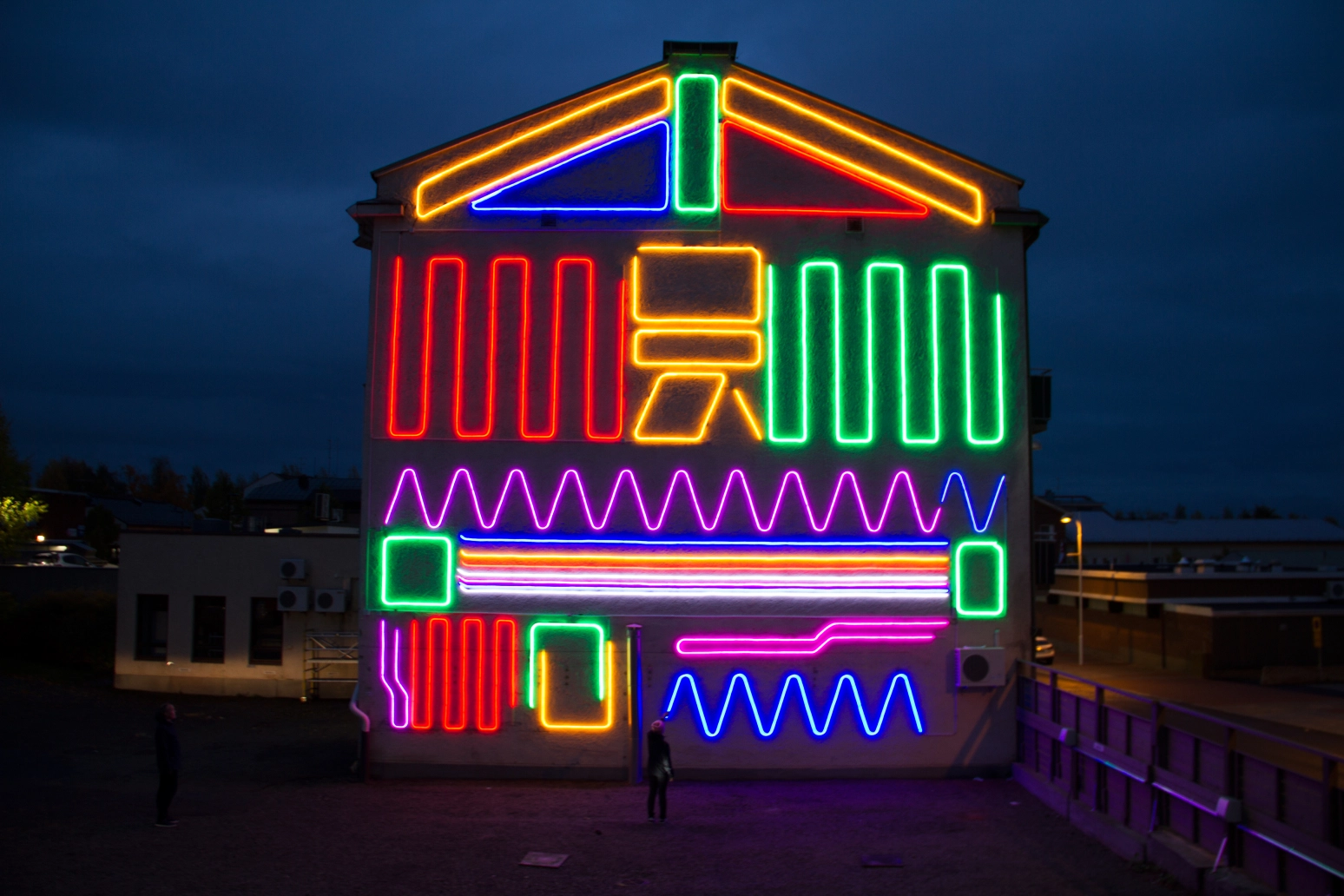
Unlike conventional painted murals, the works use physical light as their principal visual material. Flexible neon and LED elements are fixed across façades, allowing illuminated lines to frame windows, cross structural divisions and turn around corners.
During daylight, the viewer can see the physical construction: cables, fittings and geometric structures arranged across the architecture. At night, the relationship changes. The supporting components recede and the luminous line becomes dominant.
The murals therefore possess two distinct visual conditions. By day, they appear diagrammatic and structural. After dark, they reorganise the building through colour and light.
“The night is the natural time for graffiti, and in my case, it’s the natural time for neons.”
The compositions are formed from a recurring vocabulary of lines, circles, squares, triangles, frames, arrows and directional gestures. These forms do not illustrate recognisable subjects. They operate as signs within a visual system whose meanings remain unresolved.
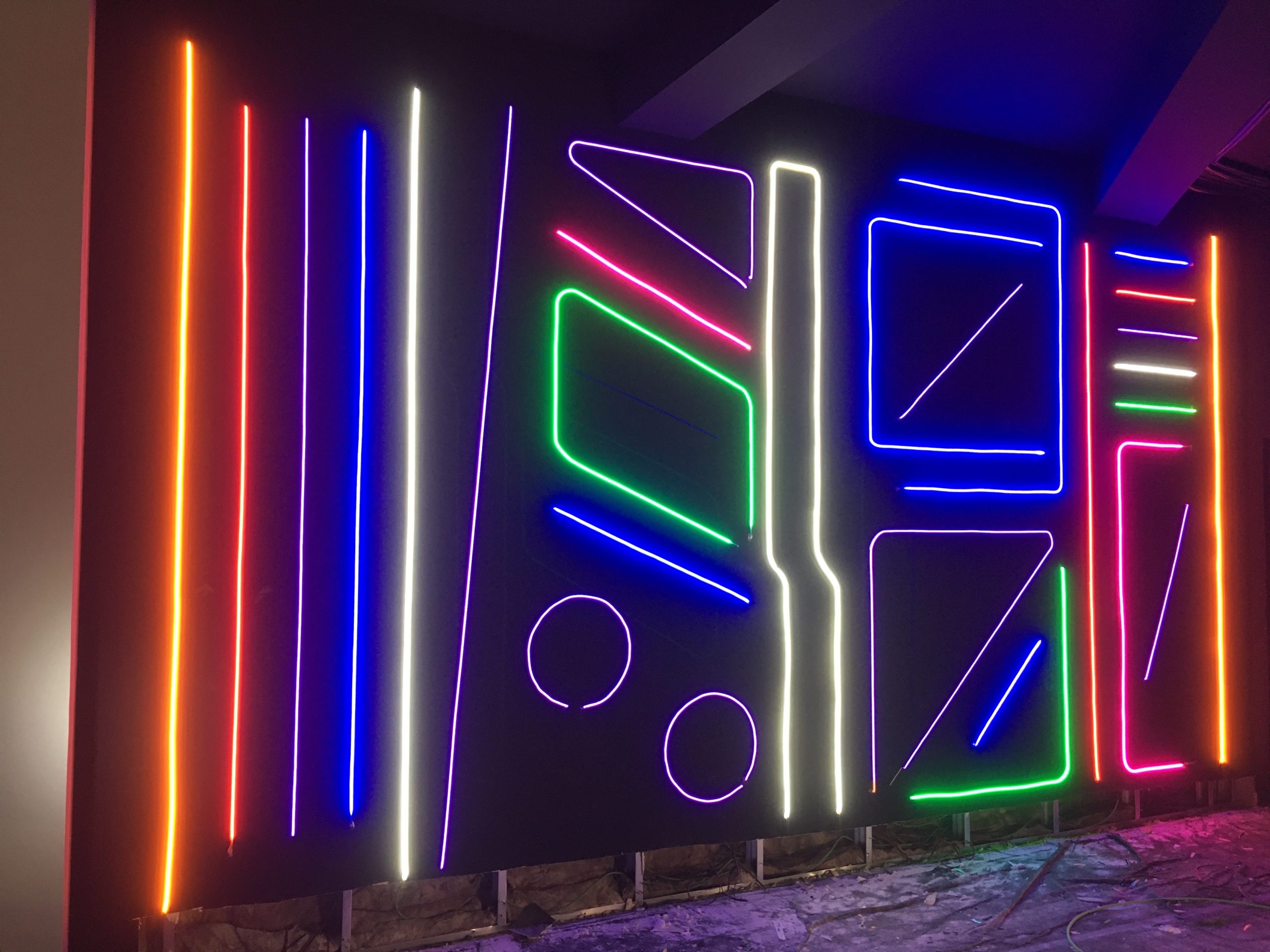
Spidertag, INM#1, ESTAU Urban Art Festival, Estarreja, Portugal, 2018. Image courtesy of Spidertag.
Futurism Primitivism
Spidertag describes the language behind his work as Futurism Primitivism.
The term unites two apparently opposing conditions. Its primitive element comes from elementary forms that have appeared throughout human history: the line, triangle, square, circle and directional sign. Such marks precede formal written language and recur within early systems of communication, ritual, architecture and navigation.
Its futuristic element comes from the material through which those forms are expressed. Neon, LEDs, electronic controls and digital interfaces belong to the visual and technological culture of the present.
“I created my own language based on primitive art forms from human history, mixed with geometry, abstraction, symbolism, and the possibilities and impossibilities of materials.”
A triangle may recall an ancient symbol while also resembling a digital icon. A sequence of parallel lines can suggest architectural order, electronic circuitry or movement through a virtual space.
This tension prevents the work from belonging entirely to either past or future. Its forms feel familiar without offering a stable translation.
Spidertag has cited graffiti, Russian Constructivism, kinetic art, architecture, electronic music, cinema, literature and video games among the influences on his practice. These references are absorbed into a language that remains recognisably his own.
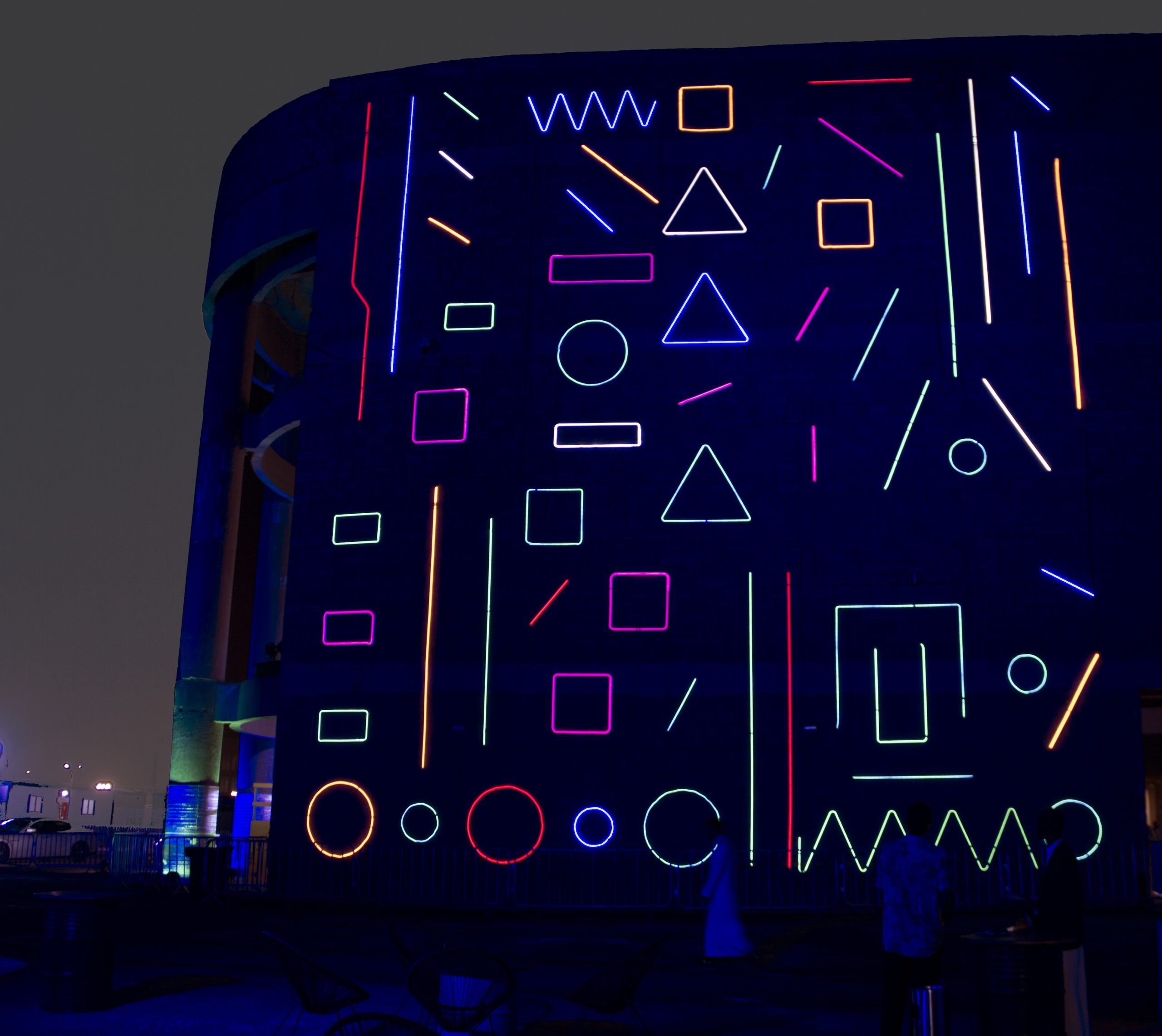
Spidertag, INM#19, Interactive Neon Mural, Riyadh, Saudi Arabia, 2023. Image courtesy of Spidertag.
Neonmetry
Spidertag also uses the term Neonmetry to describe the meeting of neon and geometry within his work.
The flexible cable functions like a drawn line, but unlike pencil, paint or aerosol, it emits light beyond its own physical edge. It affects not only the wall but also the space surrounding it.
Darkness is therefore more than a background. It is one of the conditions through which the work becomes fully visible.
As daylight fades, parts of the architecture disappear while the illuminated geometry appears to detach from its support. The mural can seem less like an object fixed to a wall and more like a coded signal suspended across the building.
This relationship between line, light and darkness connects Spidertag’s work to the nocturnal history of graffiti, while giving the night a different function. Darkness does not conceal the artwork; it activates it.
Spidertag’s murals are conceived in direct response to their architectural setting.
Windows, corners, rooflines, surface changes and the overall proportions of a façade influence the direction and balance of the composition. A building is not simply covered by an image. Its existing structure becomes part of the visual language.
Scale alters how the work is encountered. A geometric sign drawn on paper can be understood in a single glance. When extended across a building, the same form demands movement. The viewer may need to step back, look upwards or cross the street to understand the composition.
The murals are therefore experienced both visually and physically.
A line may connect distant parts of a façade, while a change of direction can lead the eye towards a window, edge or architectural interruption. Repetition creates order; deviation introduces tension.
This sensitivity to architecture separates the works from illuminated signage. Although both use artificial light, Spidertag’s murals do not advertise a fixed message. Their symbols remain open and their meaning changes according to scale, colour and location.
A major Interactive Neon Mural can require approximately two months of preparation.
The process begins with conversations between Spidertag and the commissioning festival, cultural organisation or building owner. The artist develops a composition in response to the site before translating it into a detailed technical plan.
Artistic sketches establish the movement, rhythm and balance of the forms. Technical drawings determine measurements, electrical routes, materials, fixing points and the relationship between the neon elements and the architecture.
Fabrication takes place before the components are transported to the site. Depending on the project, Spidertag may work with manufacturers, architects, engineers, electricians, contractors and assistants.
The apparent clarity of the finished work conceals a complex process involving weather resistance, power distribution, access, safety and long-term durability.
“Every advance that I make and that I’ve made requires time and effort to make it correctly.”
For the artist, the decisive moment arrives when the mural is illuminated in full for the first time.
“The instant of happiness is what I call the moment in which I turn it on for the first time every new mural.”
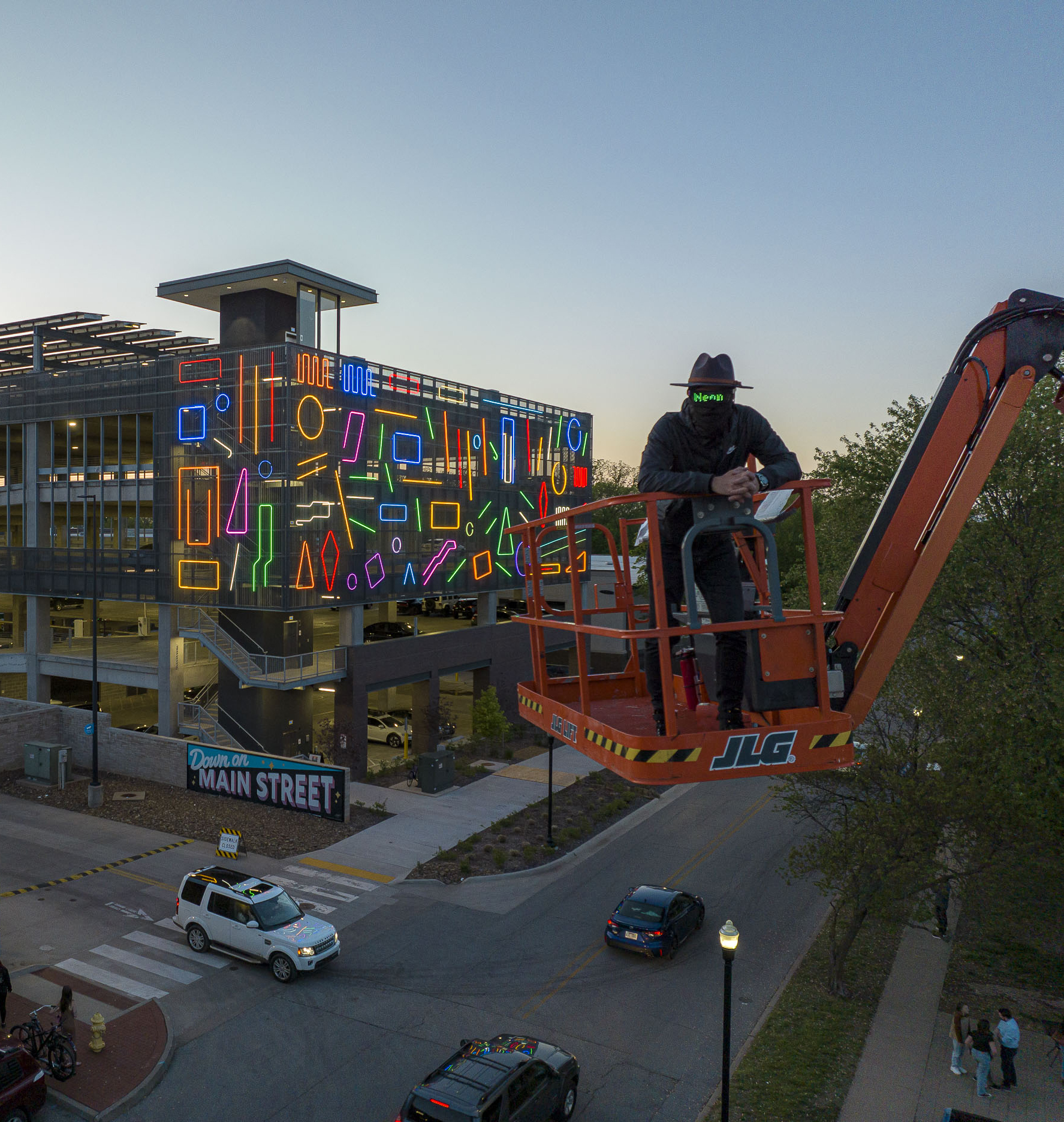
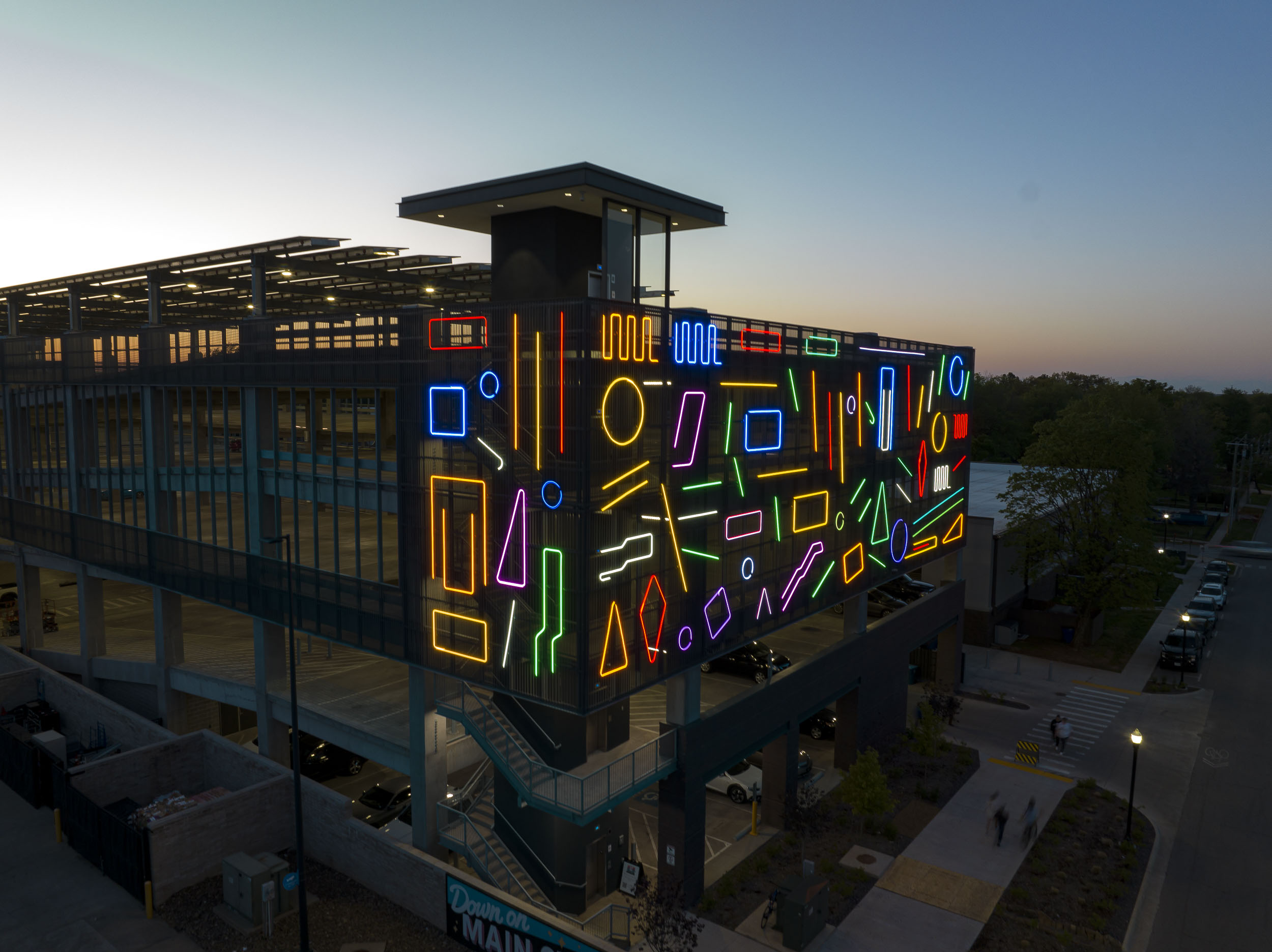
Spidertag, INM#16, Interactive Neon Mural, Bentonville, Arkansas, USA, 2023. Photograph courtesy of Justkids.
Public participation and the mobile application
Selected Interactive Neon Murals can be altered through a dedicated mobile application accessed by scanning a QR code near the work.
The app allows viewers to change colours and activate programmed lighting sequences in real time. The underlying composition remains Spidertag’s, but its appearance can temporarily shift according to public interaction.
This changes the conventional relationship between mural and audience. Rather than encountering a permanently fixed colour arrangement, the viewer becomes an active participant within the work.
Spidertag’s interest in QR technology predates its widespread use within public art. His early paste-ups explored the ability of a physical mark to connect with an unseen digital layer. The INM# application later expanded that idea to architectural scale.
The interaction often begins with uncertainty. Viewers are first attracted by the illuminated forms before discovering that the mural can respond to them.
“Once they get closer and discover that, through a QR code, they can download an app and change colours and other things to be part of the mural, they are amazed.”
Technology forms part of the encounter, drawing the audience closer and allowing the mural to remain visually changeable after its completion.
The international development of INM#
Since 2018, the Interactive Neon Murals have appeared across Europe, North America, South America, Asia and the Middle East.
The series has been presented through major mural festivals and public-art programmes including ESTAU in Portugal, POW! WOW! Hawaii, MURAL Festival Montréal, Upeart in Finland, Peinture Fraîche in Lyon, Life Is Beautiful in Las Vegas, Memorie Urbane in Italy and Points de Vue in Bayonne.
Each project retains the same core language while responding to a different architectural and cultural setting.
The series began with INM#1 in Estarreja and expanded rapidly during 2019, with murals in Santiago, Honolulu, Montréal, Worcester, Iisalmi and Chiang Mai.
Later works increased in scale and technical complexity. They also extended the project into new contexts, from gaming and esports environments to historic city centres, museums and cultural buildings.
GraffitiStreet maintains a separate visual archive documenting the complete mural chronology from INM#1 onwards.
Spidertag, INM#23, Interactive Neon Mural across the History Museum on the Square and Historic Fox Theatre, Springfield, Missouri, 2024. Image courtesy of Justkids.
Explore the complete Spidertag Interactive Neon Murals archive.
Created for ESTAU Urban Art Festival, INM#1 established the numbered series and marked Spidertag’s transition from temporary luminous interventions to permanent neon muralism.
The work brought together geometry, architecture, technical fabrication and public participation, creating the foundation for the projects that followed.
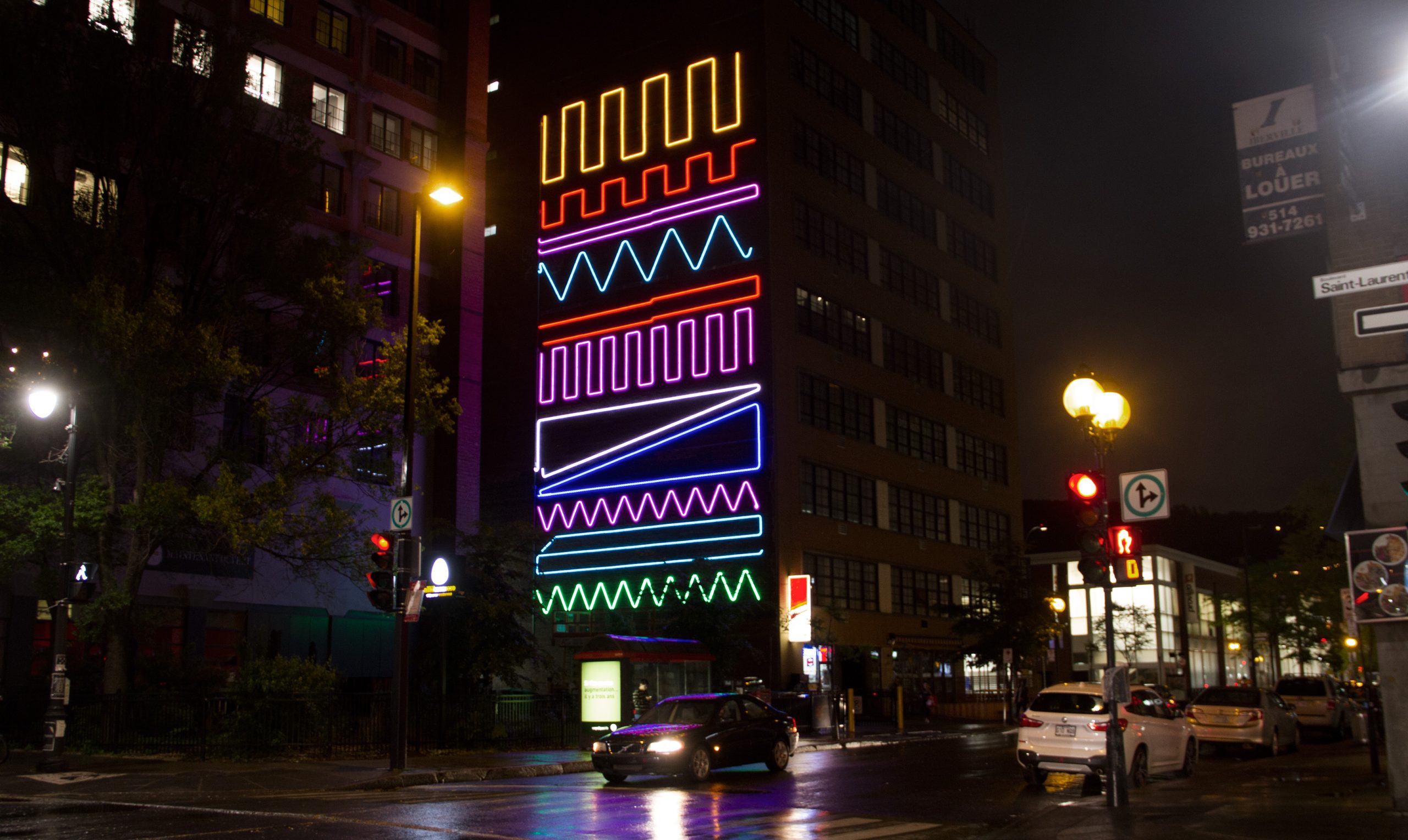
INM#4 was created for MURAL Festival at the intersection of Boulevard Saint-Laurent and Mont-Royal.
Extending across an approximately 27-by-14-metre façade, the mural demonstrated how Spidertag’s geometric language could operate at monumental scale within a dense urban environment.
Its location at a major intersection allowed the work to be seen from multiple viewpoints, while its illuminated forms transformed the building after dark.
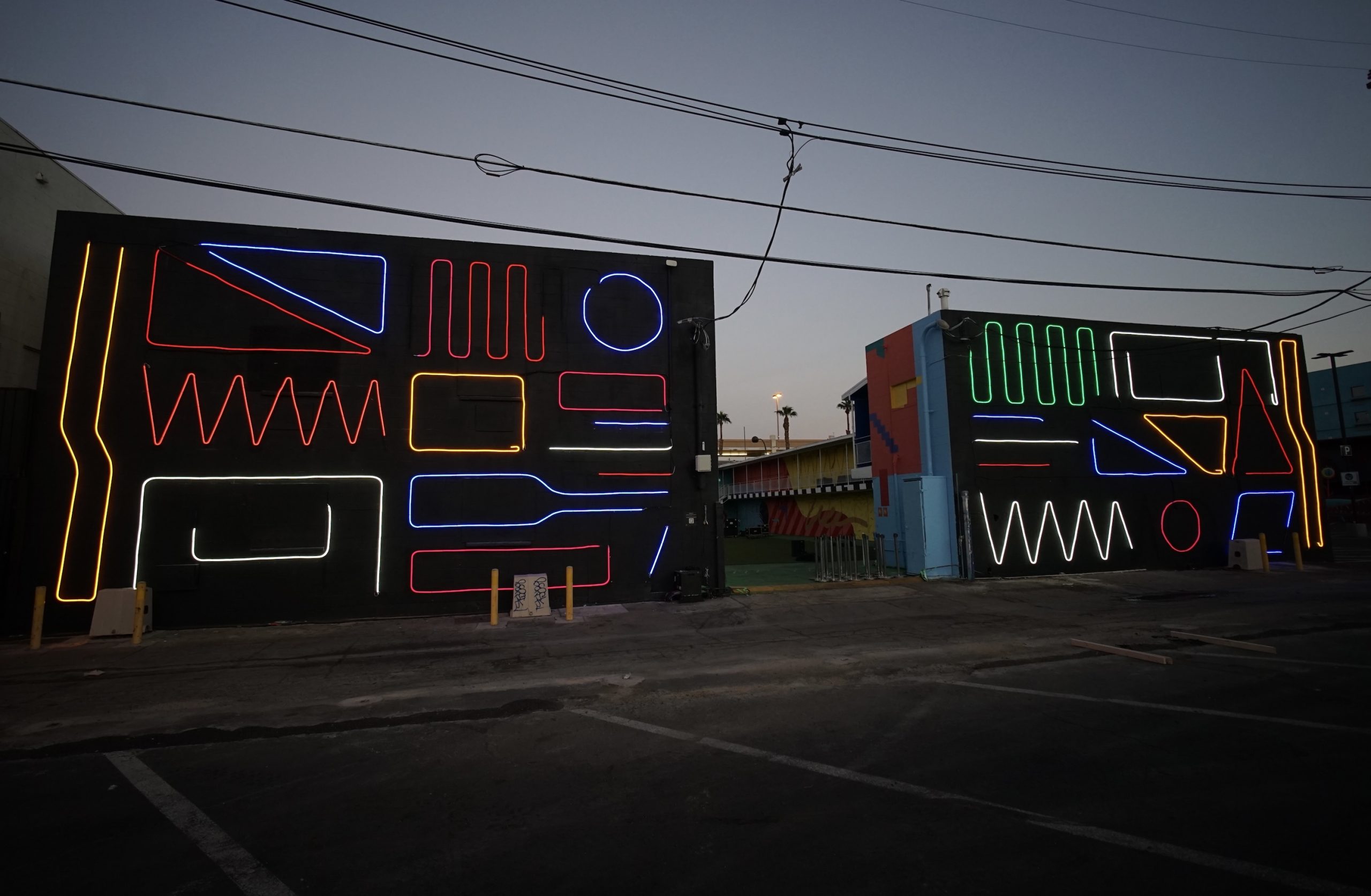
Created for Life Is Beautiful Festival, INM#12 placed Spidertag’s work within a city whose identity is inseparable from neon. Produced by Justkids.
Las Vegas traditionally uses illuminated signs to communicate names, products and destinations. Spidertag removed neon from this commercial function and redirected it towards abstraction.
The mural communicated through colour, rhythm and geometry without promoting a fixed message.
Spidertag, INM#12, Life Is Beautiful Festival, Las Vegas, USA, 2021. Photograph by Halopigg.
Created for Points de Vue Street Art Festival, INM#25 extended across an approximately 30-by-5-metre wall.
The work marked the twenty-fifth numbered mural in a project that had begun seven years earlier. Its elongated format allowed the composition to unfold horizontally, with signs and directional gestures moving across the façade like a continuous transmission.
“Neon is my language.”
Spidertag, INM#25, Points de Vue Street Art Festival, Bayonne, France, 2025. Image courtesy of Spidertag.
From public murals to studio works
Spidertag’s studio practice does not represent a departure from his muralism. It brings the same visual language into a more concentrated form.
Removed from public architecture, individual signs can be examined more closely. A line, colour change or geometric interruption carries greater emphasis when separated from the visual complexity of the street.
His studio works include illuminated pieces on acrylic, modular neon works and drawings. The recurring forms, lines, triangles, frames and directional gestures, remain consistent across each medium.
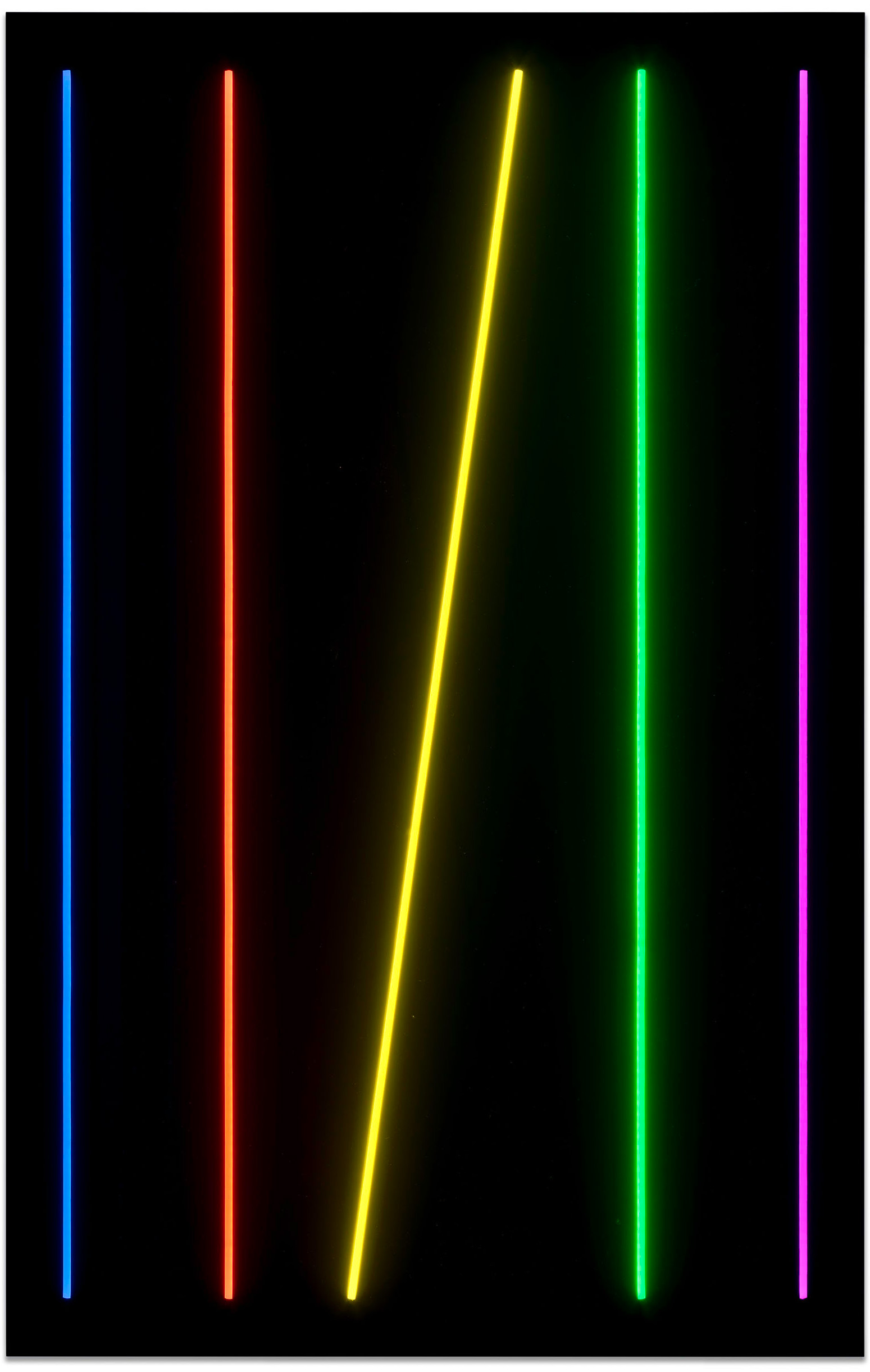
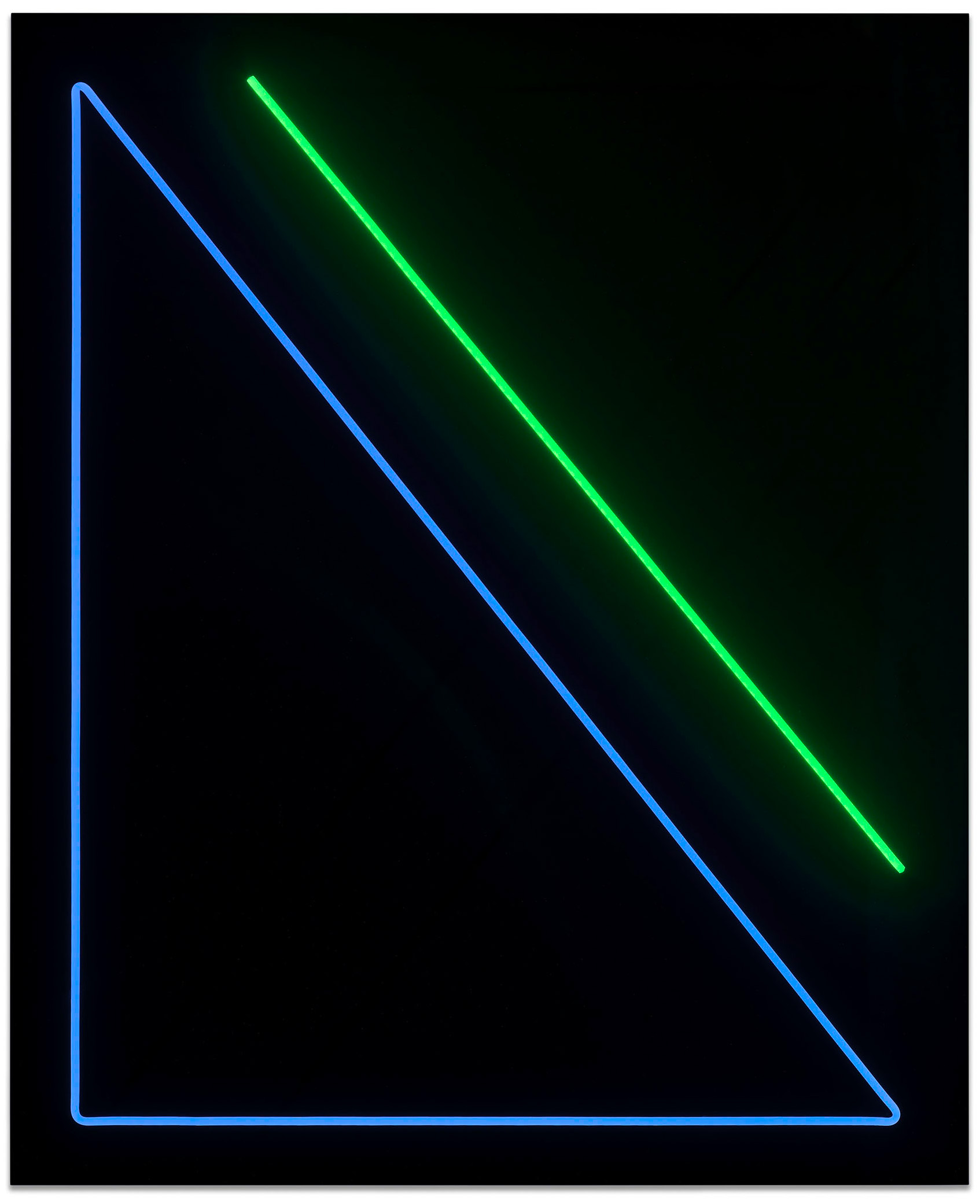
For GraffitiStreet’s 2025 exhibition Concrete & Colour, Spidertag presented works including Lines & Yellow and Triangle Line Blue & Green, and spoke to us in our interview about the power of the line.
Lines & Yellow used a sequence of parallel neon lines interrupted by a single yellow element. The deviation broke the established rhythm and introduced a sense of movement and release.
Triangle Line Blue & Green explored balance through the relationship between a stable geometric form and a directional line.
Spidertag has also developed modular works composed of separate illuminated symbols. These elements can be rearranged into different configurations, allowing the visual system to change while remaining within the artist’s established vocabulary.
Spidertag – Lines & Yellow (2025)Spidertag – Triangle Line Blue Green (2025)
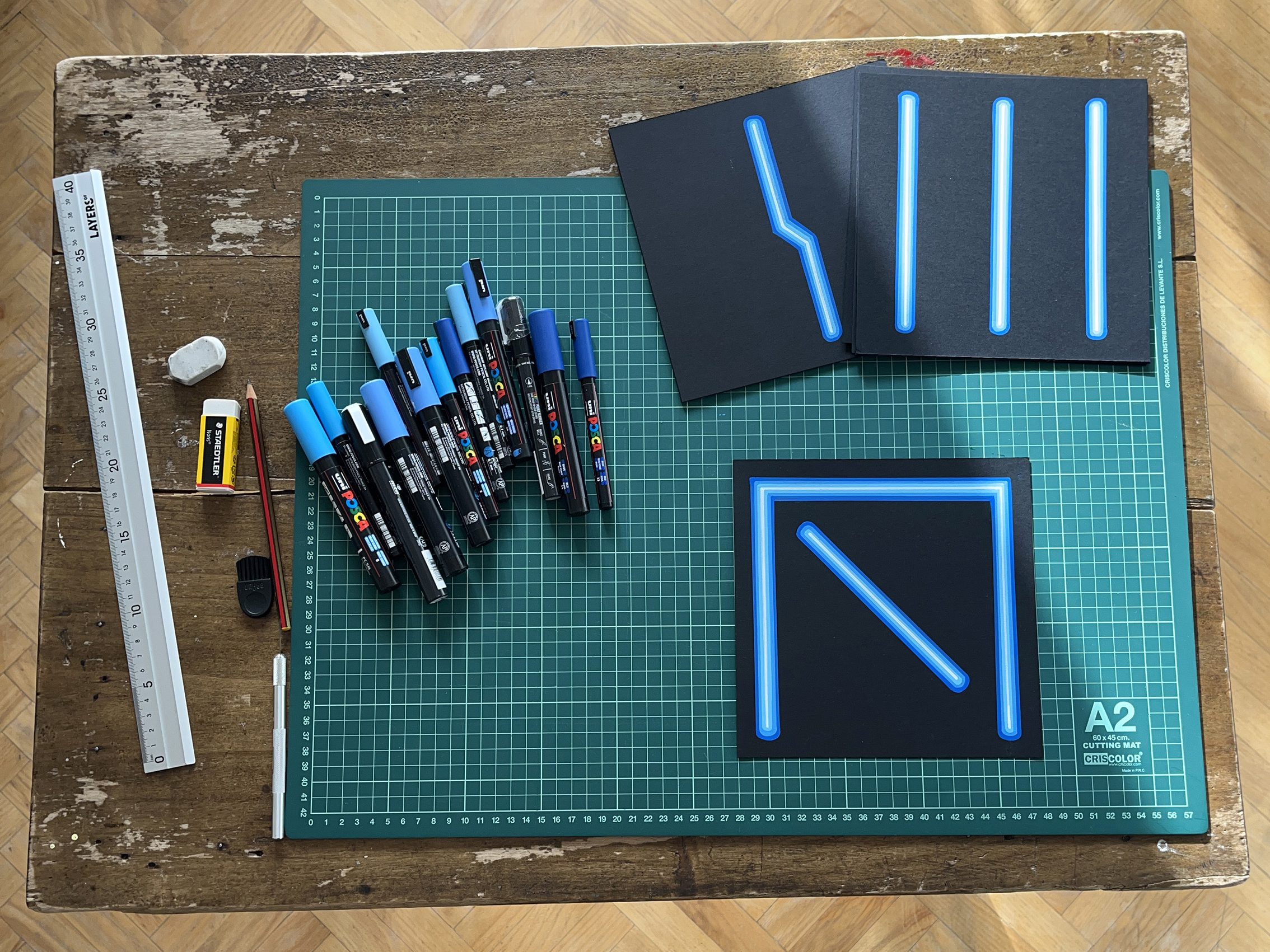
In 2026, Spidertag introduced Blue Signal /26, his first dedicated body of hand-drawn works on paper.
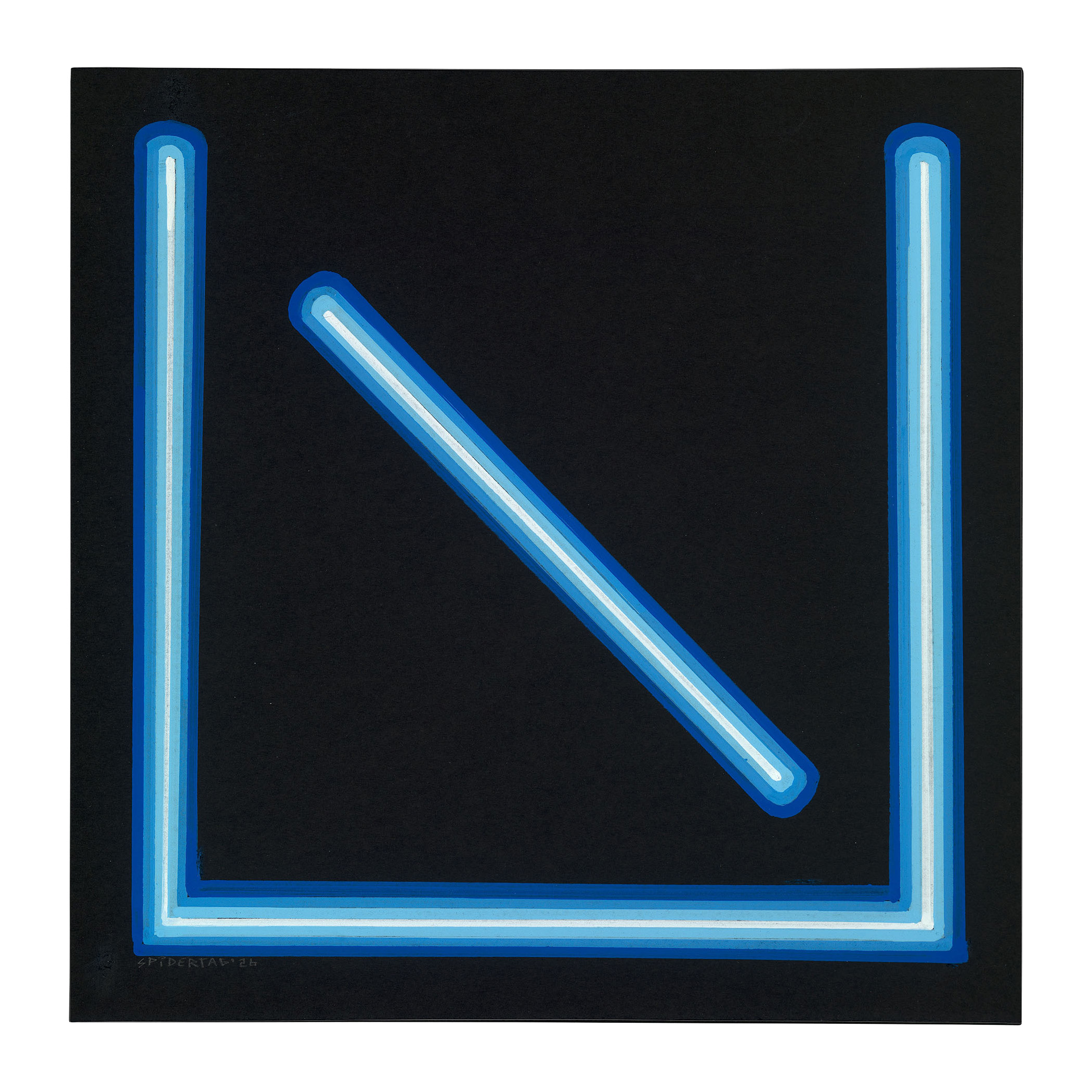
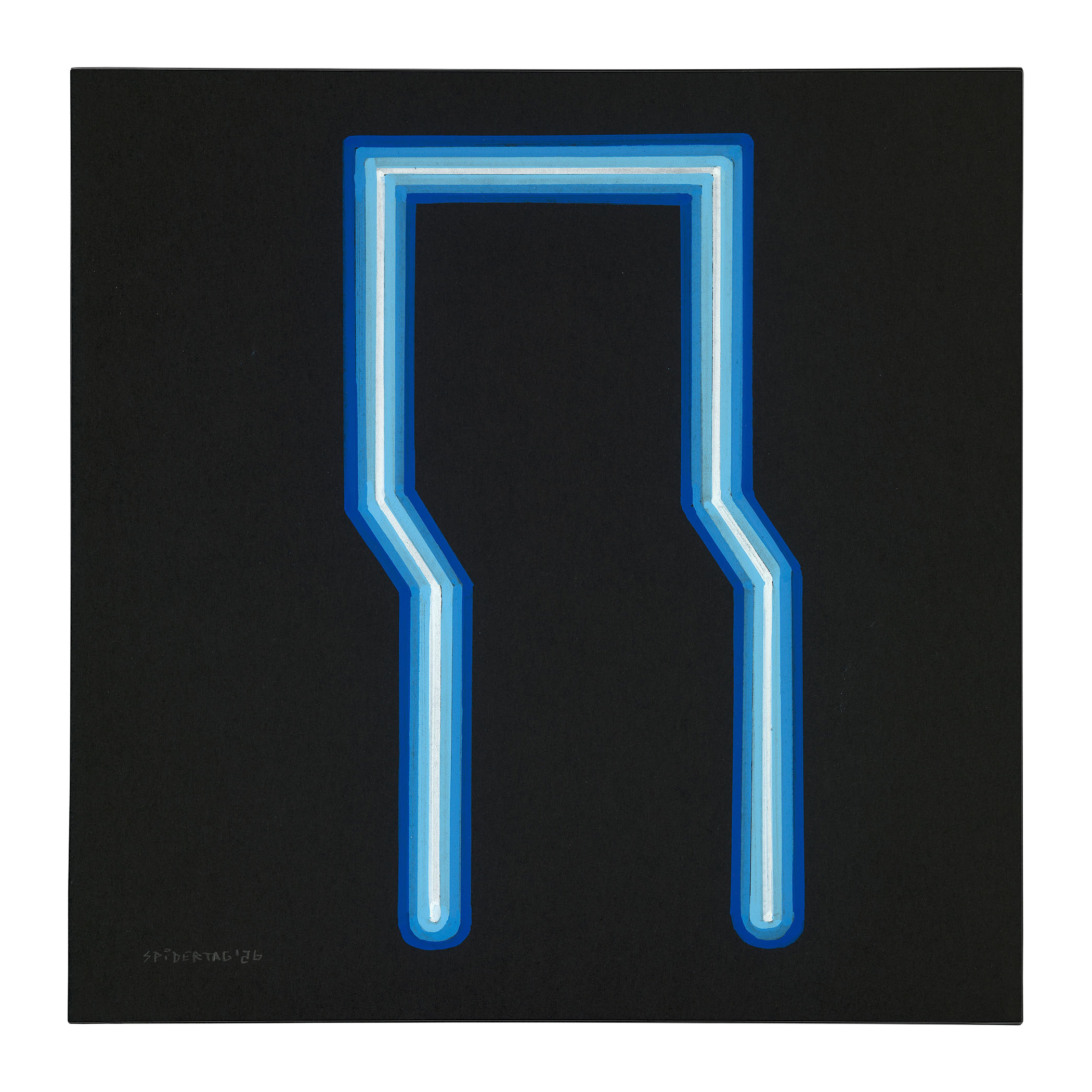
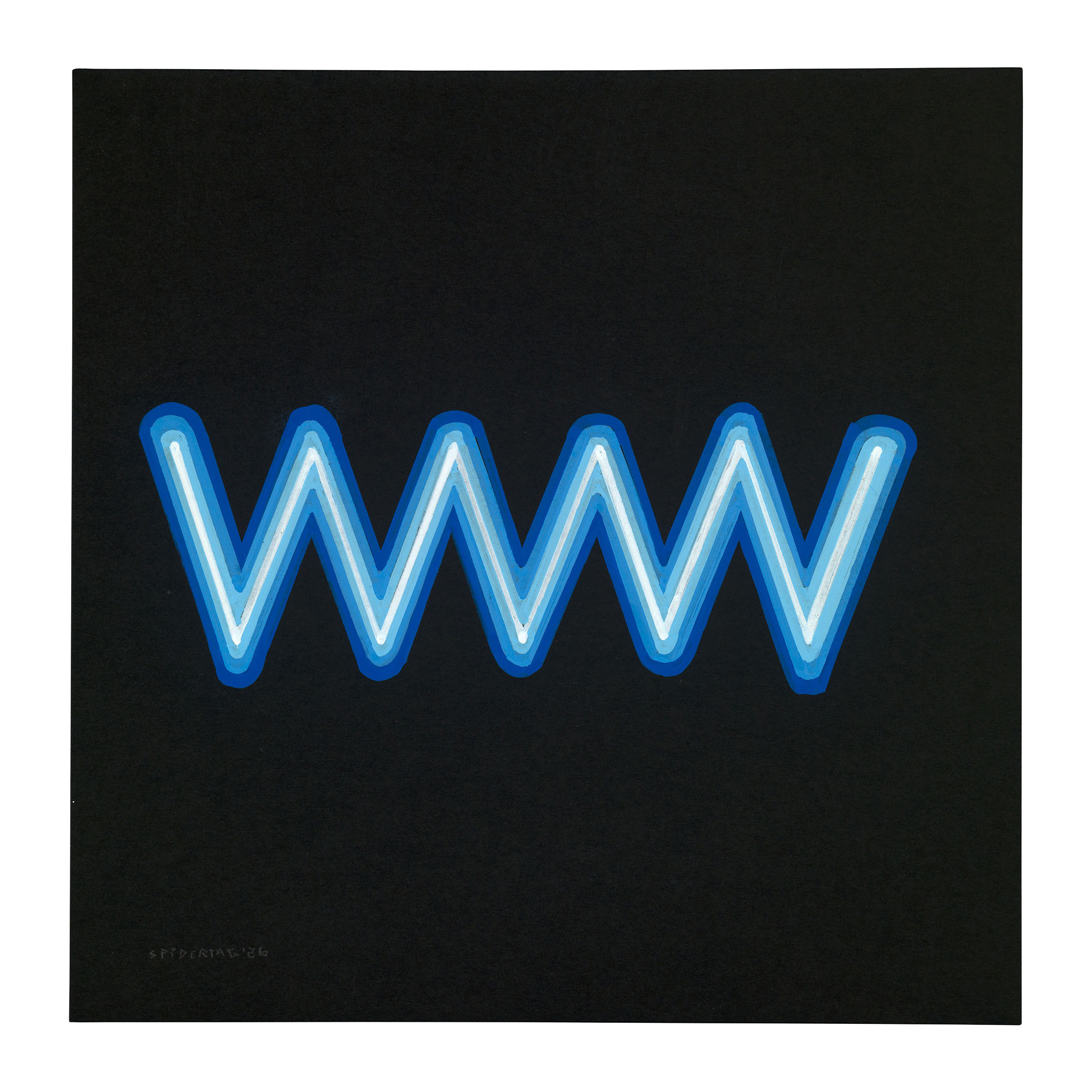
Executed with blue acrylic markers on matte black surfaces, the drawings translate the appearance of neon into pigment. Graduated tones create the impression that the lines emit light, despite containing no electrical components.
The series isolates the elements that underpin the murals: lines, triangles, squares, frames, angles and directional marks.
Each work functions independently, but together they suggest fragments of an open alphabet or coded system.
“It is still the same language, but reduced to its essential form. On paper, I can isolate a single idea, a single movement, and study it more closely.”
The black surface is not treated simply as a background. It performs the role of darkness within the mural works, creating the conditions through which the blue line can appear illuminated.
“Without that darkness, the line would not have the same presence. The black allows the line to exist as light.”
The series includes Blue Angle /26, Blue Denied /26, Blue Diagonal /26, Blue Gate /26, Blue Pulse /26, Blue Relay /26, Blue Shift /26, Blue Square /26, Blue Triangle /26, Blue Up Down /26 and Blue Vector /26.
Presented by GraffitiStreet within Urban Equinox, Blue Signal /26 reveals the underlying structure behind Spidertag’s monumental murals. Light becomes line, line becomes signal, and meaning remains open.
Spidertag – Blue Relay /26Spidertag – Blue Denied /26Spidertag – Blue Angle /26Spidertag – Blue Up Down /26
Spidertag’s contribution lies not only in his use of neon, but in the complete relationship he has established between light, architecture and public participation.
Neon is not used as a decorative border around a painted image. It is the image, the line and the principal material.
Architecture is not treated as a neutral support. Its proportions and interruptions determine the composition.
Technology is not added as a secondary attraction. In selected murals, it changes the relationship between artwork and audience by allowing the public to alter colour and sequence.
The result is a form of muralism that remains physically fixed while becoming visually variable.
This continuity extends across his public and studio works. Whether a line crosses a façade, glows from an acrylic panel or appears in blue marker on paper, it carries the same underlying ideas: direction, structure, movement and communication.
Spidertag does not describe his work as a rejection of muralism. Instead, he presents it as another route through the discipline.
“It creates new ways to see and understand muralism. Also, it’s a new path, a new highway.”
Spidertag, INM#8, Warm Coffee, Chiang Mai, Thailand, 2019. Image courtesy of Spidertag.
An evolving language of light
Spidertag’s practice began with the proposition that a line could move beyond drawing and occupy real space.
Thread carried it across walls and landscapes. Electroluminescent cable allowed it to glow. Flexible neon expanded it across architecture. Digital control introduced public participation. Studio works and drawings later reduced the system to its essential signs.
Across these changes, the language has remained coherent.
Geometry provides structure. Colour carries energy. Darkness creates the conditions for light. The viewer completes the encounter without being offered a fixed translation.
Spidertag’s works do not illustrate a known language. They propose one that remains in formation—written across cities in light.
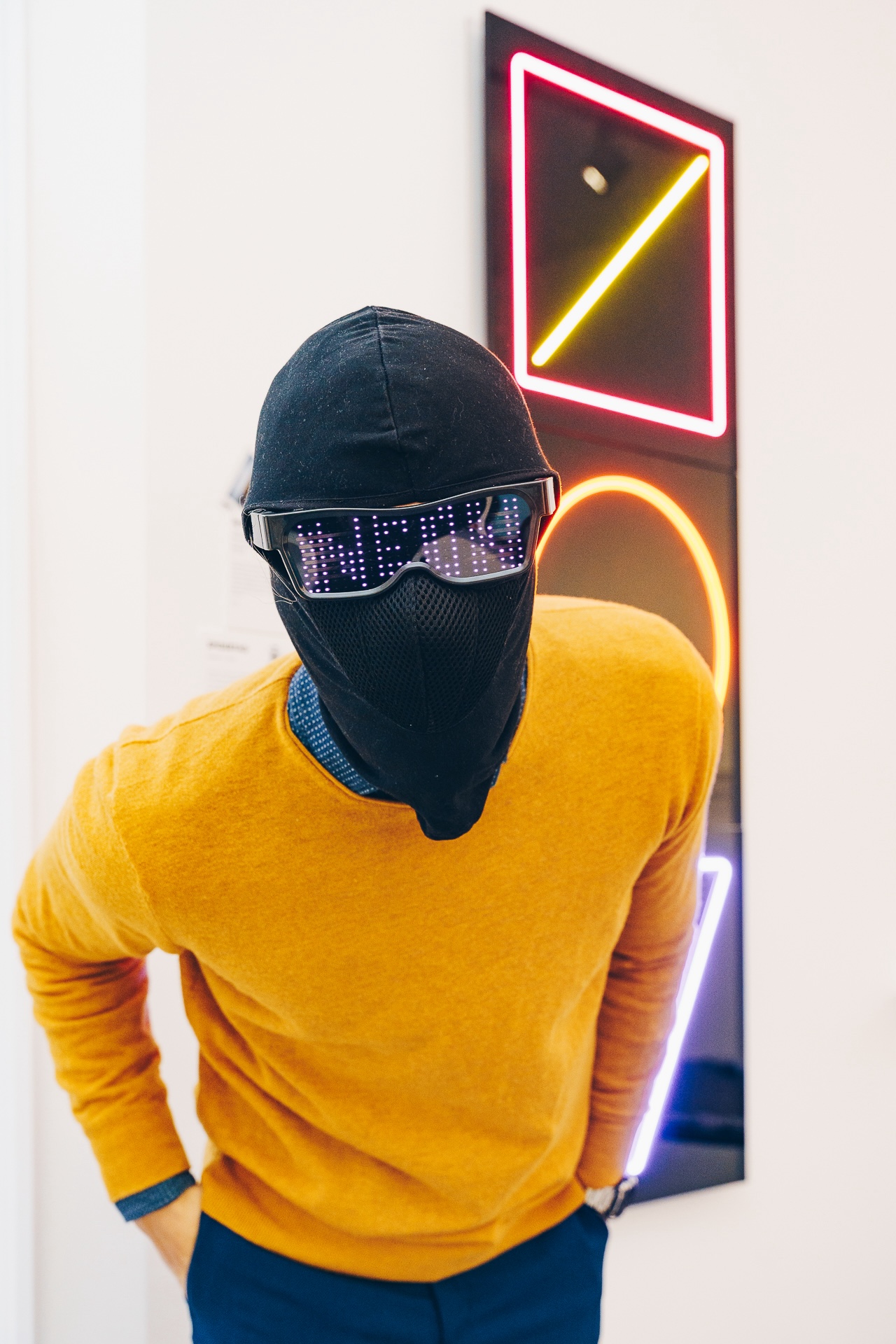
Spidertag is an anonymous Spanish urban artist and muralist known for creating Interactive Neon Murals using flexible neon, geometry, architecture and digital participation.
What are Spidertag’s Interactive Neon Murals?
They are large-scale neon artworks created directly across architectural surfaces. Selected murals can be altered by viewers through a mobile application.
What does INM# mean?
INM# stands for Interactive Neon Mural followed by the chronological number assigned to each work.
When did the INM# project begin?
The numbered series began with INM#1 at ESTAU Urban Art Festival in Estarreja, Portugal, in 2018.
What is Futurism Primitivism?
Futurism Primitivism is Spidertag’s term for combining elementary, ancient-looking forms with neon, electronics and contemporary digital culture.
What is Neonmetry?
Neonmetry describes Spidertag’s use of neon and geometry to create illuminated visual languages across architecture.
Can viewers control Spidertag’s murals?
Selected murals connect to a mobile application that allows viewers to change colours and activate programmed lighting sequences.
Are Spidertag’s works installations?
Spidertag defines the INM# works as murals. They are conceived directly in relation to walls, façades and architecture and form part of his development of contemporary muralism.
How many Interactive Neon Murals has Spidertag created?
The numbered project reached INM#25 in Bayonne, France, in 2025.
Does Spidertag create studio works?
Yes. His studio practice includes illuminated works on acrylic, modular neon pieces and hand-drawn works such as Blue Signal /26.
Where can I view the complete INM# series?
GraffitiStreet maintains a separate visual archive documenting the Interactive Neon Murals from INM#1 onwards.
Where can I buy Spidertag’s art?
Original works by Spidertag are available through GraffitiStreet Gallery and the GraffitiStreet online store.