Bordalo II’s ‘Balloon Fish’ in Trafaria, Portugal: Monumental Street Art Made from Local Trash
On a coastal street in Trafaria, Costa da Caparica, a colossal pufferfish appears to push its way through the side of a building. Its eyes are wide and alert, while its skin reveals itself as an intricate assemblage of discarded plastics, industrial remnants, broken objects and locally sourced waste.
Created by Portuguese artist Bordalo II, Balloon Fish brings the environmental language of his celebrated Big Trash Animals directly into the landscape of the Tagus estuary. The choice of species carries particular meaning: local authorities identified the pufferfish as an invasive species in the Tagus, positioning the artwork as a visual warning about human impact, ecological disruption and the preservation of local ecosystems.

Big Trash Animal ‘Balloon Fish’, Trafaria, Costa de Caparica, Portugal. Image Copyright Bordalo II
Monumental Street Art Made From Local Waste
The monumentality of Balloon Fish is inseparable from its materials. Constructed from locally sourced discarded objects, the sculpture is physically connected to Trafaria itself. Plastics, manufactured remnants and urban debris become skin, spines and facial features, allowing the residue of everyday consumption to form the body of an animal living within the wider coastal environment.
This approach sits at the heart of Bordalo II’s Big Trash Animals, where waste becomes both material and message. Bordalo II deliberately places the animal beside the discarded objects associated with environmental degradation, exposing the tension between wildlife and the systems of consumption surrounding it. His official description of the series similarly emphasises this contrast between animals and the waste materials connected to habitat destruction.

Big Trash Animal ‘Balloon Fish’, Trafaria, Costa de Caparica, Portugal. Image Copyright Bordalo II
The Gaze of Bordalo II’s Balloon Fish
Balloon Fish feels remarkably alive. Its enormous eyes convey alertness, while the inflated body, projecting spines and layered surfaces create a sense of tension and vulnerability.
Standing before the work, the relationship between viewer and animal begins to shift. The fish seems to look back at us.
That gaze is central to the emotional force of Bordalo II’s animals. Environmental damage can feel distant when described through statistics or abstract language; here it acquires eyes, character and physical presence. The ecological question becomes harder to ignore when the subject appears to be watching the people responsible for shaping its environment.
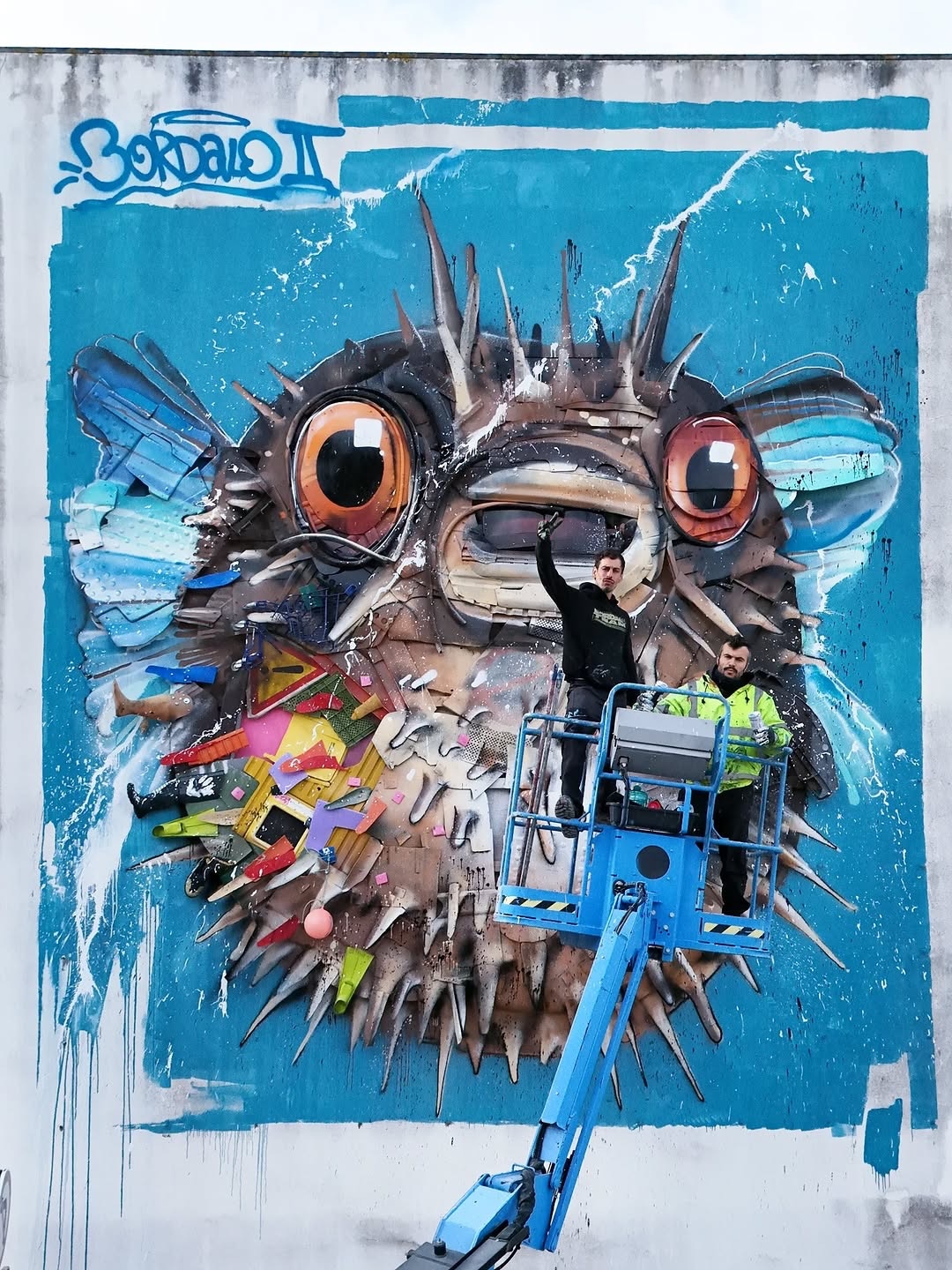
Big Trash Animal ‘Balloon Fish’, Trafaria, Costa de Caparica, Portugal. Image Copyright Bordalo II
Local Waste, Marine Life and Environmental Responsibility
On the streets of Trafaria, Balloon Fish embeds environmental questions into everyday life. The locally sourced waste carries traces of human consumption, while the pufferfish introduces the consequences that human behaviour can have on ecosystems far beyond the moment an object is discarded.
The artwork therefore operates on several levels at once: a portrait of a marine species, a record of local waste and a warning about ecological imbalance.
That combination gives Balloon Fish particular relevance within Bordalo II’s marine practice. The animal belongs to the place in which it appears, while the materials reveal the human systems operating around it.

Big Trash Animal ‘Balloon Fish’, Trafaria, Costa de Caparica, Portugal. Image Copyright Bordalo II
From Trafaria to Bordalo II’s Wider Marine Trash Animals
Balloon Fish belongs to Bordalo II’s wider marine and coastal practice, where ocean wildlife becomes a means of examining plastic pollution, consumption and the relationship between human waste and aquatic ecosystems.
The work creates a natural dialogue with the earlier Hove Trash Seagull and Trash Sharks in Tahiti, where local waste and coastal wildlife are similarly brought together within the same sculptural body. Across these very different locations, Bordalo II adapts the language of his Big Trash Animals to the species, materials and environmental concerns of each place.

Big Trash Animal ‘Balloon Fish’, Trafaria, Costa de Caparica, Portugal. Image Copyright Bordalo II
Discover Bordalo II at GraffitiStreet
Explore Bordalo II artworks at GraffitiStreet, including selected collectible works and editions, or contact GraffitiStreet for current availability, sourcing, acquisitions and private collector enquiries.
You can also visit GraffitiStreet Gallery, 25A West Street, Chichester, West Sussex, England PO19 1QW.
Images © Bordalo II.