Bordalo II and the Sea: Marine Life, Plastic Pollution and Art Made from Waste
Bordalo II’s Big Trash Animals is an ongoing series of large-scale sculptures made from discarded plastics, industrial remnants, fishing materials, bicycle parts and urban waste. Since 2015, the Portuguese artist has extended this practice into a distinct marine and coastal thread, sharks, whales, turtles, fish, crabs and seagulls built entirely from the debris altering the oceans and shorelines where they live.
Spanning installations from Norway to Tahiti to Portugal’s Atlantic coast, these works place the animal and the material harming it inside the same body, turning abstract statistics about ocean plastic into a single, physical encounter.
The marine works sit within Bordalo II’s wider Big Trash Animals practice, where discarded materials become both sculptural medium and evidence of the environmental pressures affecting the animals he depicts.
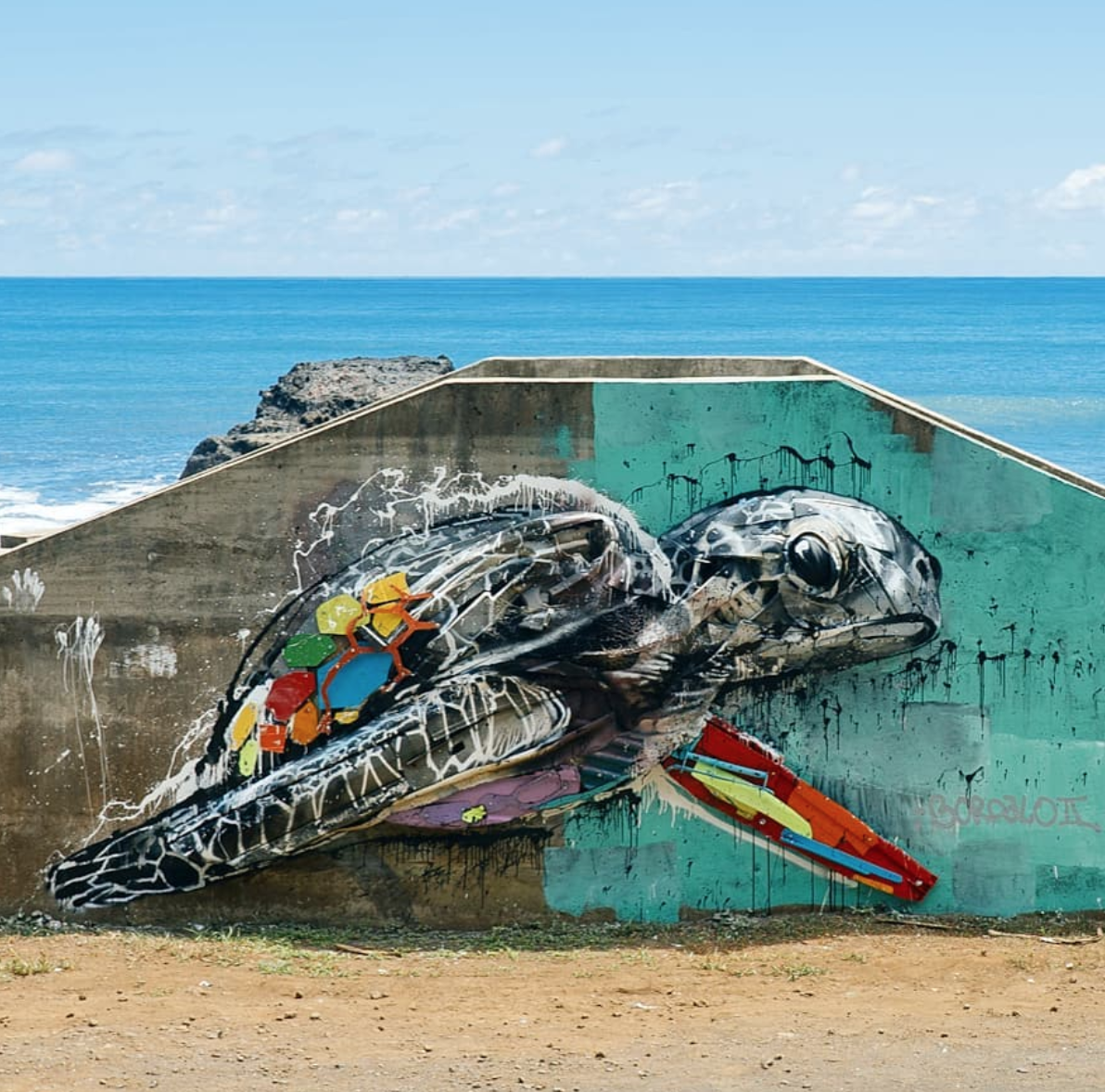
Bordalo II’s marine animals bring the physical evidence of consumption into direct contact with the species and environments affected by it.
Bordalo II’s Marine Big Trash Animals – At a Glance
Series: Big Trash Animals (marine and coastal thread)
Artist: Bordalo II (Artur Bordalo), Portugal
Materials: Discarded plastics, industrial remnants, fishing gear, bicycle parts, urban waste
Species depicted: Whales, sharks, turtles, fish, crabs, seals, jellyfish, squid, seagulls, pufferfish
Notable locations: Stavanger (Norway), Lisbon and Costa da Caparica (Portugal), Hove (UK), Las Vegas (USA), Tahiti and Bora Bora (French Polynesia), Brussels (Belgium)
Why the Sea Matters in Bordalo II’s Art
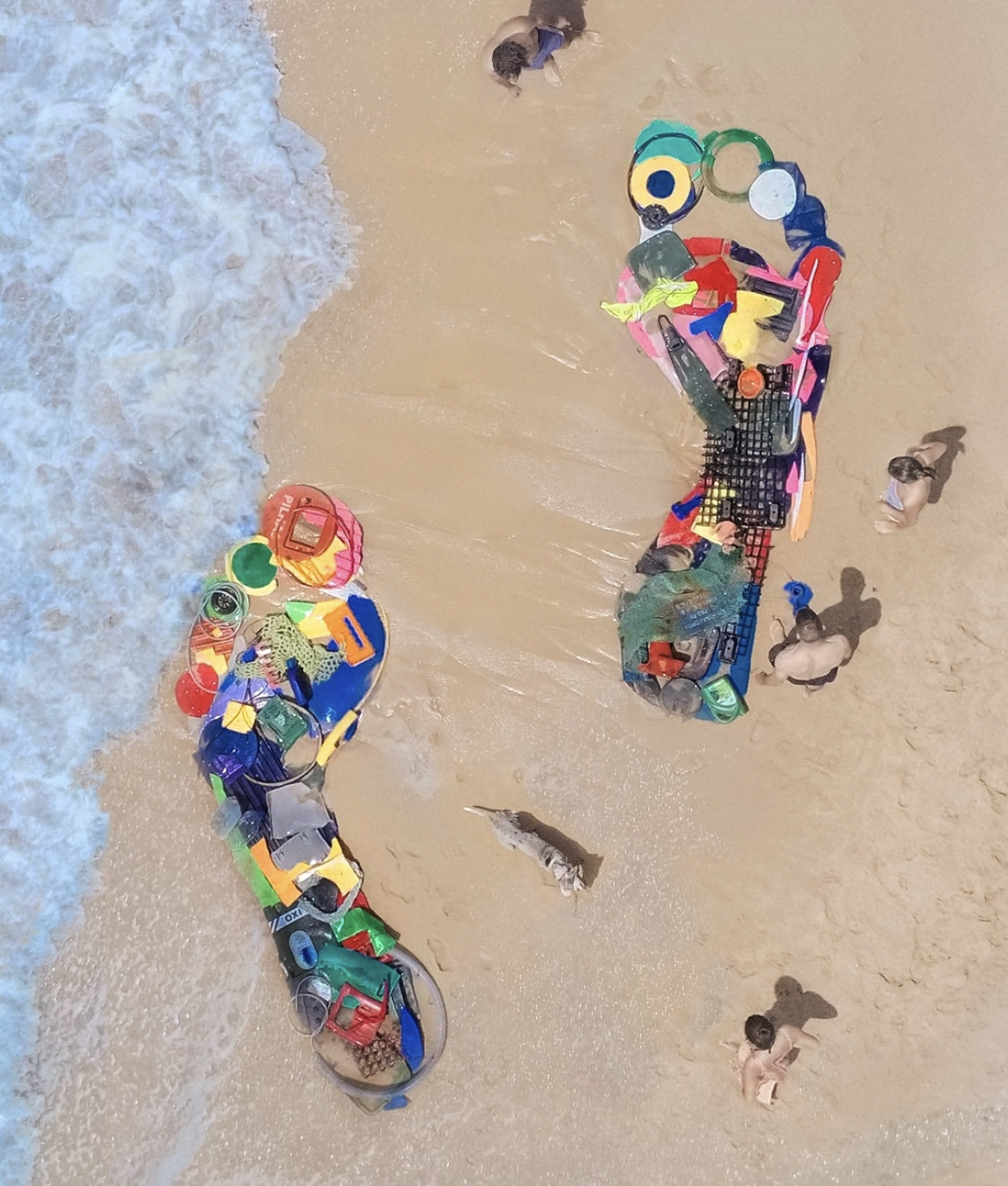
The United Nations Environment Programme currently estimates that more than 11 million metric tonnes of plastic enter the oceans every year, where debris can entangle marine animals, be ingested by wildlife and continue accumulating throughout aquatic ecosystems. UNEP’s global assessment has also identified plastic as the largest and most persistent fraction of marine litter.
The ocean is particularly suited to Bordalo II’s artistic language because it exposes one of the central contradictions running through his work. We consume an object briefly, discard it and remove it from immediate sight, yet the material continues its existence somewhere else. Increasingly, that somewhere else is a river, coastline or ocean. Bordalo II gives that largely invisible journey a physical form.
A shark made from plastic carries two identities simultaneously. It remains unmistakably an animal, while its skin reveals the discarded materials entering and altering the environment in which that animal lives. The waste does not merely illustrate pollution. It becomes the body of the creature affected by it.
This tension has become one of the most powerful recurring ideas within Bordalo II’s wider Big Trash Animals practice, where he deliberately places the represented animal alongside materials associated with the destruction of natural habitats.
Stavanger 2015: An Early Whale and the Environmental Warning
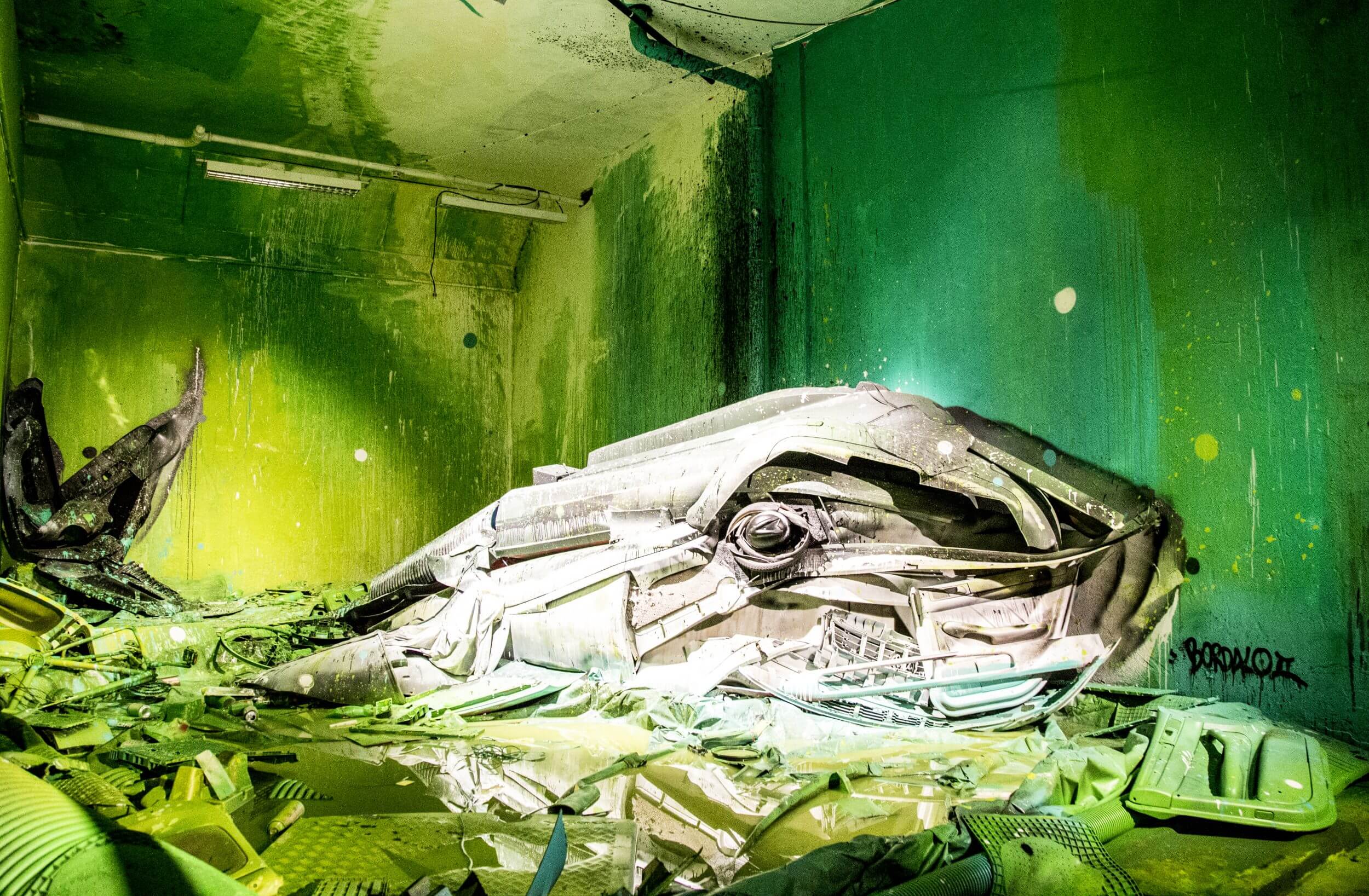
At Nuart Festival in Stavanger in 2015, Bordalo II created a large whale sculpture inside Tou Scene, alongside Pixel Pancho’s installation, with murky water jets contributing to a wider critique of the environmental damage associated with the oil industry.
Whales carry particular symbolic weight in environmental imagery because their scale suggests a natural world capable of dwarfing us. Bordalo II reverses that relationship. His whale is assembled from evidence of human activity, allowing industrial material to invade an animal whose natural territory should feel almost immeasurably larger than the city.
That early Nuart work helps establish that the sea has never been a decorative side theme in Bordalo II’s practice. It belongs to the environmental argument at its core.
Early Marine Works: Fish and Octopus in Portugal
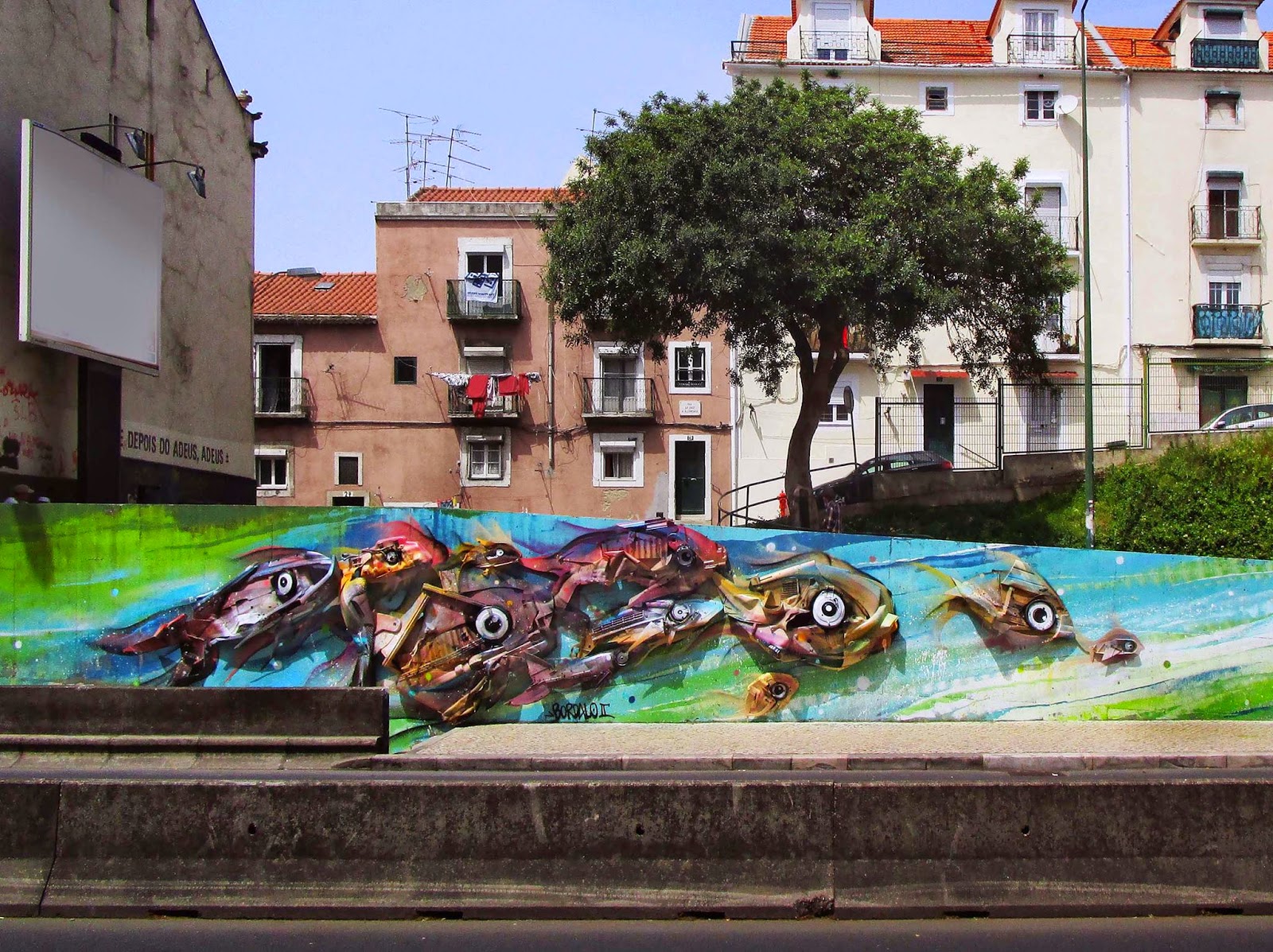
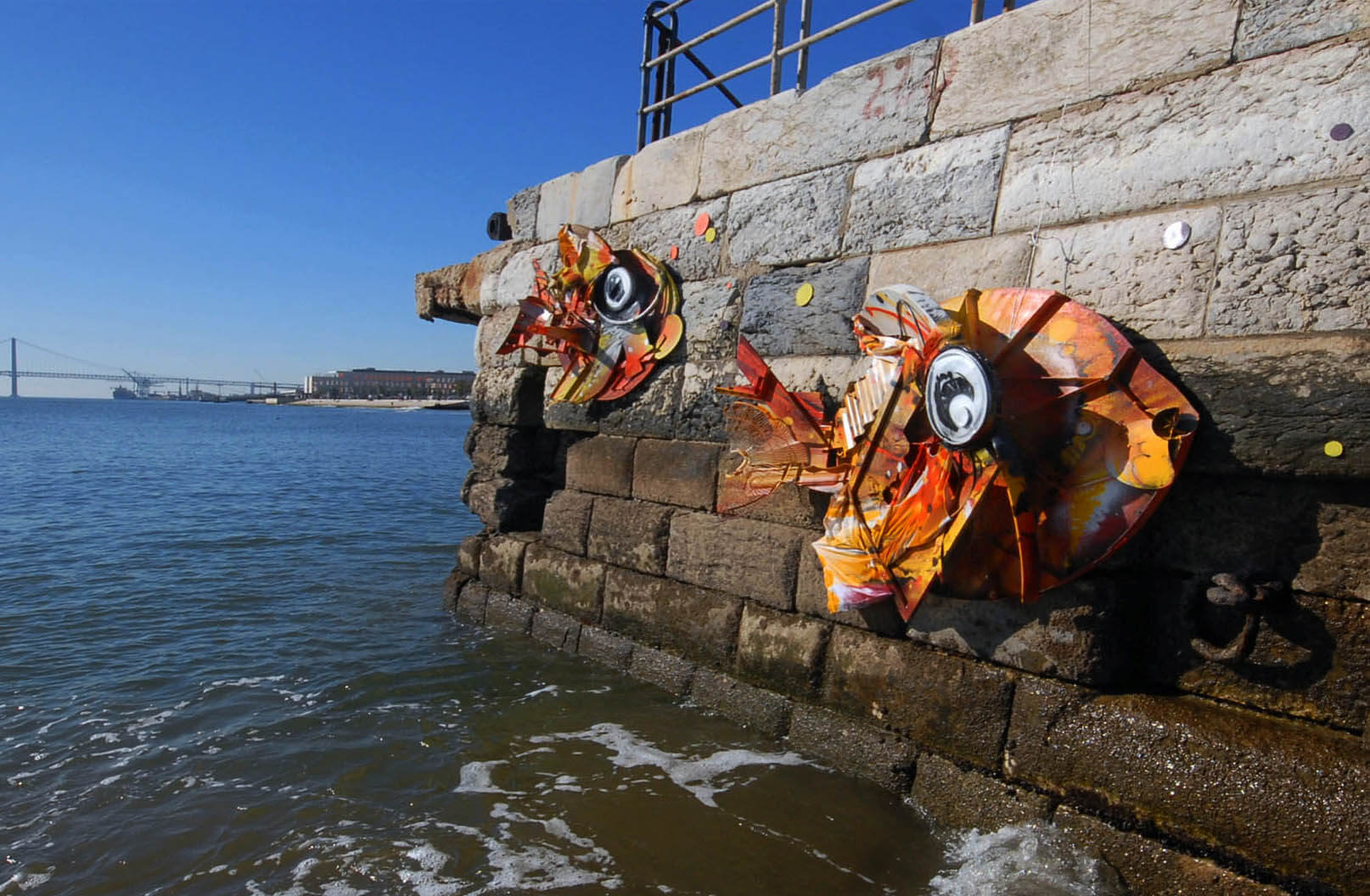
Bordalo II’s connection with marine life can be traced back to some of his earliest Lisbon interventions. In 2015, he created Peixes d’Alcântara, a group of fish assembled from found materials and waste opposite Alcântara-Terra railway station. The work was one of his early Lisbon experiments with transforming discarded urban material into animal life, already connecting the debris of the city with the pollution affecting rivers and oceans. The fish remain an important early marker of a marine theme that would return repeatedly throughout Bordalo II’s practice.
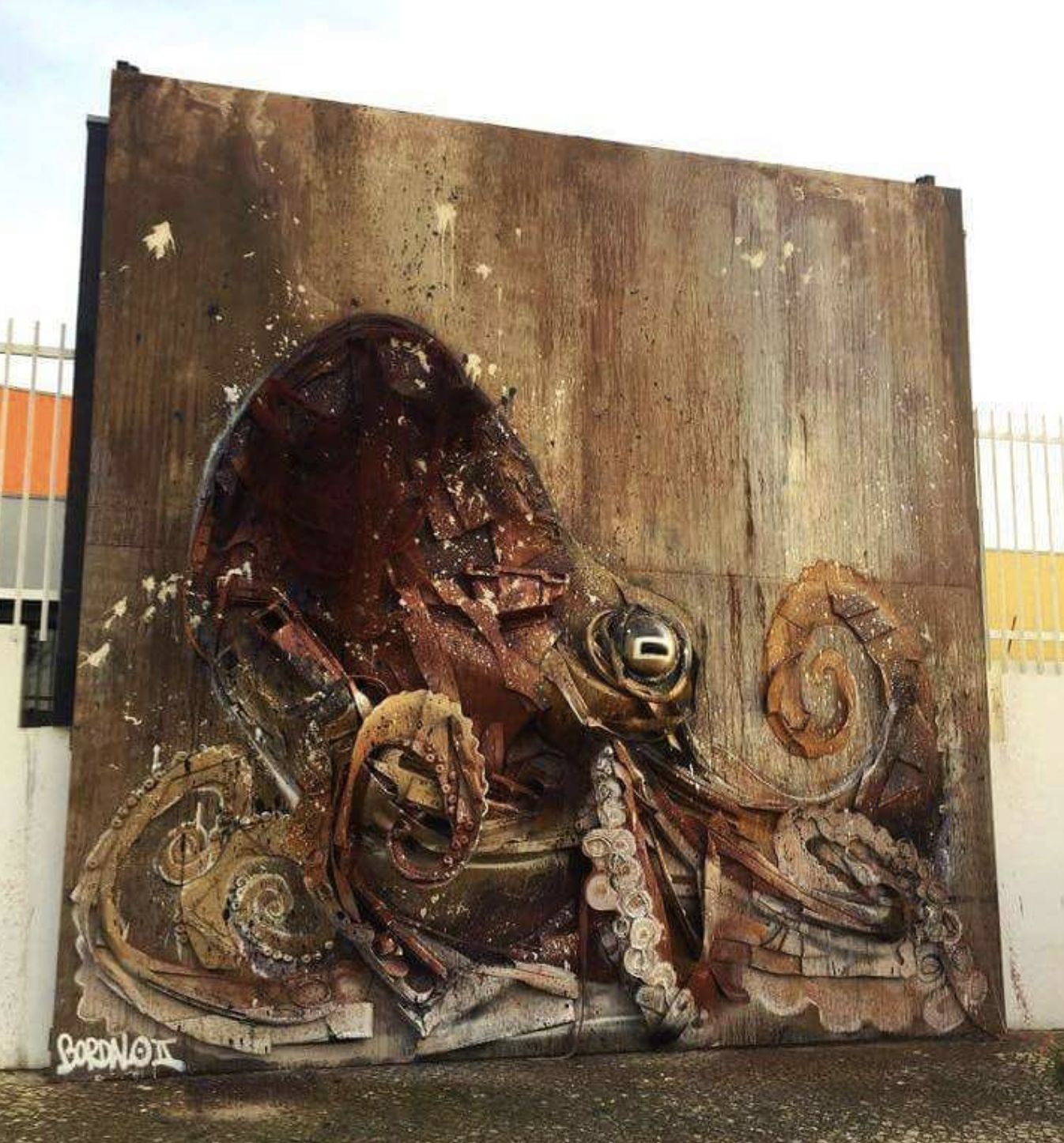
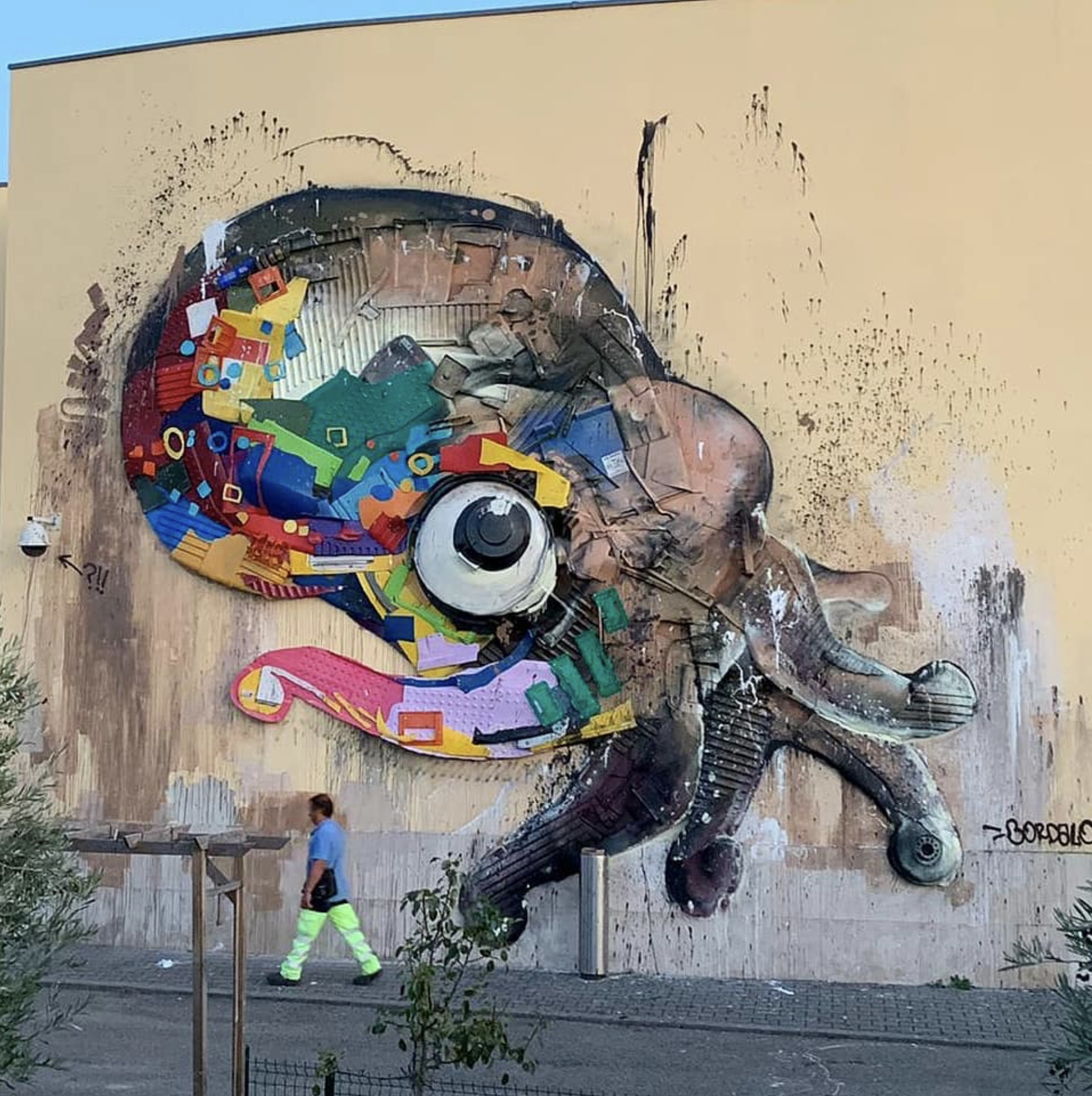
A year later, Bordalo II brought that marine language directly to Portugal’s Atlantic coastline with an Octopus at Costa da Caparica in 2016. Installed at the Centro de Monitorização e Interpretação Ambiental close to the beach, the work placed a creature of the sea within immediate reach of its natural environment. The location gave Bordalo II’s familiar collision between animal and waste an added immediacy, connecting the sculpture with a coastline where questions of pollution, habitat and human impact could be encountered beyond the artwork itself.
A Trash Seagull on the British Coast
In 2018, Bordalo II brought the environmental conversation directly to the British shoreline with his Trash Seagull at Fatboy Slim’s Big Beach Cafe in Hove. Bordalo II constructed the seagull over two days using discarded plastic and rubbish collected locally by the city’s refuse workers and stored in Norman Cook’s garage before being transformed into the sculpture.
The choice of a seagull gave the work an immediate relationship with place. These birds are so familiar within Brightons coastal life that they can become almost invisible, yet here an everyday species was reconstructed from the everyday waste generated by the city around it.
Bordalo II frequently chooses animals that belong, culturally or ecologically, to the locations where he works. The resulting sculpture feels rooted to its surroundings while also drawing attention to what those surroundings produce and discard.
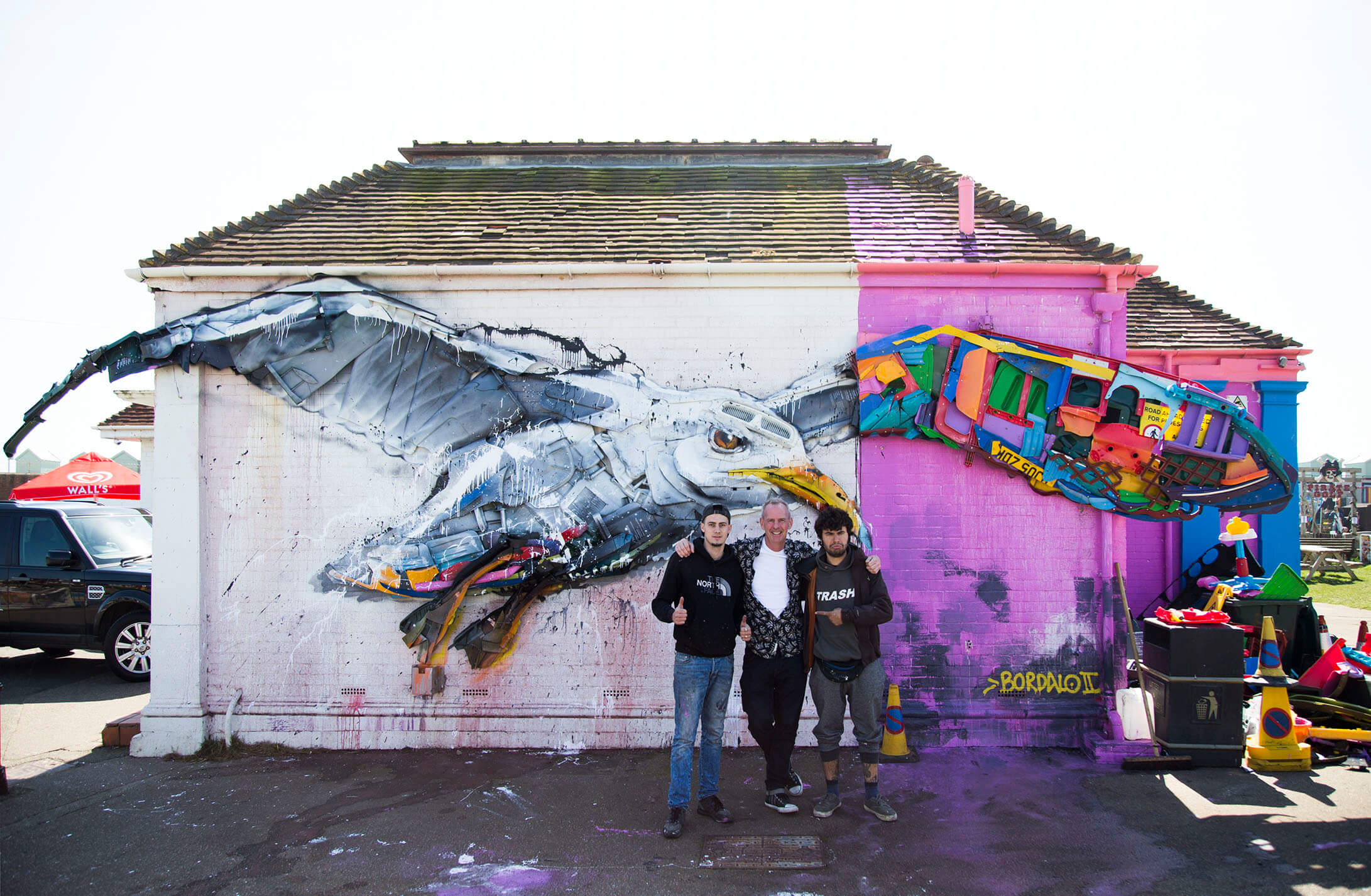
Bordalo II, Trash Seagull, Fatboy Slim’s Big Beach Cafe, Hove 2018. © Graffitistreet.com
GraffitiStreet documented the work first-hand at the time of Trash Seagull at Fatboy Slim’s Big Beach Cafe in Hove.
Jellyfish and Squid: Marine Life in Public Space
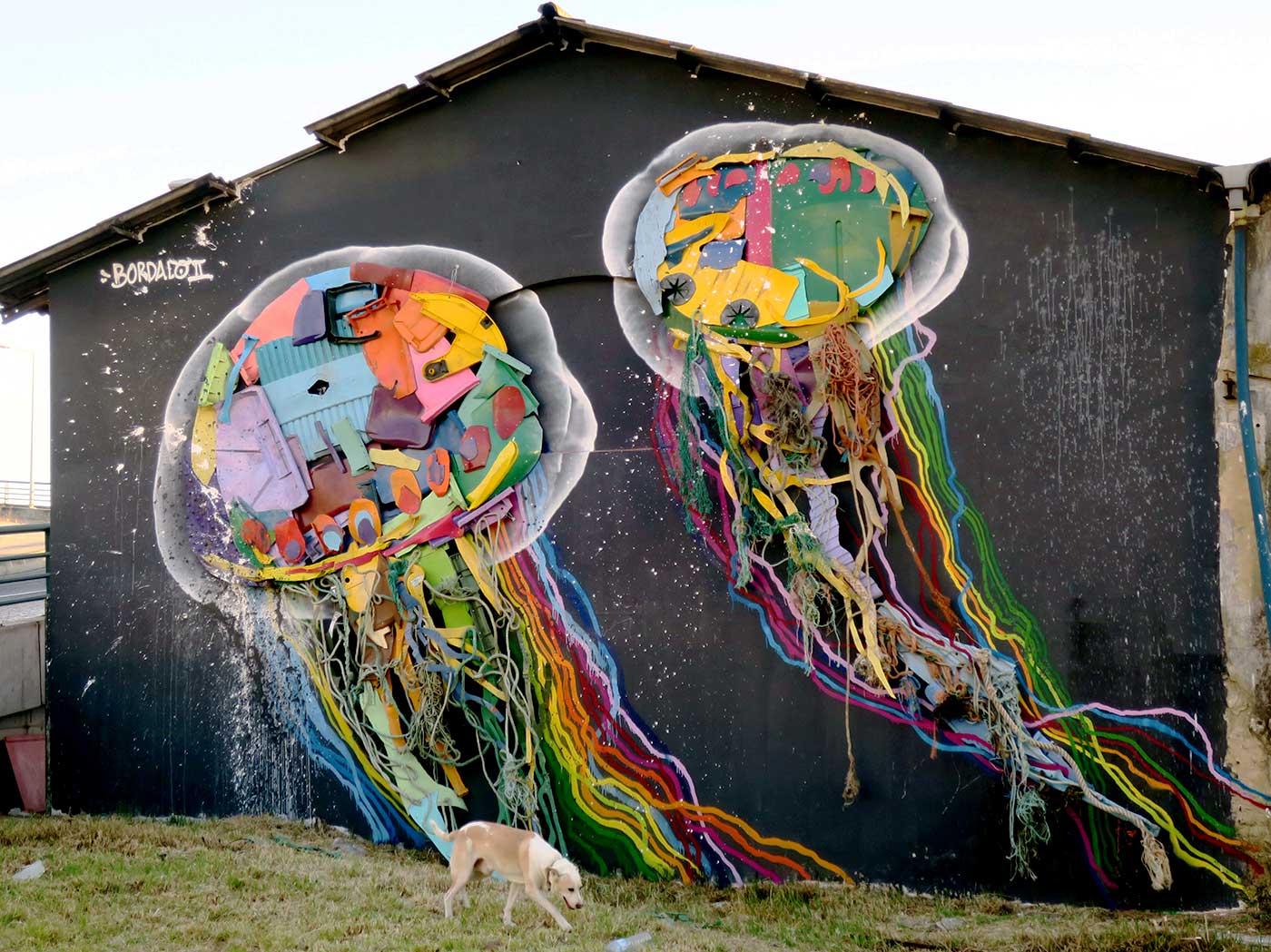
In Barreiro in 2018, Bordalo II created a pair of Plastic Jellyfishes as part of the Art in Town programme. Their translucent marine forms were reconstructed through brightly exposed discarded material, allowing the artificial textures of plastic to remain visible rather than being disguised beneath paint. The jellyfish offered an especially apt subject for this approach. Their floating, almost weightless appearance collided with the physical persistence of plastic, a material capable of remaining within marine environments long after its original use has ended.
Another marine work appeared in the Lisbon metropolitan area in 2019, when Bordalo II created a Baby Squid at Escola Básica João Villaret in Loures. The project grew from an environmental education initiative in which students had specifically proposed a marine animal, and the finished sculpture was created from discarded material on the school itself. The setting gave the work a particularly direct educational role, allowing Bordalo II’s environmental message to become part of the everyday experience of young people rather than remaining confined to a gallery or festival.
Wild Wild Waste: A Whale Caught in Our Debris
Later in 2018, the whale reappeared in a radically different context. For Wild Wild Waste, Bordalo II transformed a former motel in Downtown Las Vegas into an immersive parody of a zoo. Among the animals was a monumental whale entangled in fishing net, alongside penguins standing on plastic ice, a lion confined inside a truck, monkeys, white foxes and a panda family assembled from car parts.
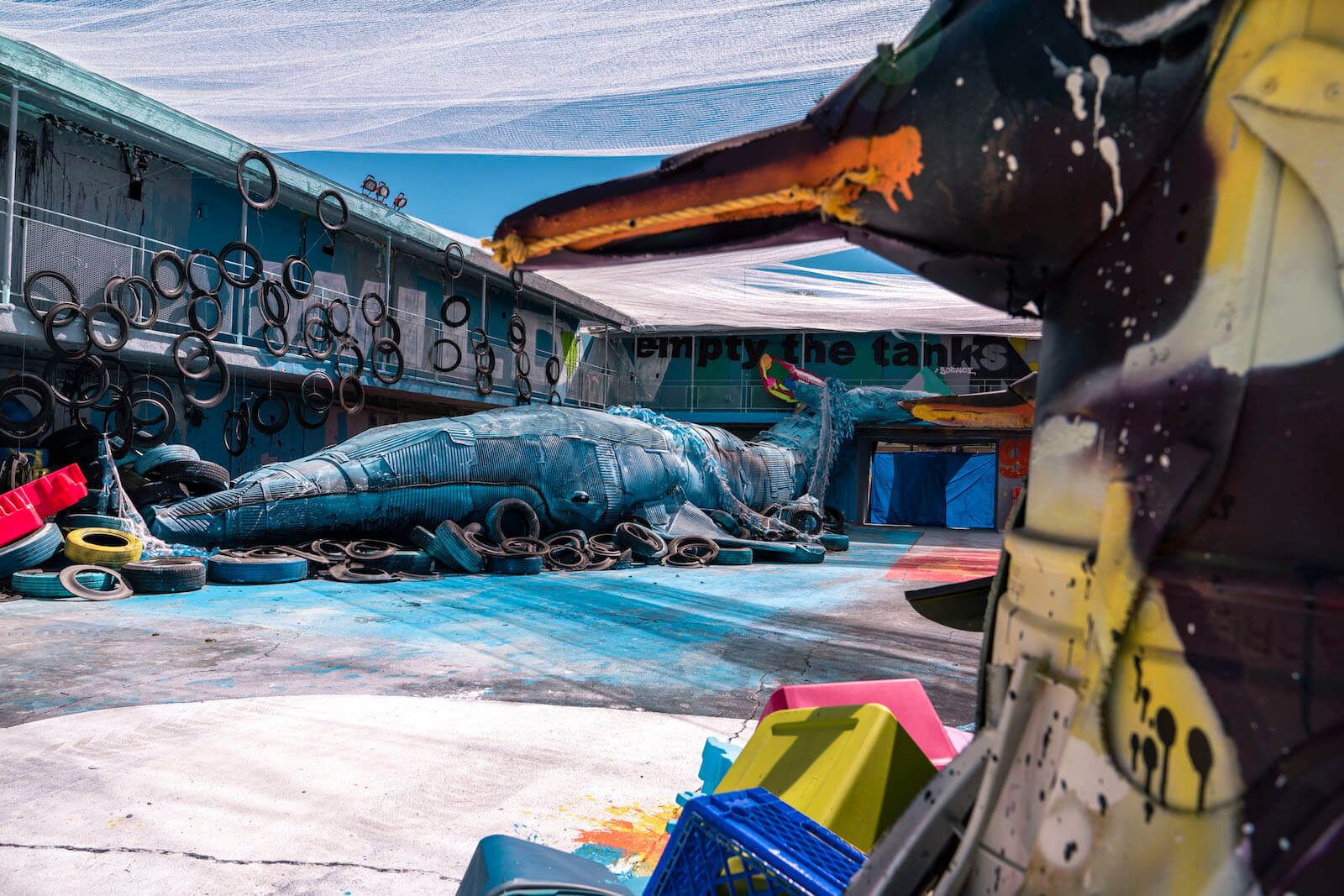
Within Wild Wild Waste, the trapped whale became part of an entire environment shaped by human waste. The animal no longer existed as an isolated warning, It inhabited a plastic world in which pollution, confinement and spectacle surrounded the viewer.
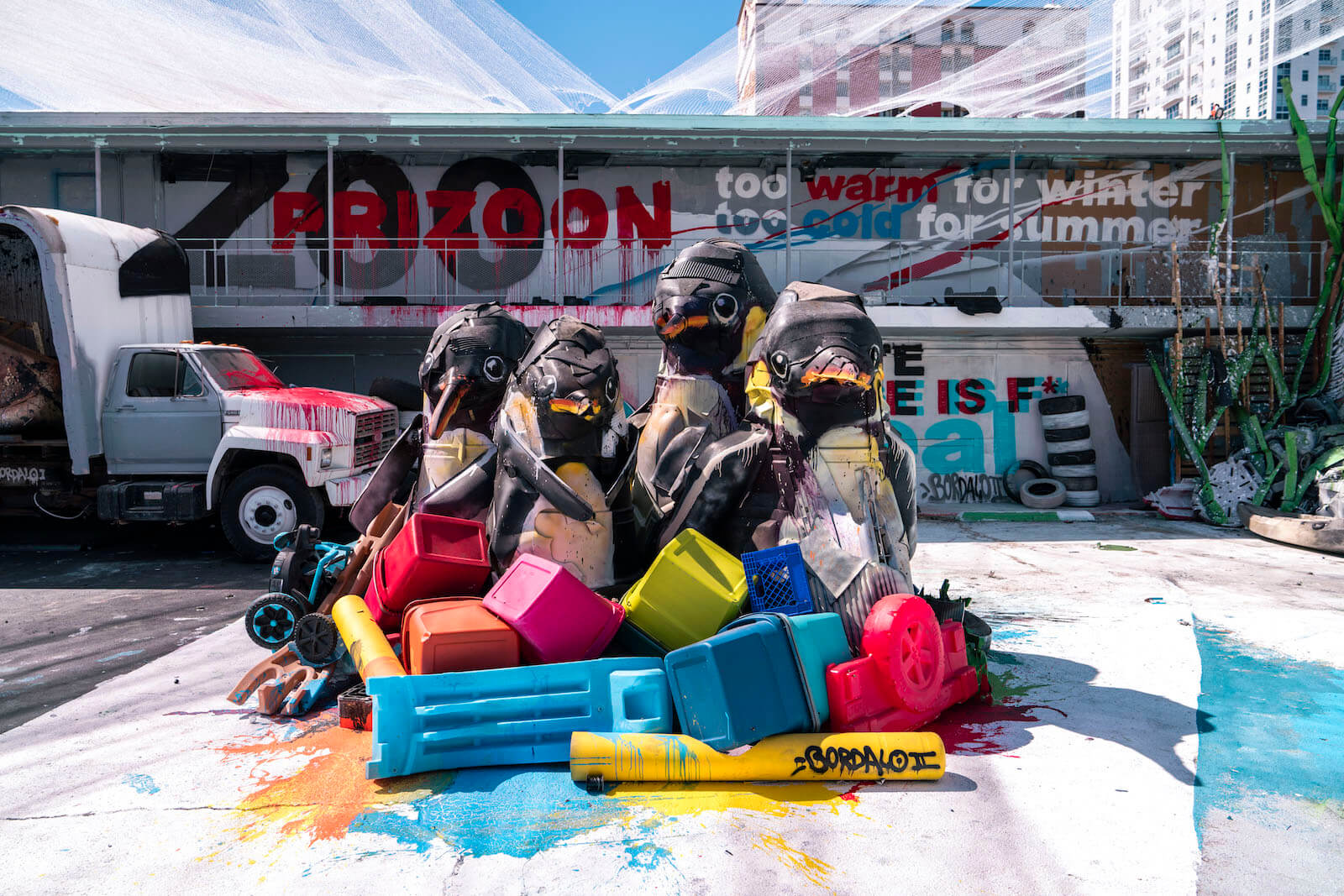
Read GraffitiStreet’s original coverage of Wild Wild Waste in Downtown Las Vegas.
Trash Seals: From San Francisco to Norway
Bordalo II has returned repeatedly to seals as a way of connecting marine wildlife with the waste accumulating within coastal ecosystems. In San Francisco in 2018, his California Harbour Seal Pup followed a visit to the Marine Mammal Center in Sausalito, where the artist encountered rescued seals and sea lions and learned more about the pressures plastic pollution places on marine species.
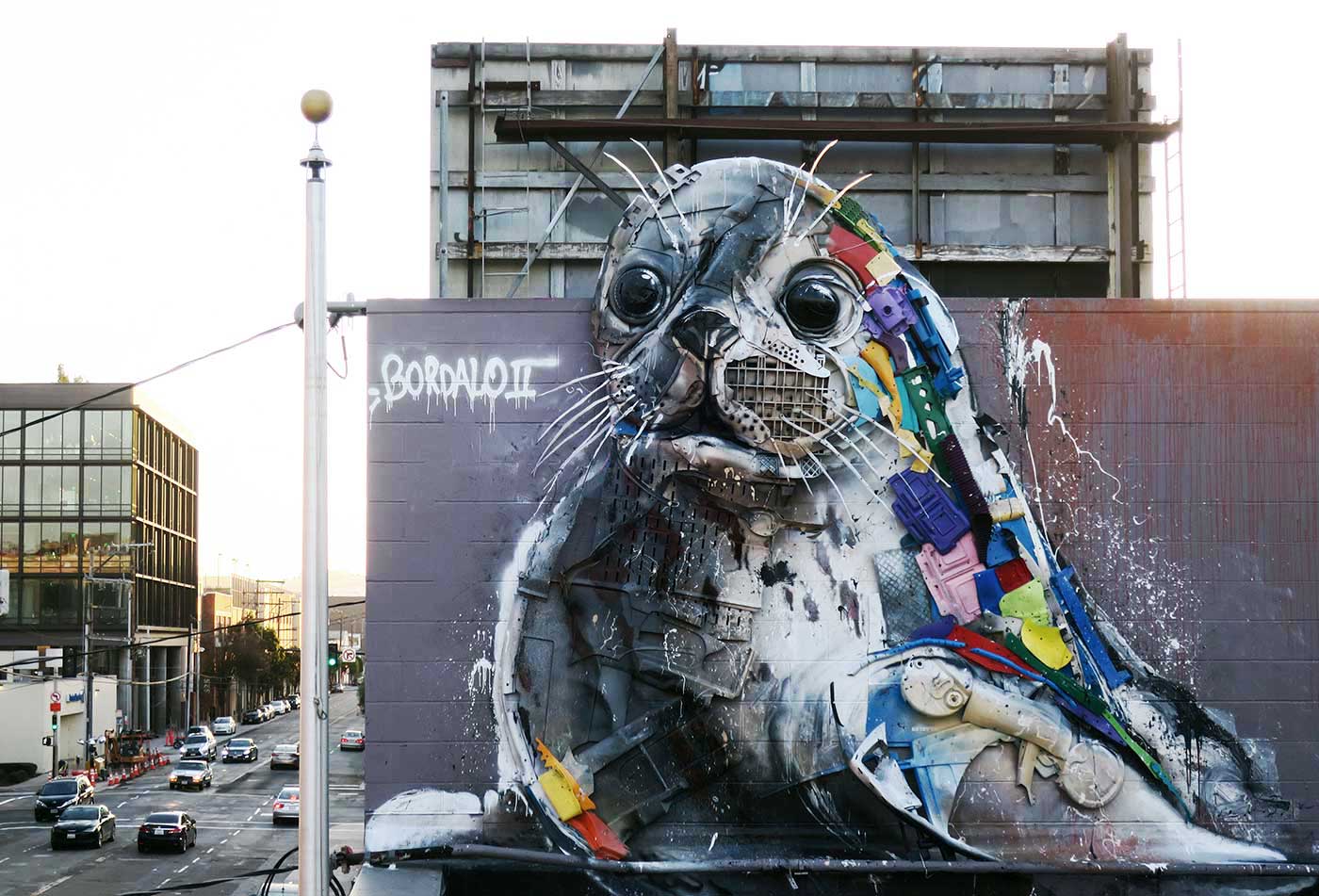
Later that year, Half Seals in Kristiansand, Norway developed the idea through his Half-Half language, allowing the naturalistic animal to give way visibly to the discarded materials beneath its surface.
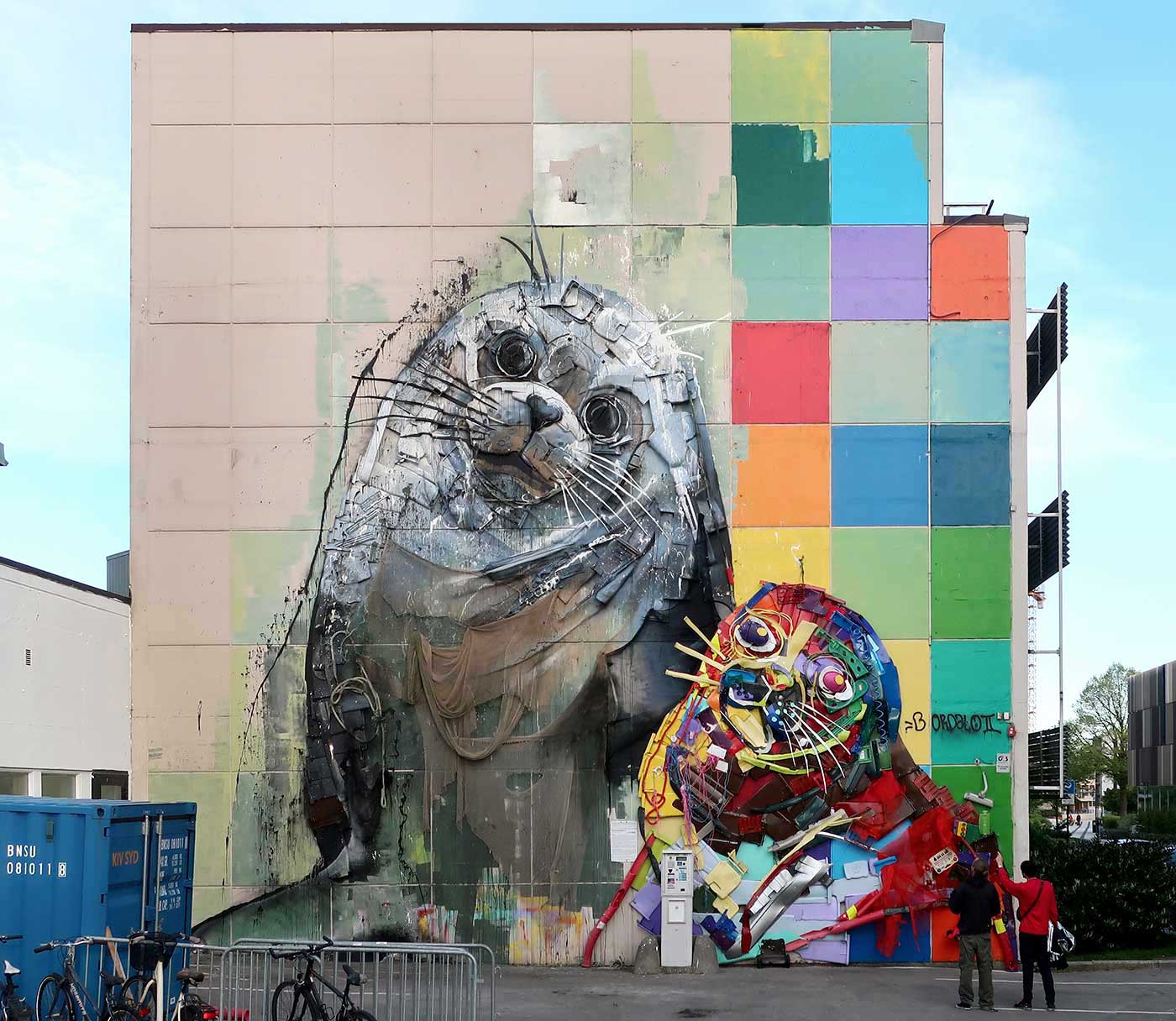
In Madeira, Lobo Marinho brought material and subject even closer together, incorporating waste recovered during a sea-cleaning campaign. Debris removed directly from the marine environment was transformed into the body of the animal that inhabits it, creating one of the clearest expressions of Bordalo II’s recurring relationship between material, habitat and environmental consequence.
Tahiti 2019: Swimming with Trash Sharks
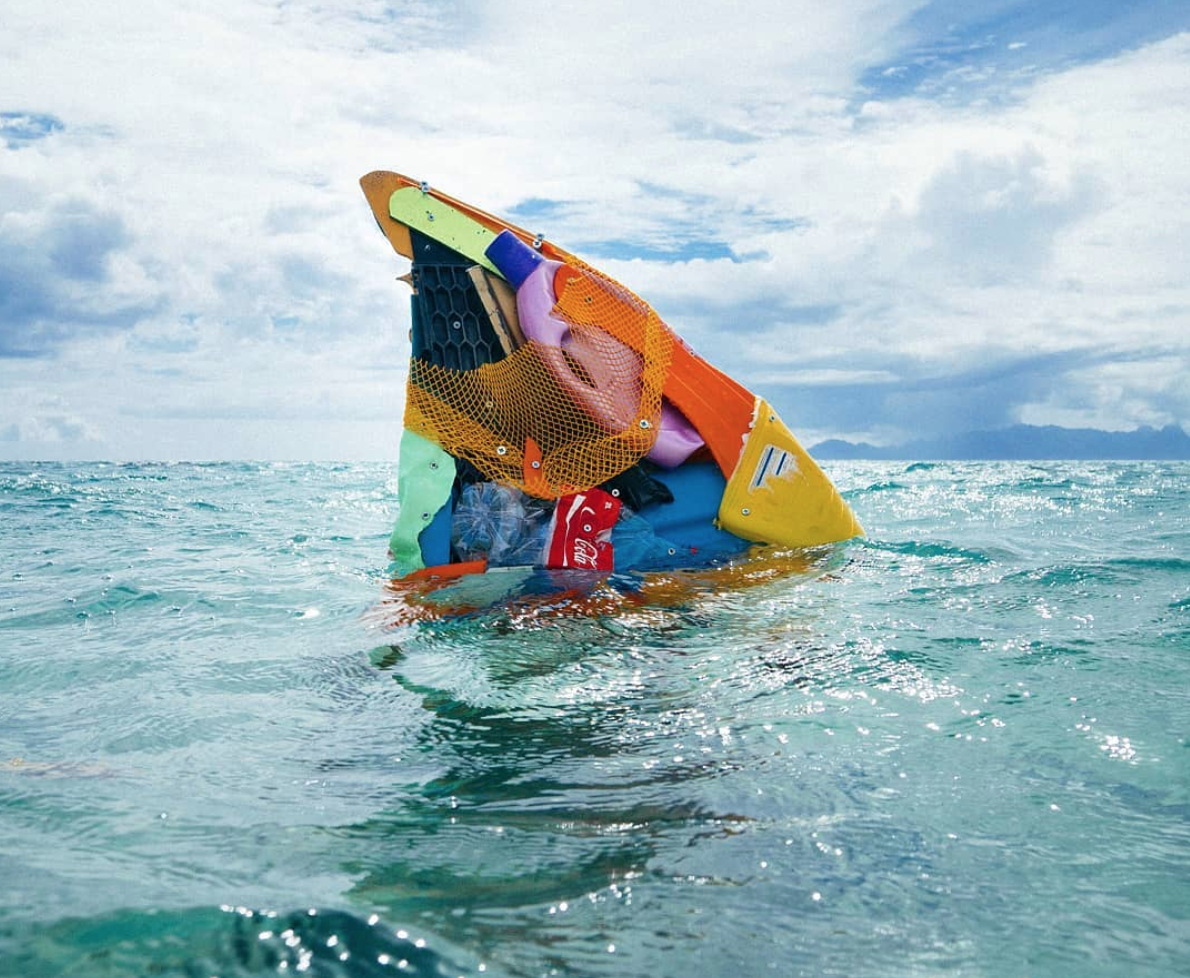
Few projects articulate Bordalo II’s relationship with the ocean as vividly as Tahiti in 2019. Returning to the island for ONO’U, the artist created several marine-focused Trash Animals, including a Half Sea Turtle, Half Hammerhead Shark and floating Trash Shark. Bordalo II summarised the idea with characteristic directness:
“The ocean’s most dangerous predator, not the sharks of course, but the trash.”
The image works because it reverses a familiar cultural fear. Sharks are habitually represented as the threat within the ocean. Bordalo II places a shark made from human debris into the water and redirects the accusation towards us.
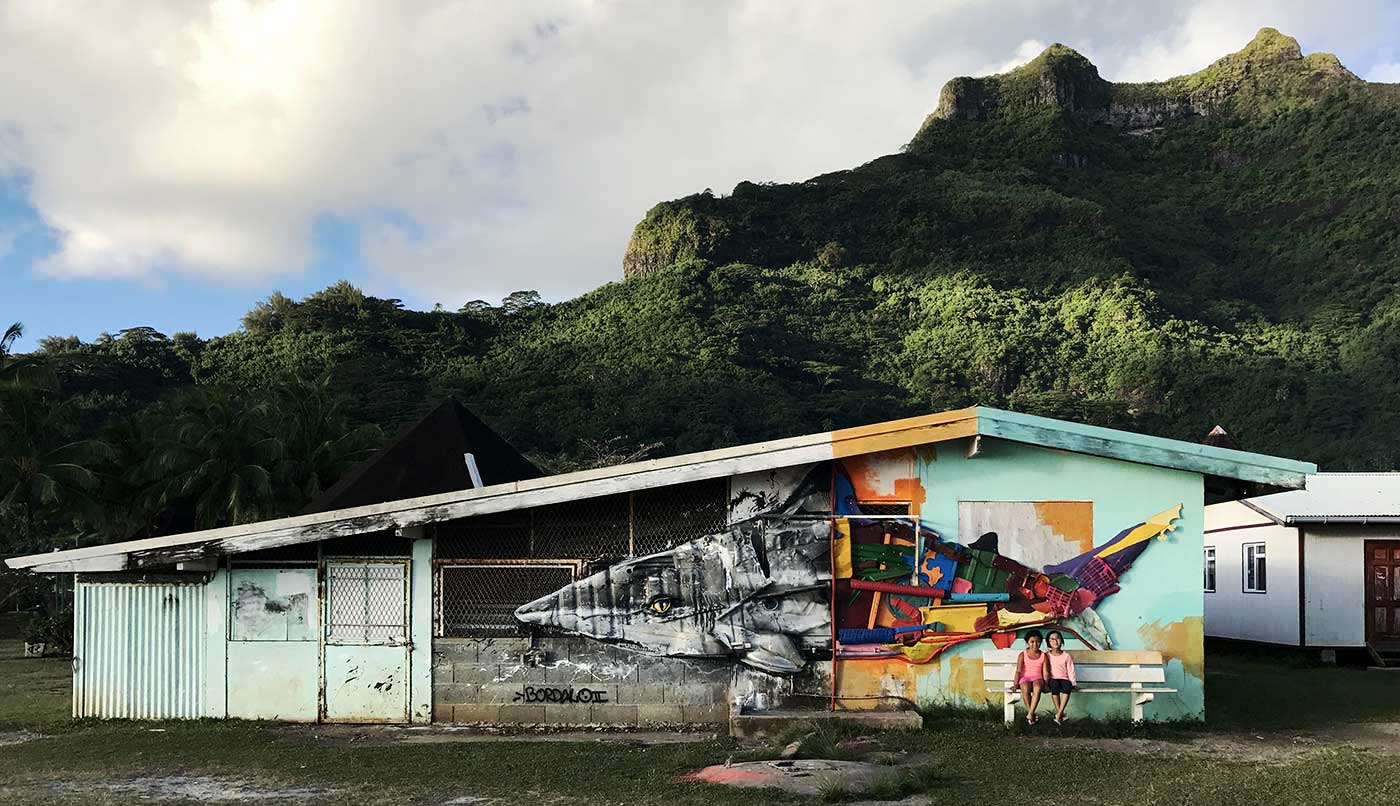
The Half Hammerhead and Half Sea Turtle deepen that argument. Bordalo II’s Half-Half approach deliberately divides the animal between a more naturalistic appearance and an exposed accumulation of waste, allowing wildlife and the materials associated with habitat destruction to occupy the same body. His official description of the series identifies precisely this collision between the animal and the waste threatening its environment.
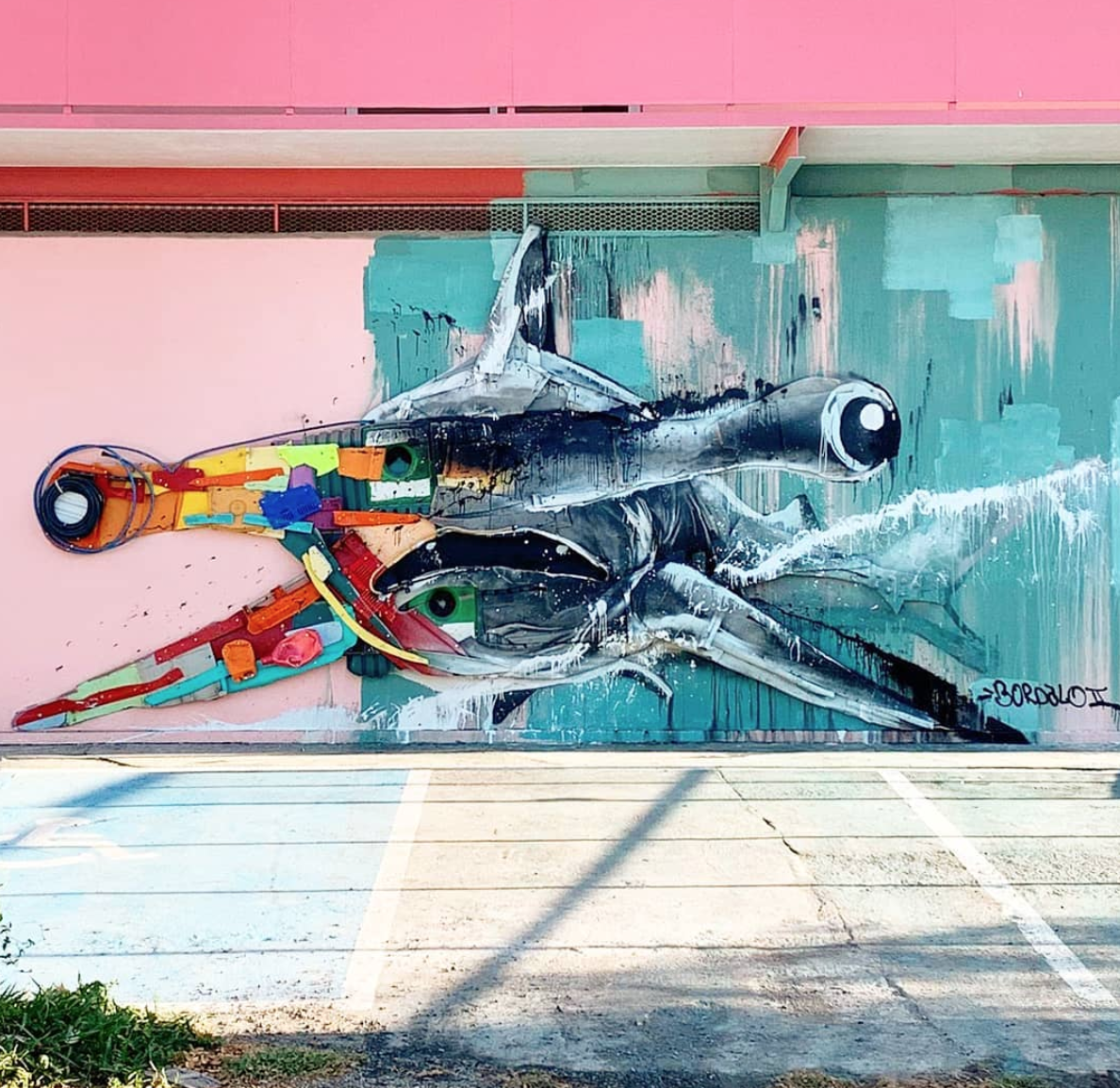
Tahiti also allowed location and subject to collapse into one another. The work was no longer an image of marine pollution created hundreds of miles inland. Bordalo II placed the plastic animal into the Pacific itself. A photograph by Selina Miles captured the artist swimming alongside the plastic shark in the Pacific Ocean.
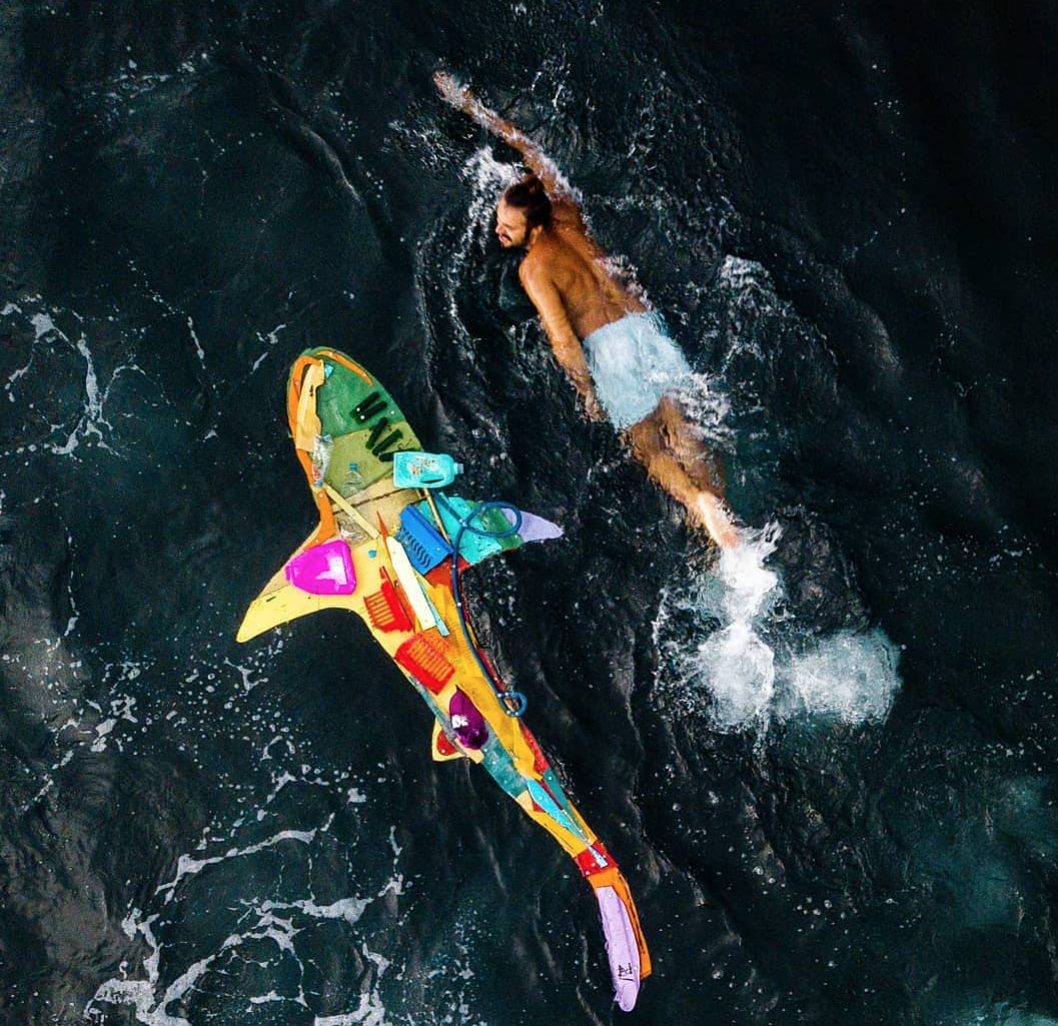
The Tahiti project became one of the clearest expressions of Bordalo II’s marine environmental language. GraffitiStreet documented the Half Sea Turtle, Half Hammerhead Shark and floating Trash Shark in our original feature, Bordalo II Swims with Trash Sharks for ONO’U Tahiti, 2019.
Bora Bora: Plastic Whales in French Polynesia
The same year, Bordalo II’s marine language continued in Bora Bora, where he created both Plastic Whales and Plastic Pearl. Within the Plastic sub-series, Bordalo II deliberately reduces the camouflage that characterises some of his earlier Trash Animals. The constituent objects remain exposed, with plastics and discarded components retaining their individual colours, forms and identities. This approach is particularly effective with marine subjects.
A whale constructed from visibly artificial material produces an immediate collision between scale, nature and manufacture. The viewer sees the animal and then begins identifying the fragments that compose it, moving mentally from ocean life back towards the consumer systems that created the waste.
French Polynesia also gives these works an unavoidable geographical resonance. Islands surrounded by extraordinary marine ecosystems sit on the receiving end of a global material economy whose discarded products travel far beyond the locations where they were first consumed. Bordalo II’s whales make that displacement visible.
Lighted Jelly Fish Addressing Ocean Pollution
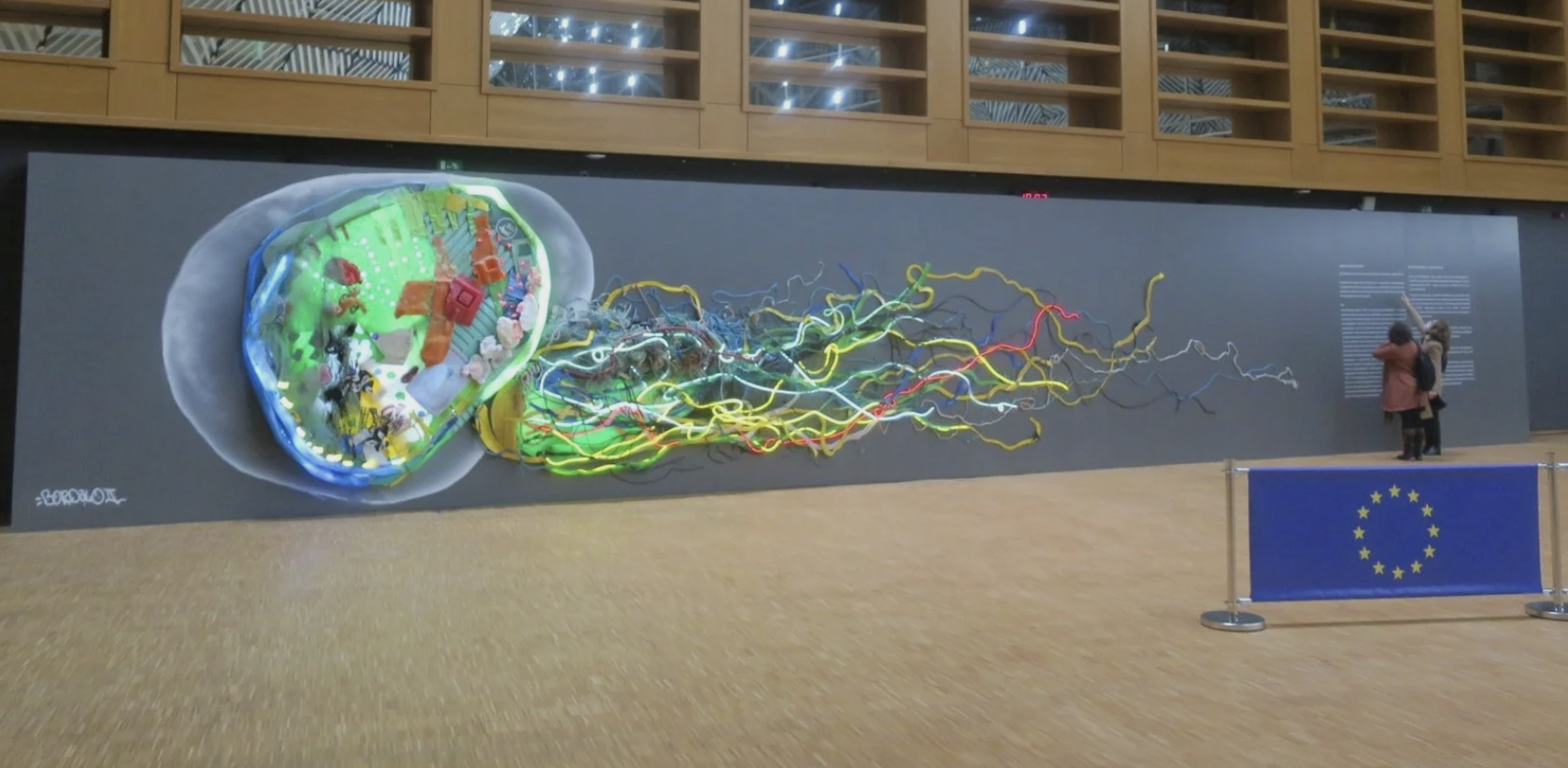
One of the most significant developments in this marine thread came with Lighted Jelly Fish, created in 2020 and subsequently exhibited at the Europa Building in Brussels during Portugal’s Presidency of the Council of the European Union. Bordalo II described the work as addressing ocean waste pollution and its impact on marine species and the food chain, while incorporating programmed light drawn from the visual language of advertising.
The sculpture later entered the Contemporary Art Collection of the Portuguese Republic and was installed permanently at the National Centre for Nautical and Underwater Archaeology in Xabregas, Lisbon. Here, the jellyfish connects several strands of Bordalo II’s practice at once: marine pollution, discarded material, environmental warning and the visual techniques of consumer culture turned back against themselves.
Sketchy Crab: Recycling Reaches the Algarve
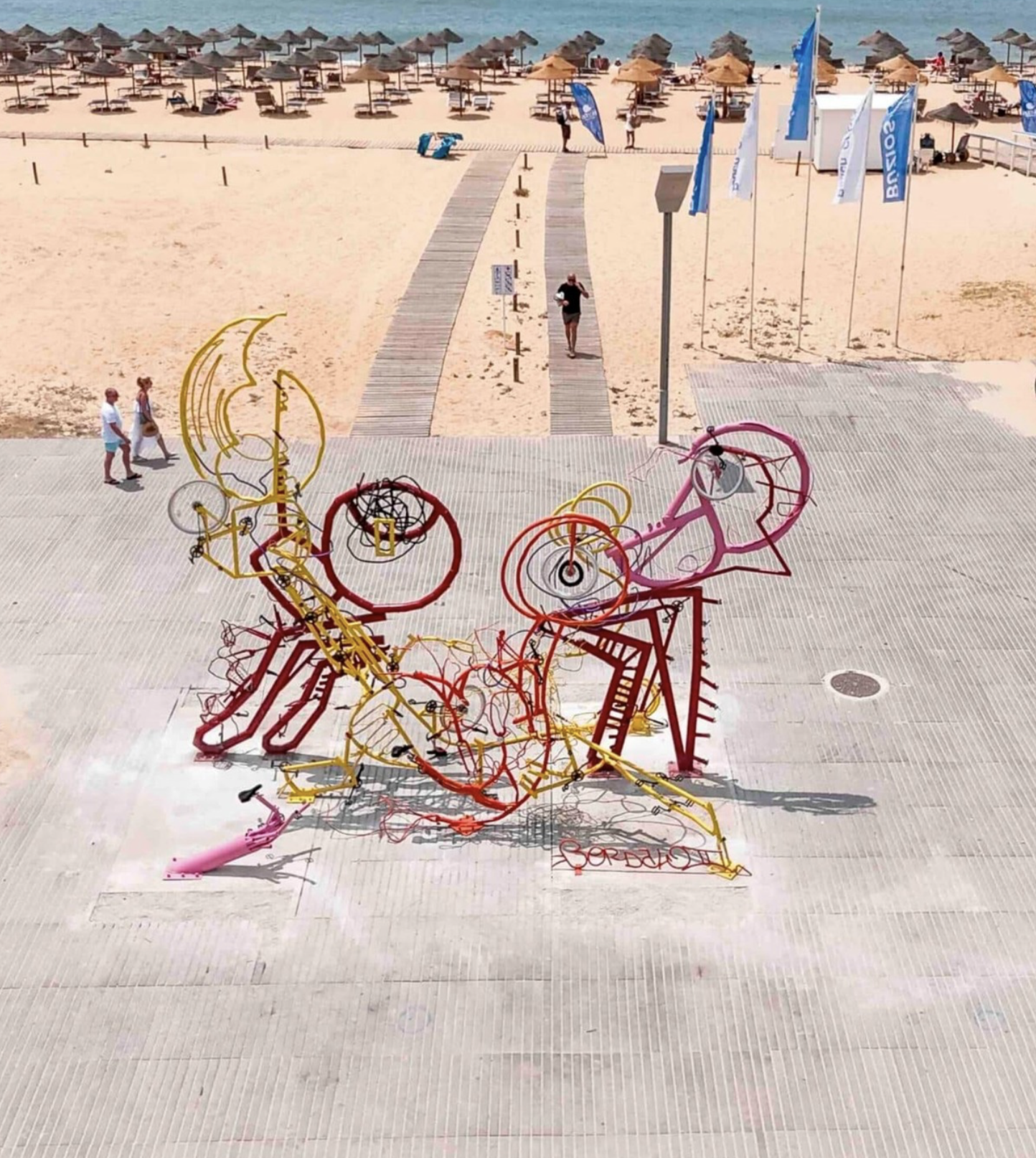
In July 2025, another marine creature appeared beside the Portuguese coast. Sketchy Crab was installed at Alameda da Praia in Vilamoura, in the Algarve, using discarded iron and components from old bicycles, including handlebars and saddles. The work as an intervention centred on reuse, sustainability and the transformation of materials that had reached the end of their original lives.
The choice of a crab connects naturally with the beach environment, although the material introduces another interesting layer. These are objects associated with human movement on land, reconstructed as a creature whose sideways movement belongs to the shoreline. Bordalo II once again allows the history of the material to remain present.
A bicycle component does not have to disappear completely into the crab. Recognition is part of the experience. The viewer discovers handlebars, metal and mechanical remnants while simultaneously reading them as legs, shell and anatomy.
With Sketchy Crab, regeneration becomes physical. Redundant objects that have stopped moving return to public life in the shape of an animal defined by movement.
Balloon Fish: A Coastal Warning in Trafaria
At the end of 2025, Bordalo II closed the year with another monumental marine animal, Balloon Fish, completed in Trafaria on Portugal’s Costa de Caparica. The giant pufferfish emerges from the façade of the local parish building through layers of discarded plastic, industrial remnants and locally sourced waste.
What makes Balloon Fish particularly compelling is its expression. The animal appears alert, almost startled, its inflated form suggesting vulnerability and defence simultaneously. Bordalo II’s use of scale gives that small marine creature an imposing presence, while the exposed debris across its surface refuses to let the viewer forget why it has been constructed this way.
The location reinforces the meaning. Trafaria sits beside the Tagus estuary and Atlantic coast, bringing the sculpture physically close to the aquatic ecosystem its imagery evokes.
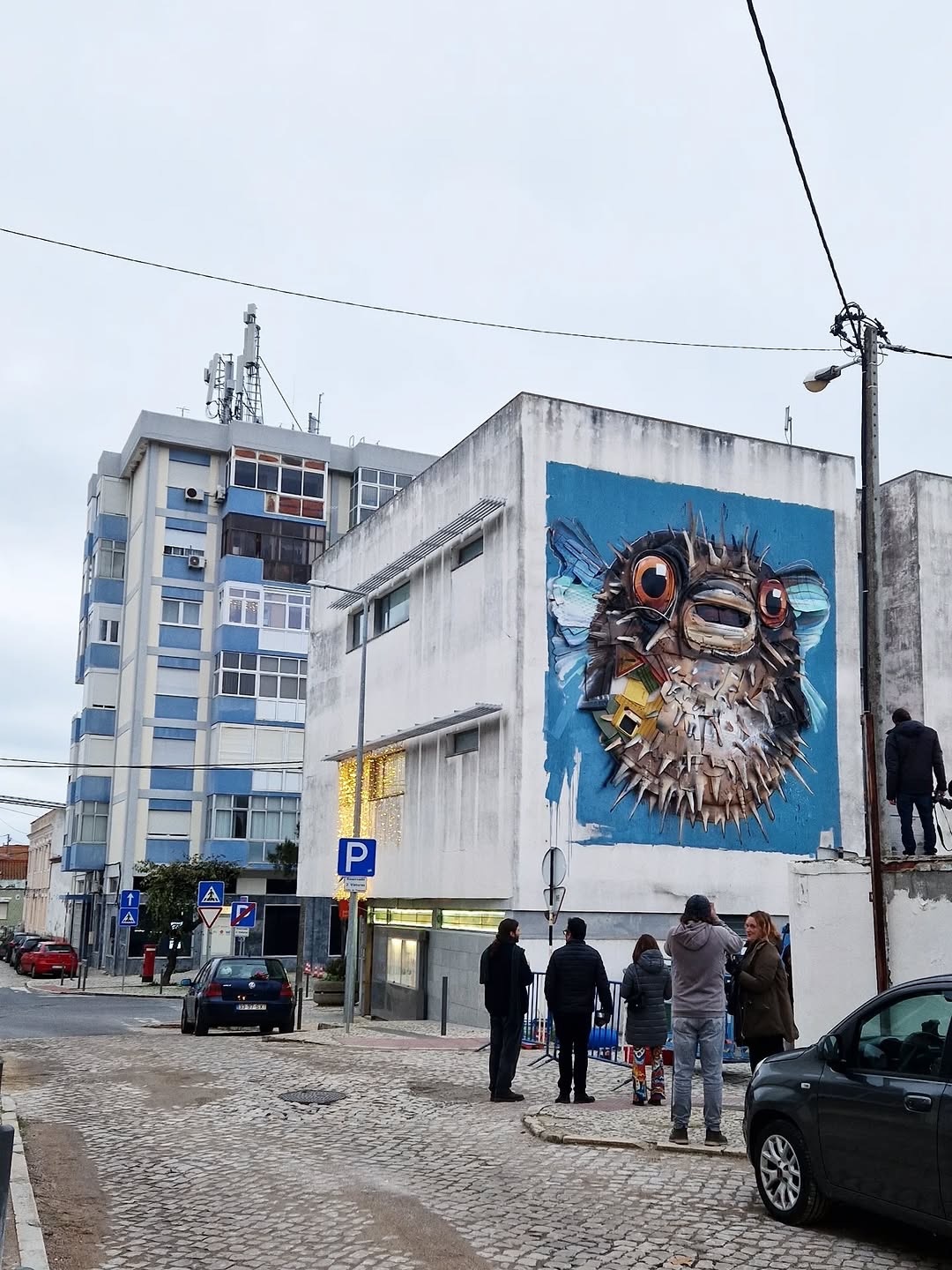
That marine thread continues in Portugal through Bordalo II’s Balloon Fish in Trafaria, where locally sourced debris becomes the skin of a monumental pufferfish on the Atlantic coast.
From Fish to Sharks: Why Bordalo II’s Marine Animals Matter
Viewed together, these works reveal that Bordalo II’s engagement with marine life is comprehensive. The Stavanger whale, Hove seagull, Wild Wild Waste whale, Tahiti sharks and turtle, Bora Bora whales, Sketchy Crab and Balloon Fish form a visual history running across more than a decade.
Across that history, the relationship between material and subject becomes increasingly precise. Fishing net traps a whale. Plastic constructs a shark. Discarded bicycle components become a crab. Locally gathered rubbish forms an enormous coastal fish. Waste does more than provide Bordalo II with an unusual sculptural medium. Its former function, location and environmental implications contribute to the meaning of the finished work.
The ocean gives that language particular urgency because rubbish rarely respects boundaries. Material discarded in one place can travel through rivers, drainage systems and currents before appearing somewhere entirely different. UNEP describes marine litter as a source-to-sea problem rooted partly in patterns of production, consumption and waste management on land. Bordalo II translates that vast system into individual encounters.
A statistic involving millions of tonnes of plastic can be difficult to visualise. A shark swimming beside a human, visibly constructed from plastic debris, requires no such abstraction.
Beauty, Attraction and Environmental Unease
There is also a reason Bordalo II’s marine animals remain so visually enjoyable. They are colourful, tactile and frequently humorous. Children can recognise them immediately, while adults are drawn towards the extraordinary construction and scale. The work does not require prior knowledge of environmental policy, contemporary art theory or waste-management systems to communicate. That accessibility gives the sculptures considerable public power.
The environmental meaning reveals itself through looking. A viewer approaches because of the animal and stays long enough to discover bumpers, bottles, nets, plastics, tyres, bicycle components and fragments of an economy that ordinarily disappears into bins, warehouses and landfill. Bordalo II makes waste visible without sacrificing the visual enjoyment.
That balance helps explain why his marine works function so effectively within public space. They can delight and disturb within the same encounter, allowing environmental criticism to enter everyday life without becoming a lecture.
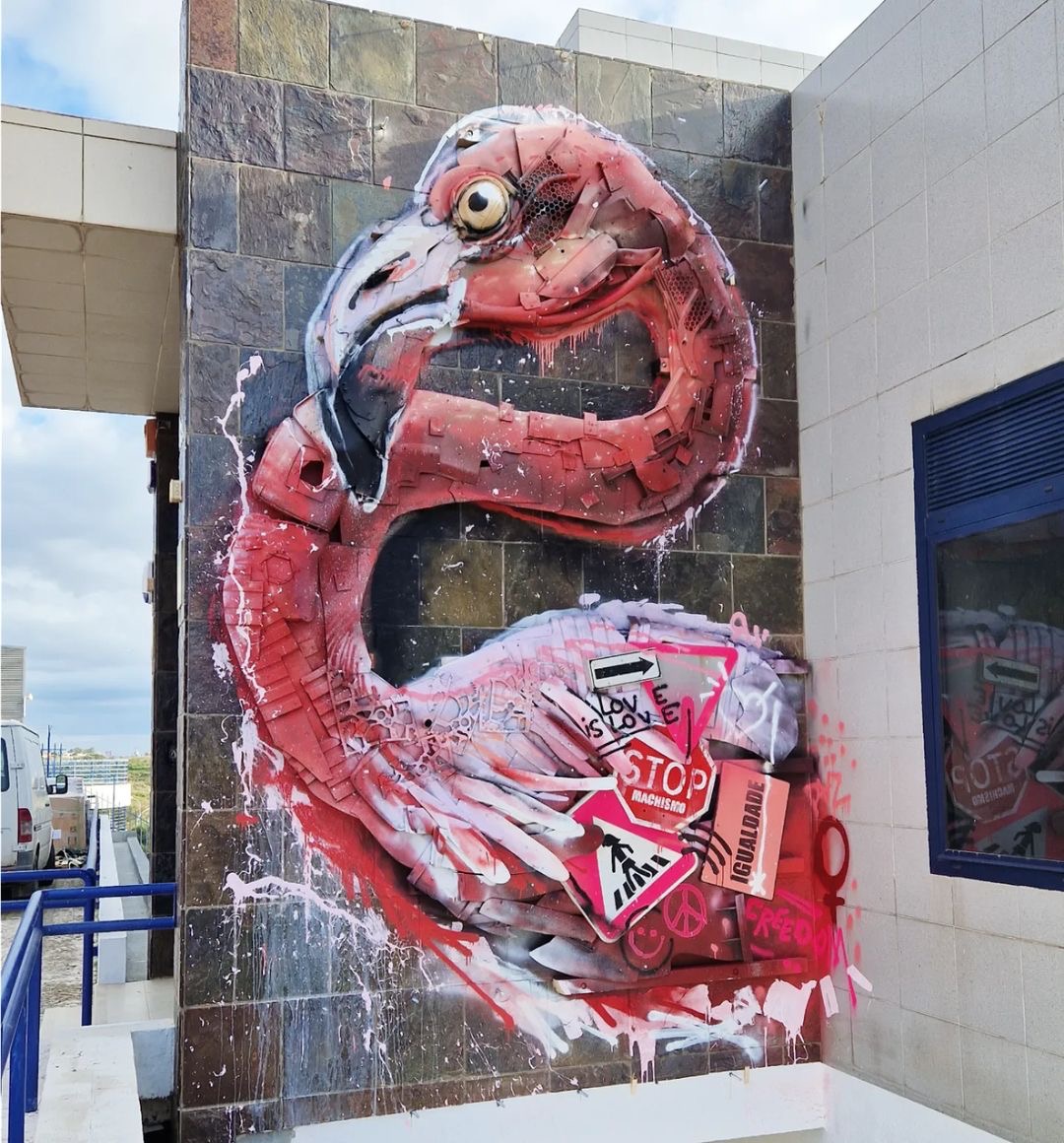
GraffitiStreet Perspective
GraffitiStreet has been documenting Bordalo II’s environmental practice for more than a decade, and the marine works provide a particularly revealing way of understanding how his ideas have developed. Seen across time, what stands out is the consistency of Bordalo II’s central idea alongside the constant evolution of its form.
The whale inside an industrial arts venue, a seagull assembled from Brighton and Hove’s discarded materials, a plastic shark floating in the Pacific, a crab constructed from obsolete bicycles and a monumental pufferfish overlooking Trafaria all belong to the same larger question: what becomes of the objects we stop wanting? The sea provides one of the clearest answers. They do not disappear.
Bordalo II gives those consequences form, transforming environmental pressure into works that are immediate, intelligent and visually unforgettable. His ability to move between sculpture, public art, installation and ecological critique while retaining the directness of the street has established him as one of the most compelling and distinctive artists working within contemporary urban art today.
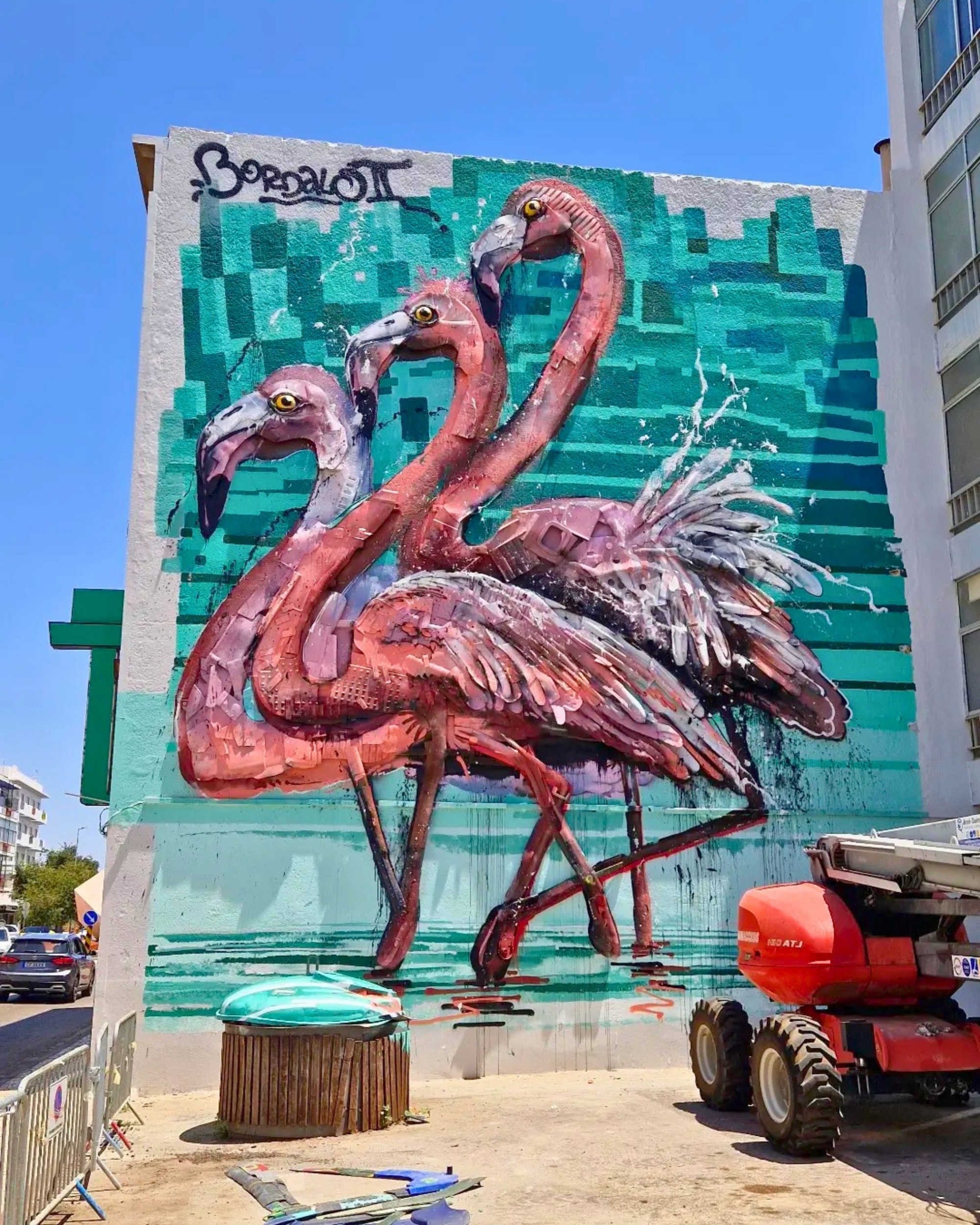
Bordalo II’s coastal dialogue continued through Flamingos da Ria Formosa in Olhão, where discarded plastic, metal and bicycle parts became birds associated with the ecology and vulnerable habitats of the nearby lagoon.
Frequently Asked Questions
Bordalo II uses discarded materials to connect the animal being represented with the environmental consequences of excessive production, consumption and waste. Within his Big Trash Animals, the contradiction between wildlife and materials associated with habitat destruction is fundamental to the work.
Documented marine and coastal works include whales, sharks, a sea turtle, hammerhead shark, pufferfish, crab and seagull. Important examples include his Stavanger whale, Hove Trash Seagull, Tahiti Trash Shark, Half Sea Turtle and Half Hammerhead Shark, Plastic Whales in Bora Bora, Sketchy Crab in Vilamoura and Balloon Fish in Trafaria.
During Bordalo II’s 2019 return to Tahiti for ONO’U, he created several ocean-related Trash Animals, including a floating Trash Shark, Half Sea Turtle and Half Hammerhead Shark. A photograph by Selina Miles showed the artist swimming alongside the plastic shark in the Pacific Ocean.
Sketchy Crab is a public sculpture installed in Vilamoura, Algarve, in 2025. The crab was constructed from reused materials including iron and redundant bicycle parts, continuing Bordalo II’s practice of transforming discarded objects into animal forms.
Balloon Fish is located in Trafaria on Portugal’s Costa de Caparica, where the large pufferfish occupies the façade of the parish building. The work was completed in December 2025 and was constructed using discarded and locally sourced materials.
UNEP estimates that more than 11 million metric tonnes of plastic currently enter the oceans each year. Marine plastic can affect wildlife through mechanisms including ingestion and entanglement and can persist within aquatic ecosystems for long periods.
Related Reading
Bordalo II’s marine animals form part of a much wider environmental language explore our complete guide to Bordalo II: Big Trash Animals, Provoc and the Politics of Waste.
Continue with our in-depth guide to Bordalo II’s Big Trash Animals, revisit the development of the series through The Evolution of Big Trash Animals, or explore how ecological concern intersects with politics and social criticism in 10 Provocative Themes in Bordalo II’s Art
Discover Bordalo II at GraffitiStreet
From monumental Trash Animals to studio works and editions, Bordalo II continues to transform the remnants of contemporary consumption into animals whose presence is difficult to ignore.
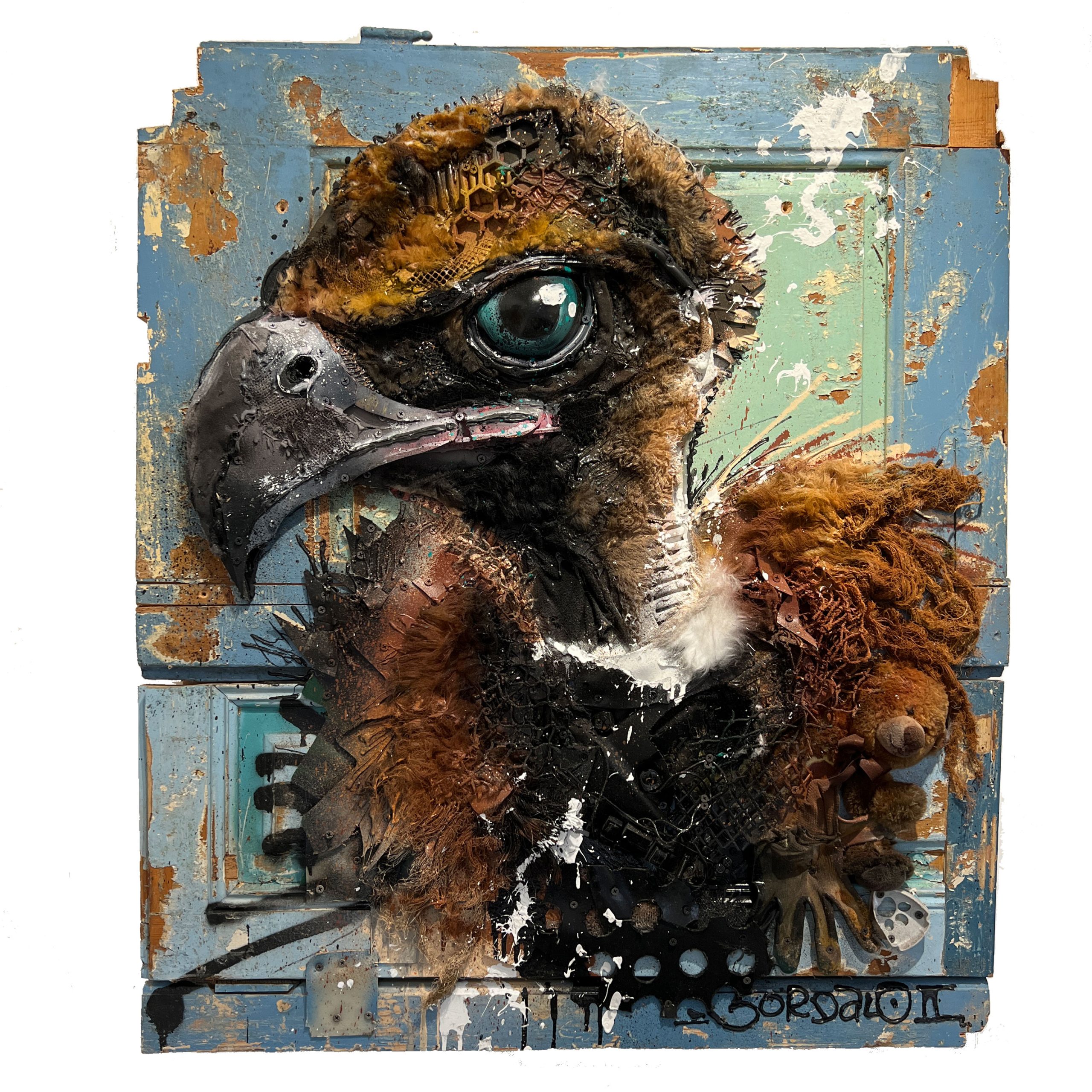
Bordalo II – Baby Vulture for X- A Decade Exhibition. Available via GraffitiStreet
For availability, acquisitions and private viewings, explore Bordalo II artworks at GraffitiStreet, contact us directly or experience works in person at:
GraffitiStreet Gallery
25A West Street
Chichester
West Sussex
England PO19 1QW