Bordalo II’s Monoplizada Turns Lisbon Into a Monopoly Board Over the Housing Crisis
Portuguese artist Bordalo II transformed Lisbon’s Praça do Duque da Terceira at Cais do Sodré into a giant Monopoly-inspired game board. Titled Monoplizada / Monopolised, the public intervention confronts Portugal’s housing crisis through one of the world’s most recognisable symbols of property, money and economic power.
Painted squares, houses, hotels and banking references surround the historic monument at the centre of the square, turning pedestrians into players within Bordalo II’s provocative urban game. At its heart is a question that reaches far beyond Lisbon: what happens when housing becomes an asset to play with rather than a place to live?

Bordalo II, Monoplizada / Monopolised, Lisbon, 2025. Image © Bordalo II.
Monoplizada: Lisbon Becomes a Real-Life Monopoly Board
For Monoplizada, Bordalo II reimagines the familiar language of Monopoly across the public space of Praça do Duque da Terceira. The installation surrounds the monument with oversized game-board graphics, allowing people to physically walk through an artwork about property, ownership and inequality.
The choice of Monopoly is deliberately accessible. Houses become hotels, properties are mortgaged to banks and fortunes depend on where a player begins. Bordalo II uses that familiar game structure to question who benefits when a city increasingly functions according to the logic of property investment.

Monoplizada /Monopolised 🏦. Image copyright Bordlao II
Bordalo II on Lisbon’s Housing Crisis
“Monopolised 🏦
Our cities are being turned into giant game boards. The right to housing, which is guaranteed by the Constitution, now depends on luck or chance.Some players exchange houses for hotels, some mortgage their properties to the bank, and others are the bank — but in this game, not everyone starts with the same amount, and few get anything when passing the starting point.” Bordalo II
The reference to housing as a right is particularly significant. Article 65 of the Portuguese Constitution states that everyone has the right to adequate housing for themselves and their family, and places responsibilities on the state around affordable and social housing, rental affordability and access to homes.
Against that constitutional principle, Bordalo II presents the city as an uneven game in which access to housing is shaped by vastly different levels of wealth and opportunity.


Monoplizada /Monopolised 🏦. Image copyright Bordlao II
A Historic Lisbon Monument Reframed
At the centre of Monoplizada stands the Monument to the Duke of Terceira, inaugurated in 1877. The bronze sculpture by José Simões de Almeida, with architectural design by António José Gaspar, commemorates the military figure closely associated with Portugal’s Liberal campaigns and the constitutionalist entry into Lisbon on 24 July 1833.
That history gives Bordalo II’s intervention an additional layer. A monument associated with nineteenth-century struggles over political liberty is temporarily surrounded by a contemporary argument about another form of freedom: the ability to remain in, afford and participate in the city where one lives.


Monoplizada /Monopolised 🏦. Image copyright Bordlao II
Housing as a Game of Power
The strength of Monoplizada lies in the simplicity of its metaphor. Monopoly begins with property as a game, yet Bordalo II uses it to expose the very real consequences of housing becoming increasingly tied to investment, speculation and financial advantage.
His intervention does not require viewers to understand complex housing economics before entering the work. Everyone recognises the board. Everyone understands houses becoming hotels. Everyone understands that some players begin a game with advantages others do not possess.
By placing that imagery directly beneath pedestrians’ feet, Bordalo II turns economic inequality into a physical experience of public space.

Monoplizada /Monopolised 🏦. Image copyright Bordlao II
Art as Urban Intervention
Monoplizada belongs to the socially critical side of Bordalo II’s practice, where public space becomes both medium and audience.
Rather than asking viewers to enter a gallery, the artist interrupts an existing civic environment and inserts an argument into daily life. Commuters, residents and visitors moving through Cais do Sodré become part of the installation simply by crossing the square.
This is central to Bordalo II’s wider Provoc and art-activism practice, where familiar urban spaces are disrupted to expose political, social and environmental tensions.

Monoplizada /Monopolised 🏦. Image copyright Bordlao II
Where Was Bordalo II’s Monoplizada?
Monoplizada / Monopolised was installed at Praça do Duque da Terceira in Cais do Sodré, Lisbon, close to the Tagus River and one of the city’s busiest transport and nightlife districts.
The location matters. Bordalo II placed an artwork about housing, property and access at the centre of an intensely visible part of contemporary Lisbon, transforming a historic square into a temporary arena for debate.
Discover Bordalo II at GraffitiStreet
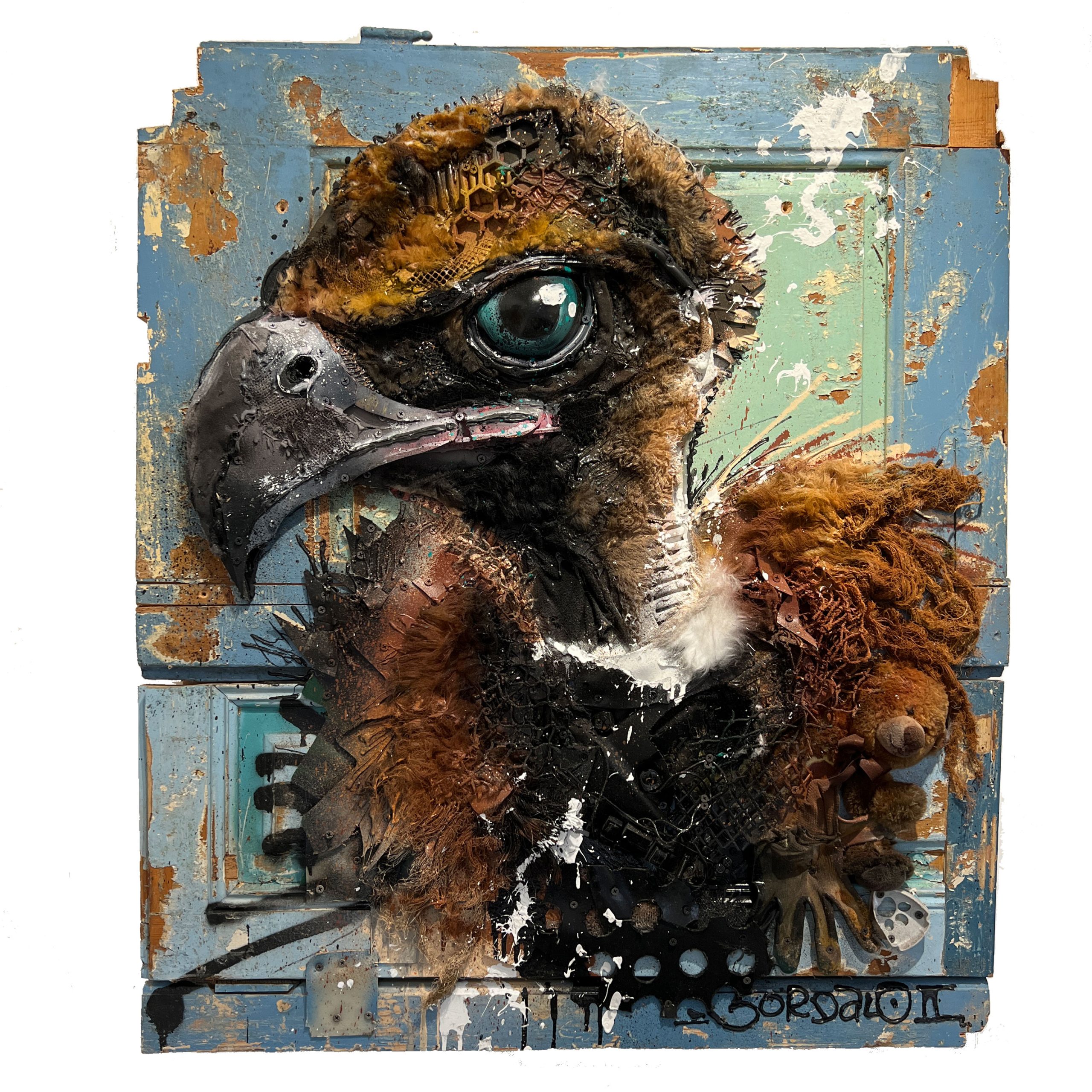
Monoplizada belongs to Bordalo II’s wider Provoc and art-activism practice, where the artist turns public space into a platform for social and political critique. That critical instinct also runs through his Big Trash Animals, which confront consumption, waste and environmental responsibility through monumental animal sculpture. Together, these two strands reveal the breadth of Bordalo II’s practice, from ecological urgency to questions of housing, power and inequality. GraffitiStreet’s 2015 interview with Bordalo II captures many of these concerns at an early stage, while later interventions such as Sensitive Content show how his language of protest has continued to evolve.
Explore Bordalo II artworks at GraffitiStreet, including editions, studio works and original pieces. For current availability, acquisitions, sourcing or private viewings, contact GraffitiStreet directly.
You can also experience selected works in person at GraffitiStreet Gallery, 25A West Street, Chichester, West Sussex, England PO19 1QW,.
Images © Bordalo II.