Shamsia Hassani’s Nowadays: Dandelions, Fractures and the Memory of Home
Shamsia Hassani’s Nowadays is a quietly powerful painting about exile, memory and the fragile feeling of belonging to a homeland carried within the heart. Through a barefoot female figure, a faint remembered city, a jagged line carefully mended with small plasters, and dandelion seeds drifting through a muted landscape, Hassani gives poetic form to displacement, emotional repair and the quiet resilience of hope.
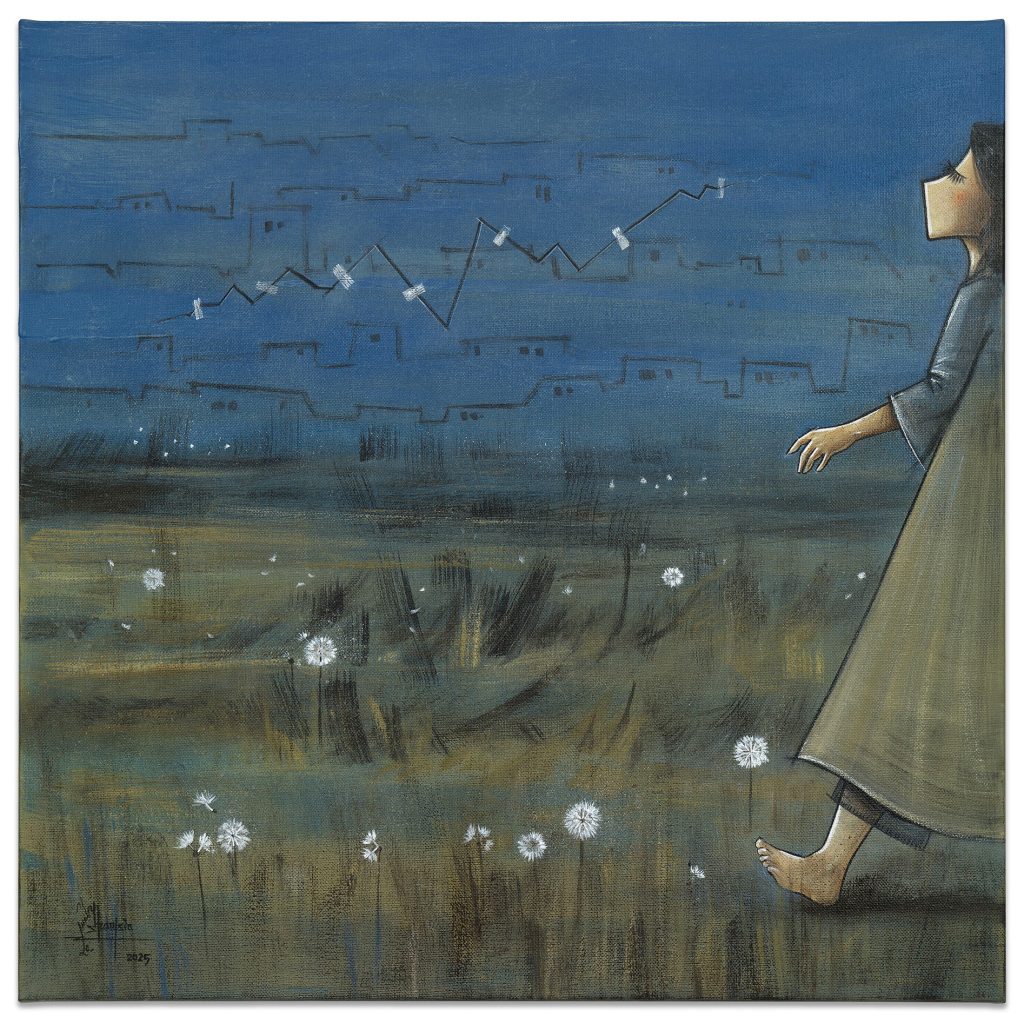
Shamsia Hassani, Nowadays #05, 2025, acrylic on canvas, unique work, 50 x 50 cm, signed by the artist. Exhibited at Urban Equinox, GraffitiStreet Gallery, 2026.
View details via GraffitiStreet
- Shamsia Hassani Nowadays: A quiet painting with a powerful emotional charge
- The barefoot figure and the language of belonging
- The city as a memory suspended in the sky
- A fractured line, carefully repaired
- Dandelions as wishes, seeds and survival
- Memory wrapped around the canvas
- Shamsia Hassani and the politics of visibility
- The political force of tenderness
- GraffitiStreet Perspective
- Frequently Asked Questions
- Discover Shamsia Hassani at GraffitiStreet
Shamsia Hassani Nowadays: A quiet painting with a powerful emotional charge
At first glance, Nowadays appears gentle. Its palette is restrained, its atmosphere contemplative, its central figure almost weightless as she moves through a dreamlike landscape. Yet the work carries a deep emotional charge. It belongs to the visual language that has made Shamsia Hassani one of the most important Afghan voices in contemporary street art: the silent female figure, the charged city, the fragile dream, the wound, the wish and the act of continuing.
Shamsia Hassani’s art is often recognised for its clarity. Her figures are immediately legible, reduced to elegant silhouettes, closed eyes and simplified gestures. Their emotional force arrives more slowly. They do not speak, yet they hold the full pressure of lived experience. In Nowadays, that pressure gathers around exile, memory and the unsettling fear that the homeland carried within the heart may one day feel unfamiliar, changed or unreachable.
The painting was sent from Shamsia Hassani’s studio in Los Angeles, where the artist now lives after leaving Afghanistan following the fall of Kabul in 2021. That context matters. Nowadays is not simply an imagined landscape. It is a work made from distance, shaped by the emotional geography of being far from home while remaining deeply rooted in memory.
The barefoot figure and the language of belonging
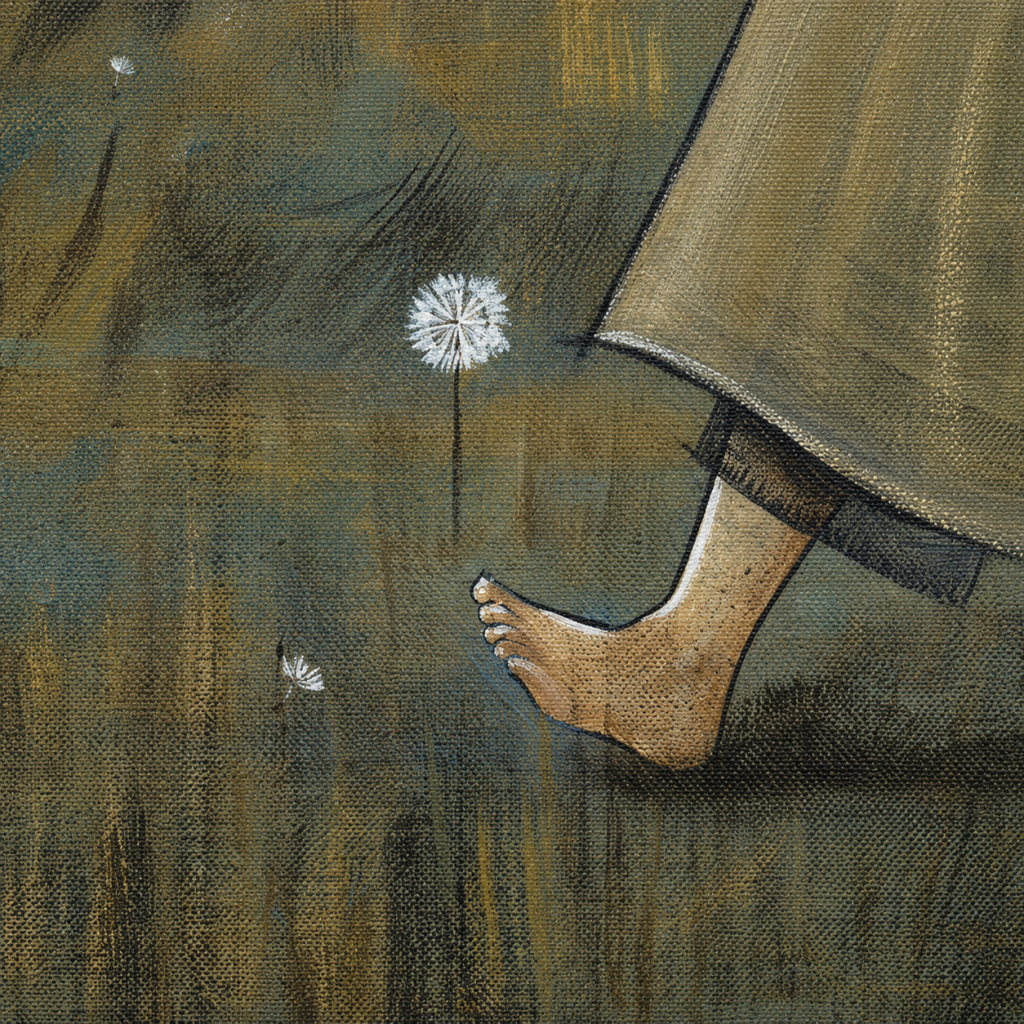
The female figure in Nowadays moves barefoot across the lower right of the canvas. Her posture is calm, her movement soft, her face turned gently upward. She appears composed, yet the bareness of her feet makes the image profoundly intimate. She is not separated from the land beneath her. She touches it directly.
This small detail gives the painting much of its emotional power. Bare feet suggest vulnerability, but also connection. They speak of a body in contact with place, of memory felt through the ground, of belonging that exists beyond borders, distance or political rupture. Hassani’s figure moves through the landscape as though guided by something internal, as though home remains present beneath each step.
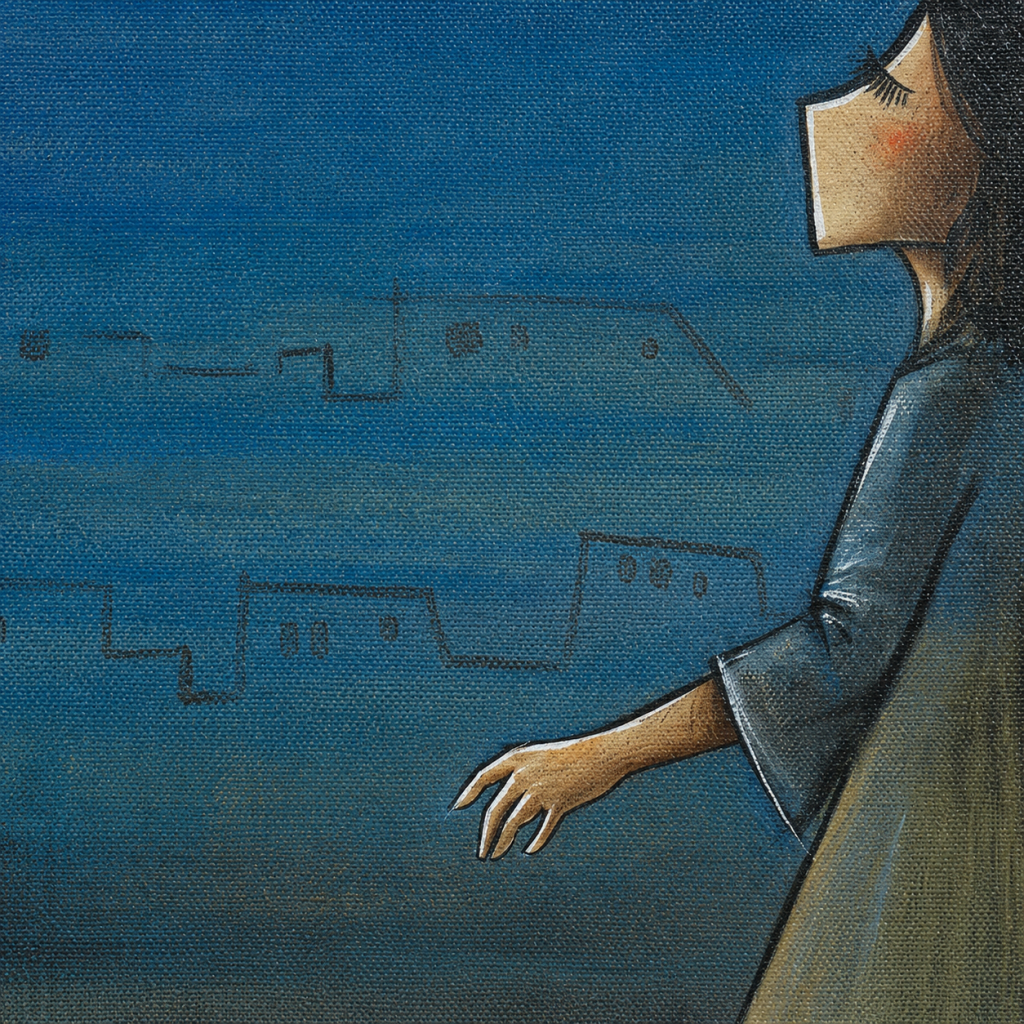
Her signature closed eye and no mouth, and silent expression continue a symbolic language that runs through Hassani’s murals, paintings and public works. The women she paints appear without speaking mouths, yet they are never empty or passive. Their silence becomes charged with meaning. They carry emotion, imagination and resistance in the space where speech has been withheld.
In Nowadays, the figure’s calmness is not the calm of ease. It is the calm of endurance. She moves forward with a quiet strength that feels lived rather than performed.
The city as a memory suspended in the sky
Across the blue field of the painting, the city appears in thin, simple outlines. Its rooftops, walls and window-like marks hover in the atmosphere, faint and almost spectral. The buildings feel remembered rather than observed, as if the city exists somewhere between place, memory and dream.
For Shamsia Hassani, the city has always carried more than architectural meaning. Her practice began in Kabul, where public walls became spaces of visibility and possibility. To paint women onto those walls was to insist on presence, to create images that could be seen repeatedly and remembered. In Nowadays, the city has shifted from public surface to suspended memory. It remains visible, yet distant.
That distance is where the painting becomes especially poignant. Home is present, but it is no longer stable. It appears as outline, trace and atmosphere. Shamsia Hassani captures the emotional uncertainty of exile with extraordinary restraint: the knowledge that the place remembered may continue changing while one is away, and the fear that return may reveal a homeland altered beyond recognition.
A fractured line, carefully repaired
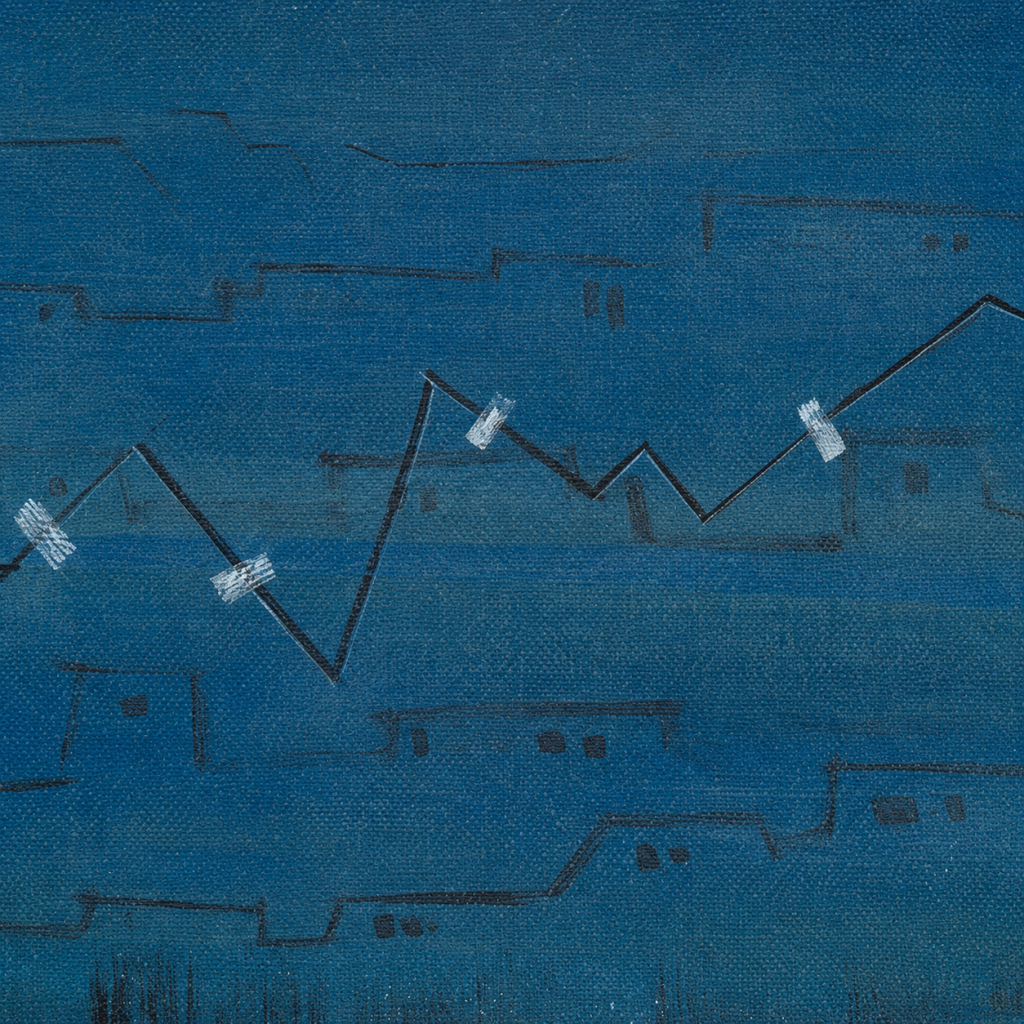
A jagged dark line cuts across the sky, moving through the composition like a rupture. It is angular, restless and unsettled. Small white plaster-like marks hold it together at intervals, creating one of the painting’s most affecting symbols.
The line can be read as a fracture of displacement, a broken connection between past and present, homeland and exile, memory and reality. Its rhythm suggests instability, while the plasters suggest care. Hassani does not erase the brea, she tends to it.
This is where Nowadays reveals its deepest emotional intelligence. Healing is shown as an act of attention rather than concealment. The wound remains visible, but it is held. The rupture is acknowledged, yet the image refuses collapse. In Hassani’s hands, repair becomes a quiet form of resistance.
The small plasters also introduce a human scale to the painting’s larger political and emotional themes. Exile can be discussed through history, borders and crisis, but Hassani brings it back to the body, to the hand, to the intimate gesture of mending what has been torn.
Dandelions as wishes, seeds and survival
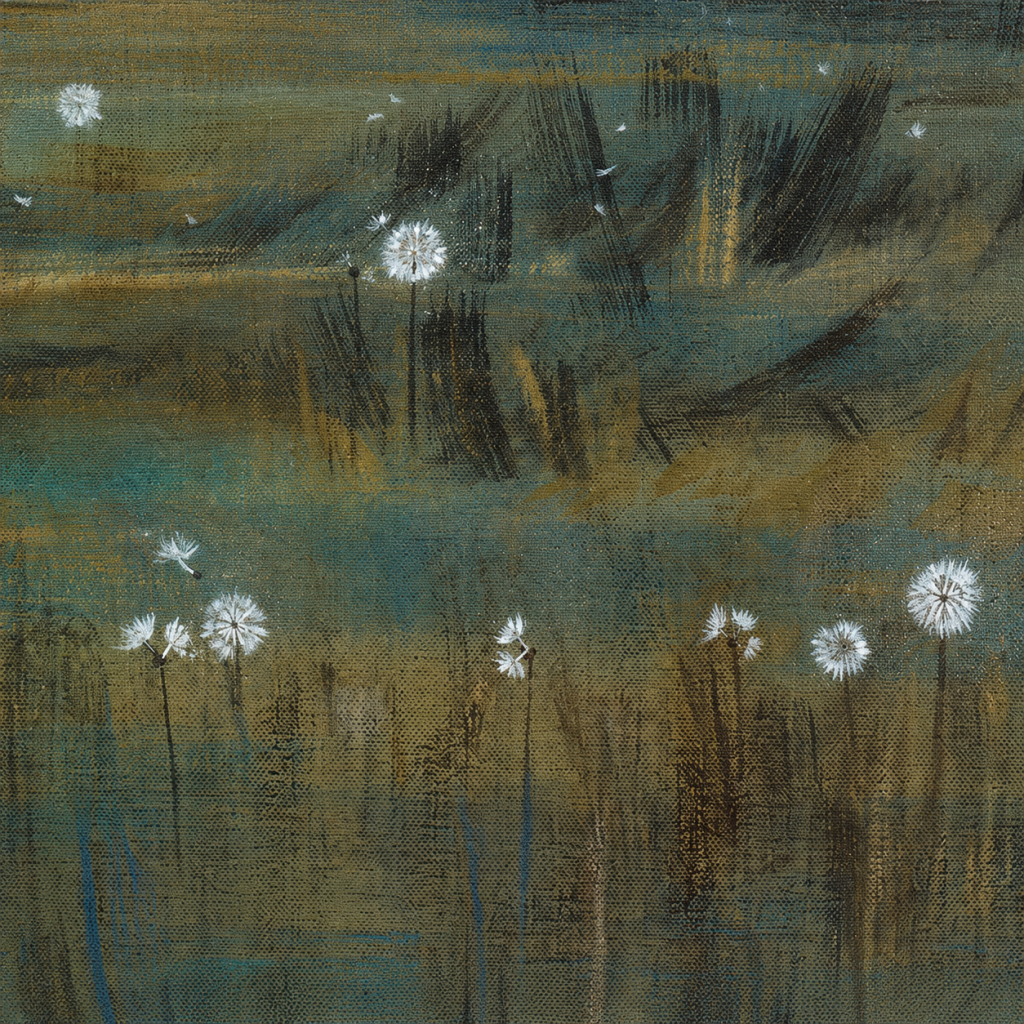
Around the figure, white dandelion seeds drift through the field. Some remain rooted on slender stems, while others float freely across the surface. Their lightness gives the painting tenderness, but their symbolism reaches further.
In Shamsia Hassani’s visual world, dandelions often suggest wishes, dreams and fragile hope. They are delicate, yet resilient. They travel because they must, carried by forces beyond their control, but still carrying the possibility of renewal. In Nowadays, the dandelions become an image of exile itself. They are uprooted and moving, yet full of life.
The seeds also deepen the painting’s relationship to memory. They drift like thoughts, prayers or fragments of home. Some remain close to the ground, rooted in the landscape. Others rise into the air, uncertain of where they will settle. Hassani gives this movement a quiet dignity. The hope here is fragile, but it is not weak.
The dandelions help the work breathe. They soften the wound without denying it, offering a quiet reminder not to lose hope.
Memory wrapped around the canvas
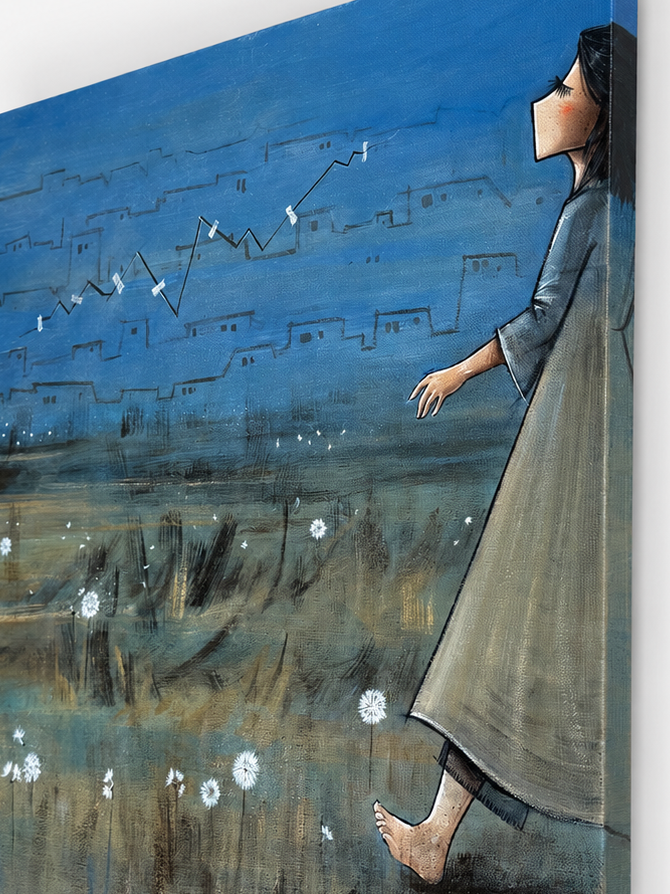
One of the most intimate details of Nowadays reveals itself when the painting is seen from the side. Hassani’s image continues around the canvas edge, carrying the figure and landscape beyond the front surface. The detail is subtle, but it changes how the artwork is experienced. The feeling does not stop at the first view. It continues around the frame.
This matters because Nowadays is a work about memory, and memory rarely behaves like a flat image. It wraps around us. It returns from unexpected angles. It extends beyond what can be seen directly. Hassani’s decision to paint around the canvas edge gives the work a deeper sense of continuity, as though the emotional world of the painting cannot be contained by a single plane.
The wraparound detail also reveals the care within Shamsia Hassani’s practice. Every part of the canvas contributes to the feeling of the work. The figure is not simply placed within a scene. She seems to belong to the entire painted world, moving through it, across it and around it. The canvas becomes a field of memory rather than a fixed window.
Shamsia Hassani and the politics of visibility
Shamsia Hassani is internationally recognised as Afghanistan’s first female graffiti artist, and her practice has long centred on visibility, resilience and the inner lives of women whose voices have been restricted or silenced. Her figures often appear with closed eyes, absent mouths and elongated forms, yet they carry a monumental emotional presence.
This visual language is one of the reasons her work resonates so widely. Hassani’s women are accessible at first glance, but they continue to unfold through symbolism, context and feeling. Their simplified forms allow emotion to move directly through the image. Their silence creates space for viewers to listen differently.
In earlier murals and works, musical instruments, birds, dandelions, architecture and dreamlike urban settings became part of a symbolic vocabulary of hope, imagination and resistance.
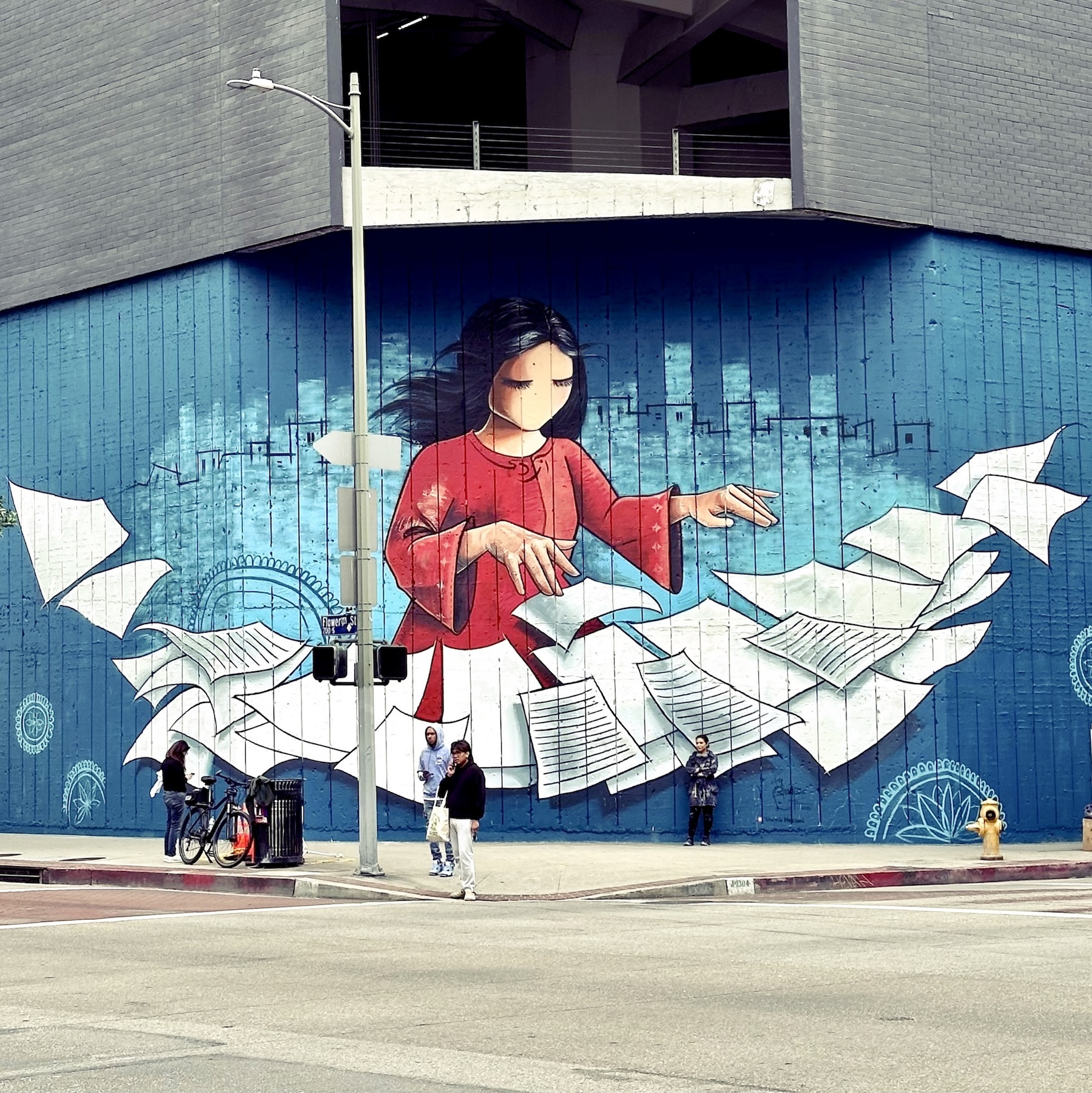
Shamsia Hassani, mural, Los Angeles, California, USA. Image copyright Shamsia Hassini. Read more here.
The political force of tenderness
Shamsia Hassani’s practice is often described through the language of resilience, visibility and Afghan women’s voices, but Nowadays shows how political strength can also emerge through tenderness. The painting is gentle in atmosphere, but its subject is profound. It speaks to exile, loss, distance, healing and the fear of estrangement from home.
This is the emotional intelligence of Shamsia Hassani’s work. She does not need to make the image louder for it to become more powerful. The strength lies in the restraint. The figure does not shout. The city does not collapse. The wound does not bleed across the canvas. Instead, the painting offers a still, careful language of endurance.
Within the broader history of street art, this matters. Street art has often been defined by immediacy, public address and visual impact. Hassani brings those qualities into conversation with interiority. Her work shows that public art can also be quiet, that political art can be poetic, and that visibility can be achieved through grace as much as confrontation.
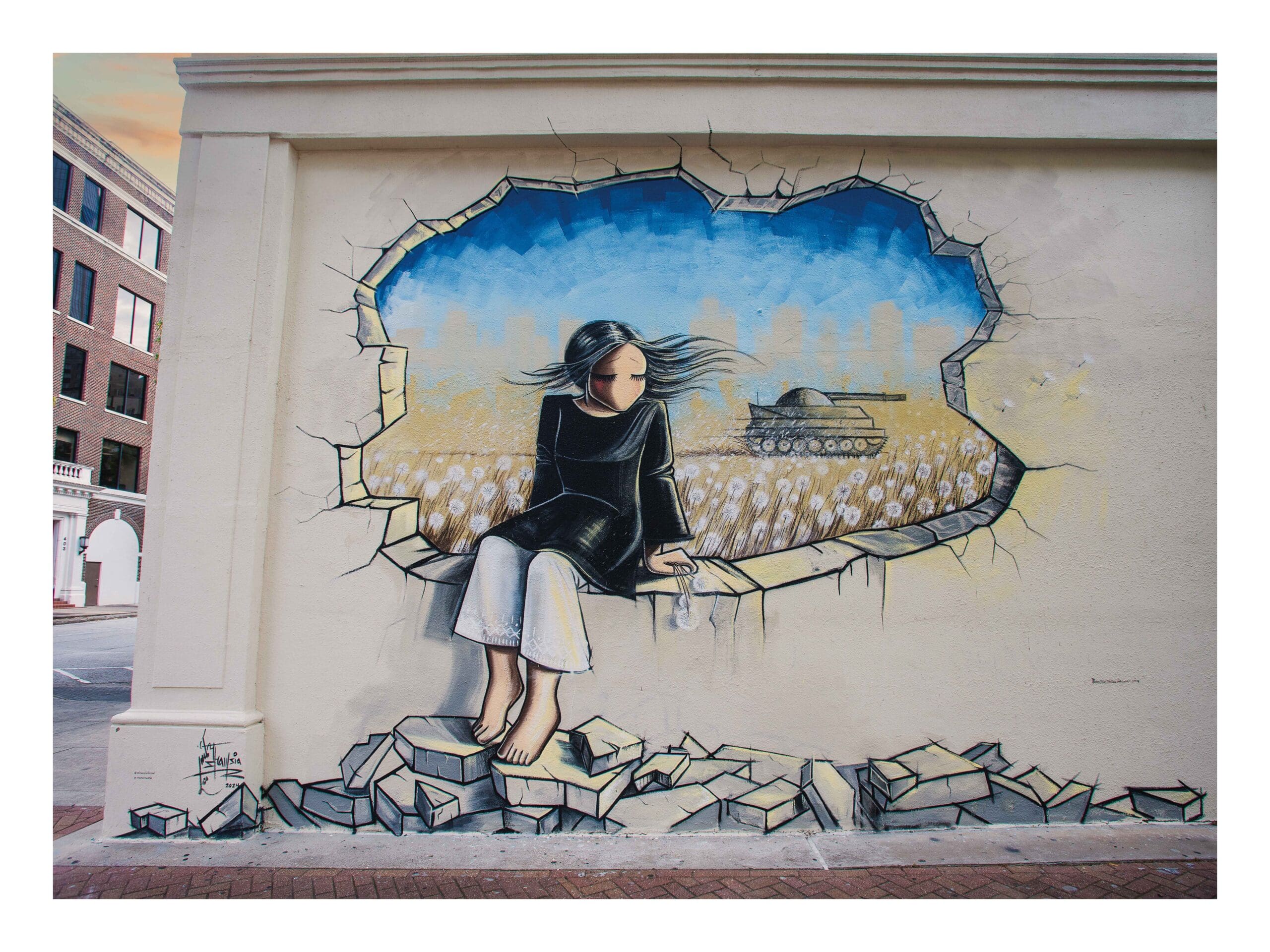
Shamsia Hassani, Birds of No Nation, mural. Curated and produced by Street Art for Mankind. © Dr Derek Hassani. All rights reserved.
GraffitiStreet Perspective
Nowadays transforms exile into a visual language of restraint, intimacy and repair. It avoids spectacle and instead builds meaning through precise symbolic details: the bare foot touching the land, the city reduced to outline, the wound held together by plasters, the painted memory continuing around the canvas edge, and the seeds drifting across the surface like hopes carried through uncertain air.
“In this gentle scene, Shamsia reveals a tender and difficult truth: home can be lost, remembered, repaired, feared and hoped for, all at once. Nowadays gives that truth a form of remarkable grace.” Donna Haden, Co-Founder and Curatorial Lead, GraffitiStreet
Having experienced the work in the gallery, where it was exhibited as part of Urban Equinox, GraffitiStreet sees Nowadays as one of Hassani’s most quietly affecting meditations on memory, belonging and emotional resilience.
“For collectors and viewers, Nowadays offers a rare combination of clarity and depth. It is immediately recognisable as Hassani’s language, yet it invites prolonged looking. Its power is not dependent on scale. It rests in the quiet relationship between figure, land, wound and wish.” Rosh Boroumand, Co-Founder, GraffitiStreet
The work also matters within Shamsia Hassani’s wider practice because it brings her recurring motifs into a deeply intimate composition. The canvas holds the emotional weight of displacement while remaining visually delicate. It speaks to Afghan women, exile and memory, but it also reaches anyone who understands the ache of belonging to a place that has changed, or fearing that return may no longer restore what distance has altered.
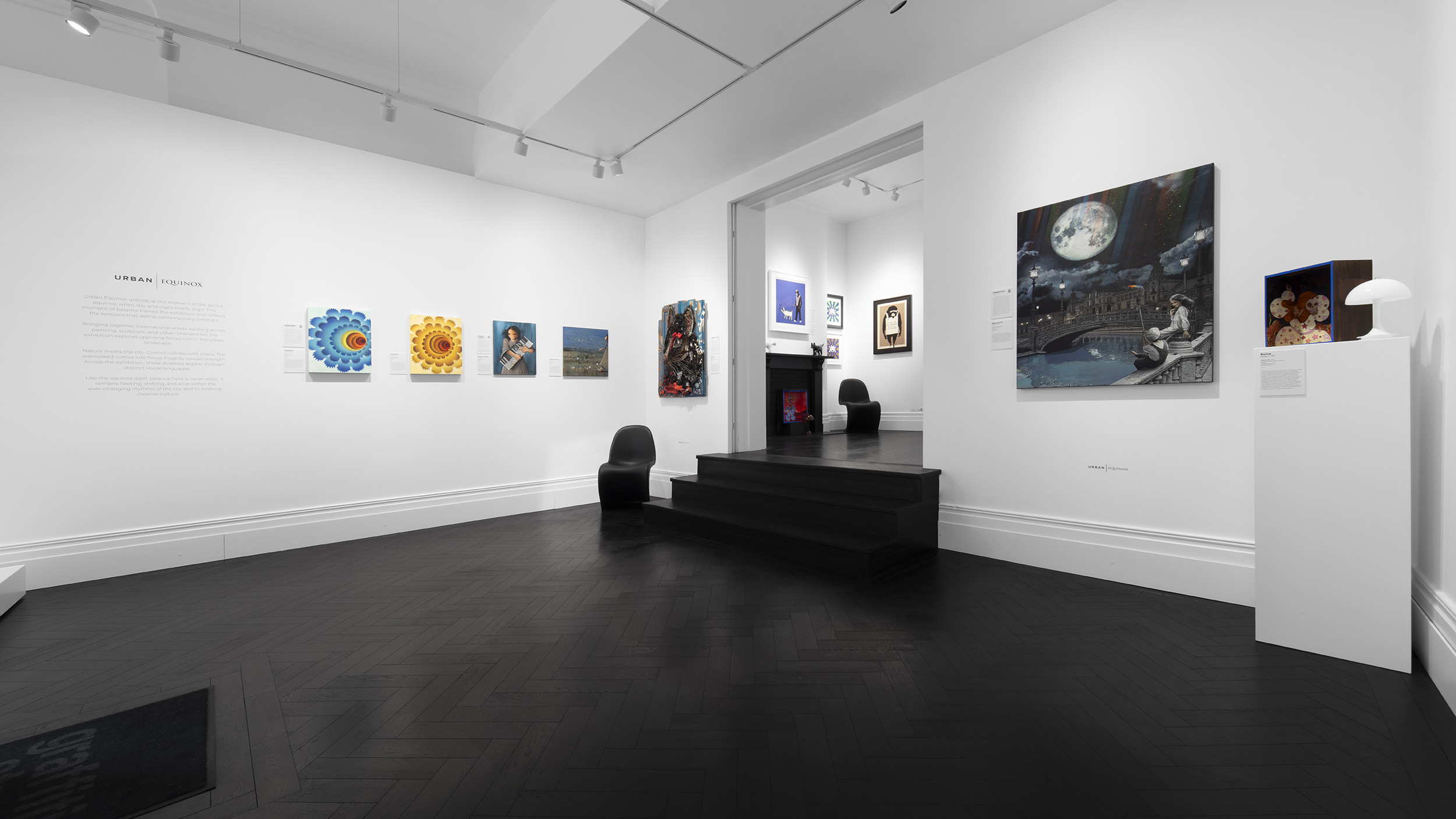
Urban Equinox at GraffitiStreet Gallery
Frequently Asked Questions
Shamsia Hassani’s Nowadays reflects on exile, memory, displacement and belonging. The canvas shows a barefoot female figure moving through a muted landscape, with a faint city, a mended jagged line and drifting dandelion seeds suggesting homeland, healing and hope.
The jagged line can be read as a symbol of rupture, displacement or emotional fracture. The small plaster-like marks suggest healing, care and the desire to repair what has been broken while still acknowledging the wound.
Dandelions in Shamsia Hassani’s work often suggest wishes, dreams, hope and movement. In Nowadays, they also evoke exile, where fragile hopes are carried across distance while remaining rooted in memory.
The bare feet create a direct connection between the figure and the land. In the context of exile, this detail suggests vulnerability, resilience and an intimate longing for homeland.
Shamsia Hassani’s female figures appear with closed eyes and absent mouths, creating a powerful visual language around silence, visibility and inner strength. Their silence does not remove their presence. It intensifies it.
Shamsia Hassani’s Nowadays #05 is available through GraffitiStreet and can be viewed through the gallery by enquiry. The work is a unique acrylic on canvas, signed by the artist and dated 2025.
Related Reading
In Conversation with Shamsia Hassani: Art and Visibility, International Women’s Day
Shamsia Hassani: 10 Things to Know About Afghanistan’s First Female Graffiti Artist
The Symbolism in Shamsia Hassani’s Murals: Women, Silence and Imagination
Street Artist in the Spotlight: Shamsia Hassani
Shamsia Hassani, The Melody Mural in Los Angeles
Urban Equinox at GraffitiStreet Gallery
Sources & Further Reading
GraffitiStreet artwork listing: Shamsia Hassani, Nowadays #05
GraffitiStreet artist page: Shamsia Hassani
Shamsia Hassani official website
Discover Shamsia Hassani at GraffitiStreet
International known as Afghanistan’s first female graffiti artist, Shamsia Hassani has developed a deeply recognisable visual language of powerful female figures, imagined cities, dandelions, memory and resilience.
Through our gallery and editorials, we continue to explore Shamsia Hassani’s wider practice, from her murals and public works to intimate canvases such as Nowadays #05, where exile, homeland and hope are held with extraordinary tenderness.
For Shamsia Hassani availability, acquisitions and private viewings, explore the collection online, contact us directly, or visit our gallery in the heart of Chichester, England.
GraffitiStreet Gallery
25A West Street
Chichester
West Sussex
England PO19 1QW