Banksy in Palestine: The Complete Guide to His Art Across Bethlehem, the West Bank and Gaza
Banksy’s work in Palestine forms one of the most sustained and politically significant chapters of his career, beginning with Love Is in the Air / Flower Thrower in the Bethlehem in 2003, expanding through a celebrated series of interventions on the West Bank barrier in 2005 and a return to Bethlehem in 2007, before continuing into Gaza in 2015 and the opening of The Walled Off Hotel in 2017.
Across these works, location is inseparable from image: windows open through concrete onto impossible landscapes, children appear to escape by balloon, a dove faces the threat of gunfire, a soldier inspects a donkey’s papers, and a kitten searches for play among the ruins of Gaza.

Banksy, Love Is in the Air / Flower Thrower, Bethlehem, Palestine. Image copyright GraffitiStreet.
Why Palestine Became So Important to Banksy’s Art
Banksy’s interventions in Palestine shifted his practice onto a scale where architecture, geography and politics became inseparable. The West Bank barrier, constructed by Israel beginning in the early 2000s, incorporates concrete walls, fencing and other infrastructure along a route through and around the West Bank. Israel has consistently described the barrier as a security measure intended to prevent attacks, while Palestinians have experienced it through restrictions on movement, access and territory. In its 2004 advisory opinion, the International Court of Justice concluded that construction of the wall within the Occupied Palestinian Territory and its associated regime were contrary to international law.
For Banksy, the wall became both surface and subject. His strongest Palestine images rarely require elaborate explanation because their visual logic is immediate: a window offers a landscape the viewer cannot physically reach; a ladder climbs towards the top of an overwhelming concrete structure; children transform instruments of surveillance into playground equipment. The humour opens the image quickly, while the location prevents that humour from becoming comfortable.
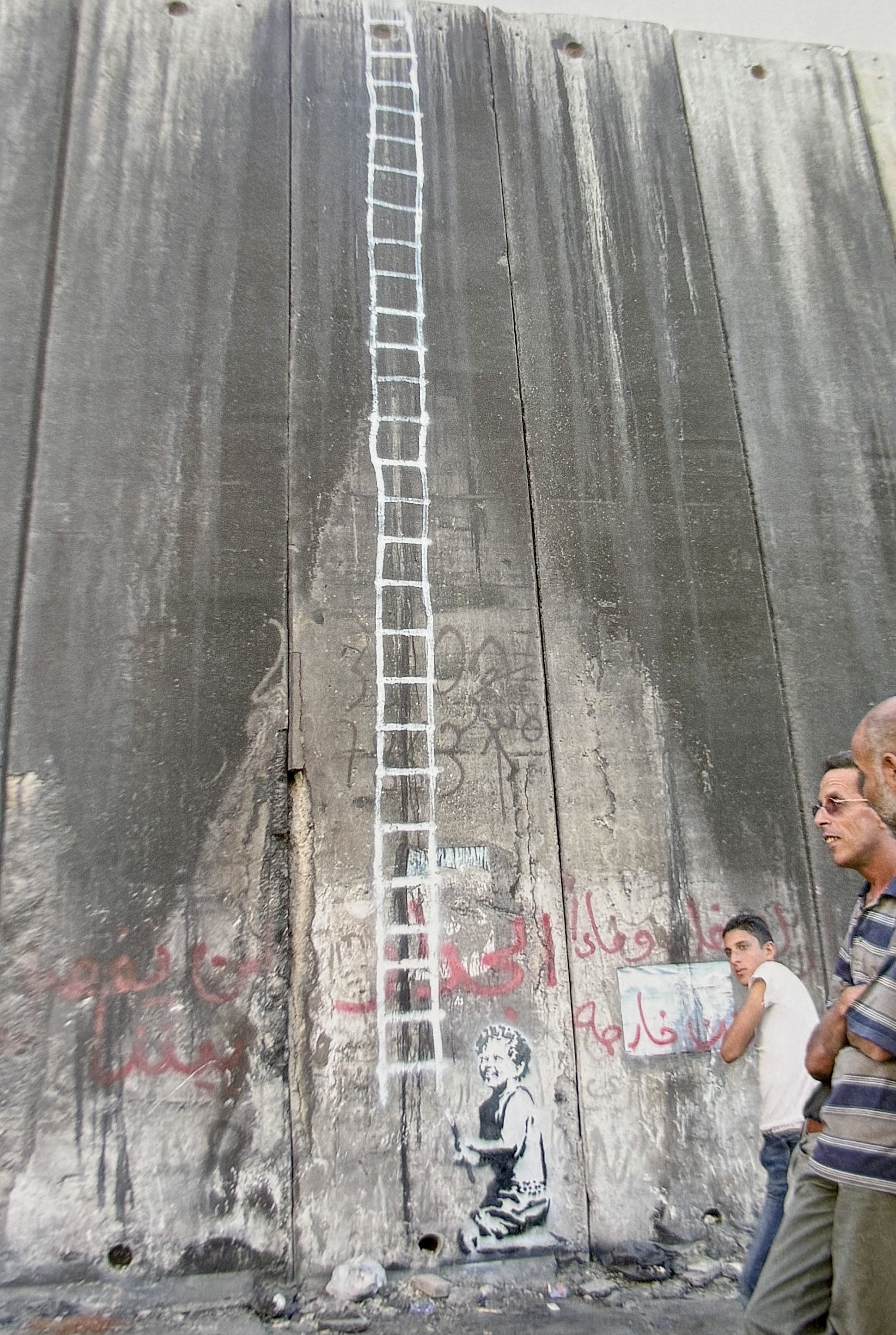
Images reproduced from Banksy, Wall and Piece (Century, 2005).
This relationship between image and site is crucial to understanding Banksy in Palestine. Removed from their surroundings, many of these compositions still work as powerful images. Encountered against the actual architecture of separation, they acquire another register entirely.
Love Is in the Air: From Protest to Flowers
Banksy’s Love Is in the Air, also widely known as Flower Thrower or Rage, the Flower Thrower, emerged in 2003 and became one of the defining images of his career. The original guerrilla iteration is associated with Beit Sahour, near Bethlehem, where the masked figure adopts the physical stance of a protester preparing to throw a weapon, yet holds a bouquet of flowers instead.
The substitution gives the image its extraordinary economy. Everything in the body suggests confrontation: the covered face, extended arm, twisting torso and forward momentum. The bouquet redirects the gesture towards peace, beauty and the possibility of another response to violence.
That apparent simplicity has allowed Love Is in the Air to travel far beyond its original wall. It became a screenprint in 2003, appeared across major paintings and canvases, entered Wall and Piece, and developed into one of Banksy’s most internationally recognised motifs. Yet its origin in Palestine remains essential to its meaning, because the flowers were first encountered within a landscape where questions of protest, security, restriction and political power were already physically present.
GraffitiStreet returned to the original image during our 2017 journey through Bethlehem. Guided locally by Alaa, we visited and photographed Banksy’s surviving works across the area before staying at The Walled Off Hotel, where another version of the Flower Thrower appeared inside the piano bar as a triptych with real dried flowers. The transition from street wall to interior installation changed the emotional character of the image while preserving its fundamental tension between confrontation and peace.

Flower Thrower appeared inside the piano bar as a triptych with real dried flowers. Image copyright GraffitiStreet
Banksy’s 2005 West Bank Barrier Murals
In 2005, Banksy returned to the West Bank and created nine stencilled murals on the Palestinian side of the barrier, a group documented contemporaneously as his “holiday snaps.” Rather than repeating a single political symbol, Banksy approached the structure through a series of visual propositions about escape, imagination and what might exist beyond the concrete.
Banksy described the wall itself in blunt terms: a barrier built from 2002, three times the height of the Berlin Wall and eventually stretching over 700km, roughly the distance from London to Zurich, turning Palestine, in his words, into the world’s largest open-air prison.
One mural depicted a boy kneeled beneath a rope ladder rising towards the top of the wall, while a young girl appeared to float upwards with the assistance of balloons.
Banksy painting in the West Bank.
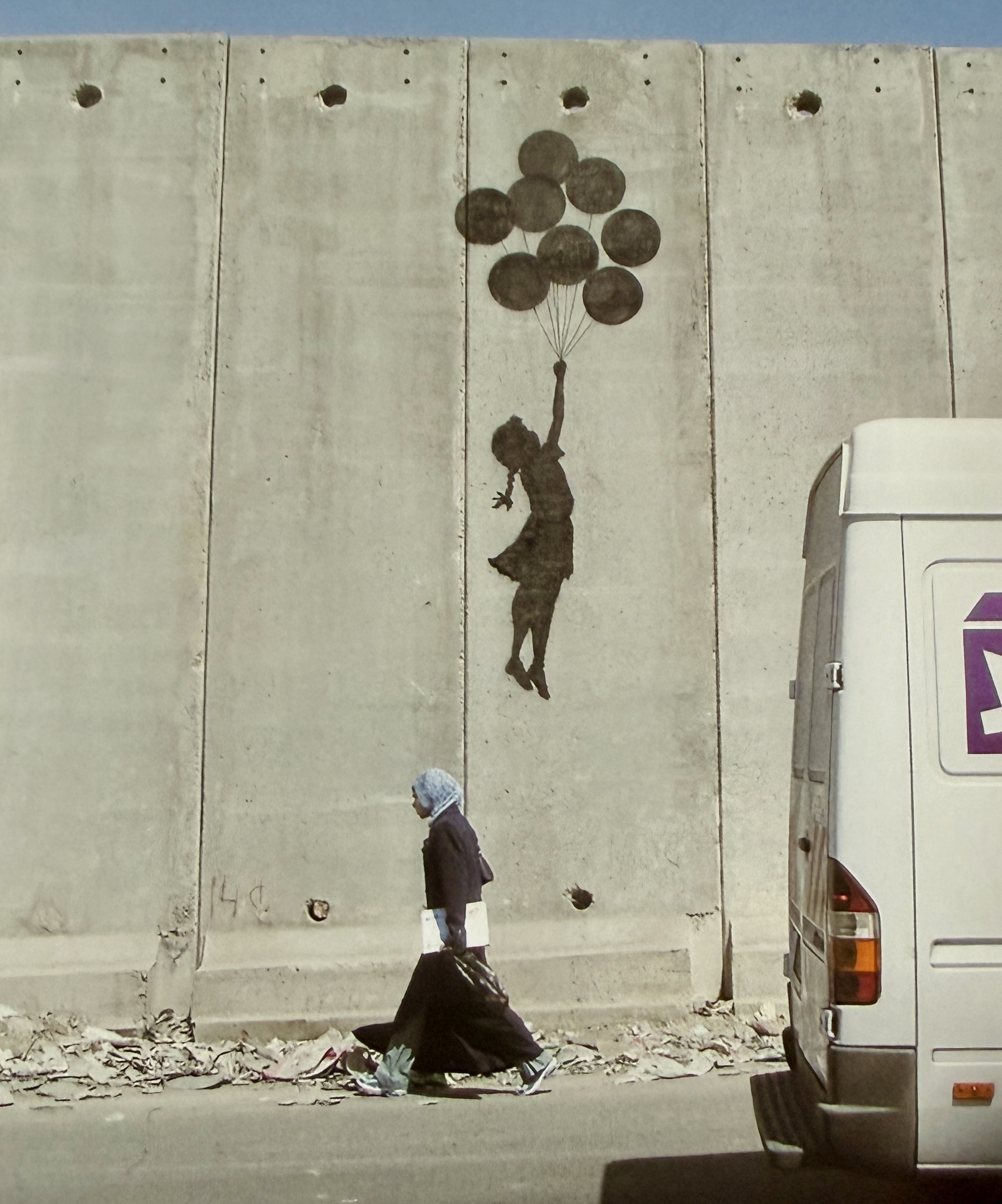
Images reproduced from Banksy, Wall and Piece (Century, 2005).
Windows on the West Bank
Among the most enduring images from the 2005 intervention are the works commonly described as Windows on the West Bank. One showed two children with a bucket and spade beneath an opening onto a tropical beach lined with palm trees. Another showed the same child alone, standing on rubble, seen through a jagged tear in the concrete that opened onto nothing but empty sky and cloud. A third turned the barrier into a domestic sitting room, complete with two oversized armchairs and a painted window framing an Alpine lake and mountains.
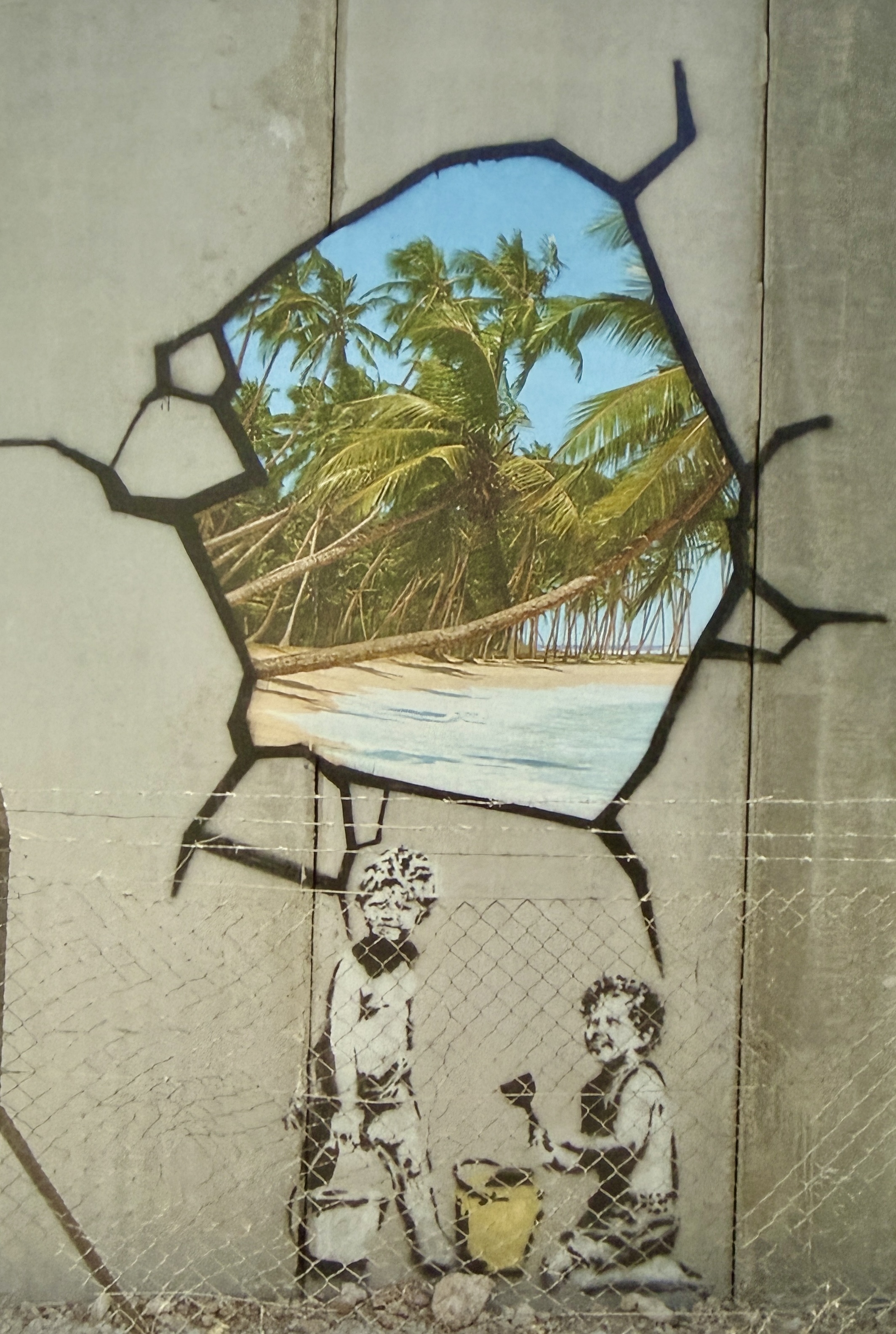
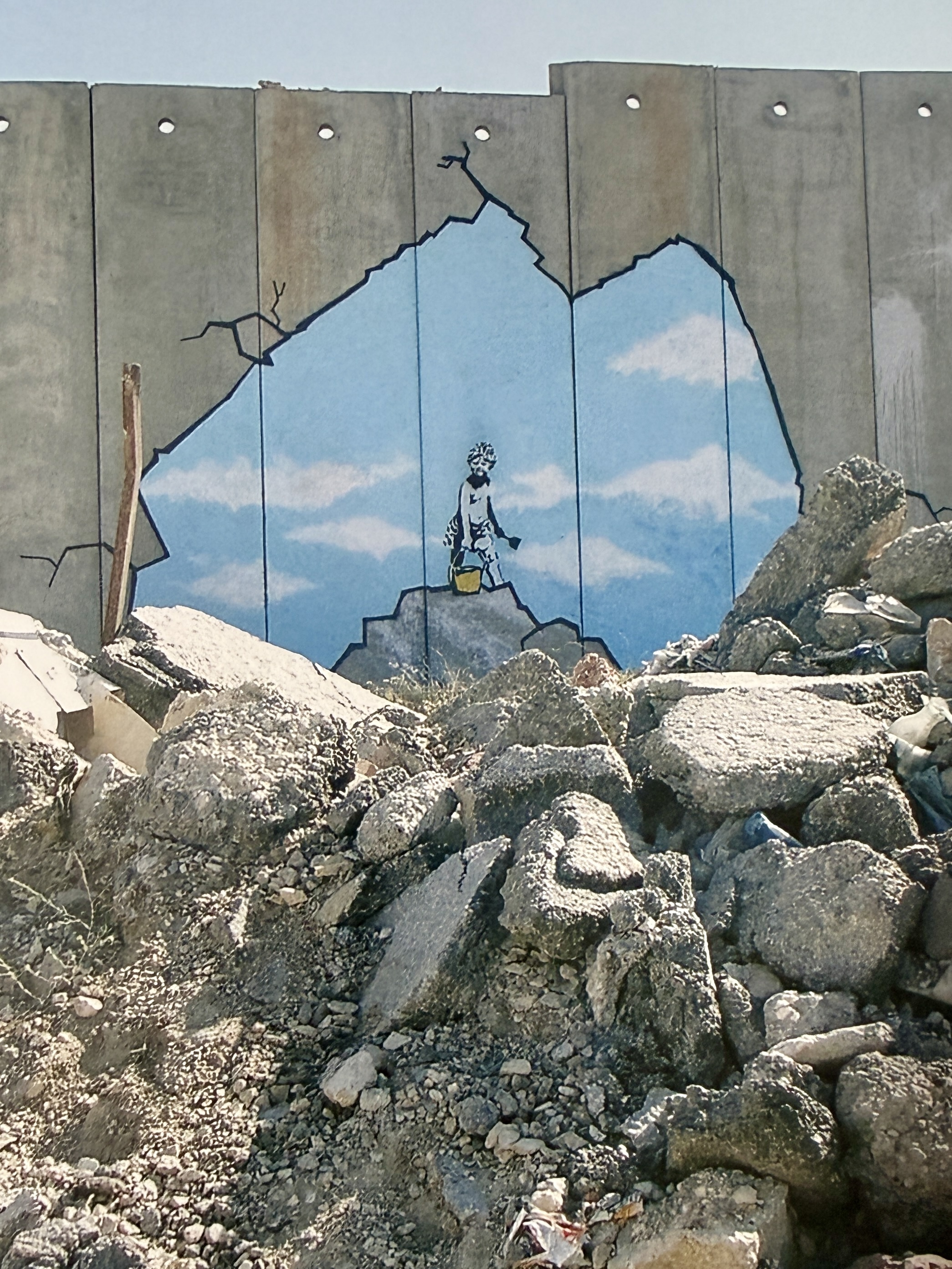
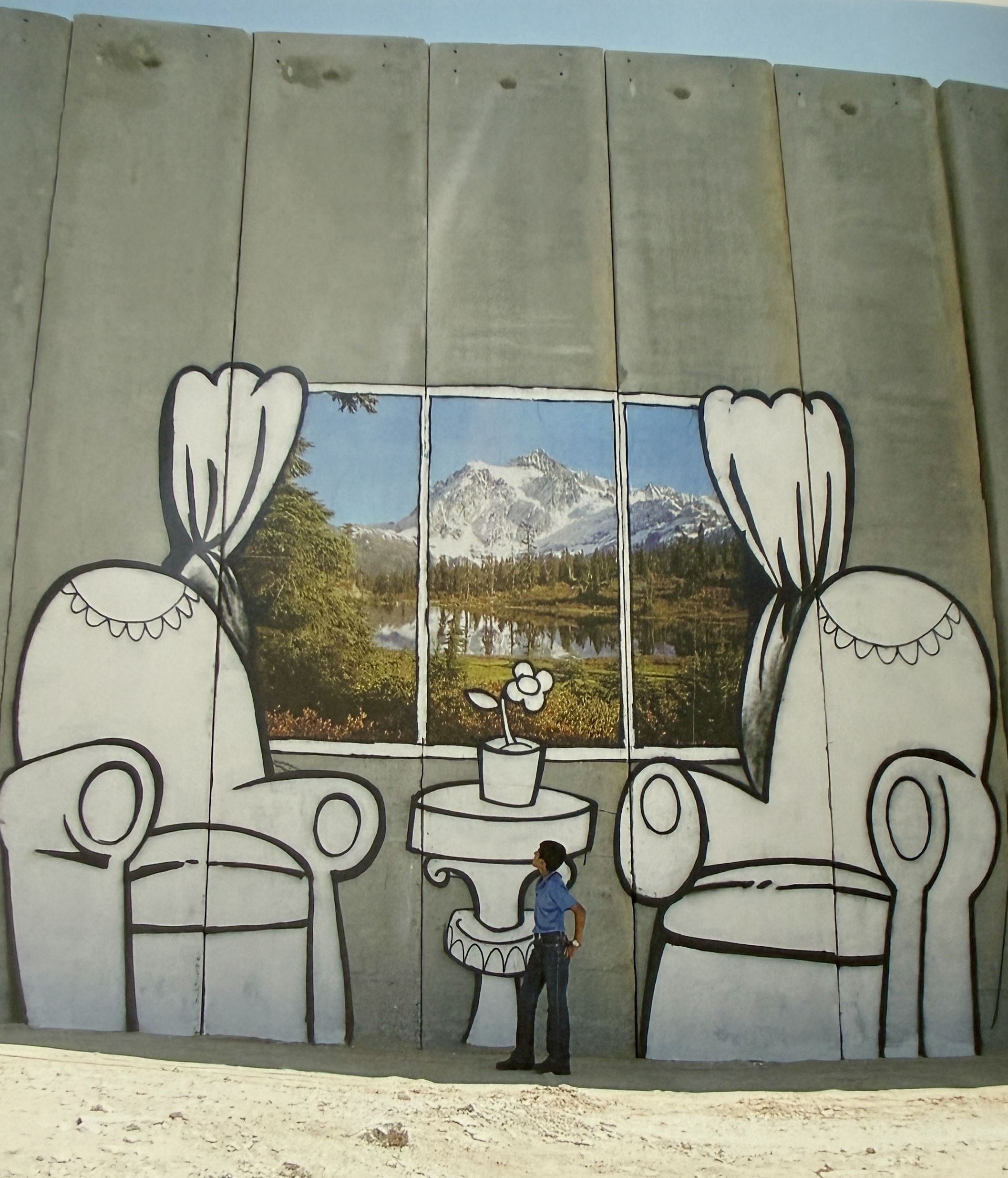
Images reproduced from Banksy, Wall and Piece (Century, 2005).
The domestic language makes the work particularly affecting. A window is ordinarily an everyday architectural device, offering light, distance and a connection between interior and exterior space. Banksy paints that ordinary possibility onto architecture designed precisely to regulate movement and separation.
The idyllic landscape therefore feels deliberately artificial, closer to a postcard or remembered holiday than a believable view. Its unreality is part of its power. The image asks the viewer to imagine a freedom that can be pictured with ease while remaining physically inaccessible.
The motif would later reappear within The Walled Off Hotel’s miniature wall-section sculptures, where the painted room, mountain landscape and barrier are compressed into a small three-dimensional object. The scale changes dramatically, while the central proposition remains intact: architecture can restrict the body even when imagination passes through it.
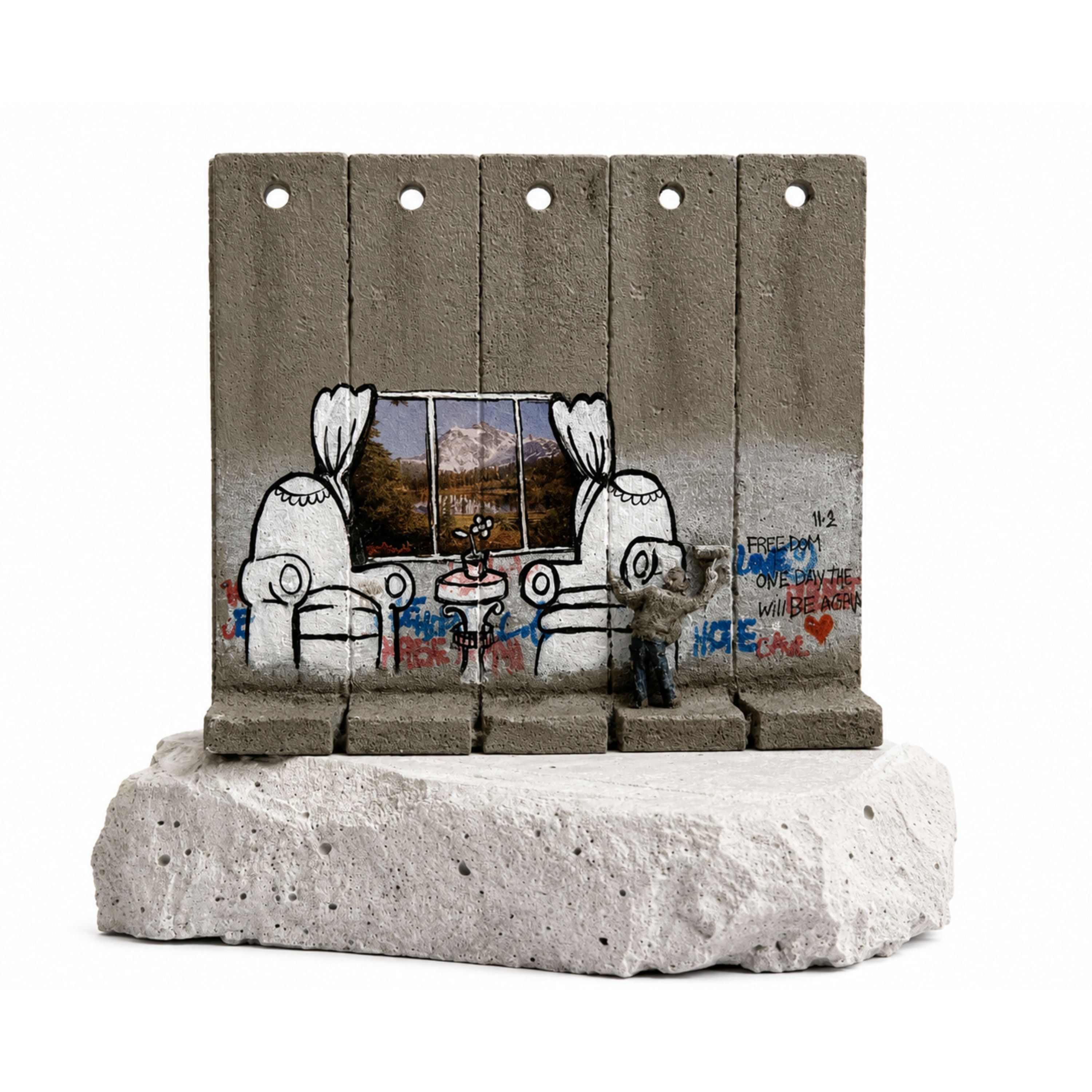
Banksy Walled Off Hotel Window On The West Bank Sculpture (2019-2020). Available via GraffitiStreet
Bethlehem 2007: Banksy Turns Towards Authority
Banksy returned to Bethlehem in late 2007 in connection with the final edition of Santa’s Ghetto. The Christmas pop-up “squat art concept store” had run in London from 2002 to 2006, showcasing Banksy alongside fellow Pictures on Walls artists, before relocating for its final year to the city — where Banksy painted four new stencil street works around the checkpoint area: an Israeli soldier checking the papers of a donkey, a white dove wearing body armour and marked by a target, a rat armed with a slingshot, and a young girl frisking a soldier.
Where the 2005 interventions often imagined escape through windows, ladders and balloons, the 2007 works place authority itself inside the frame. Soldiers, checkpoints, identification papers, defensive equipment and weapons become part of Banksy’s visual vocabulary.
Armoured dove.
Banksy’s Armoured dove. takes one of the most universally recognised symbols of reconciliation and places it under immediate threat. The white dove appears wearing a bulletproof vest, with a target centred on its chest, making the possibility of peace feel simultaneously present and precarious.
The image is powerful because the dove remains recognisable as a symbol of peace even after Banksy militarises its surroundings. Protective clothing suggests that peace itself requires protection, while the target makes clear that protection may prove insufficient.
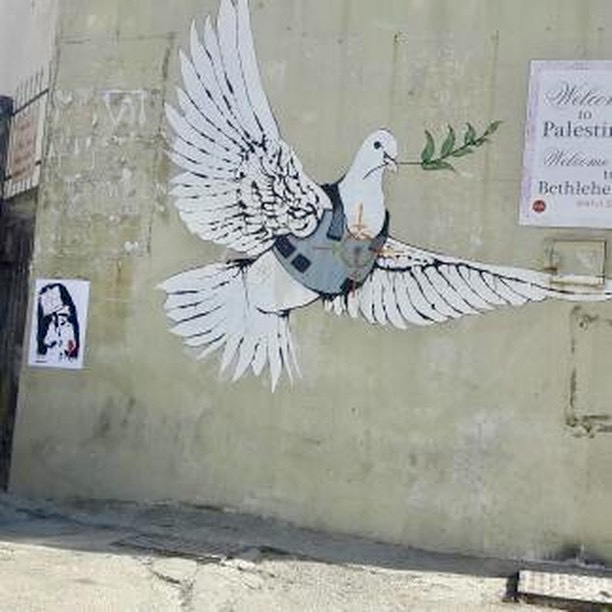
Banksy, Armoured Dove, Bethlehem 2017. Image copyright GraffitiStreet
Donkey Documents
Donkey Documents belongs to Banksy’s most cutting uses of absurdity. The mural depicts an armed soldier examining the identification papers of a donkey, placing the bureaucratic rituals of a checkpoint into a scenario whose ridiculousness is immediately legible. The work was in Bethlehem in 2007 on the route from the Church of the Nativity towards the main checkpoint leading to Jerusalem.
The donkey is central to the image because it makes administrative authority appear both excessive and strangely automatic. According to Wisam Salsaa, manager of The Walled Off Hotel, Donkey Documents was inspired by a real checkpoint encounter in which a soldier asked to see a farmer’s donkey’s papers. The image has sometimes been misread as comparing Palestinians to donkeys, but Wisam’s account makes clear that Banksy’s target was the absurdity of bureaucracy and restricted movement.
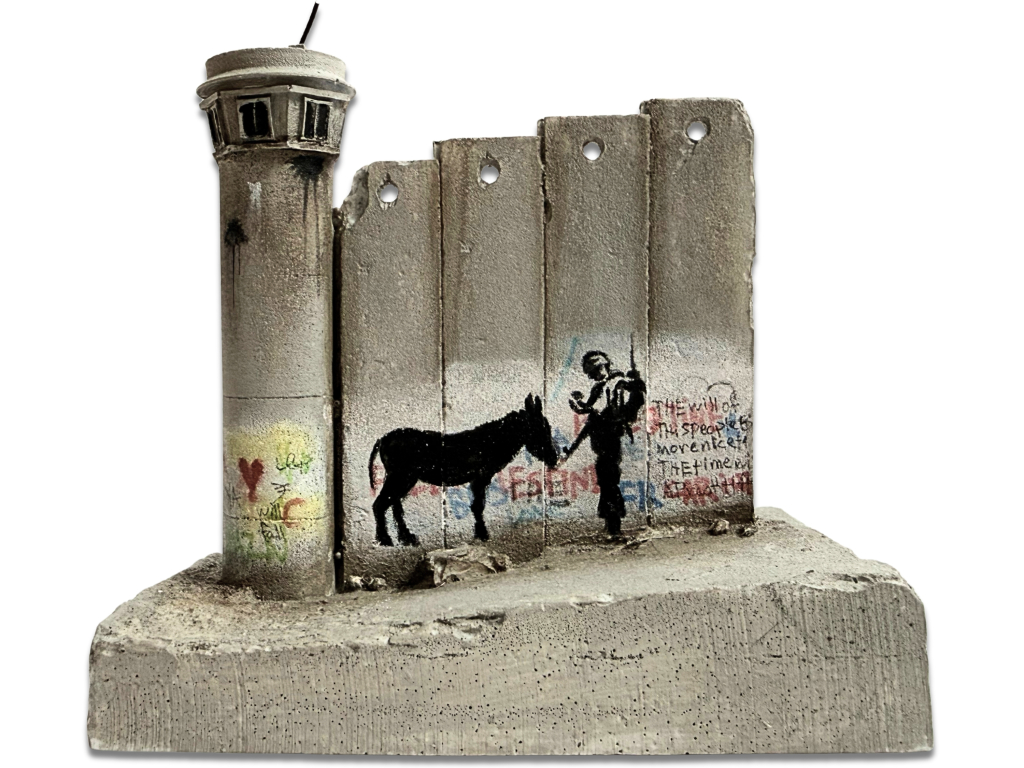
Banksy Walled Off Hotel Donkey Documents Watchtower Sculpture (2019-2020). Available via GraffitiStreet.
Stop and Search
In Stop and Search, Banksy reverses the expected direction of authority. A young girl with ponytails and a pink dress searches an armed soldier as though conducting a checkpoint inspection, leaving the adult military figure temporarily subject to the procedures ordinarily associated with institutional power. The work was documented in Bethlehem in 2007 opposite the Intercontinental Hotel.
The child’s apparent composure gives the image much of its tension. Banksy frequently uses childhood as a visual language for vulnerability, imagination and moral clarity, and here that language collides directly with uniform, equipment and state authority.
The wall bearing Banksy’s Stop and Search was later removed from its original location in Palestine and sold, becoming part of a wider debate around the removal, ownership and commercialisation of site-specific street art. Its journey was subsequently explored in the documentary Saving Banksy, which examined what happens when works created for public space are detached from the places and communities that gave them meaning.

Stop & Search, Street Art, Saving Banksy Documentary 2017
Sling Shot Rat
Banksy’s rats have long operated as small agents of resistance, surviving at the edges of cities and occupying spaces from which they are rarely invited. In Bethlehem, that role became particularly literal: contemporary reporting documented a rat armed with a small wooden slingshot on a concrete block at the foot of the wall.
The scale of the animal against the surrounding architecture sharpens the image. A slingshot is an almost primitive weapon set against a structure of immense physical and political weight, allowing the disproportion itself to become part of the work.
The concrete block bearing Banksy’s Slingshot Rat was later removed from its original location in Bethlehem and resurfaced at a Tel Aviv gallery in 2022, raising wider questions around the removal, relocation and ownership of site-specific street art.

The meaning behind Banksy’s Rats – Explained. Image copyright Banksy
2015: Banksy Enters Gaza
A decade after his 2005 West Bank intervention, Banksy returned to Palestine with a markedly different body of work created among damaged buildings in Gaza. He released the works alongside a short satirical travel film, Make this the year YOU discover a new destination, using the language of tourism to expose a landscape shaped by destruction after the 2014 conflict.
The Gaza works included a large kitten playing with a coil of rusted metal, children turning a military watchtower into something resembling a fairground ride, and a grieving goddess that has been variously compared to Rodin’s Thinker and the classical figure Niobe mourning the loss of her children.
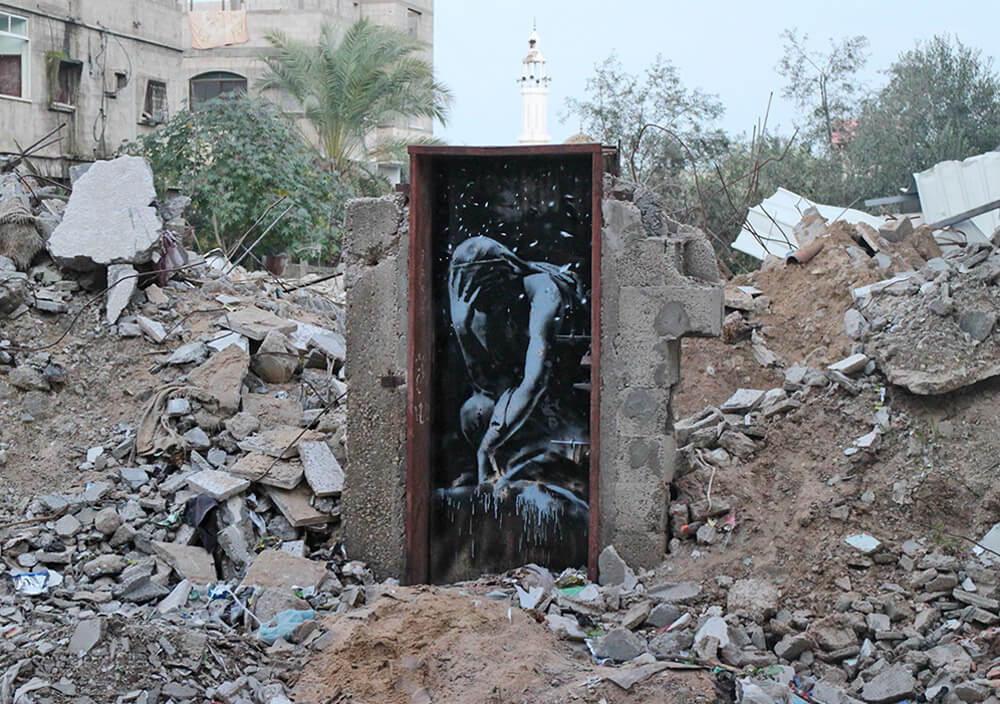
Banksy’s Gaza Thinker / Niobe. Image copyright Banksy
These images retain Banksy’s familiar visual economy, yet the ruined architecture around them carries an intensity that no studio recreation can fully reproduce. The wall is no longer only a barrier. In Gaza, the damaged building itself becomes evidence within the composition.
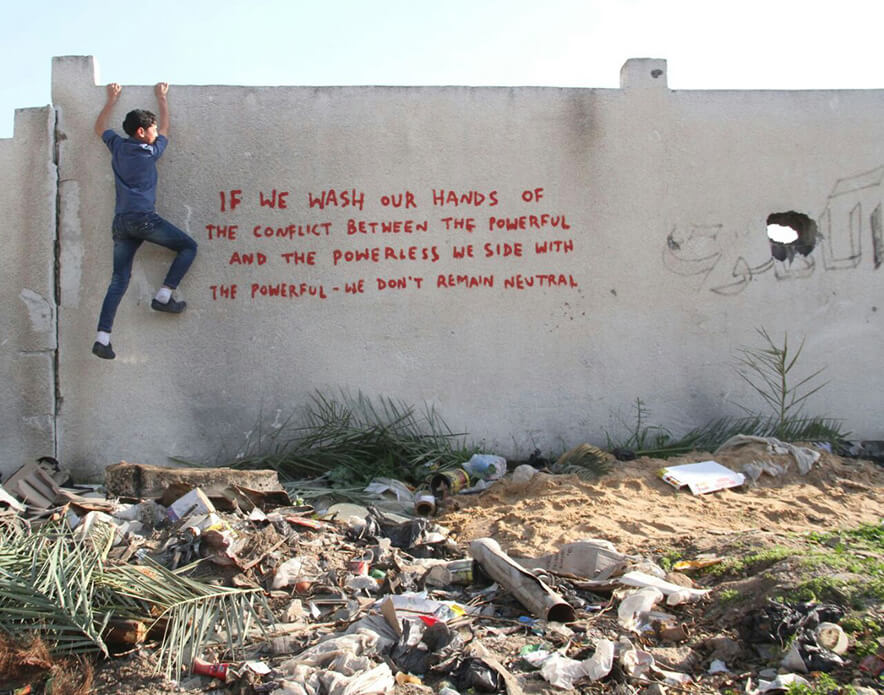
Banksy’s “Gaza quote “if we wash our hands”. Image copyright Banksy
Gaza Kitty and the Politics of Attention
Gaza Kitty is arguably the most digitally self-aware of Banksy’s Palestine works. A large kitten appears on the remains of a damaged building, playing with twisted metal as though it were a ball of wool. Banksy explained at the time that the choice of a kitten was connected to the internet’s appetite for cute animal imagery, deliberately using that visual attraction to direct attention towards destruction that might otherwise receive less engagement.
The strategy is deceptively sophisticated. The viewer is drawn in by something familiar, harmless and instantly shareable, then forced to register what surrounds it. The kitten’s play becomes disturbing because the object beneath its paw belongs to the physical remains of conflict.
Through the Walled Off Hotel sculpture Gaza Kitty… I Want My Ball Back, which translates the Gaza motif onto a miniature section of barrier while adding its own language of loss, play and return. Our dedicated Gaza Kitty article explores that transition from public mural to collectable in greater depth.

Banksy’s Gaza Kitty. Image copyright Banksy
Explore Banksy’s murals in Palestine.
From the West Bank and Gaza to The Walled Off Hotel
The opening of The Walled Off Hotel in Bethlehem in 2017 brought together many ideas Banksy had been developing in Palestine for more than a decade. Positioned only a short distance from the barrier, the project transformed the conventional hotel into an extended artwork encompassing accommodation, Banksy installations, a museum devoted to the history of the wall, a gallery providing a permanent platform for Palestinian artists, and a colonial-themed piano bar.
Its famous description as having the “worst view in the world” condensed the project’s dark humour into a single line. Guests could occupy beautifully constructed interiors while remaining confronted by the barrier immediately outside, producing the same collision between visual seduction and political reality that had shaped Banksy’s earlier murals.

Banksy, Walled Off Hotel, Piano Bar, Palestine, Bethlehem
GraffitiStreet visited Bethlehem and The Walled Off Hotel in September 2017, travelling through the area to photograph Banksy’s surviving street works and staying in the Presidential Suite. That first-hand experience remains central to the way we understand the project today because the artworks, streets, wall and local community cannot be separated cleanly from one another.


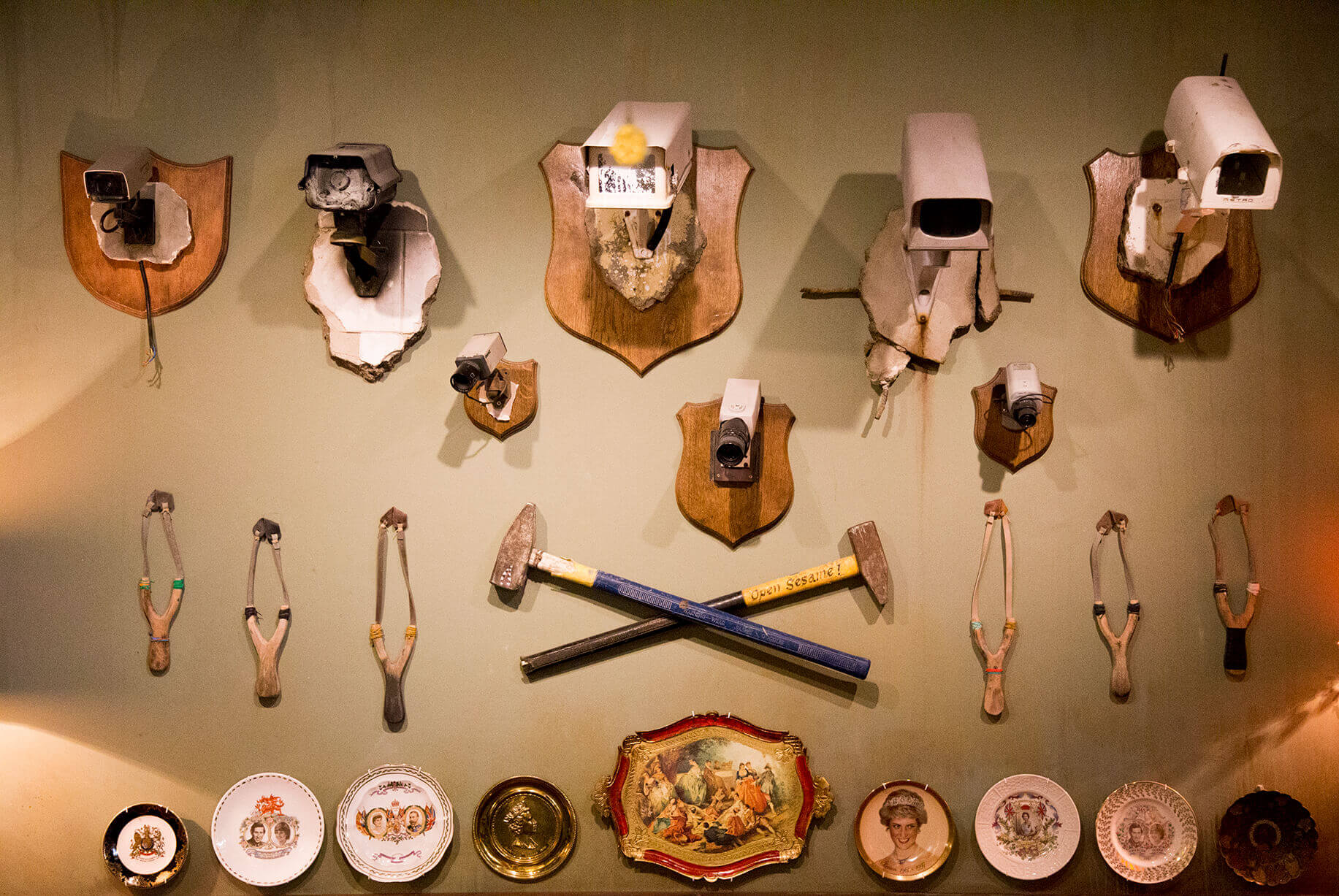

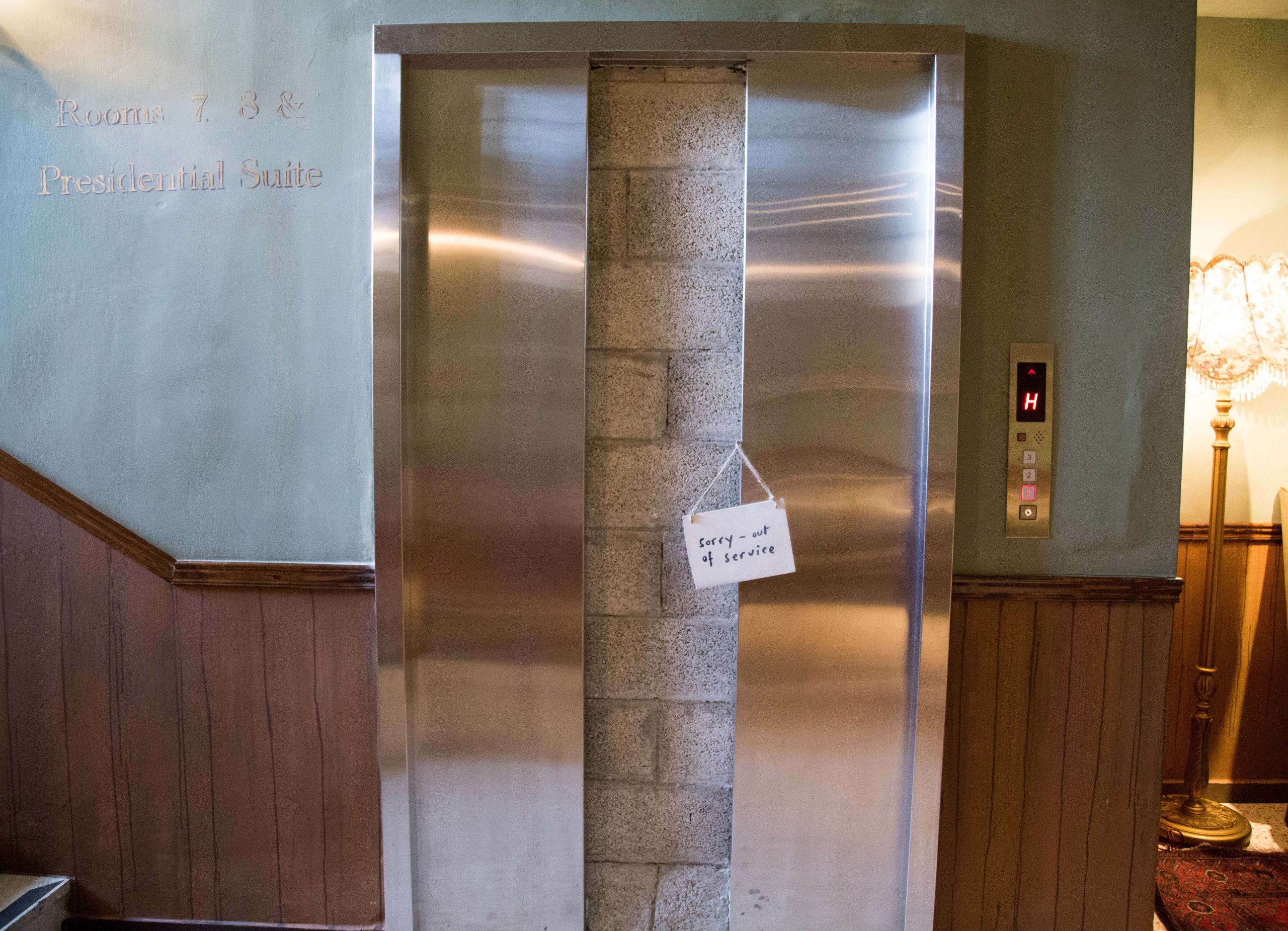
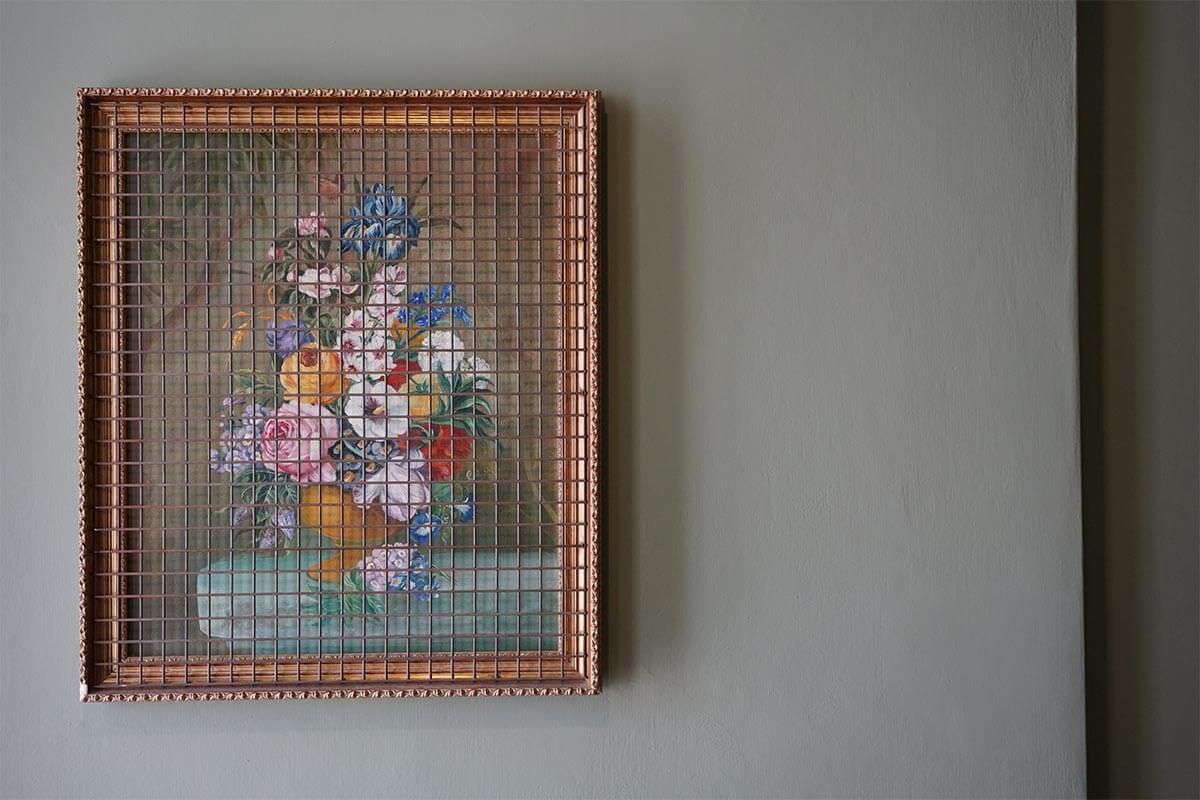
Banksy, Walled Off Hotel, Palestine, Bethlehem. Image copyright BanksyGraffitiStreet
The Walled Off Hotel Box Set: From Gaza to Bethlehem
The Walled Off Hotel Box Set provides a direct link between Banksy’s 2015 intervention in Gaza and the later Bethlehem project. Its monochrome image is based on Banksy’s Gaza mural depicting children turning an abandoned military watchtower into an improvised fairground ride, transforming a structure associated with surveillance and conflict into an image of childhood play, resilience and imagined escape.

Banksy in Gaza, 2015. Image copyright Banksy
Released exclusively through The Walled Off Hotel, the Box Set combines the printed image with a small piece of concrete hand-sprayed in red, green or a combination of both, referencing the colours of the Palestinian flag. Accompanied by its Walled Off Hotel purchase documentation, the work became one of the earliest collectable objects through which Banksy’s Palestine imagery could move from its original public setting into private collections.
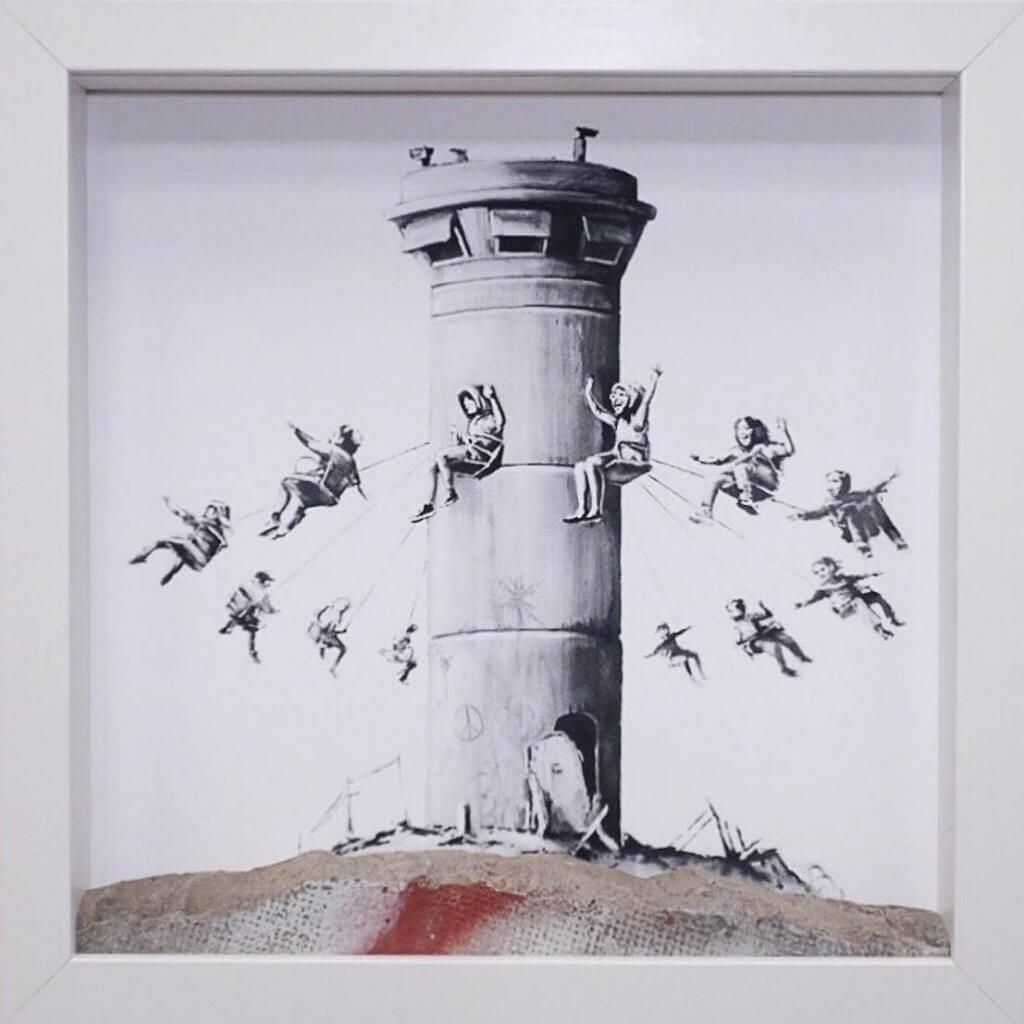
Banksy, The Walled Off Hotel Box Set. Available via GraffitiStreet.
From Palestine Murals to Walled Off Hotel Wall Sections
The Walled Off Hotel later became the source of an unusual body of collectable objects that translated elements of Banksy’s Palestine imagery into miniature wall sections. Images associated with Peace Dove, Donkey Documents, Stop and Search, Sling Shot Rat, Window on the West Bank, Love Is in the Air and Gaza Kitty appeared across sculptures that combined the visual language of the barrier with individually painted graffiti, architectural details and, in some examples, watchtowers or damaged concrete. GraffitiStreet’s Walled Off Hotel Collectables guide examines this category separately, including provenance, hotel documentation and the evolution of the sculptures.
Keeping these two histories connected is important. The collectables gain much of their cultural weight from the public images that preceded them, while the original murals belong to a very different category of site-specific work whose meaning was created through their physical relationship with Palestine.
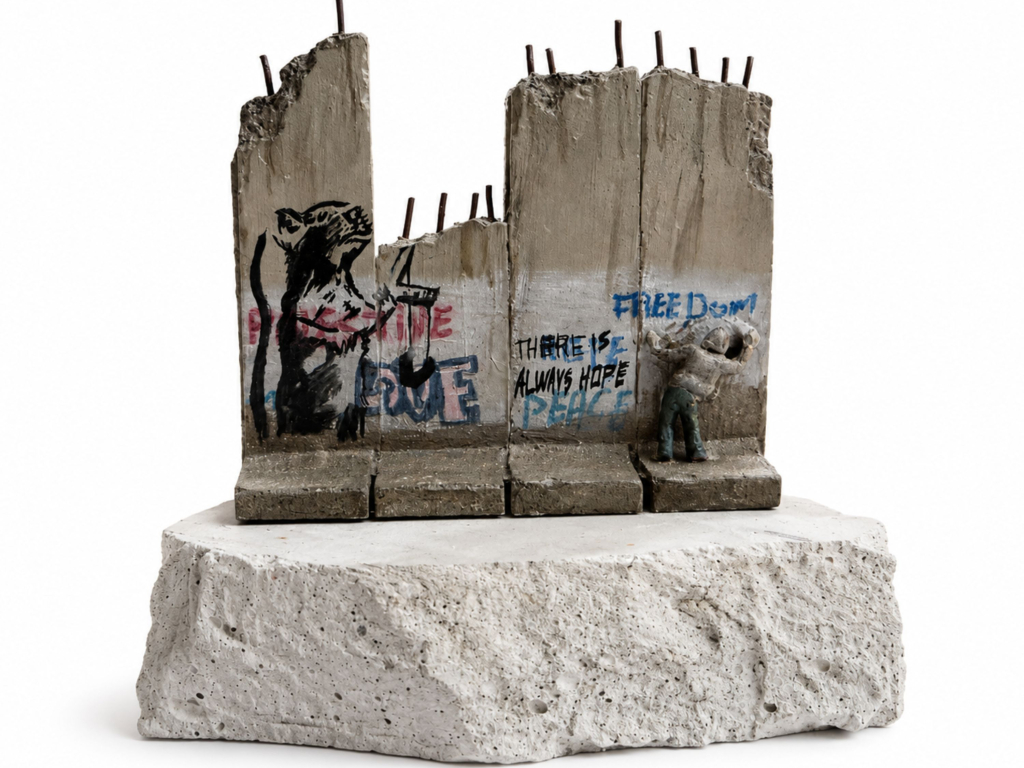
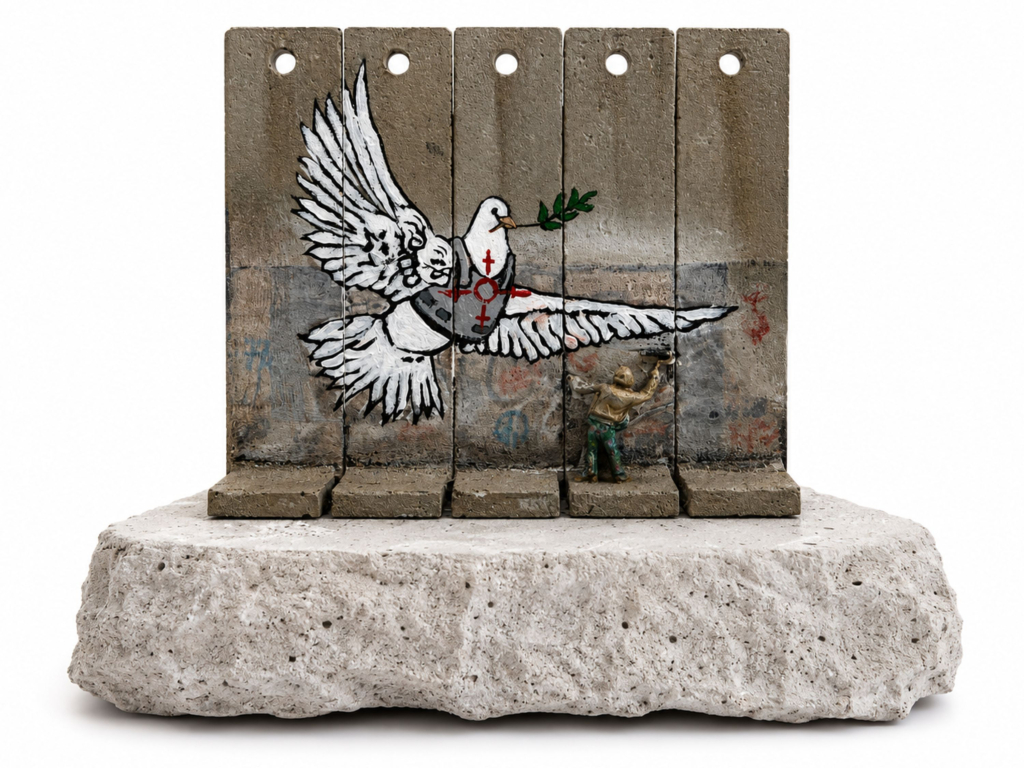
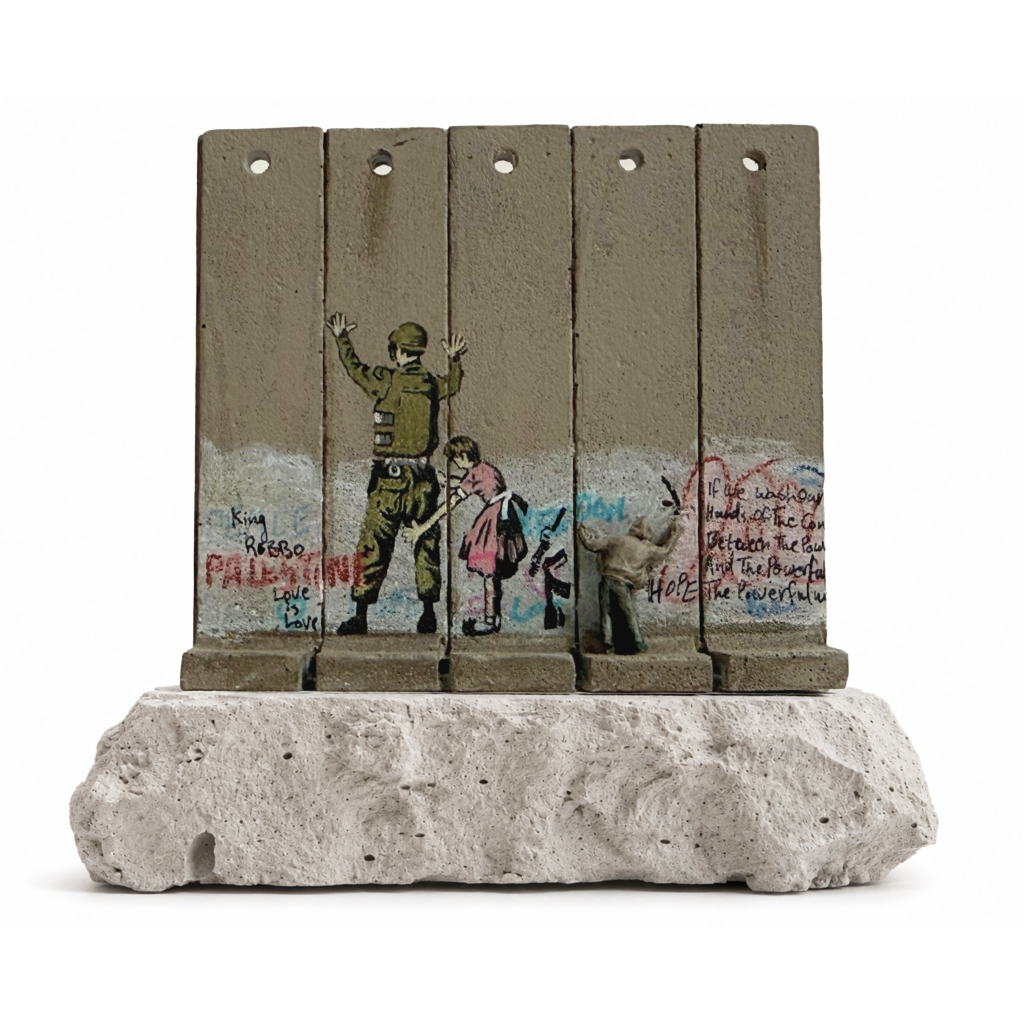
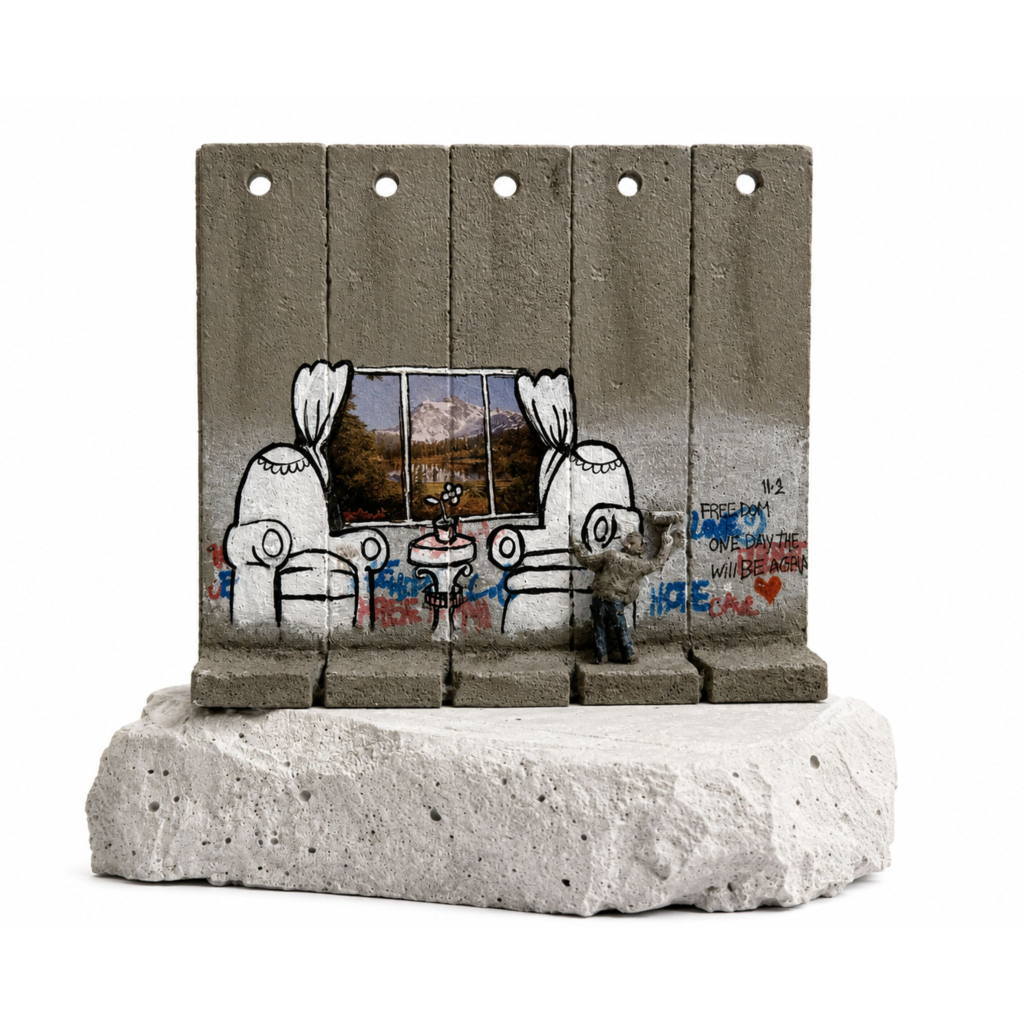
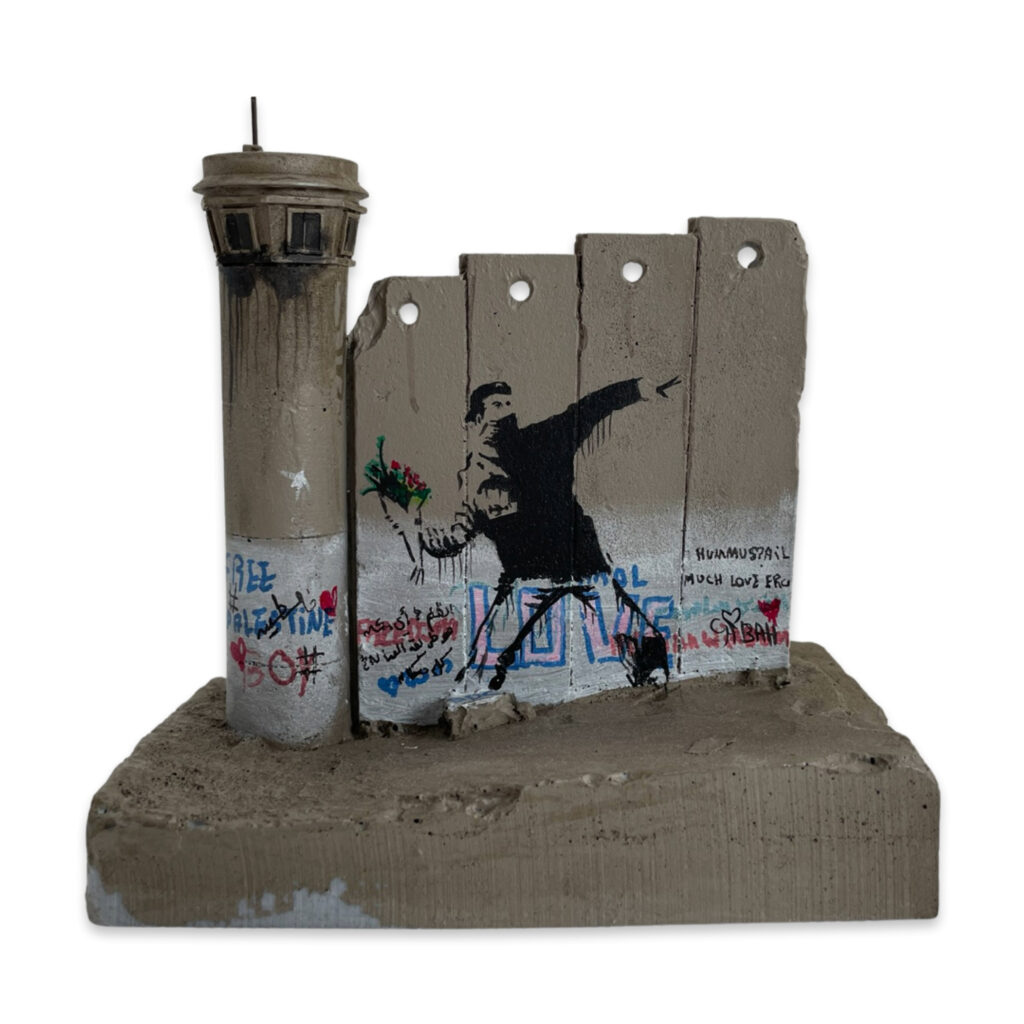
Walled Off Hotel Sculptures available via GraffitiStreet. Each work is accompanied by provenance from The Walled Off Hotel, Palestine, including its original hotel receipt together with a duplicate receipt signed by the hotel. Each purchase contributes to the ongoing support of The Walled Off Hotel, Palestine.
Explore our feature on Banksy’s Walled Off Hotel collectables.
Why Banksy’s Palestine Works Matter
Banksy’s Palestine interventions represent a turning point in the scale of his practice. Earlier works had already addressed policing, war, capitalism and state authority, yet the West Bank brought those concerns into direct contact with an internationally contested physical landscape.
The walls are never passive backgrounds. They determine what the images mean. A painted window matters because the real wall blocks the view. A balloon matters because it can pass above an obstacle that a human body cannot. A donkey’s papers become absurd because checkpoints and identification procedures are already part of the surrounding environment. A dove in protective armour becomes unsettling because the language of peace is placed directly inside the visual vocabulary of threat.
Gaza intensified this relationship further. There, Banksy worked with damaged architecture and the mechanics of digital attention, using a kitten, children and familiar art-historical references to redirect global audiences towards civilian destruction.
Across these different interventions, Banksy rarely supplies a political programme or solution. His method is visual compression: a complicated reality is reduced to an image simple enough to understand instantly, while its location restores the complexity that the stencil initially appears to remove.
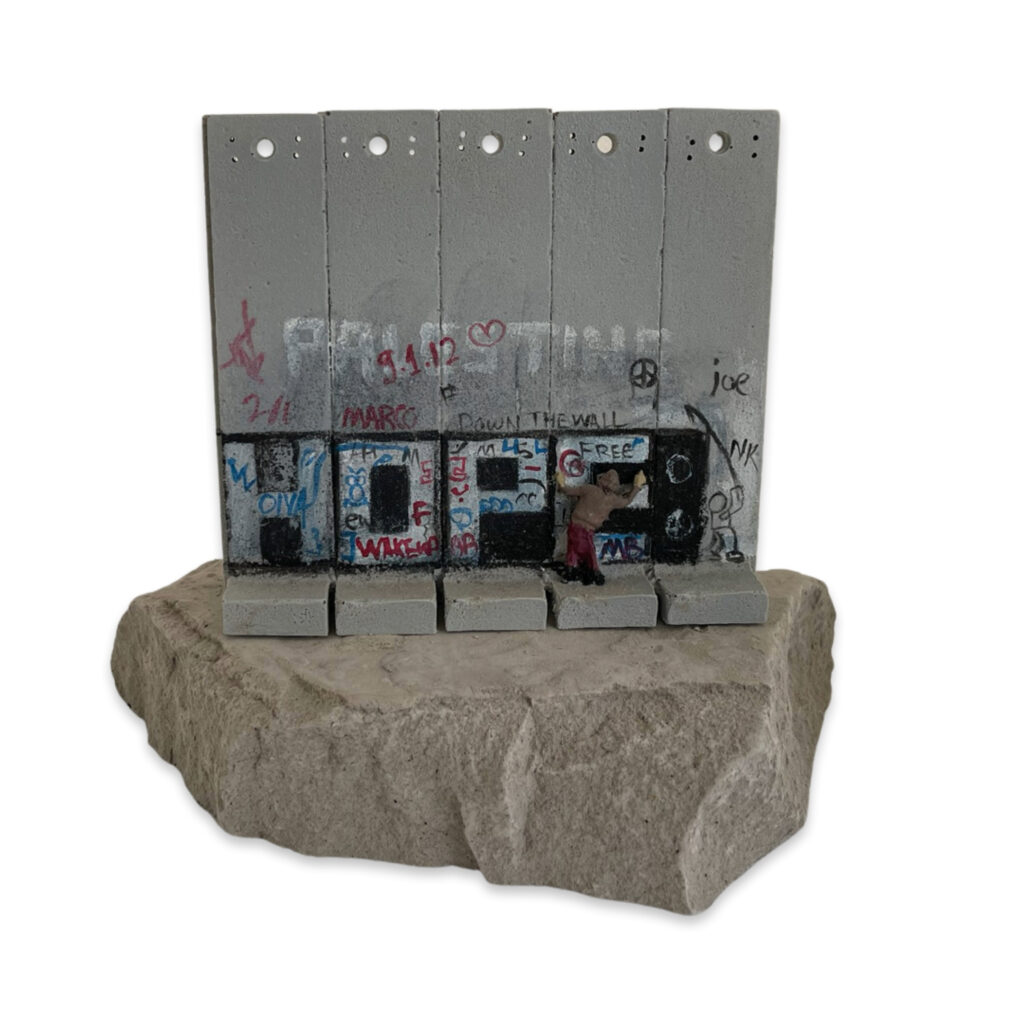
Banksy Walled Off Hotel Wall Section Hope (2017). Available via GraffitiStreet
The Alternativity: Banksy, Danny Boyle and Christmas in Bethlehem, 2017
In December 2017, Banksy returned to Bethlehem for The Alternativity, an alternative Nativity production conceived around The Walled Off Hotel and staged in its car park on 3 December, only a short distance from Manger Square. Banksy invited Oscar-winning filmmaker Danny Boyle to help realise the project alongside Palestinian theatre-maker Riham Isaac, with Hotel Manager Wisam Salsaa assisting locally as the production developed. Rather than importing a conventional theatrical company into Bethlehem, the performance was built around local children, families and performers, placing the familiar Christmas story within the contemporary streets and realities of the city in which the biblical narrative is traditionally located.
The production unfolded beneath the physical presence of the separation barrier, combining carols, Arabic and English songs, theatrical humour, a donkey and even artificial snow within a setting where the surrounding architecture could never become merely theatrical scenery. The project was filmed for BBC Two, with the documentary following Boyle over six weeks as the cast and production came together, before the performance itself was broadcast later that December. The involvement of local children was particularly important, allowing Banksy’s wider Palestine project to move beyond murals and objects into a collaborative event shaped by people living within Bethlehem itself.
It was during this period that Banksy created two new Christmas interventions in Bethlehem. Peace on Earth appeared near the Chapel of the Milk Grotto, presenting the traditional seasonal message followed by an asterisk and the dry qualification “Terms and conditions apply.” His second work depicted two cherubs using crowbars to prise apart sections of the West Bank barrier, with a narrow opening revealing the sky beyond. Together with The Alternativity, the works extended Banksy’s recurring use of religious imagery, humour and childhood into a particularly charged setting, placing the universal language of Christmas peace alongside the physical reality of division surrounding Bethlehem. Read our feature here.
The Alternativity 37:40
Banksy Takes Palestine to London: World Travel Market
In November 2018, Banksy extended The Walled Off Hotel beyond Bethlehem by taking Palestine to the World Travel Market at ExCeL London, one of the international travel industry’s major trade fairs. For his first appearance at a trade event, Banksy created a replica section of the separation barrier for the Palestine stand, transforming the polished language of tourism into another platform through which to confront visitors with the political reality surrounding the hotel.
The installation featured two cherubs attempting to prise open the concrete wall with crowbars, an image Banksy had previously introduced in Bethlehem in 2017. Alongside the installation, visitors were offered free Palestine posters, while Banksy characteristically encouraged people to register for the fair and “pretend to be a travel agent”, turning the conventions of tourism promotion into part of the intervention itself.
GraffitiStreet attended and photographed The Walled Off Hotel’s Palestine stand at ExCeL London, where a relatively small exhibition space attracted considerable attention within the wider travel fair. The intervention was significant because it carried Banksy’s Palestine project into an entirely different environment: Bethlehem, the separation wall and The Walled Off Hotel were presented within an industry built around freedom of movement, international travel and destination marketing, giving the setting an irony that was unmistakably Banksy.
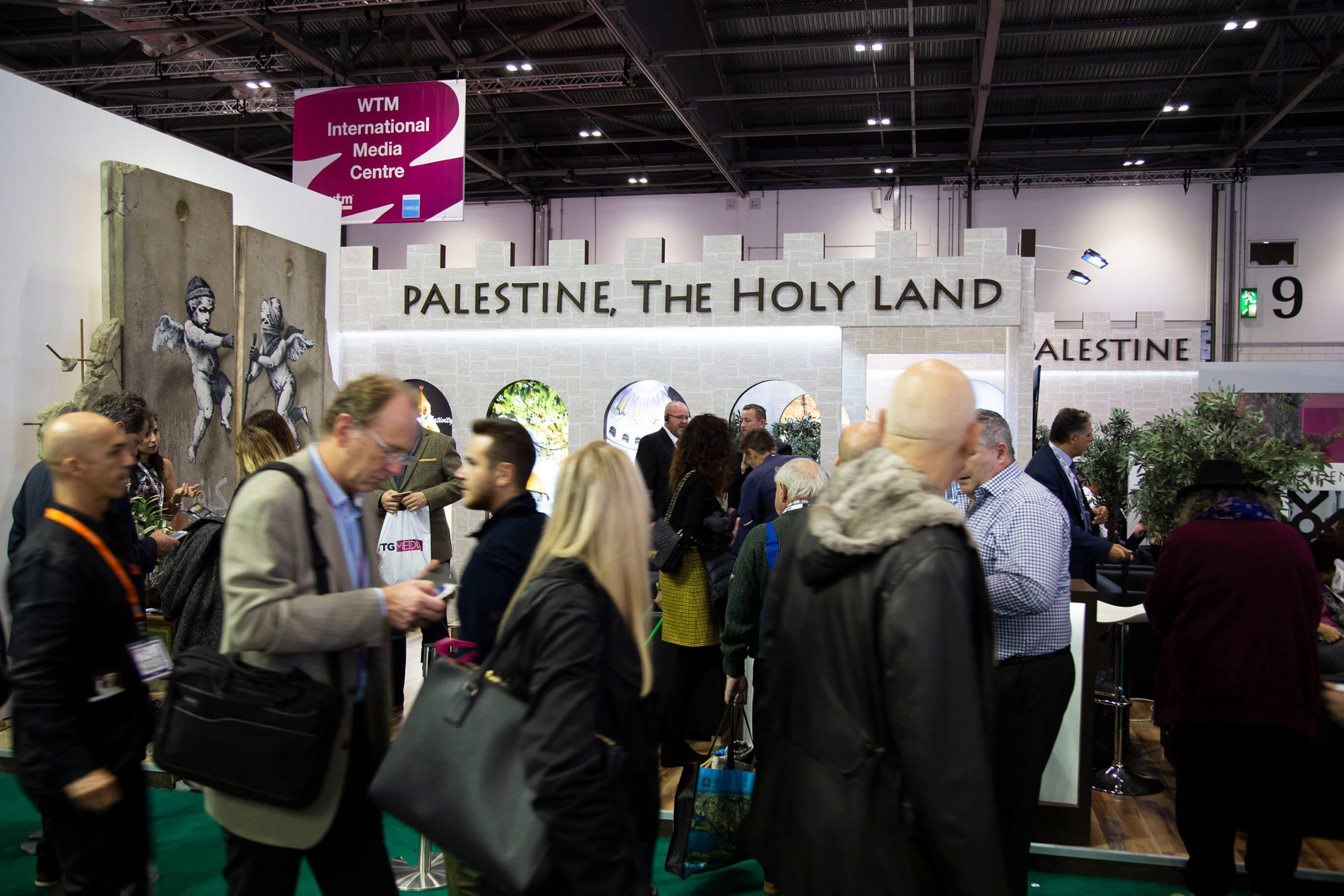
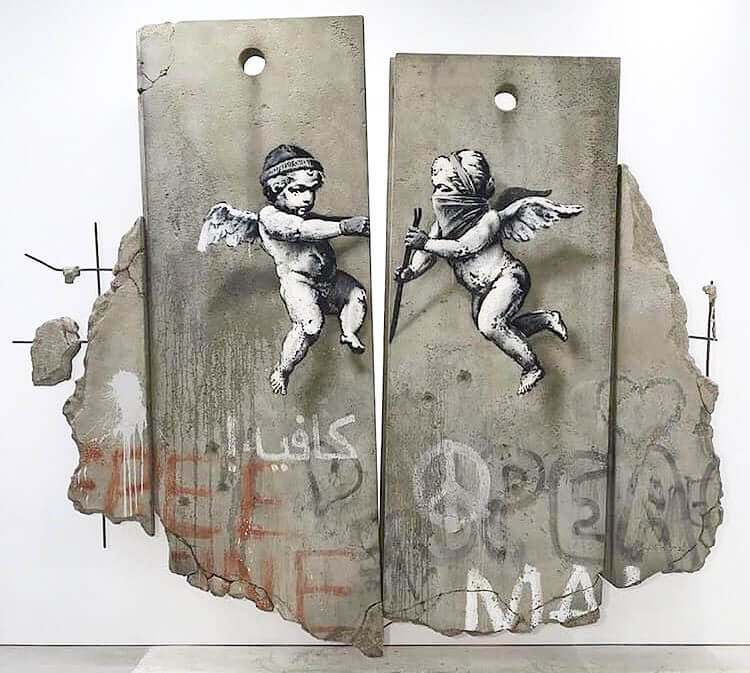
Banksy, The Walled Off Hotel, Palestine Stand, World Travel Market, ExCeL London, 2018. Image copyright GraffitiStreet.
GraffitiStreet Visit 2017
Our relationship with Banksy’s Palestine works changed significantly when we travelled to Bethlehem in 2017. The scale of the wall, the distances between works, the movement through checkpoints and neighbourhoods, and above all the warmth of the people we met became inseparable from the experience. We were welcomed with extraordinary generosity by The Walled Off Hotel manager Wisam, his family and the hotel staff, making our time in Bethlehem one of the most rewarding and memorable journeys we have made.
Guided through the city in search of Banksy’s remaining works, we photographed the murals in situ with Alaa while staying at The Walled Off Hotel Presidential suite, where Banksy’s visual language extended from public walls into rooms, objects and installations, while the friendships and conversations formed around them gave the project a deeply human dimension.
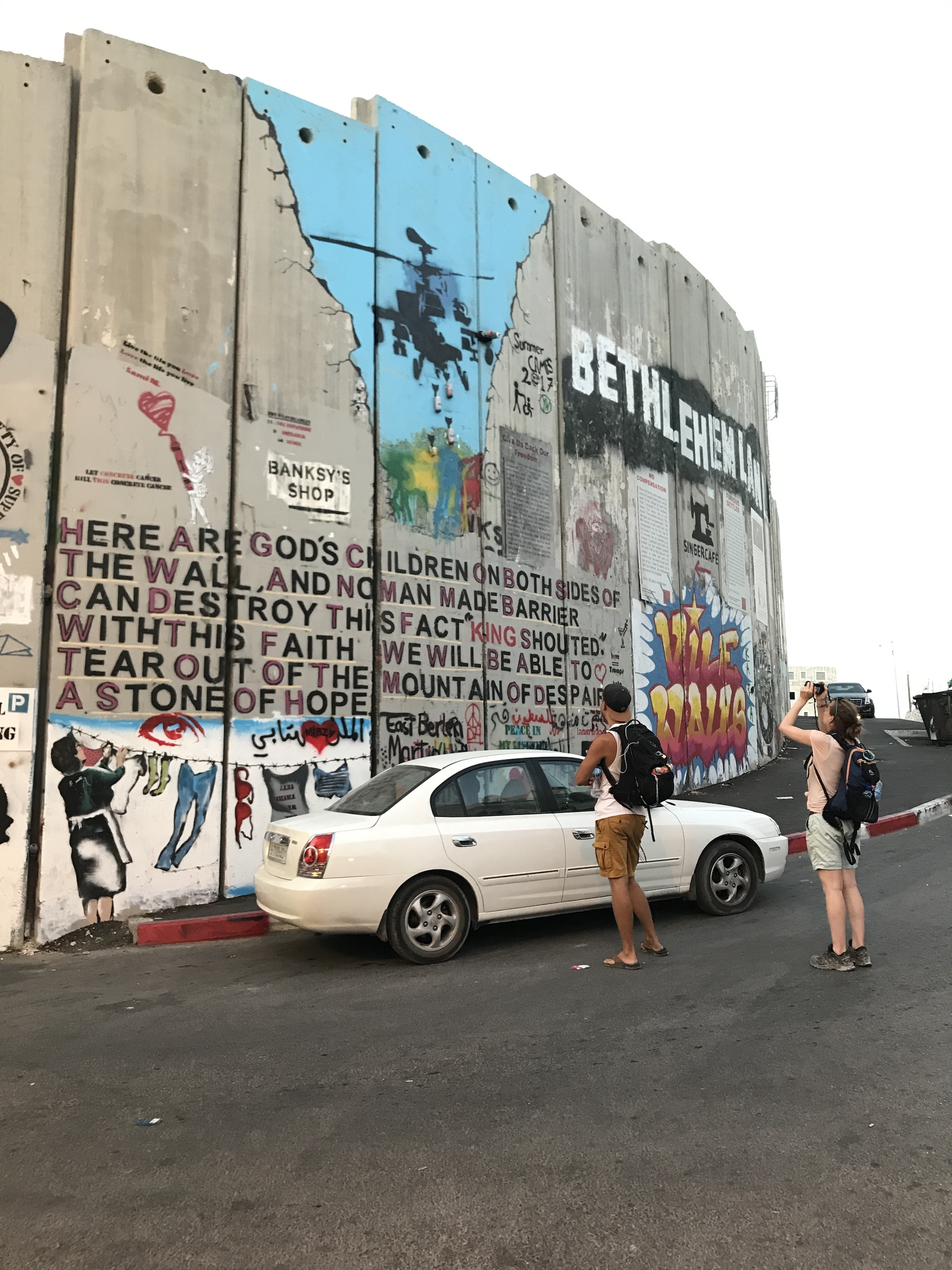
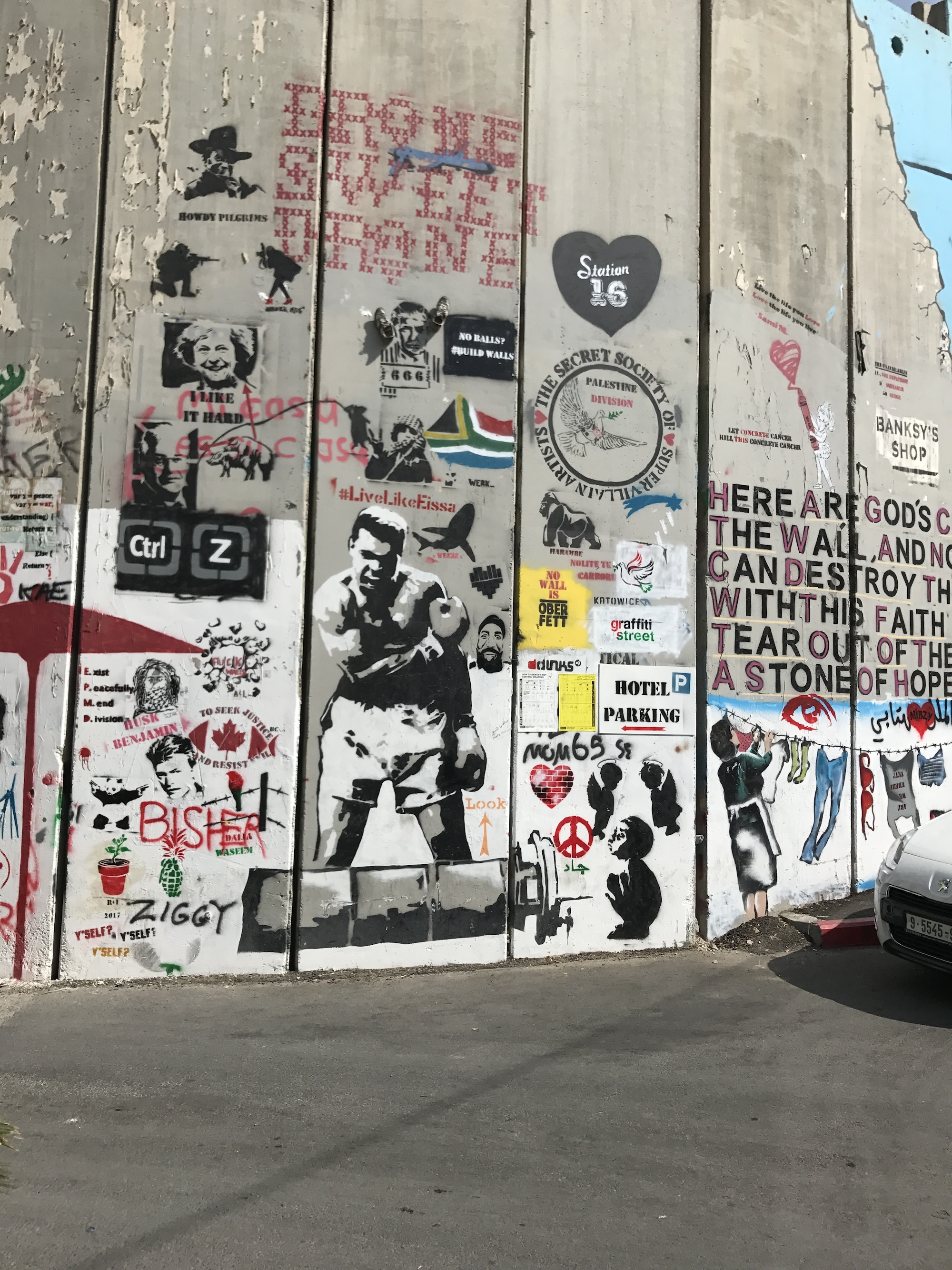
Separation Wall, West Bank, Palestine 2017. Image copyright GraffitiStreet.
Frequently Asked Questions
One of Banksy’s earliest and most famous Palestine images, Love Is in the Air / Flower Thrower, dates to 2003 and is associated with Beit Sahour near Bethlehem. He subsequently created nine documented interventions on the West Bank barrier in 2005 and returned to Bethlehem with another group of works in 2007.
Banksy’s 2005 intervention included nine works. Children standing beneath openings onto idyllic landscapes, a domestic sitting room with an Alpine view, a boy beneath a rope ladder and a girl rising into the air with balloons.
Peace Dove was created in Bethlehem during Banksy’s 2007 return showing a white dove wearing a bulletproof vest with a target centred on its chest.
Donkey Documents shows a soldier inspecting the identification papers of a donkey. The absurd scene places checkpoint bureaucracy at the centre of the image and was documented in Bethlehem in 2007 on the route towards the main checkpoint leading to Jerusalem.
Banksy’s Stop and Search depicts a young girl frisking an armed soldier, reversing the expected power relationship of a checkpoint search. The mural was documented in Bethlehem in 2007 and was subsequently removed from its original location.
Gaza Kitty was created during Banksy’s 2015 intervention in Gaza. The work depicts a kitten playing with twisted metal amid the remains of a damaged building and was released alongside Banksy’s satirical Gaza film.
The Walled Off Hotel opened in Bethlehem in 2017 after more than a decade of Banksy interventions in the region. Its artworks, museum, architecture and later wall-section collectables extend many of the same concerns found in the earlier murals, particularly borders, surveillance, movement, childhood, protest and the political meaning of walls.
Related Reading
Continue exploring Banksy’s work in Palestine through The Meaning Behind Banksy’s Love Is in the Air – Explained, ‘Welcome to Gaza’ by Banksy, 2015 and Banksy’s Gaza Kitty: Meaning, Mural and the Walled Off Hotel Sculpture.
For the story of Bethlehem and The Walled Off Hotel, read Banksy Opens New Hotel in Bethlehem, 2017, Banksy’s Art at The Walled Off Hotel, Banksy’s Christmas Messages “Peace on Earth” and “Cherubs” and Banksy and Danny Boyle Bring The Alternativity to Bethlehem.
The story continues through Banksy Places Palestine on the Travel Map at World Travel Market, London ExCeL 2018, Banksy’s Scar of Bethlehem, Saving Banksy and our guide to Banksy’s Walled Off Hotel Collectables: Art, Politics and the Souvenir.
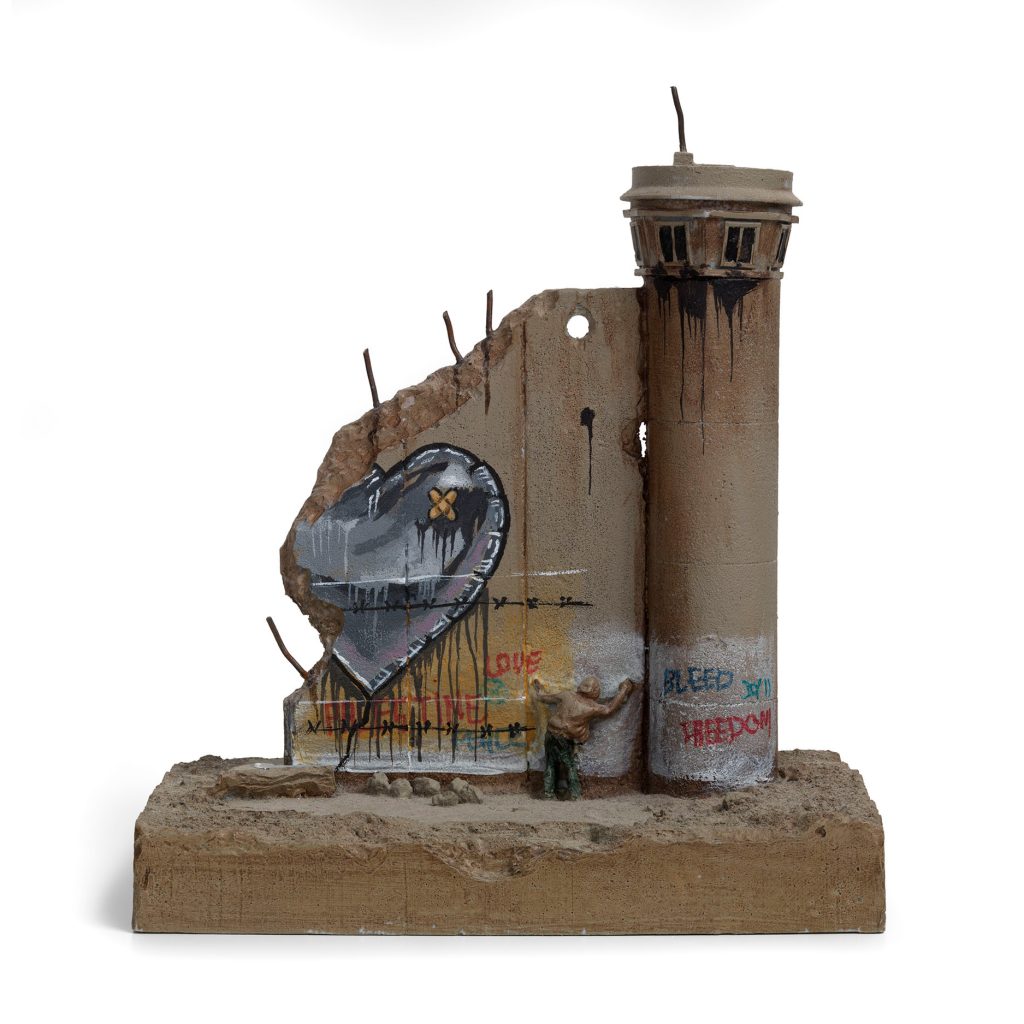
Banksy, Walled Off Hotel Defeated Wall Section ‘Love Hurts’, 2018. Painted concrete cast resin sculpture, uniquely numbered. Available via GraffitiStreet.
Discover Banksy at GraffitiStreet
GraffitiStreet has worked with Banksy artworks for more than thirteen years, developing specialist knowledge across authenticated prints, rare editions, Walled Off Hotel works, provenance, condition and collector acquisition strategy. Our understanding of Banksy’s Palestine work also draws upon first-hand experience in Bethlehem, where we photographed surviving street works, spent time within the local community and stayed at The Walled Off Hotel during its first year.
Discover Banksy artworks through GraffitiStreet online or experience selected works in person at GraffitiStreet Gallery, 25A West Street, Chichester, West Sussex, England PO19 1QW.
For availability, acquisitions, sourcing and private viewings, contact GraffitiStreet directly.