Bordalo II: Big Trash Animals, Provoc and the Politics of Waste
Bordalo II is the artistic name of Portuguese artist Artur Bordalo, born in Lisbon in 1987, whose practice transforms discarded materials and public space into a language for examining overproduction, pollution, consumerism and wider social and political pressures.
Best known internationally for his monumental Big Trash Animals, Bordalo II has developed a far broader practice encompassing sculpture, assemblage, graffiti, environmental art and the socially critical interventions he calls Provoc, alongside bodies of work including Lighted, Pixels, Wood, Rock and Small Trash Animals. His art repeatedly asks what contemporary society chooses to consume, discard, ignore and, ultimately, live with.
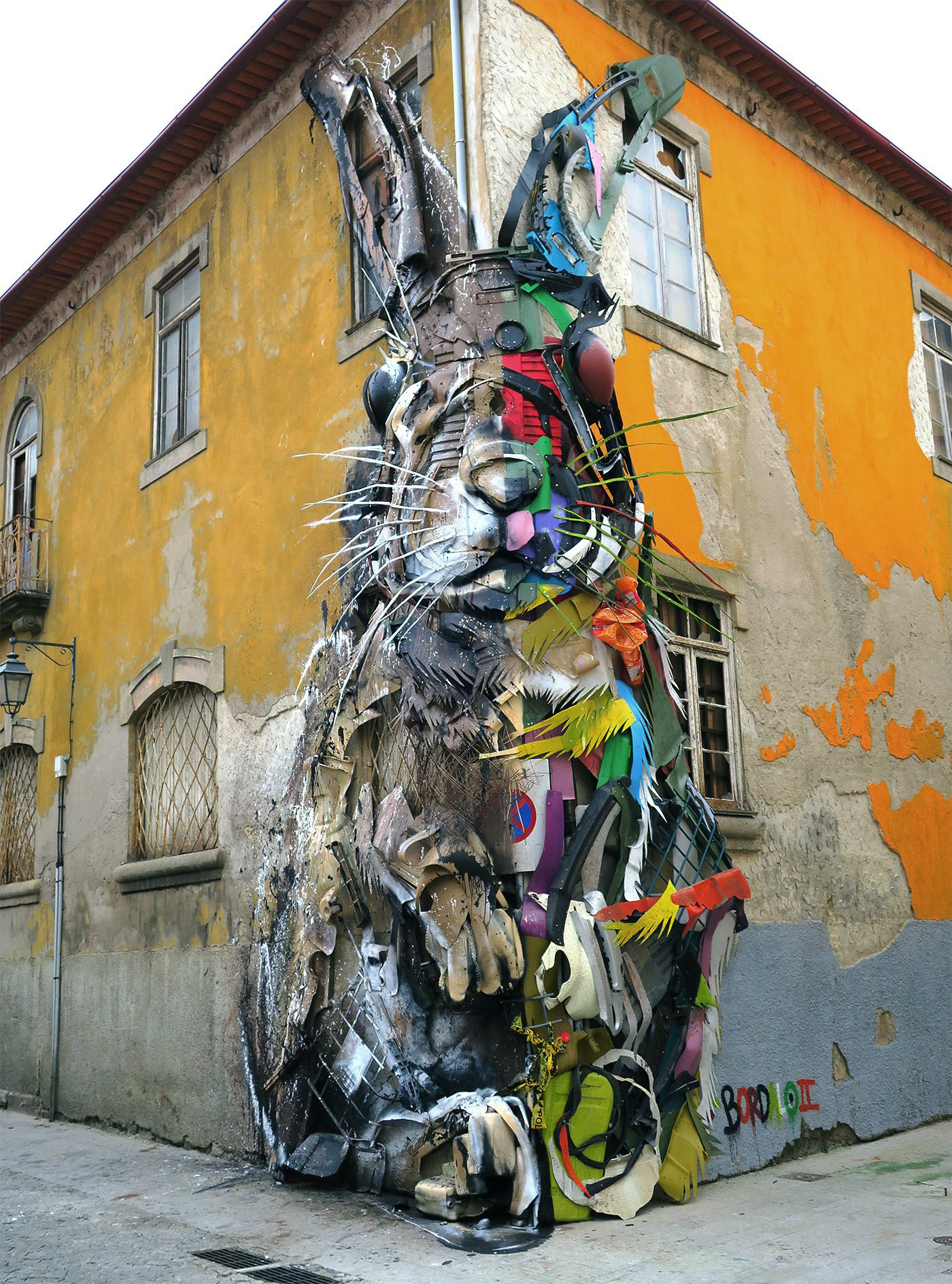
Bordalo II transforms discarded materials into works that move between environmental warning, sculptural invention and social critique. Image copyright Bordalo II
Bordalo II’s practice can be explored through two closely connected strands: the ecological and material language of his Big Trash Animals and the social and political interventions examined in Art and Activism: 10 Provocative Themes in Bordalo II’s Art.
Explore Bordalo II artworks at GraffitiStreet
Who Is Bordalo II? Understanding Bordalo II Art
Bordalo II was born Artur Bordalo in Lisbon in 1987 and continues to live and work in the Portuguese capital. His artistic name pays tribute to his grandfather, the painter Real Bordalo, carrying a family legacy forward while signalling a distinctly different generation and artistic language. His own development emerged through graffiti and the visual culture of the street before expanding into sculpture, assemblage and increasingly ambitious interventions within public space.
That evolution is important because Bordalo II is sometimes compressed into a convenient description: the artist who makes animals from rubbish. The description is recognisable, although it captures only one part of a practice that has grown considerably since he began working professionally in 2012. His current archive separates his work across Big Trash Animals, Small Trash Animals, Provoc, Lighted, Wood, Rock and Pixels, revealing an artist who continues to test how discarded material, image, spectacle and public space can carry critical meaning. At the time of publication, Bordalo II’s official website records 178 tonnes of reused material since 2012.
Across these bodies of work, one idea persists: the material world carries evidence of the systems that produced it. A broken bumper, plastic toy, tyre, cable, discarded sign or redundant piece of machinery arrives in the studio with a previous history of production, desire, use and abandonment. Bordalo II rarely allows that history to disappear completely. Instead, he reorganises its remains.
This is where the sophistication of the work lies. Waste becomes both medium and evidence.
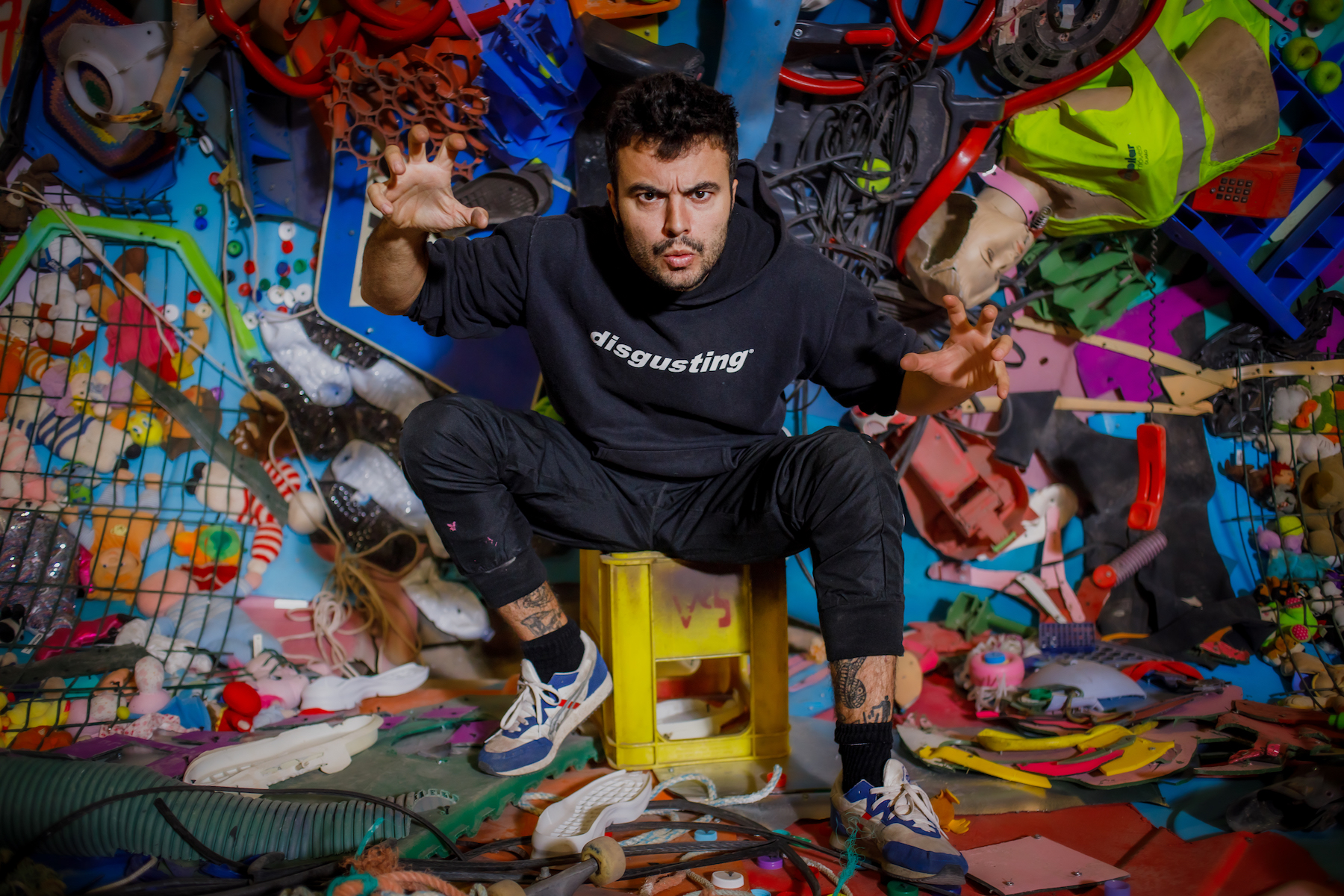
Big Trash Animals: Wildlife Made From the Materials That Threaten It
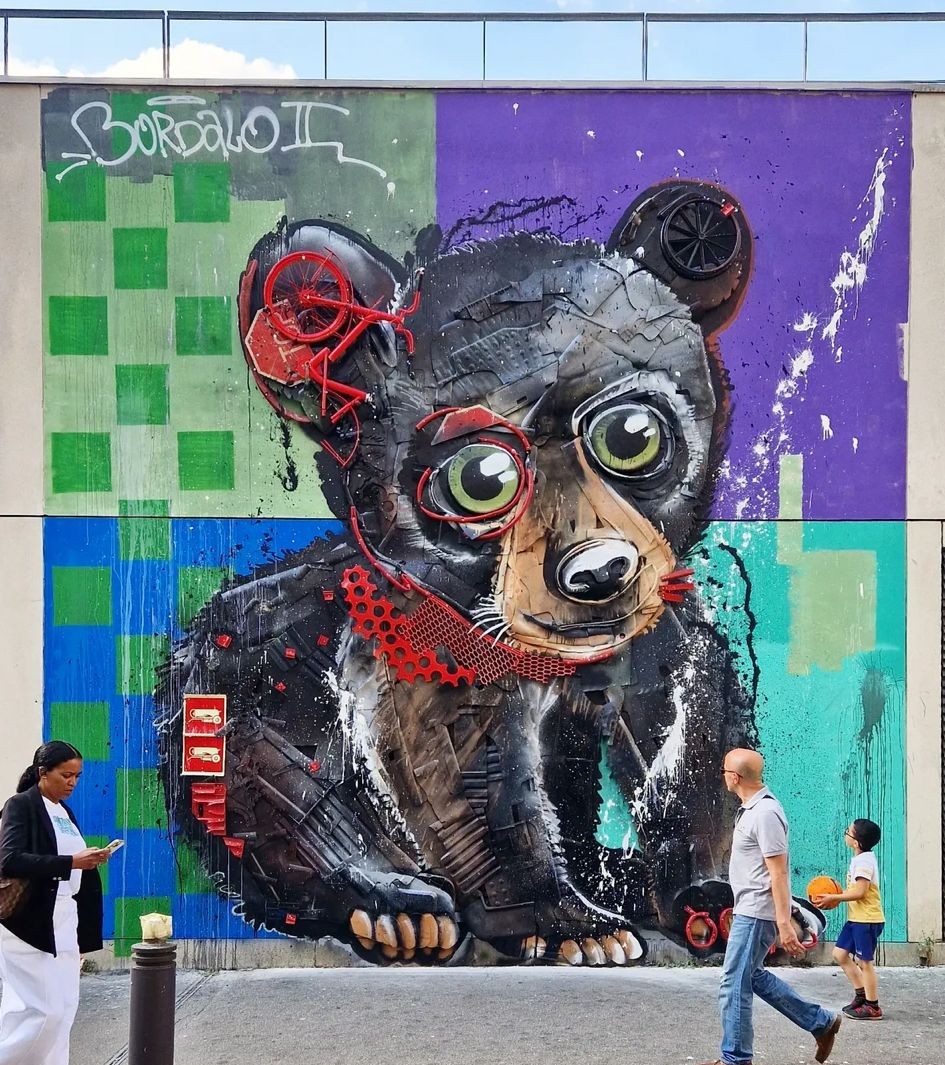
Bordalo II’s Big Trash Animals remain his most internationally recognisable works. Monumental animals emerge from fragments of discarded plastic, car parts, industrial debris, fabric, electronics, nets, toys and other recovered objects, often sourced close to the location in which the finished work will appear. The animals command attention through scale and familiarity before their surfaces reveal the discarded materials from which they have been constructed.
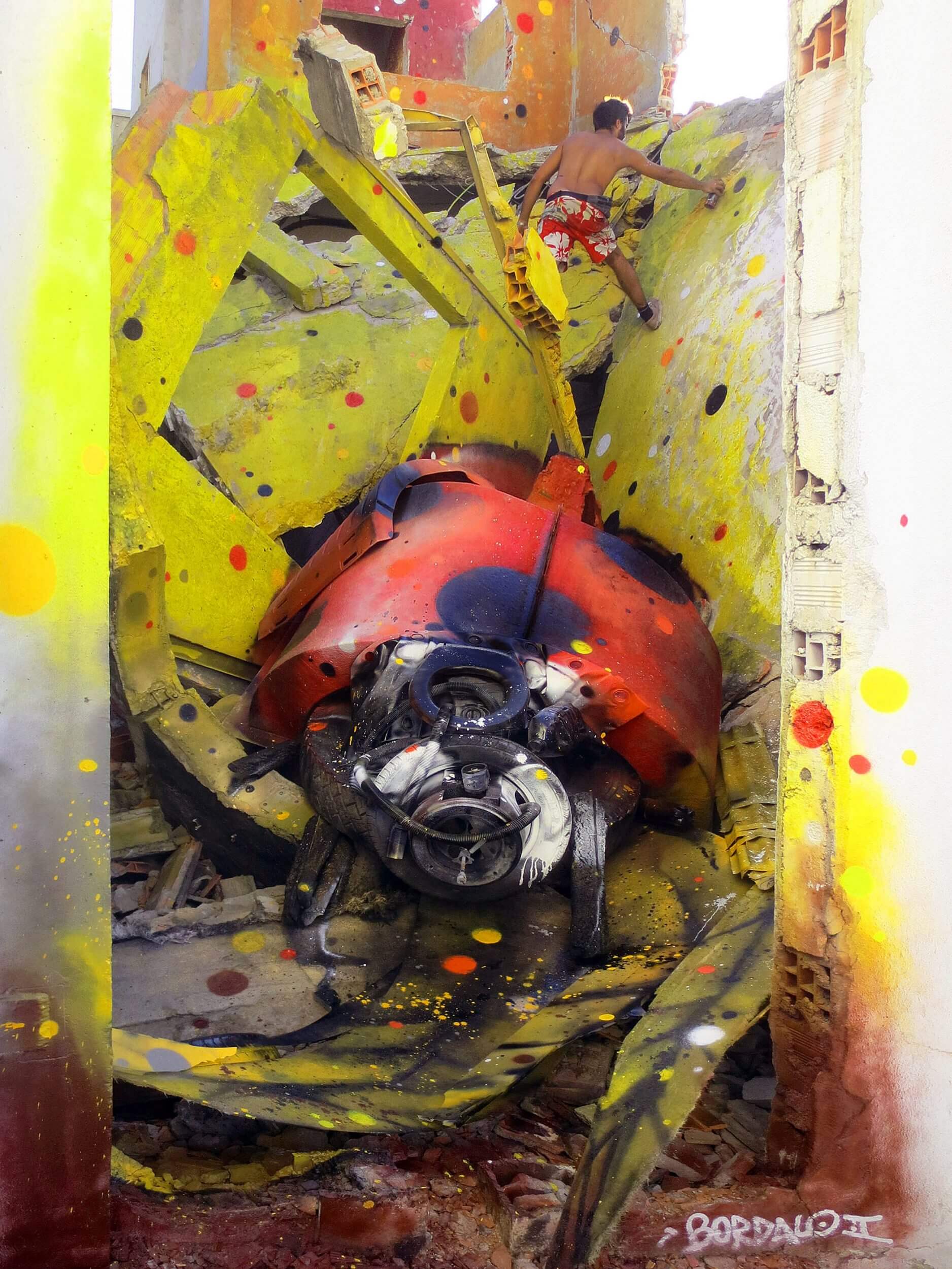
The conceptual contradiction is deliberate. Wildlife is reconstructed from the remnants of human consumption, bringing the animal and the material responsible for environmental pressure into the same visual field.
GraffitiStreet has followed this body of work since its formative years. Our original 2015 Big Trash Animals feature recorded an artist establishing an increasingly distinctive language from car bumpers, tyres, plastics and the debris of contemporary consumer life.
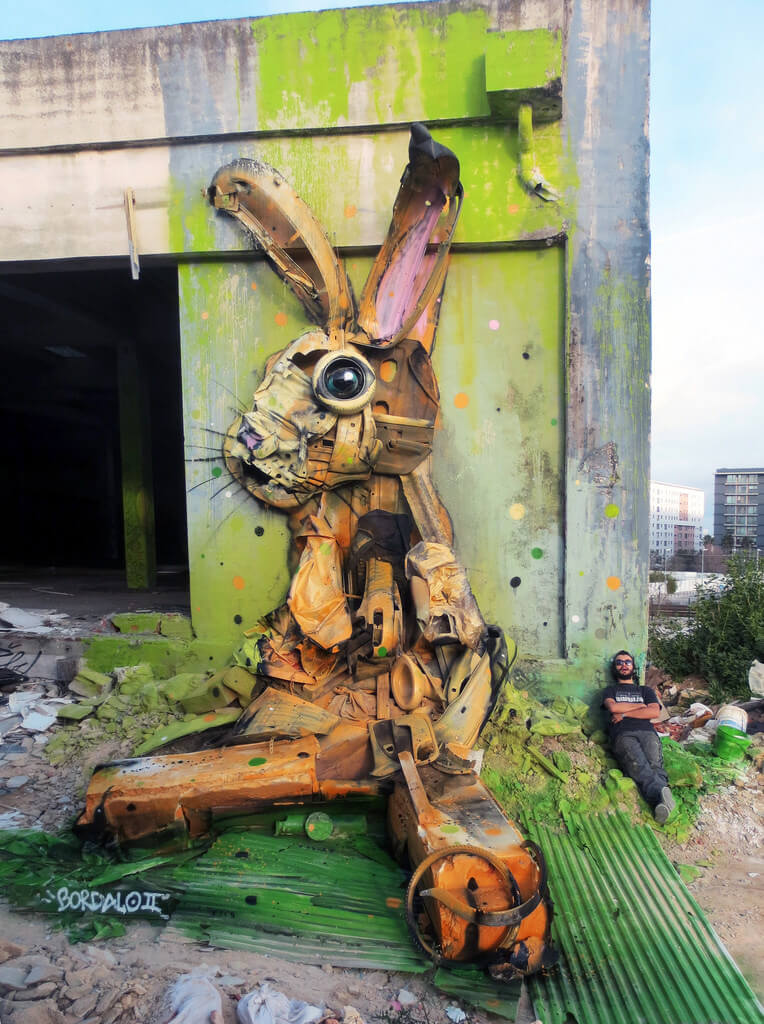
Bordalo II, Neutral Big Trash Animal
More than a decade later, the series has developed into several formal approaches. In Neutral, paint and carefully selected objects camouflage the waste until the animal can appear almost organic. Half-Half divides the image between an apparently naturalistic animal and a visibly constructed counterpart, sharpening the tension between wildlife and human debris. Plastic removes much of the camouflage and allows the constituent materials to remain visually dominant.
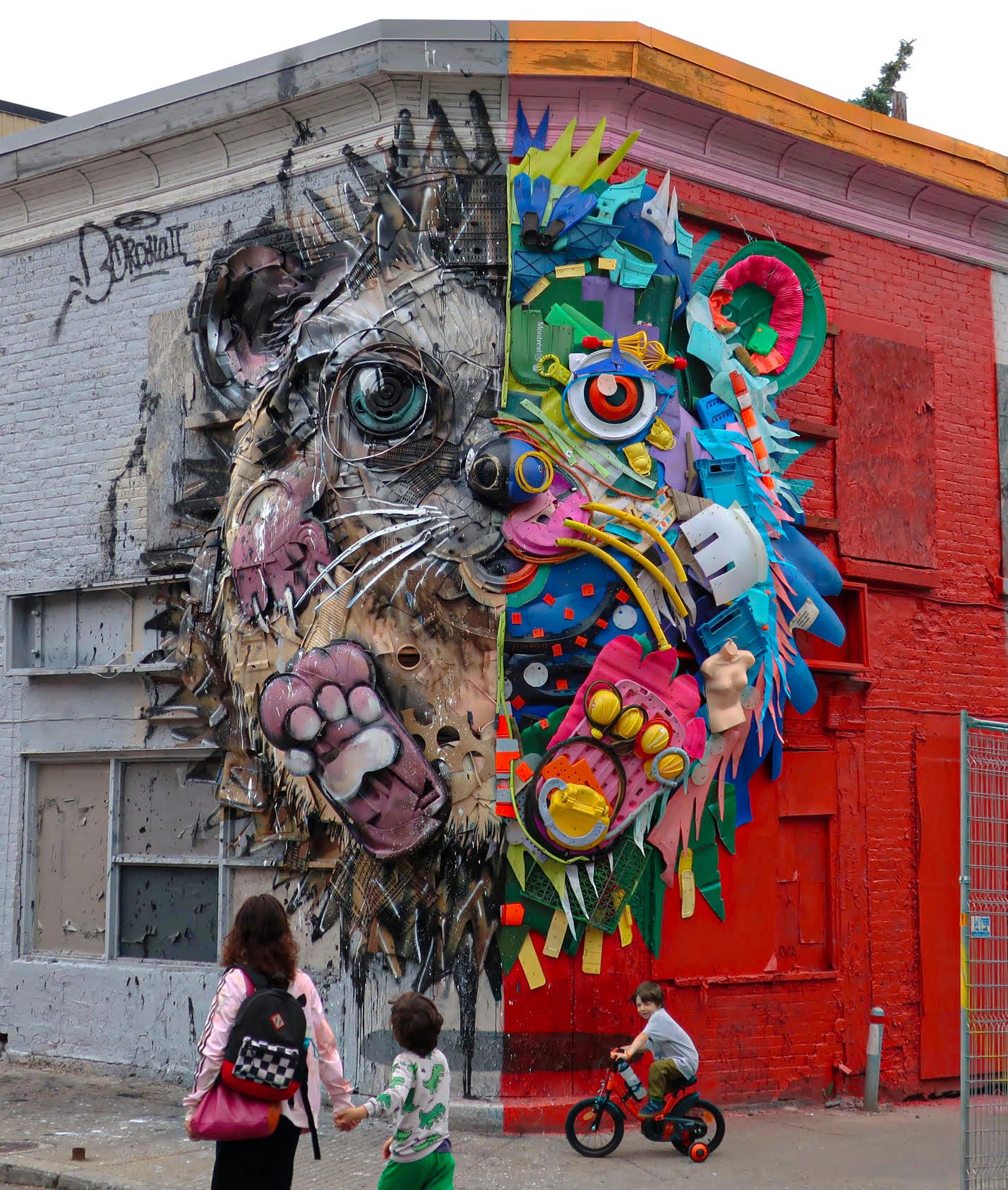
Bordalo II, Half-Half Big Trash Animal
For a deeper exploration of the series, its materials and ecological meaning, read our dedicated pillar, Bordalo II Big Trash Animals: Waste, Wildlife and Meaning. GraffitiStreet’s earlier feature, The Evolution of Big Trash Animals, also traces the emergence of Neutral, Half-Half and Plastic within the developing series.
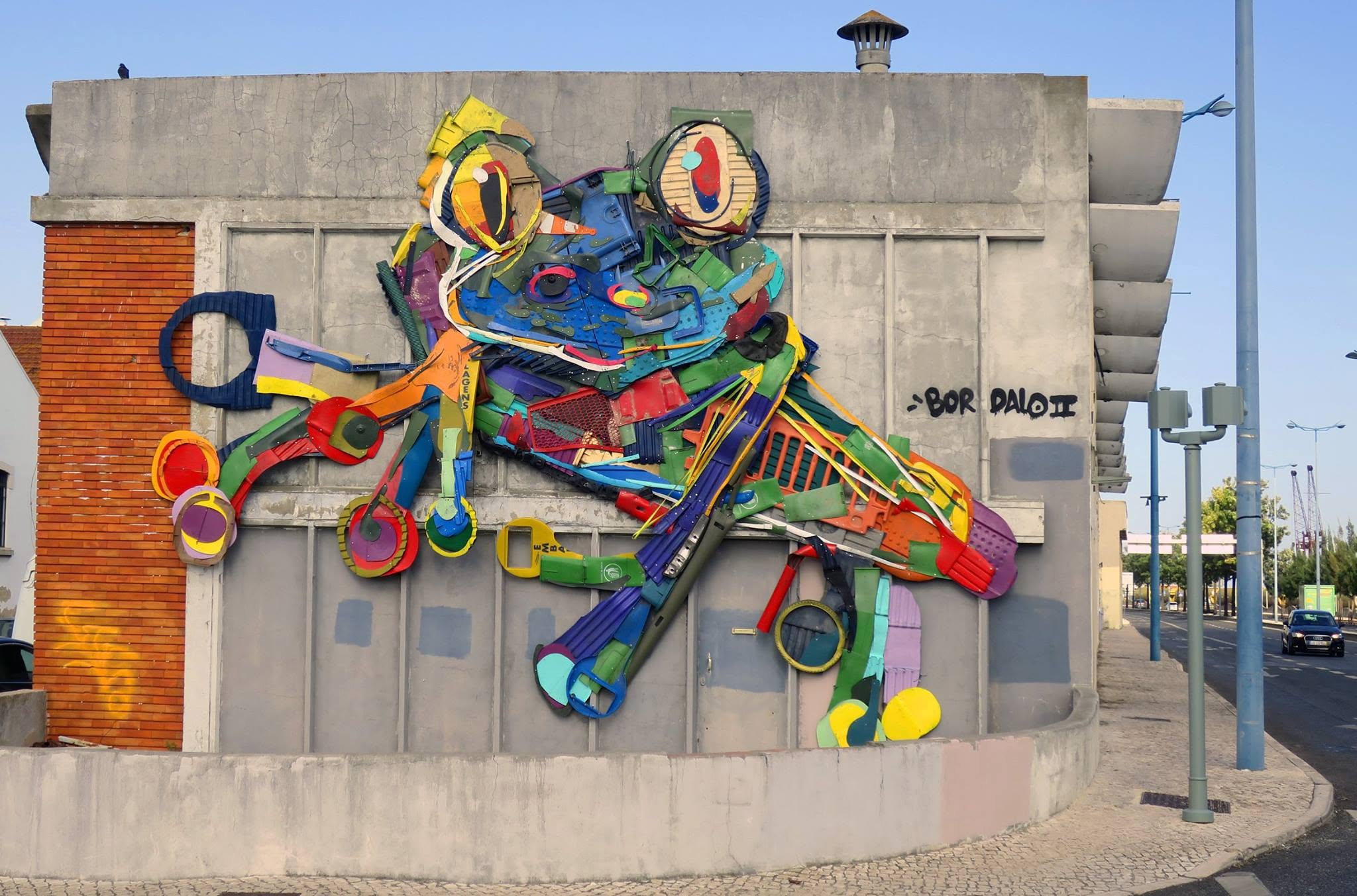
Bordalo II, Plastic Big Trash Animal
The Animal as Image, the Waste as Memory
Bordalo II’s animals succeed partly because they operate at radically different distances. From across a street, the figure may register immediately as a panda, flamingo, rat, raccoon, whale, fish or quokka. Move closer and recognition begins to fragment. A muzzle becomes part of a car bumper. Fur becomes cables and broken plastics. The smooth logic of the animal gives way to an archaeological surface of objects. That shift in perception matters. The viewer first encounters a creature and then encounters consumption.
In Bordalo II’s hands, rubbish retains a form of material memory. The plastic toy once belonged to someone; the bumper belonged to a vehicle; the cable, extinguisher, helmet or fragment of furniture once occupied an entirely different system of value. The artist does not return these objects to their previous usefulness. He gives their redundancy visibility.
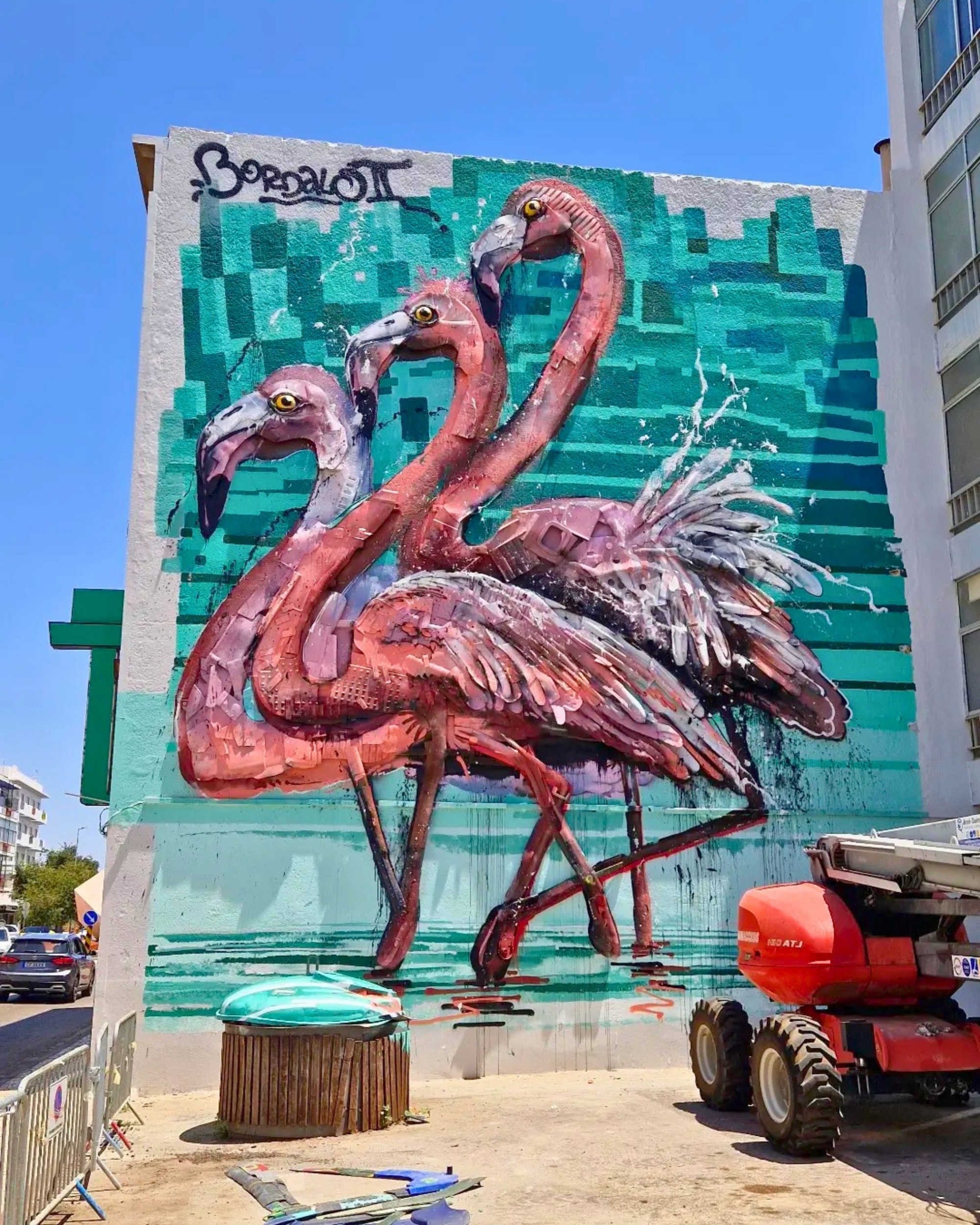
The process also allows individual works to become geographically specific. Flamingos da Ria Formosa in Olhão connects discarded plastic, metal, bicycle parts and abandoned objects with birdlife associated with the nearby Ria Formosa lagoon. Balloon Fish in Trafaria similarly turns urban debris into marine life within a Portuguese coastal setting.
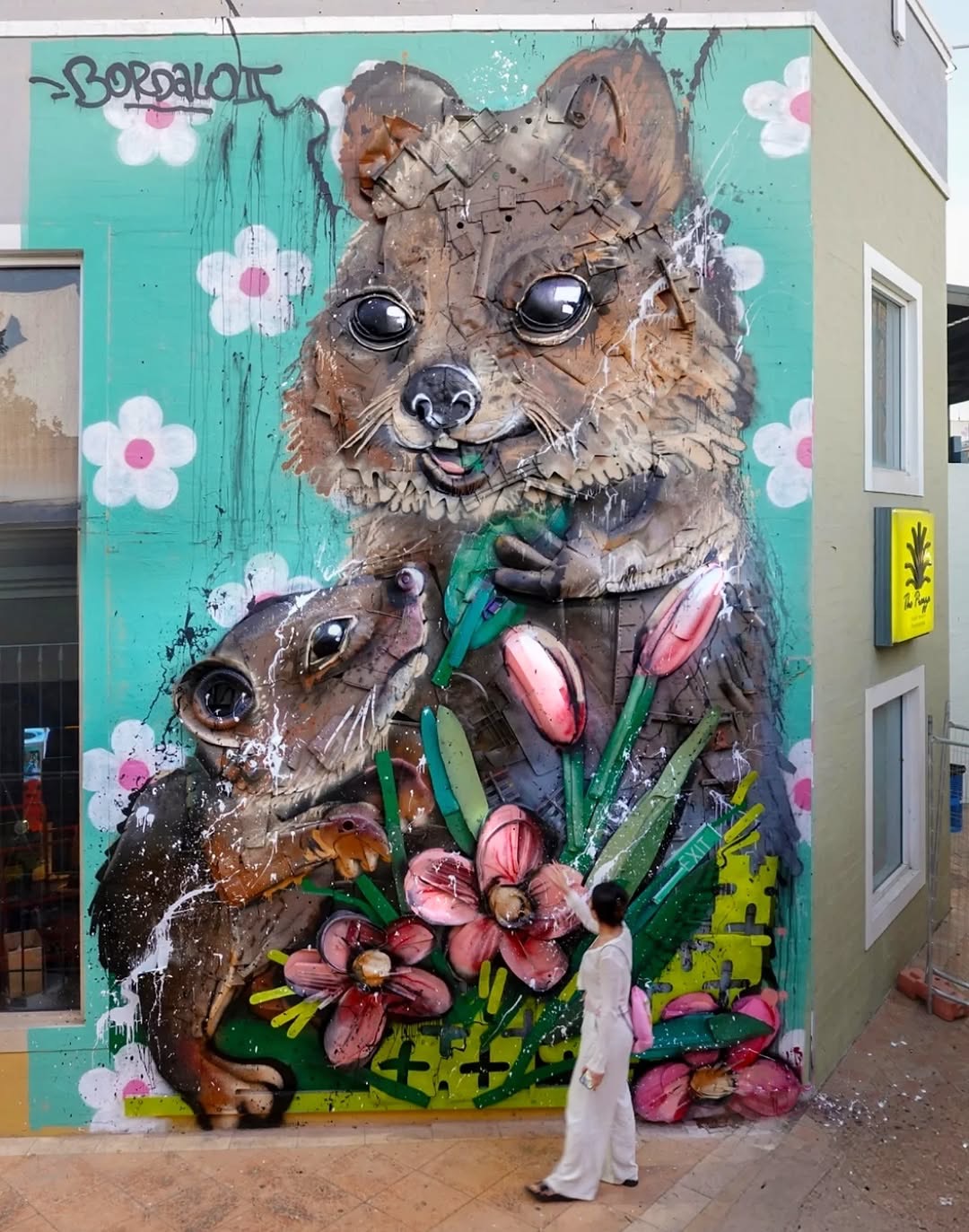
In Australia, Happy Quokkas brought the same visual language to Fremantle, using recovered waste to construct one of Western Australia’s most recognisable native animals.
From Relief to Monument: Bordalo II’s Giant 3D Sculptures
Scale has always been central to Bordalo II’s practice, although some of his most ambitious works move beyond the architectural relief of the Big Trash Animals and become fully spatial sculptures. These works alter the relationship between viewer and animal. A façade allows a creature to emerge from architecture, while a freestanding sculpture occupies the same physical space as its audience and can be experienced from every direction.
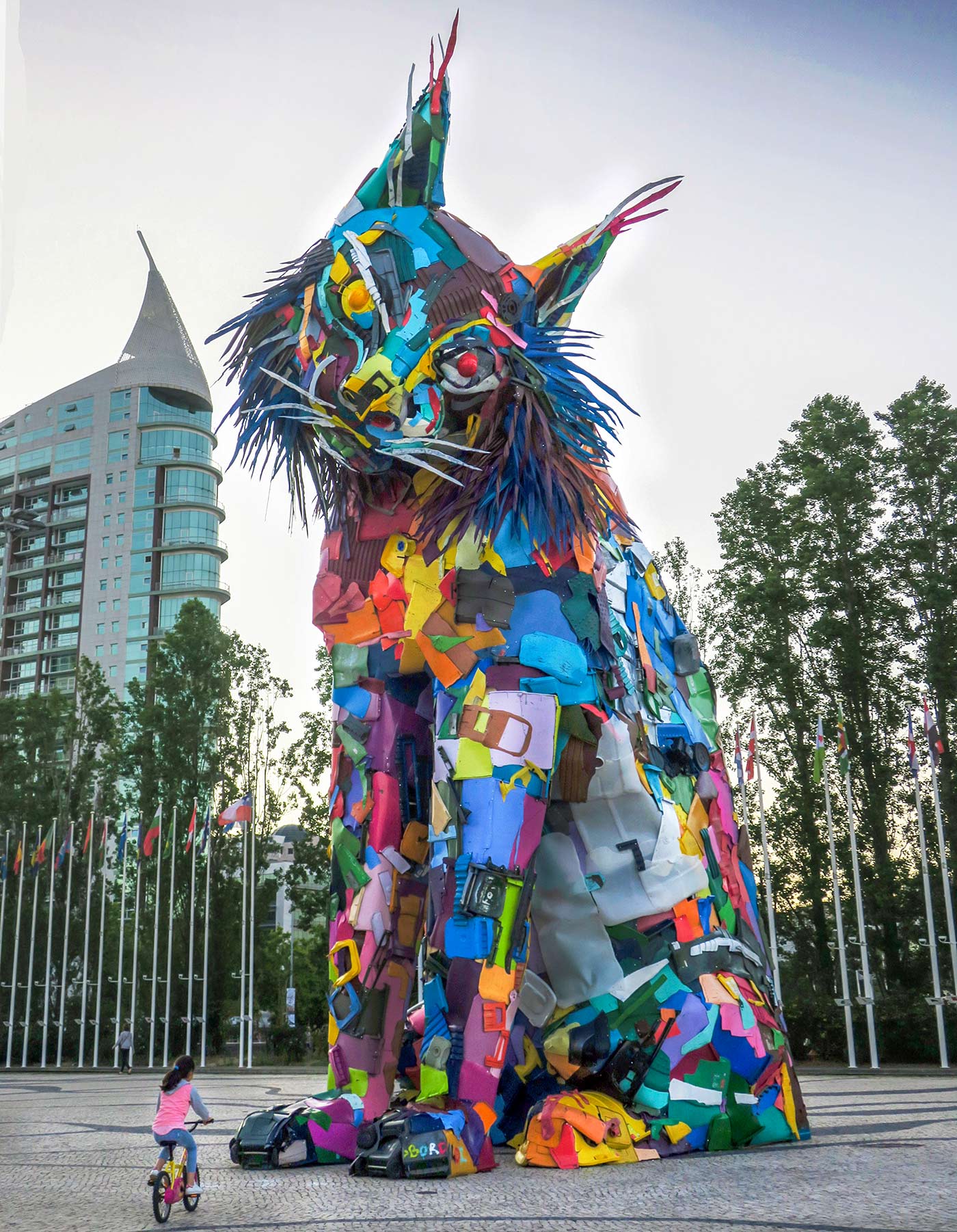
This shift gives Bordalo II’s materials a different weight. Plastic, bumpers, tyres, cables and industrial remnants begin to behave less like discarded fragments and more like construction material. Waste acquires mass, volume and an unexpected sense of permanence.
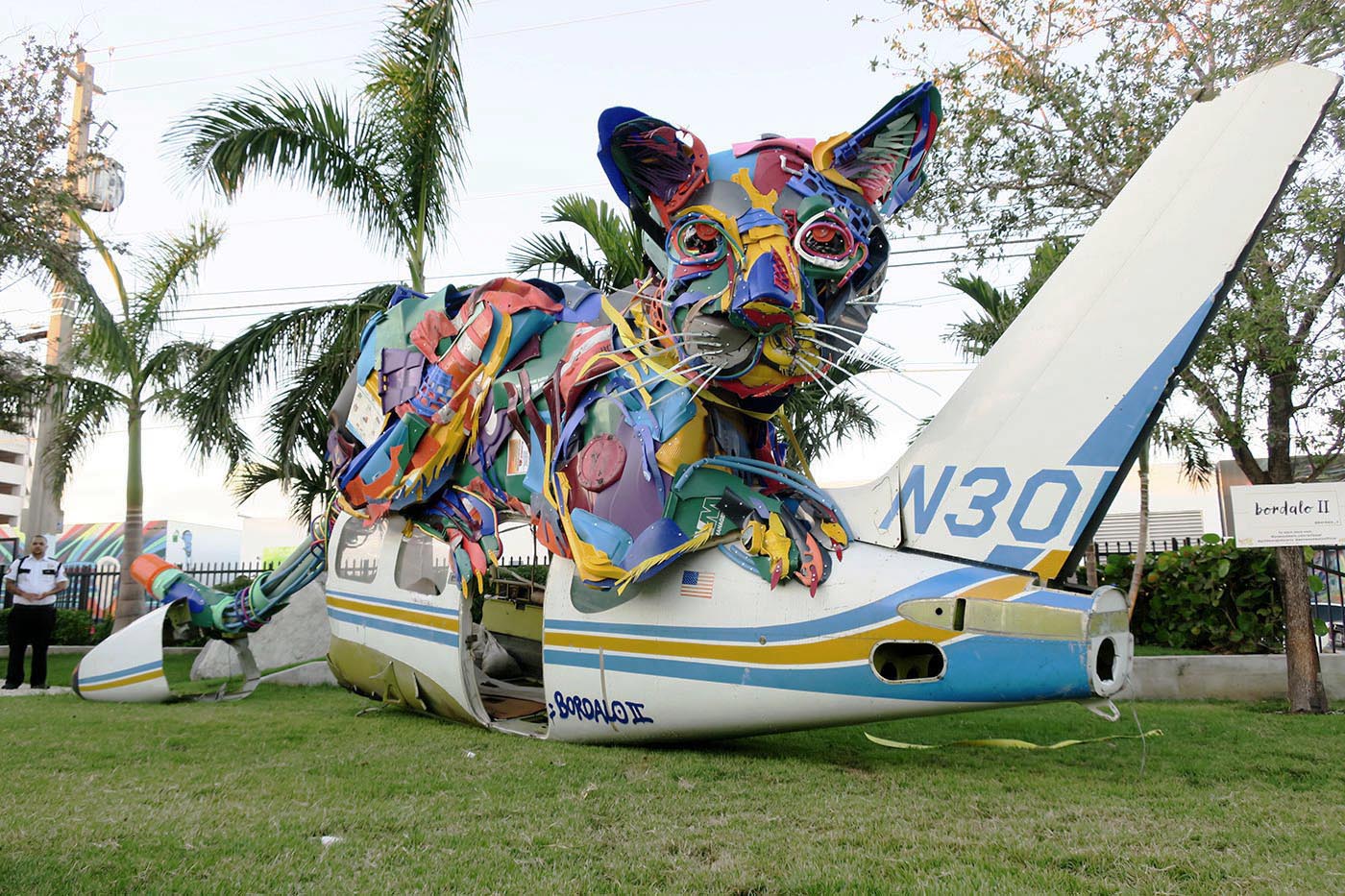
Works including Lynx in Lisbon, Plastic Mom and Baby Monkeys in Miami, the monumental Panther in Florida and other increasingly ambitious animal sculptures demonstrate how far this vocabulary has developed. Within Bordalo II’s Plastic works, the constituent debris remains deliberately visible, allowing the viewer to recognise both the animal and the consumer objects from which it has been constructed.
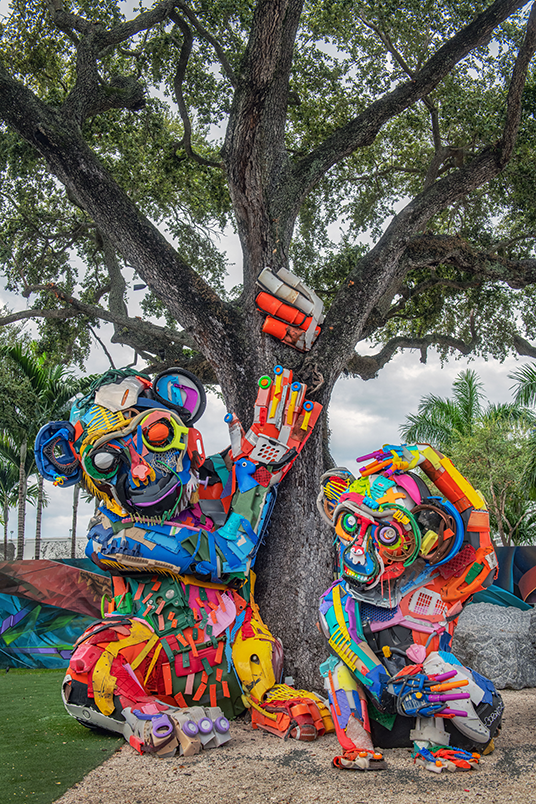
At this scale, waste stops feeling temporary. It becomes architectural, while the wildlife represented through it appears increasingly vulnerable. That reversal sits at the heart of Bordalo II’s sculptural language: the materials society considers disposable are made monumental, while the natural world they threaten becomes the subject demanding our attention.
Wild Wild Waste: When Environmental Art Became Immersive
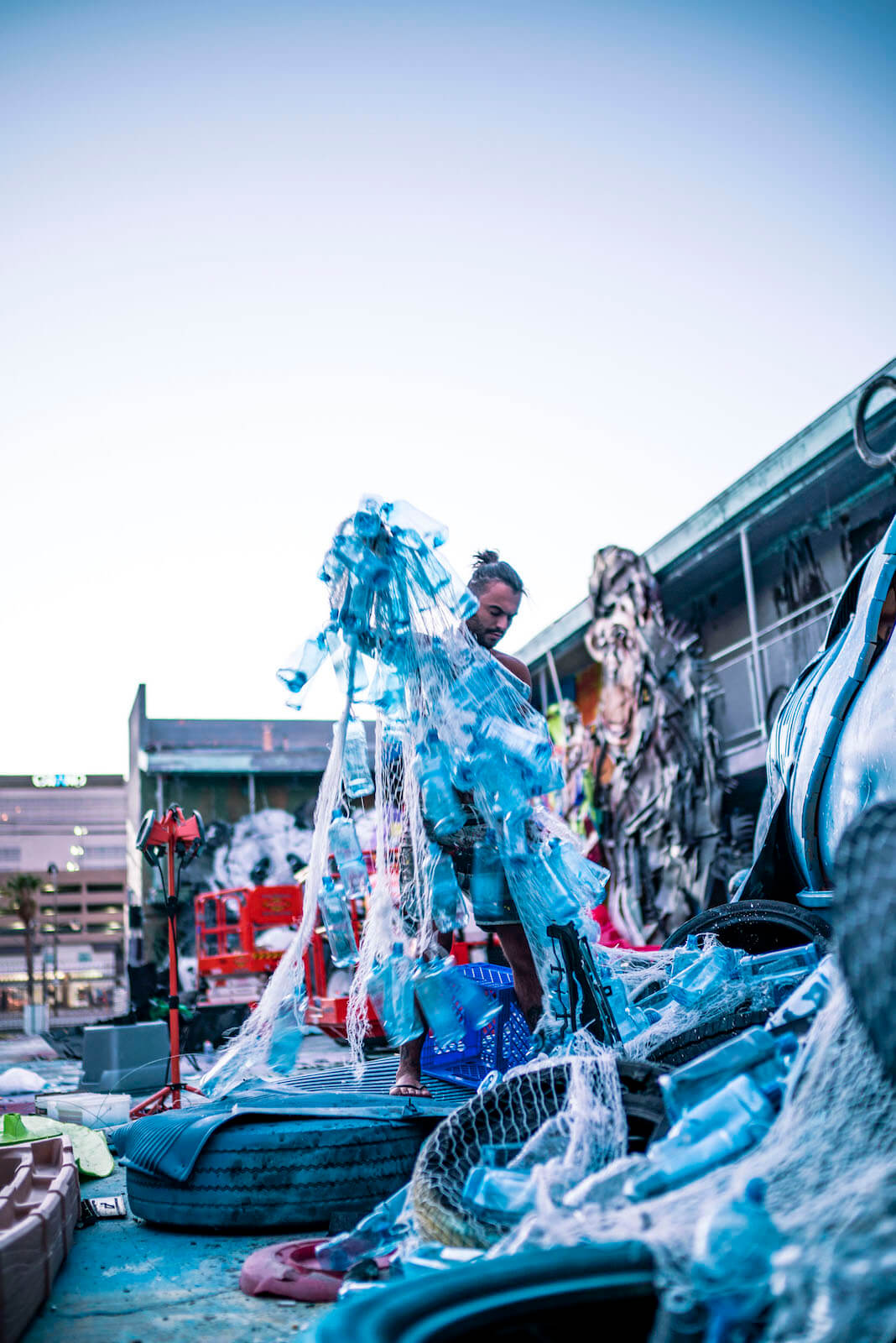
Las Vegas provides an unusually revealing thread through Bordalo II’s career, with the artist returning to the city at two distinct stages of his development. For the Life Is Beautiful Festival in Downtown Las Vegas in 2015, he created a group of large meerkats from discarded local materials. Three years later, Bordalo II returned with Wild Wild Waste, one of the most ambitious installations of his early career.
Read GraffitiStreet’s original coverage of Wild Wild Waste in Las Vegas.
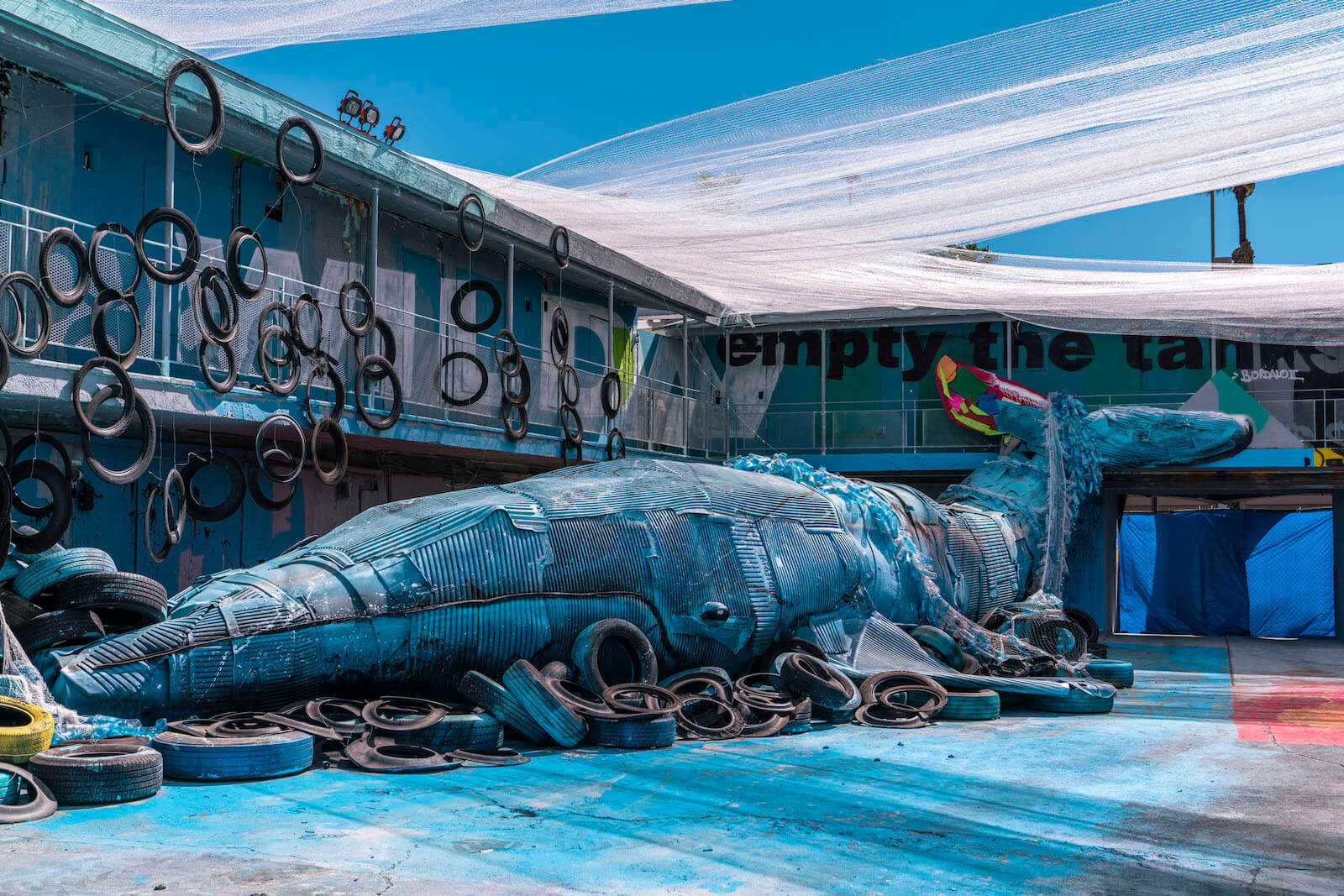
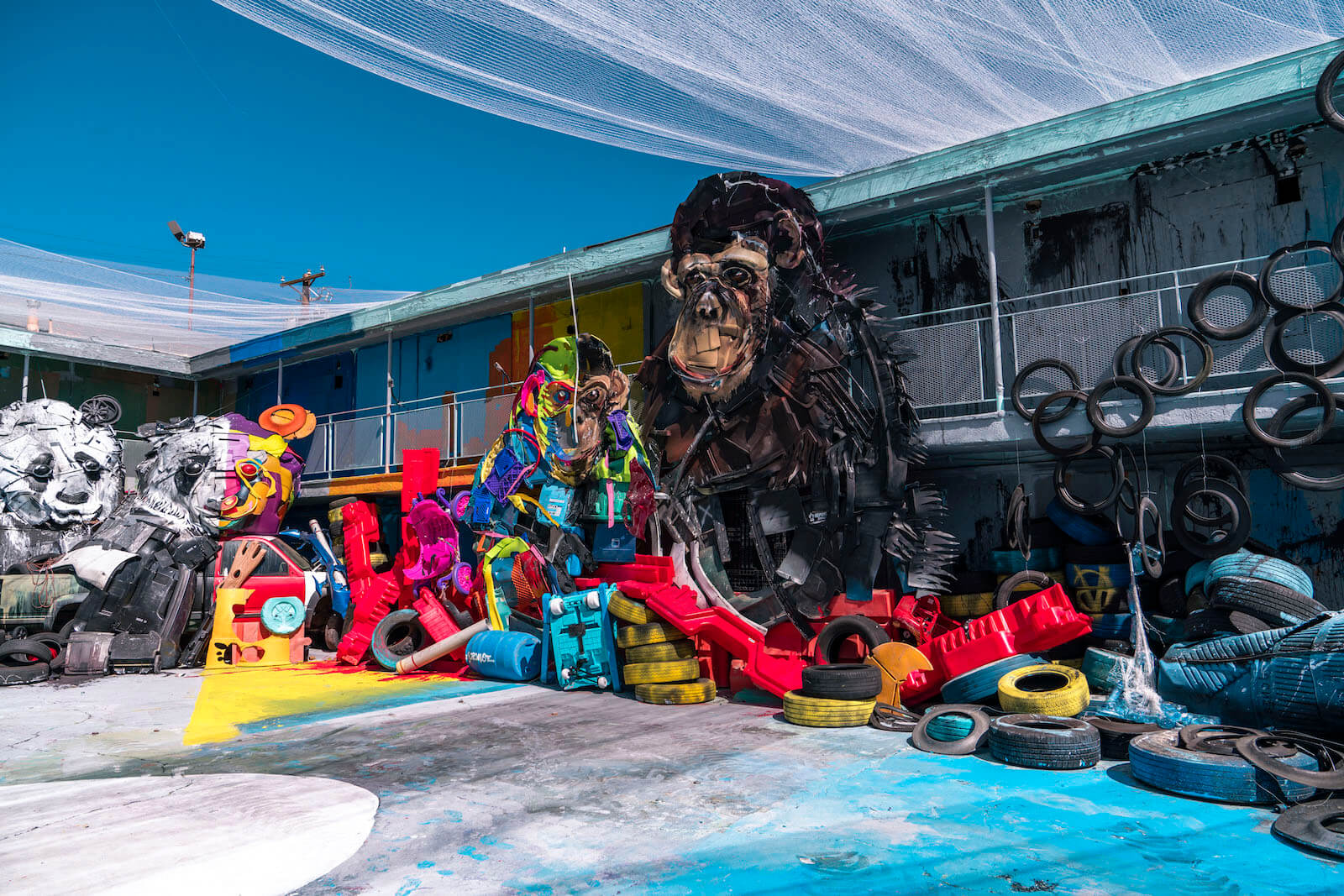
Created with JUSTKIDS for Life Is Beautiful, the project transformed approximately 10,000 square feet of a former motel into a darkly playful parody of a zoo. GraffitiStreet documented the installation when it opened in 2018.
A lion was confined inside a truck, a huge whale became entangled in fishing net, penguins stood on blocks of plastic ice, while a panda family constructed from car parts, foxes and monkeys occupied the surrounding environment. Individually, these animals extended ideas already familiar from the Big Trash Animals. Together, however, they created something different.
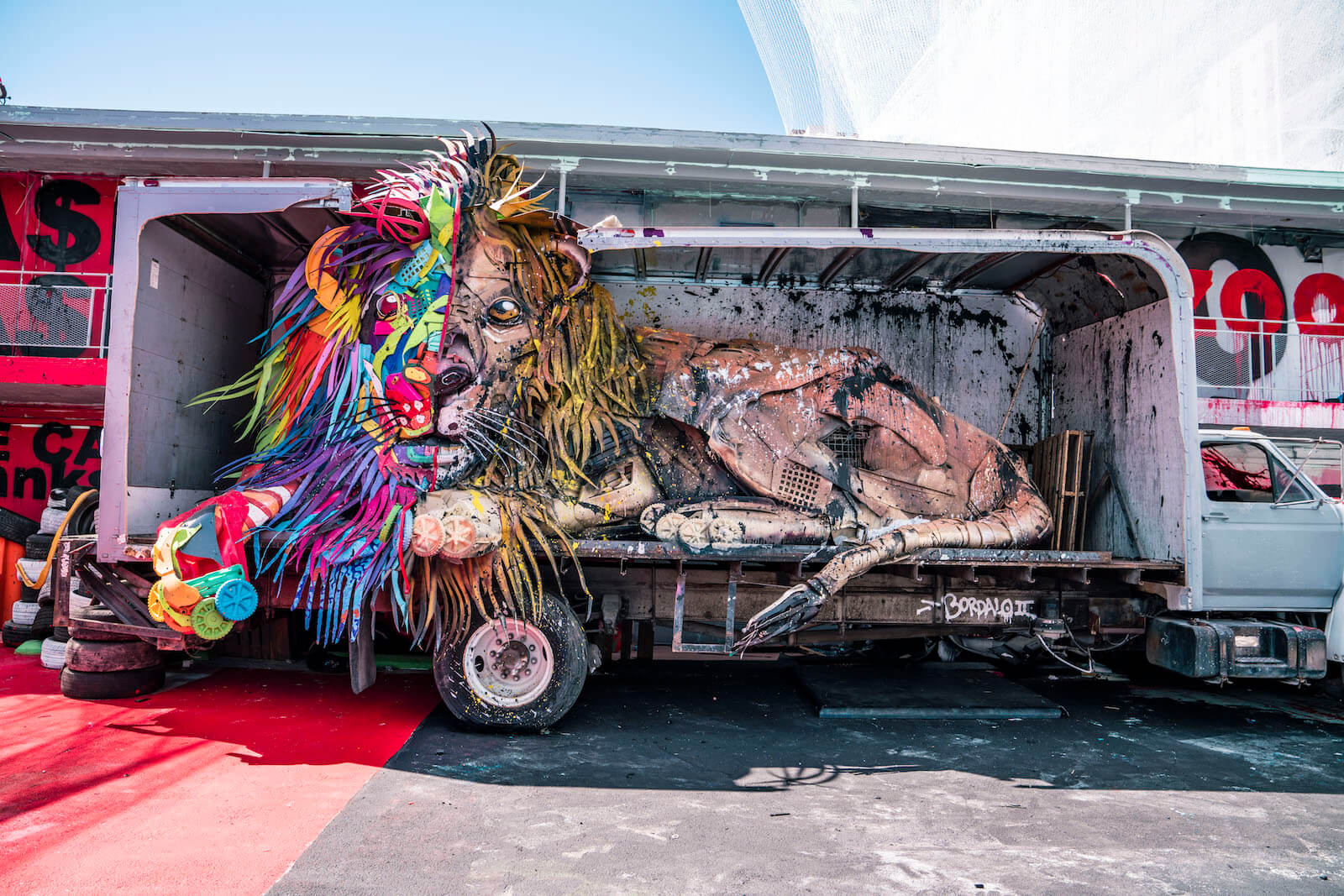
Visitors entered a fabricated ecosystem in which wildlife had been reconstructed through the debris associated with overconsumption and habitat destruction. The zoo format sharpened that contradiction. Humans traditionally create zoos in order to observe and contain animals; Bordalo II rebuilt that relationship using animals whose bodies were evidence of the pressures human activity places upon the natural world.
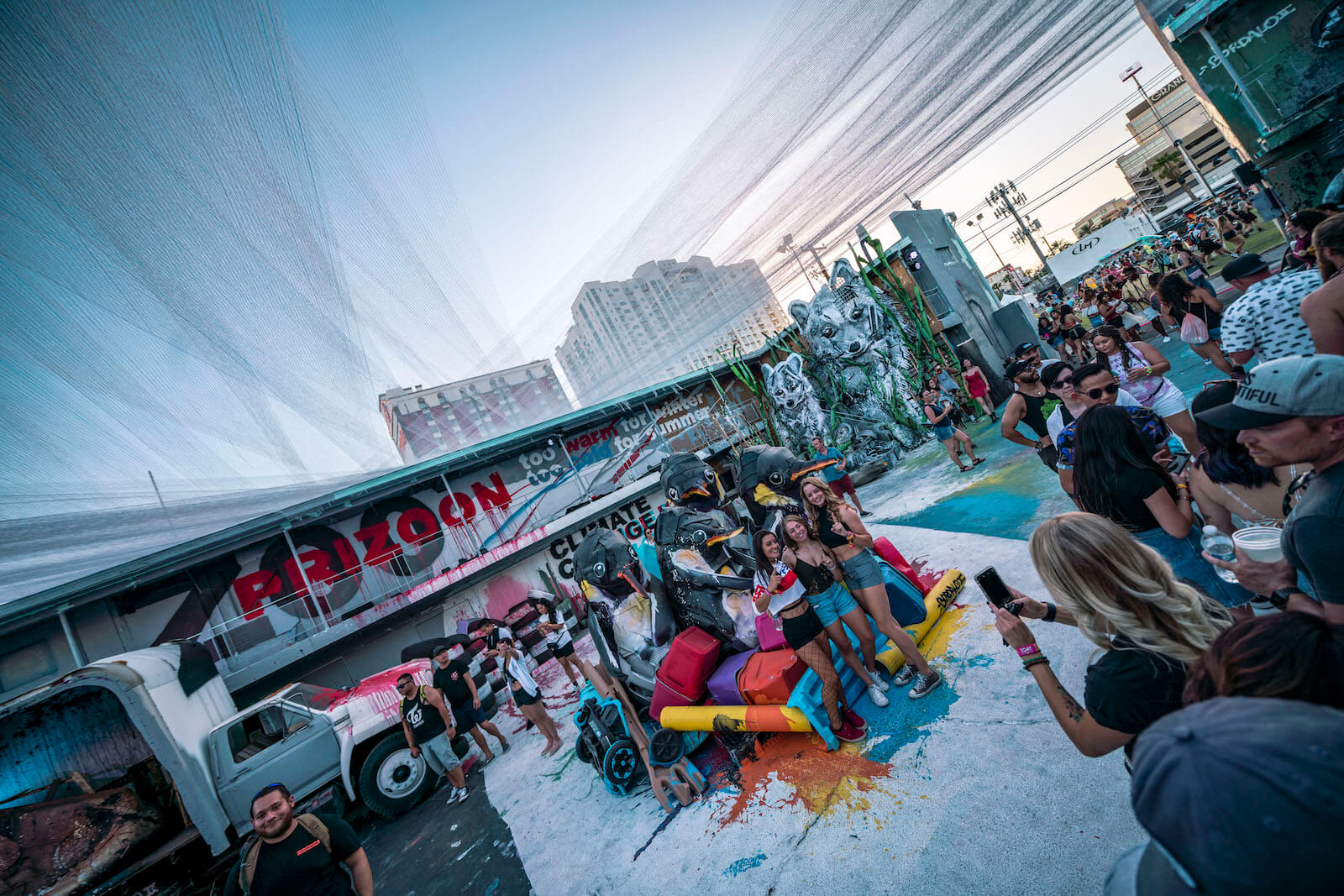
The installation also implicated the viewer. Visitors moved through an entertainment experience while being confronted with the consequences of a culture driven by continual production, consumption and disposal.
Las Vegas made that tension particularly effective. In a city famous for spectacle at architectural scale, Bordalo II created a spectacle of his own, although beneath the colour and theatricality sat a distinctly ecological warning.
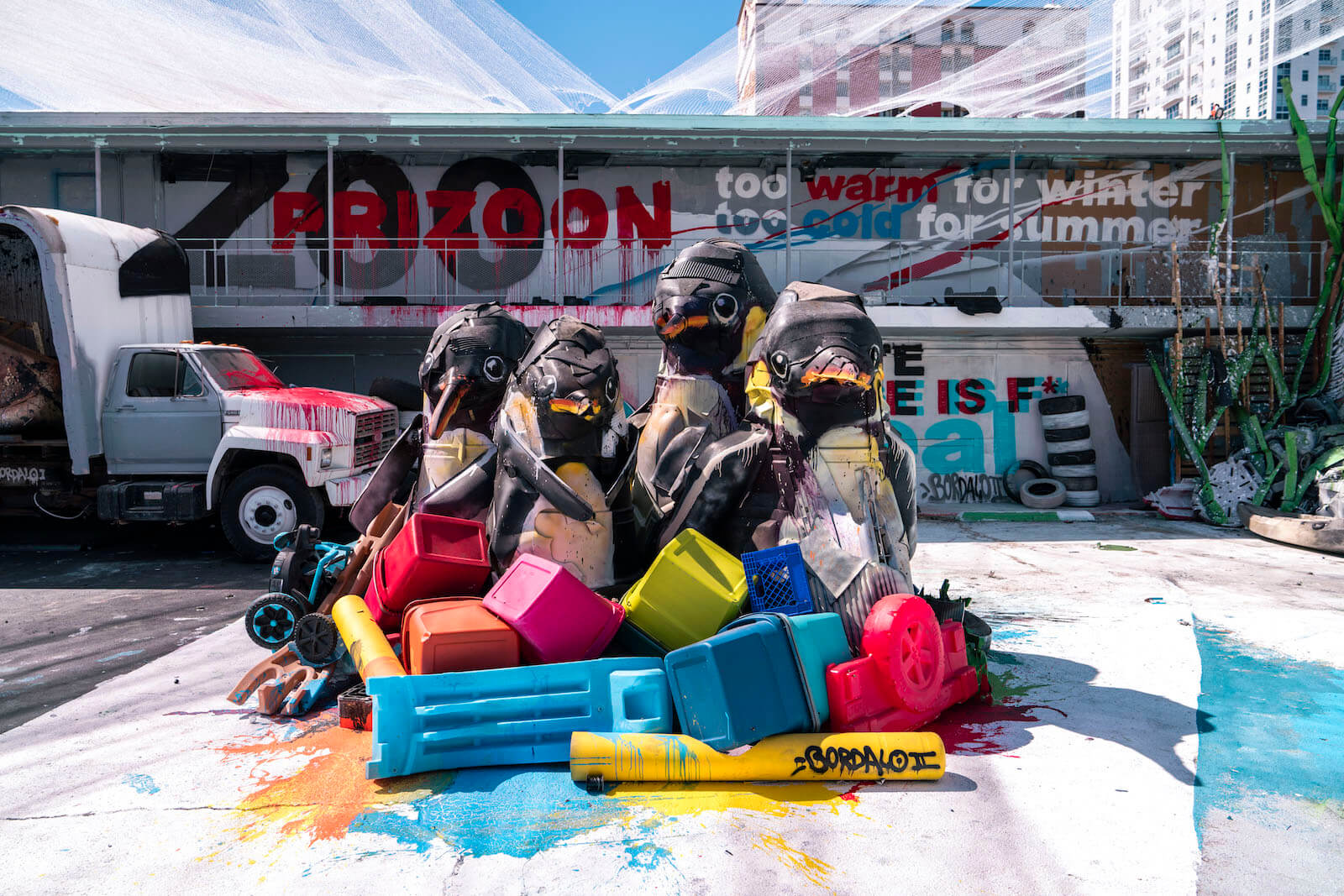
Wild Wild Waste marked an important evolution in his practice because the environment surrounding the animal became part of the artwork. Sculpture expanded into installation, and the viewer became physically immersed within Bordalo II’s argument.
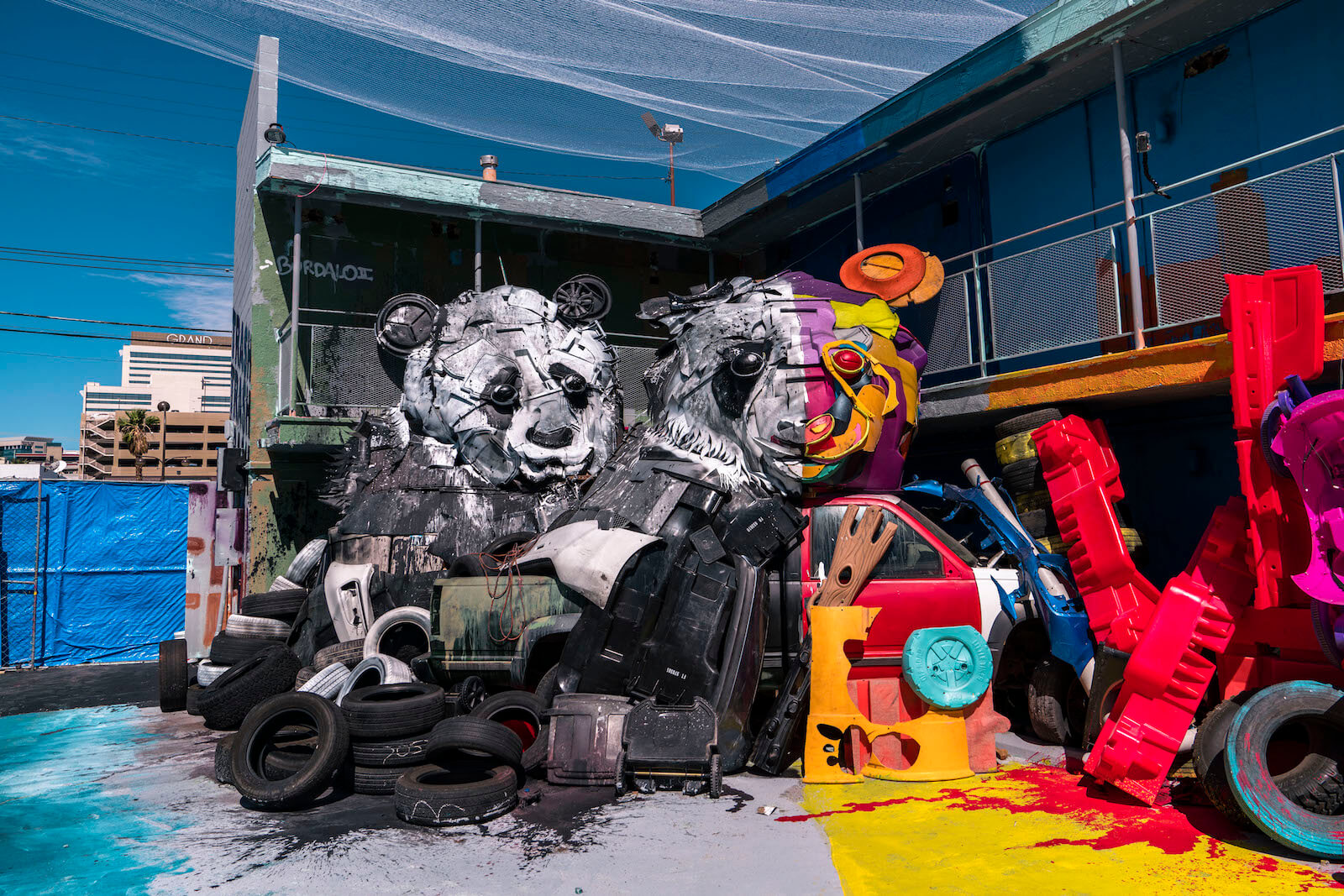
Explore GraffitiStreet’s wider Life Is Beautiful Las Vegas coverage.
The Sea: Plastic, Pollution and Marine Life
The ocean has become one of the most persistent environments within Bordalo II’s ecological practice. Marine animals allow the artist to expose a particularly direct contradiction: creatures whose habitats are increasingly affected by plastic pollution are reconstructed from the very materials associated with that damage.
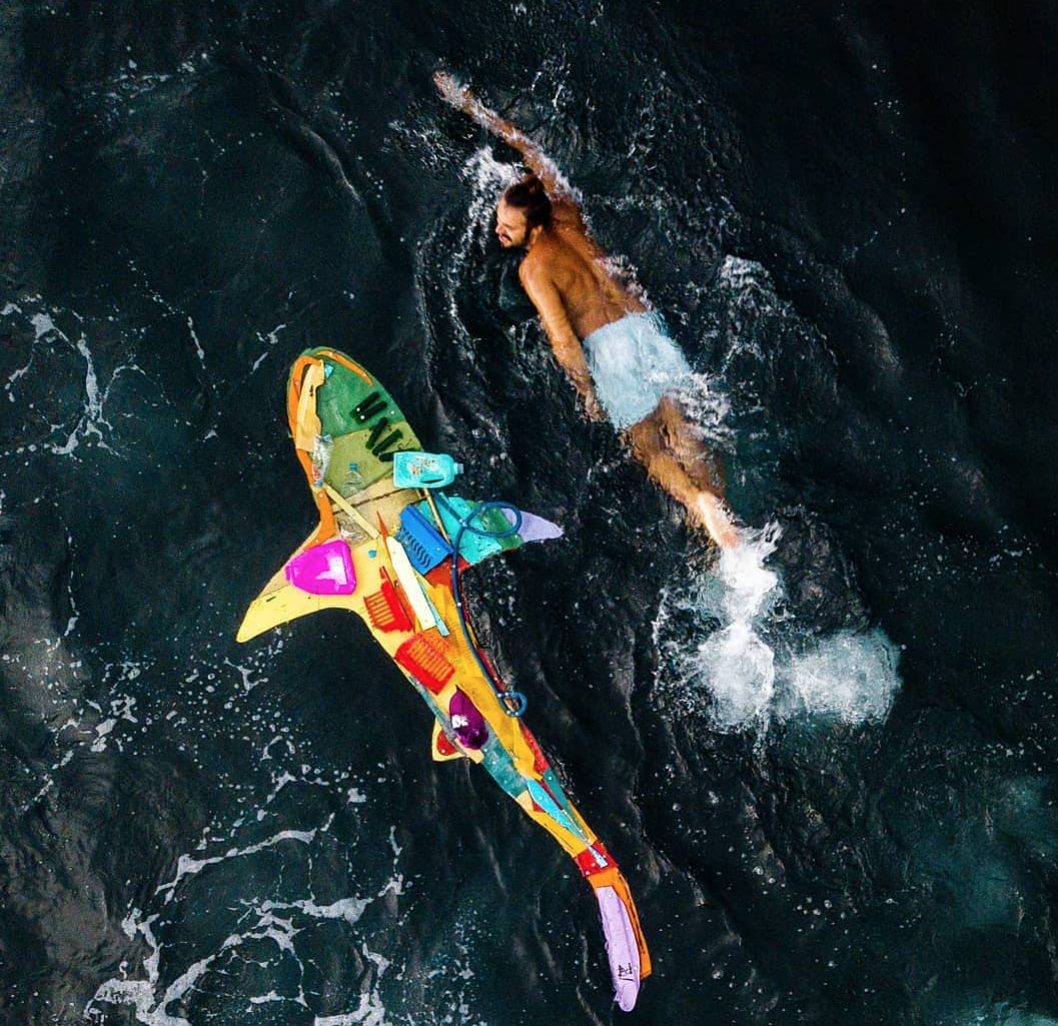
This idea became especially powerful in Tahiti in 2019, when Bordalo II returned to the island for ONO’U and created a series of ocean-related Trash Animals, including a Half Sea Turtle, Half Hammerhead Shark and a floating Trash Shark.
Here the location was inseparable from the meaning. The discarded plastics were no longer simply materials used to depict an endangered or vulnerable animal. By positioning the work beside, and even within, the ocean itself, Bordalo II collapsed the distance between the artwork and the environmental problem it addressed.
copyright Selina Miles
Explore GraffitiStreet’s original 2019 feature, Bordalo II Swims with Trash Sharks for ONO’U Tahiti.
Marine life has continued to surface throughout his practice. His official archive includes Plastic Whales in Bora Bora, while the enormous whale trapped in fishing net within Wild Wild Waste transformed marine pollution into part of an immersive ecological landscape.
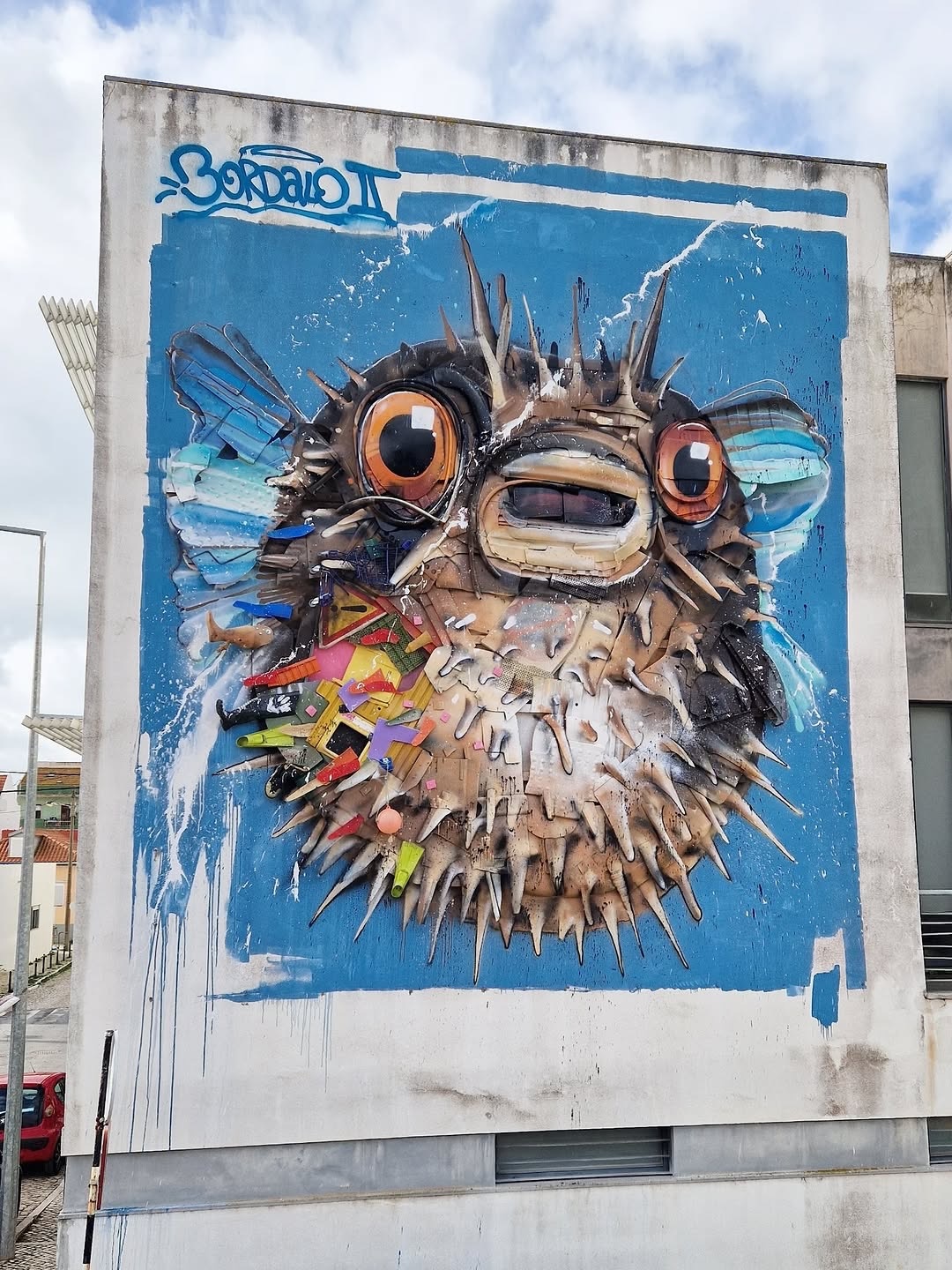
More recently, Bordalo II returned to Portugal’s coastline with Balloon Fish in Trafaria in 2026. Constructed from locally sourced waste on the Costa de Caparica, the monumental pufferfish connects the debris of everyday consumption directly with the marine environment beside which the work exists.
Read GraffitiStreet’s feature on Bordalo II’s Balloon Fish in Trafaria.
Across these works, the sea becomes more than another habitat populated by Bordalo II’s animals. It becomes a vast repository for the consequences of human consumption. Sharks, turtles, whales and fish emerge from discarded material as both living presences and warnings, reminding us that what disappears from our homes and streets does not simply disappear from the world.
Explore Bordalo II’s practice in greater depth through GraffitiStreet’s guide to Big Trash Animals, his evolving relationship with marine life and plastic pollution, and the Provoc works and social interventions that extend his language beyond environmental sculpture.
Bordalo II’s Provoc: Art as Public Interruption
Environmental critique is only one dimension of Bordalo II’s practice. His Provoc works move more explicitly into social and political territory, using existing urban architecture, street furniture, monuments, signs and familiar visual languages to interrupt the rhythms of the city. Bordalo II’s official description of Provoc identifies subjects including pollution, exploitation of women, media sensationalism, connectivity and control, with the interventions intended as vehicles for communication and awareness.
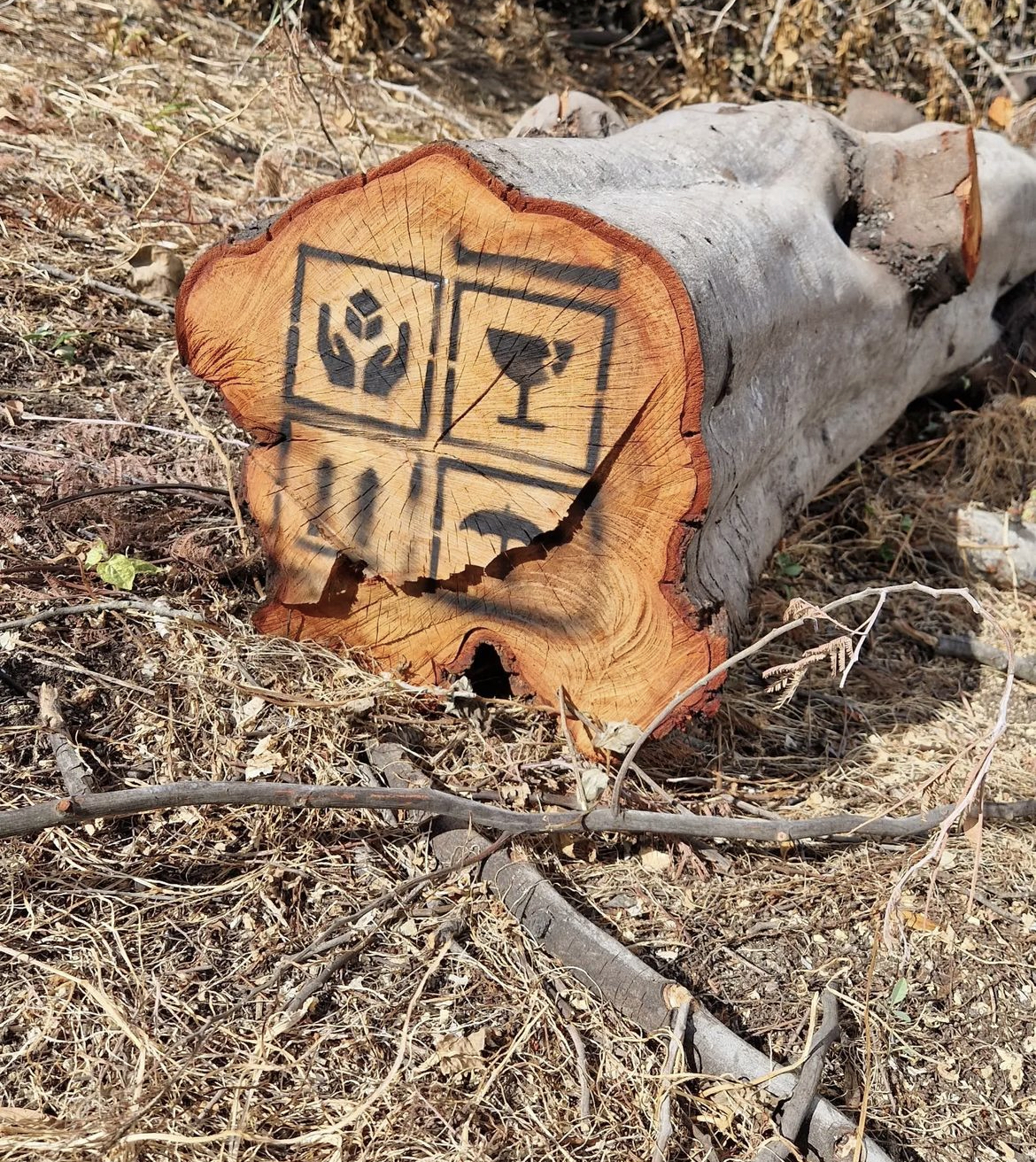
When GraffitiStreet interviewed Bordalo II in November 2015, our conversation focused specifically on what he then described as provocative street art and the ability of public work to engage directly with society. Asked about the role of street art, Bordalo II told us that it should retain its “critic spirit“. Later in the conversation, discussing artistic responsibility, his response was characteristically concise: “If artists will not do, who will?“
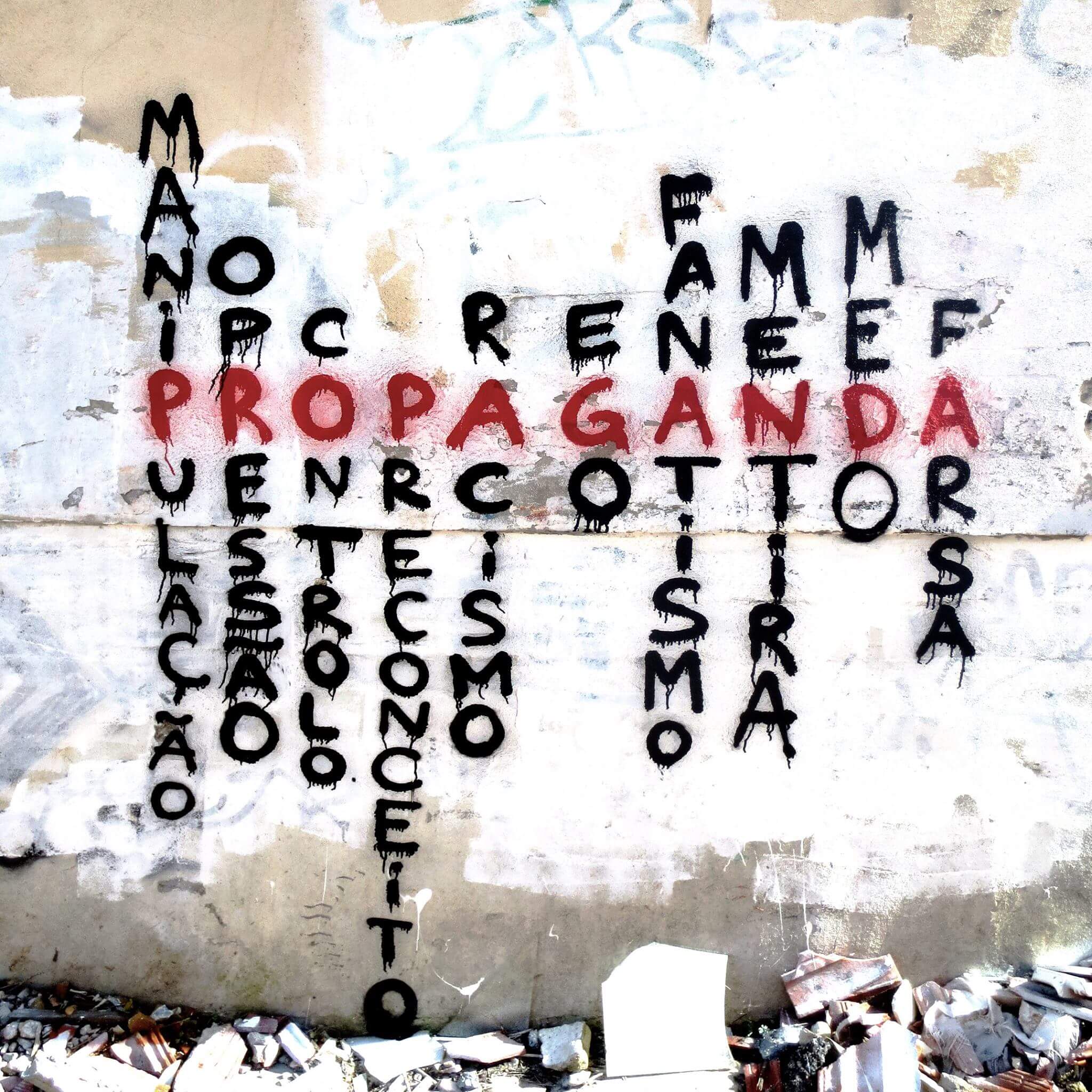
Those early interventions make his contemporary Provoc works easier to understand. Their materials and imagery may differ from the Big Trash Animals, yet the underlying instinct is related: locate something society has normalised, expose its contradictions, and place the result where ordinary life is forced into contact with it.
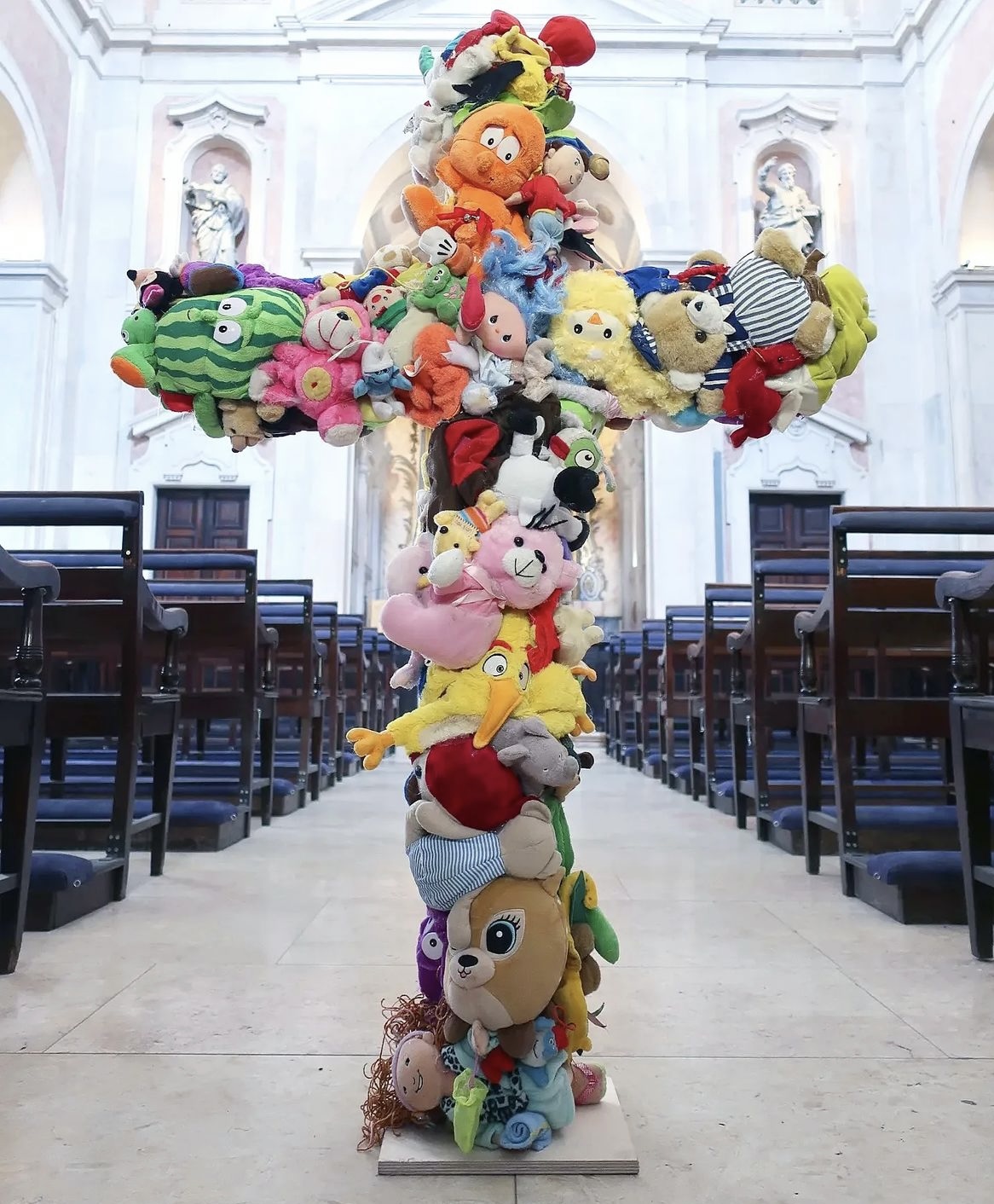
For a closer examination of this strand of his practice, our existing feature Art and Activism: 10 Provocative Themes in Bordalo II’s Art explores the artist’s responses to subjects including environmental destruction, war, racism, women’s rights, social media, institutional power and consumer excess.
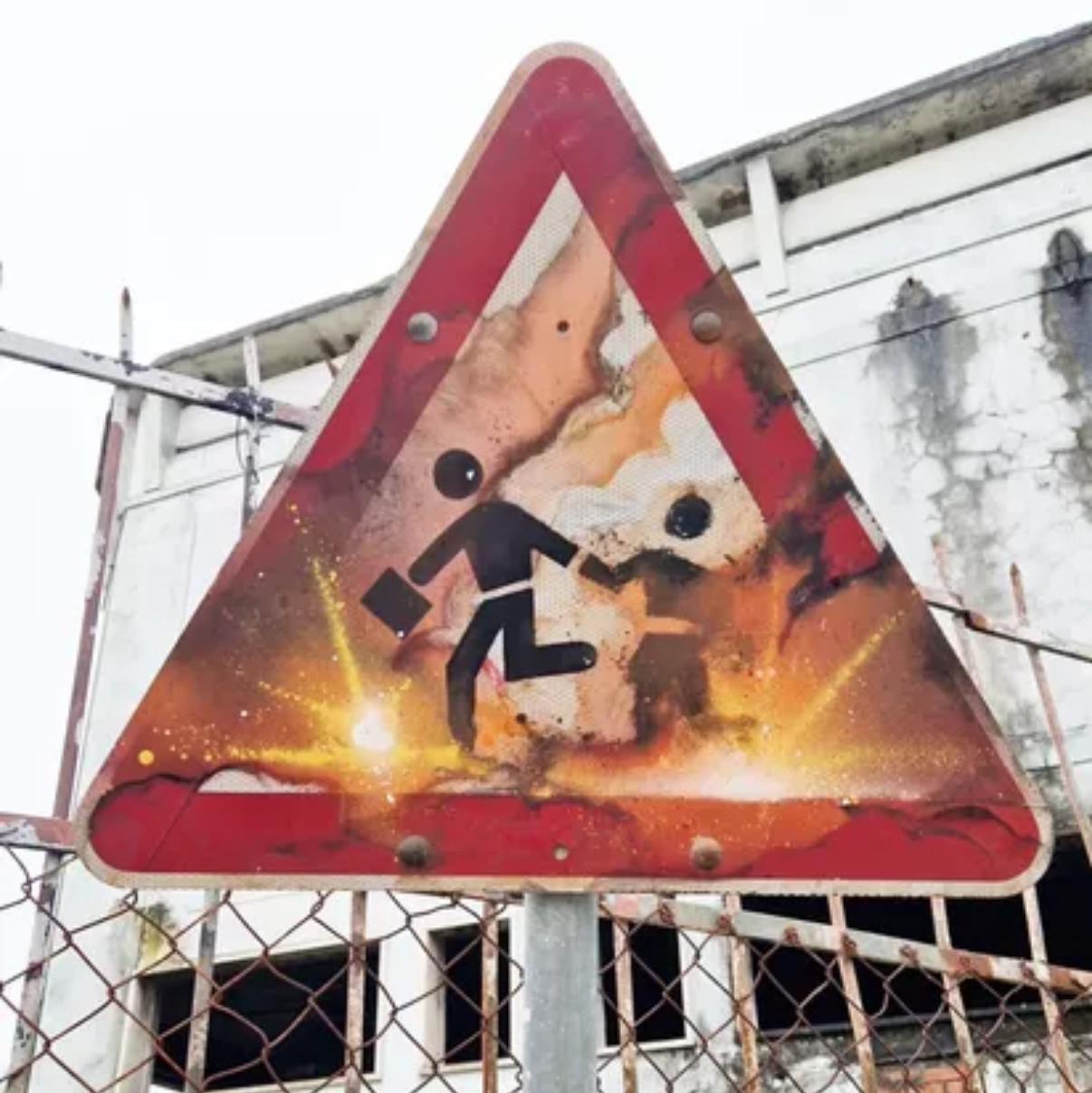
War Children, Palestine and the Provoc Instinct
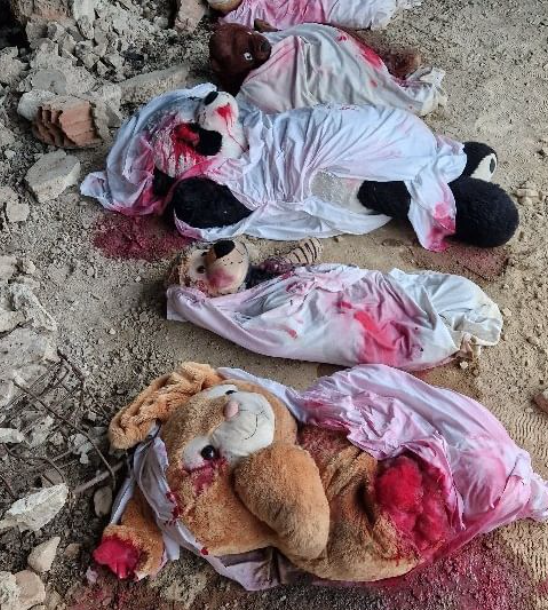
Within his wider Provoc practice, children’s toys have become a disturbing material through which to address war. Soft toys normally associated with comfort, childhood and protection are damaged and marked with red paint, transforming familiar objects into representations of children caught within violence.
GraffitiStreet explored this strand of Bordalo II’s work in Art and Activism: 10 Provocative Themes in Bordalo II’s Art.
The mechanism differs from the Big Trash Animals, although the underlying artistic method remains recognisable. Bordalo II begins with an object that already carries cultural meaning, then alters that object until its familiarity becomes uncomfortable.
In November 2023, this became particularly visible through War Children, where mutilated toys marked with red paint evoked the physical consequences of conflict. GraffitiStreet later documented how imagery connected with the work encountered sensitive-content restrictions online, a detail that became increasingly relevant to Bordalo II’s later examination of censorship and visibility.
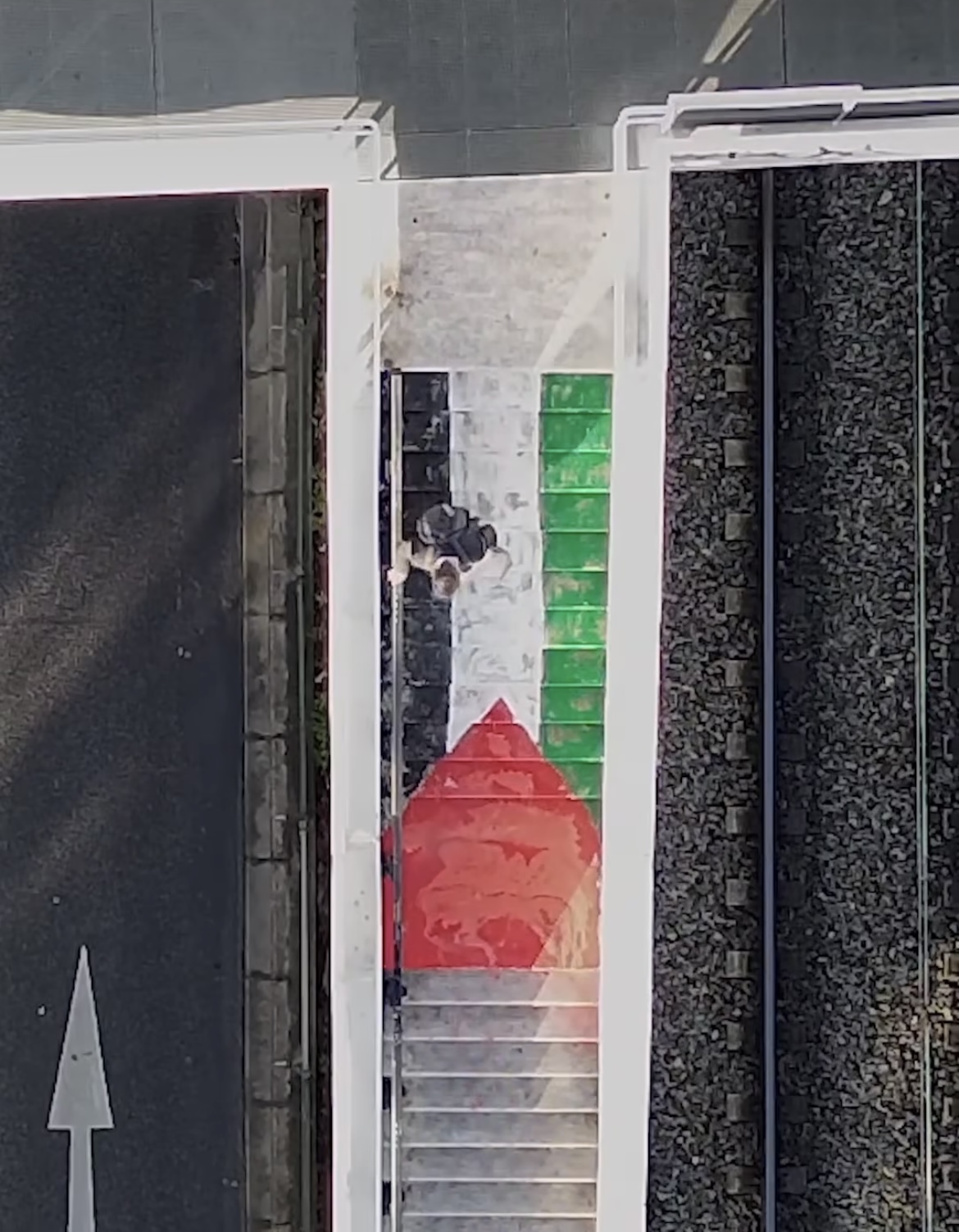
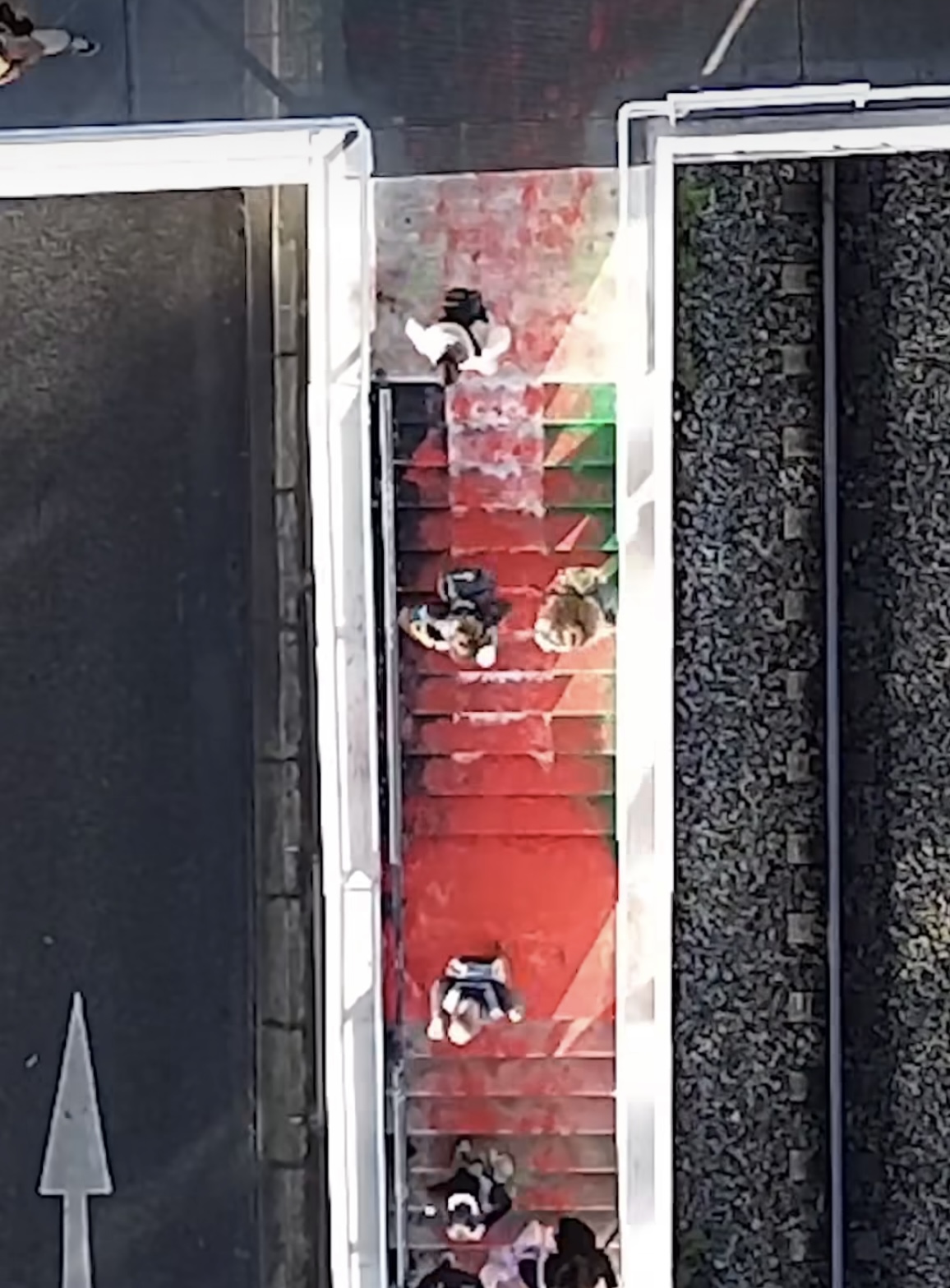
Only days later, he created Guilty Steps at Santos railway station in Lisbon. A Palestinian flag was painted across a public staircase using wet red paint, allowing pedestrians to carry red footprints beyond the image as they crossed it.
The site transformed observation into participation. Commuters had to choose whether to walk across the work, avoid it or continue through the station as normal. Those who crossed it physically extended the intervention through the surrounding space.
This is where Bordalo II’s Provoc works become particularly effective. Public space is never simply a background. Its movement, architecture and everyday behaviour become part of the artwork.
The thread continued with Sensitive Content, Bordalo II’s later Paris intervention using a blurred Palestinian flag and the visual language of digital moderation to examine the way images of conflict can be hidden, restricted or sanitised online.
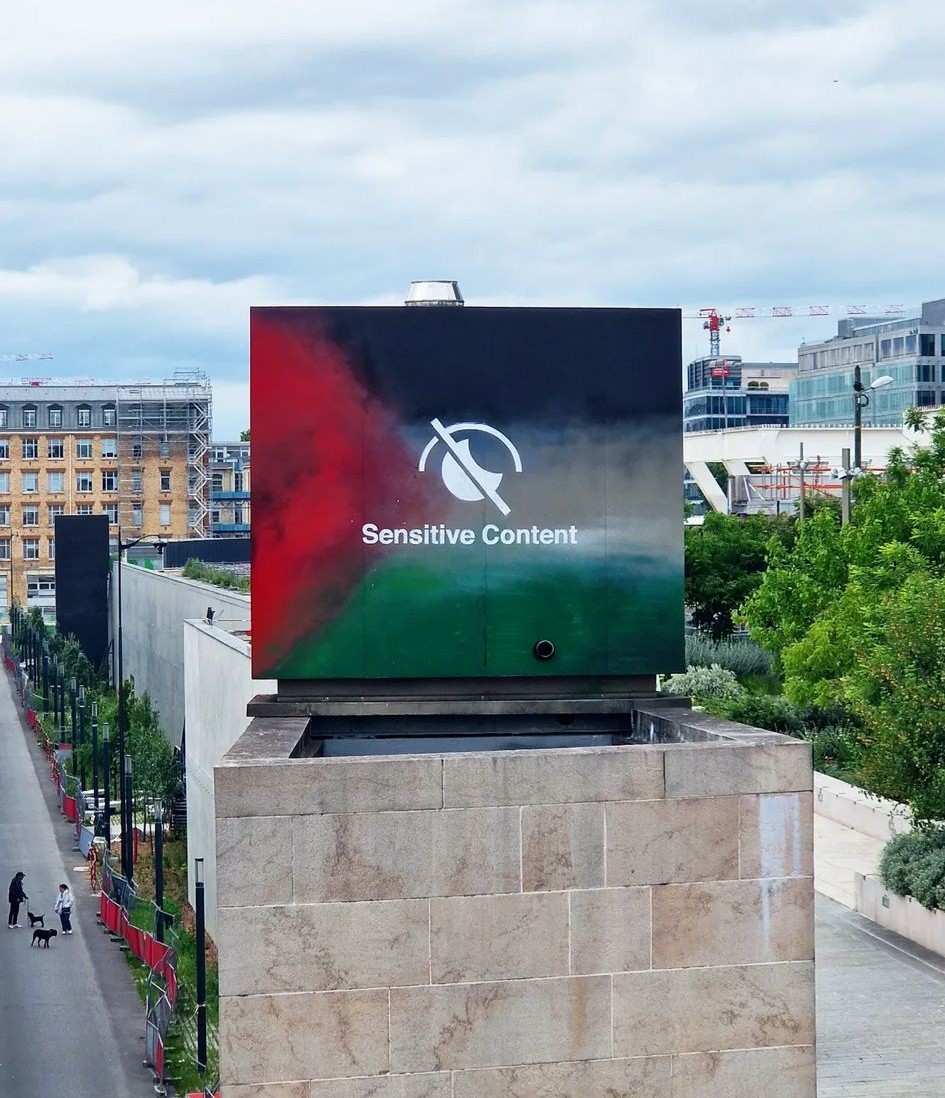
GraffitiStreet explored that work in UNMUTED: Bordalo II’s Sensitive Content Above Paris Speaks Loudly in Silence.
Viewed together, War Children, Guilty Steps and Sensitive Content reveal an increasingly connected strand within Bordalo II’s political practice. Childhood, violence, spectatorship and the control of images become part of the same wider question: what happens when society becomes accustomed to seeing suffering, or becomes increasingly skilled at hiding it?
Monopolised: When the City Becomes a Game Board
One of Bordalo II’s clearest recent Provoc interventions arrived in Lisbon in 2025. For Monoplizada / Monopolised, the artist transformed Praça do Duque da Terceira in Cais do Sodré through the visual grammar of Monopoly. The historic public space became an oversized game board through which the housing crisis, ownership, speculation and inequality could be read as systems with unequal players and unequal starting positions. Bordalo II’s official Provoc archive situates the work directly within concerns around the constitutional right to housing and the growing transformation of cities through property economics.
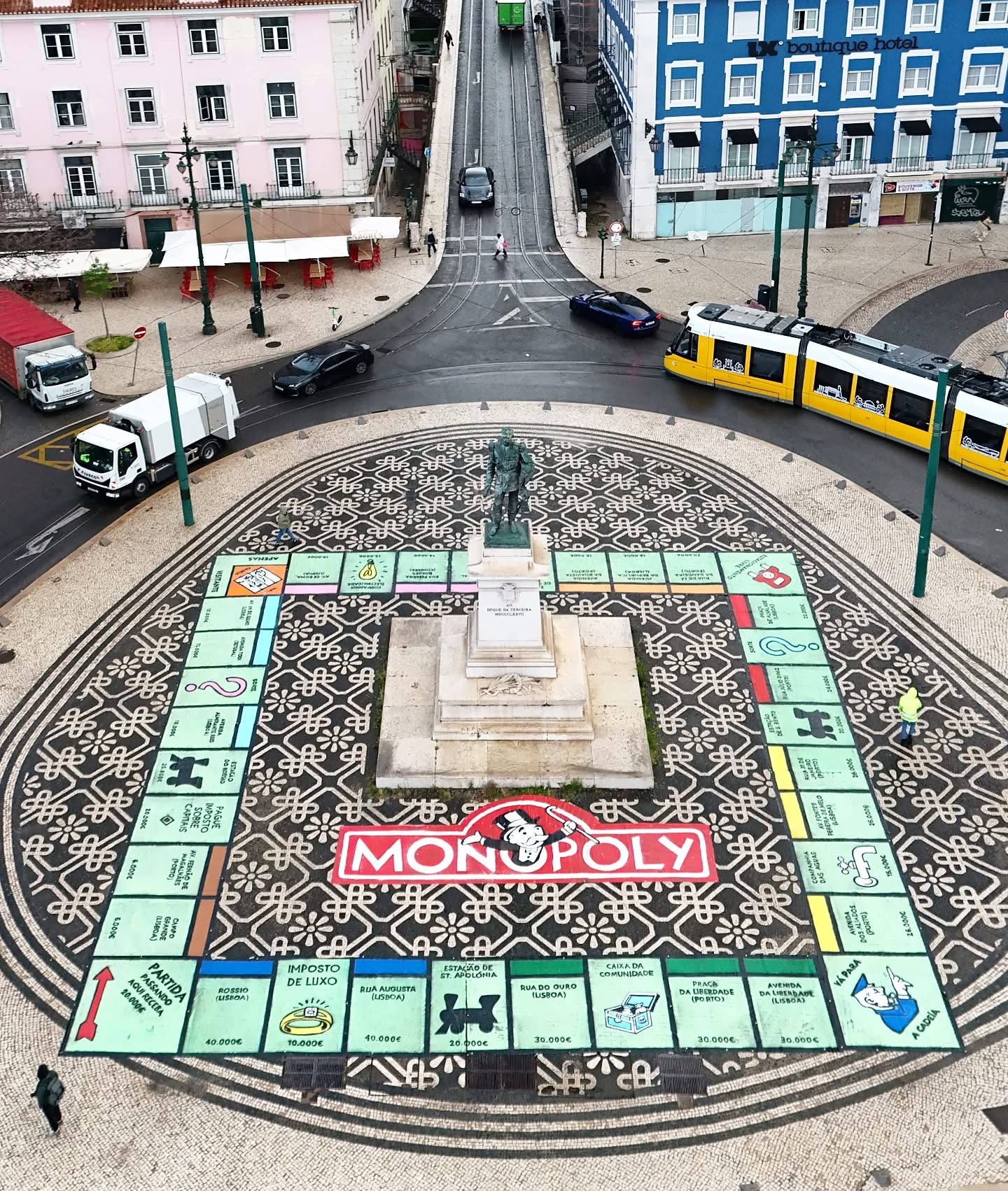
Read our full feature: Bordalo II’s Monoplizada / Monopolised Transforms Lisbon into a Street Art Protest Against the Housing Crisis.
The intervention demonstrates why public space is fundamental to Bordalo II’s practice. A critique of housing that occupies a city square within the urban economy it addresses, the site becomes part of the argument. The city is no longer the background… It becomes material.
Public Space as a Critical Medium
In our 2015 conversation, he described graffiti as a form of schooling that helped remove fear around working quickly and directly in highly visible locations. His comments illuminate the confidence with which later interventions occupy streets, monuments, walls and civic structures.
A passer-by has not necessarily chosen to encounter the work. The surrounding architecture already carries political, economic or civic meaning. Signs have functions. Monuments have histories. Streets regulate movement. Advertising competes for attention. Bordalo II inserts art into those systems and makes them temporarily unstable.
That ability to work with the language already present in the city helps connect his Provoc interventions to street art’s broader critical history. Humour, visual shortcuts and familiar symbols allow a complex subject to be understood rapidly, while the location supplies a second layer of meaning.
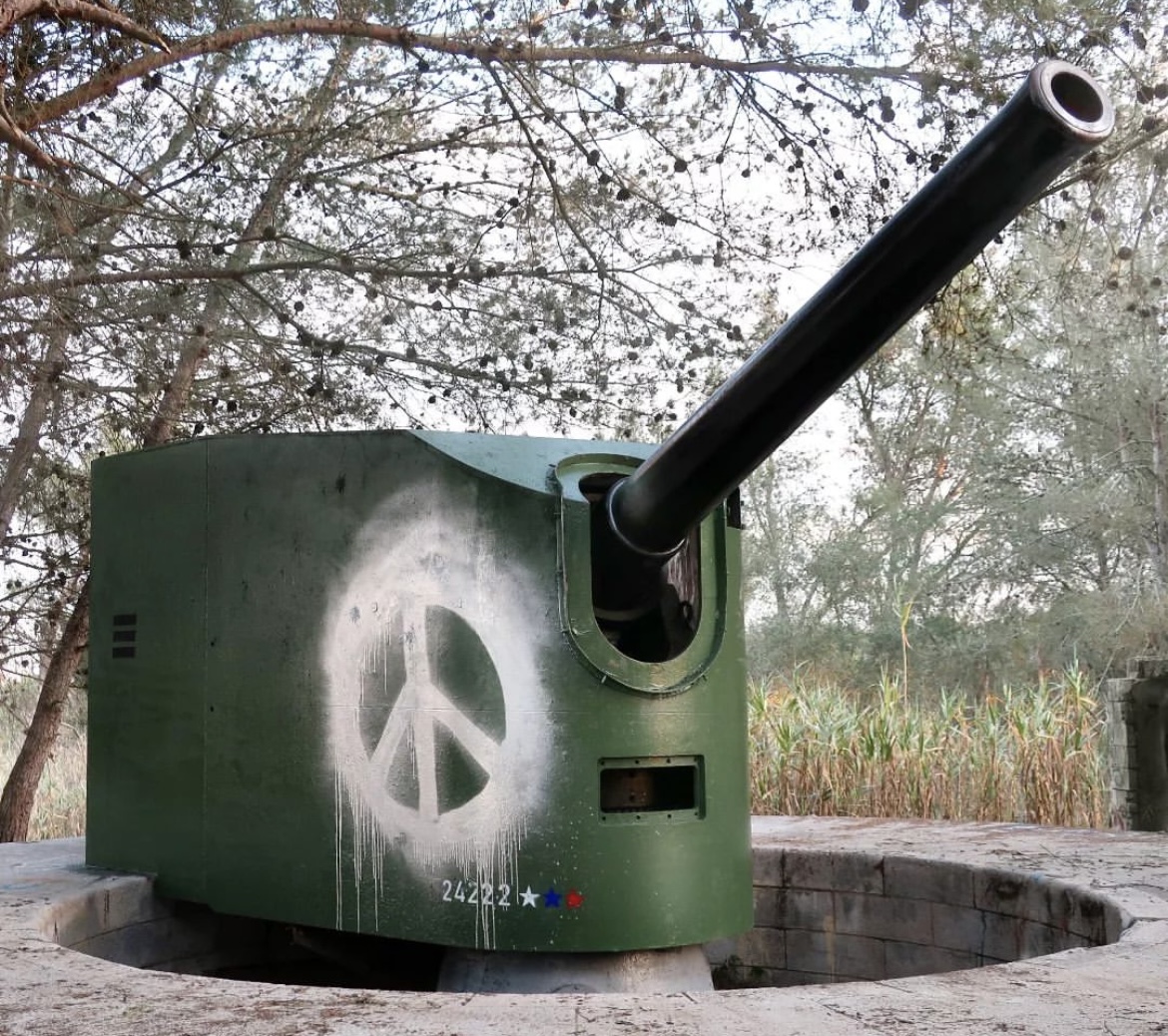
The strategy also explains why Bordalo II’s practice remains rooted in urban culture even as his sculptural work has moved comfortably into galleries, exhibitions and collections.
Attero: Inside Bordalo II’s Lisbon Studio
In 2017, Bordalo II opened the doors of his working studio in Lisbon for Attero, transforming the warehouse at Rua de Xabregas into an immersive exhibition that brought visitors directly into the environment where his ideas and materials were taking shape. A giant chimpanzee clinging to the building greeted visitors at the entrance, immediately signalling the scale and theatricality waiting inside. Contemporary accounts described Attero as a retrospective of Bordalo II’s practice to that point, bringing together works of different scales, experimental approaches and his increasingly recognisable Big Trash Animals.
GraffitiStreet attended Attero, and experiencing the exhibition inside Bordalo II’s own Lisbon studio gave the work a particular immediacy. The discarded materials, monumental animals and installations felt inseparable from the raw industrial surroundings in which they had been conceived. Rather than encountering individual works in isolation, visitors moved through Bordalo II’s developing world of waste, wildlife and environmental criticism, seeing how his practice was already expanding beyond street façades into immersive exhibition-making.
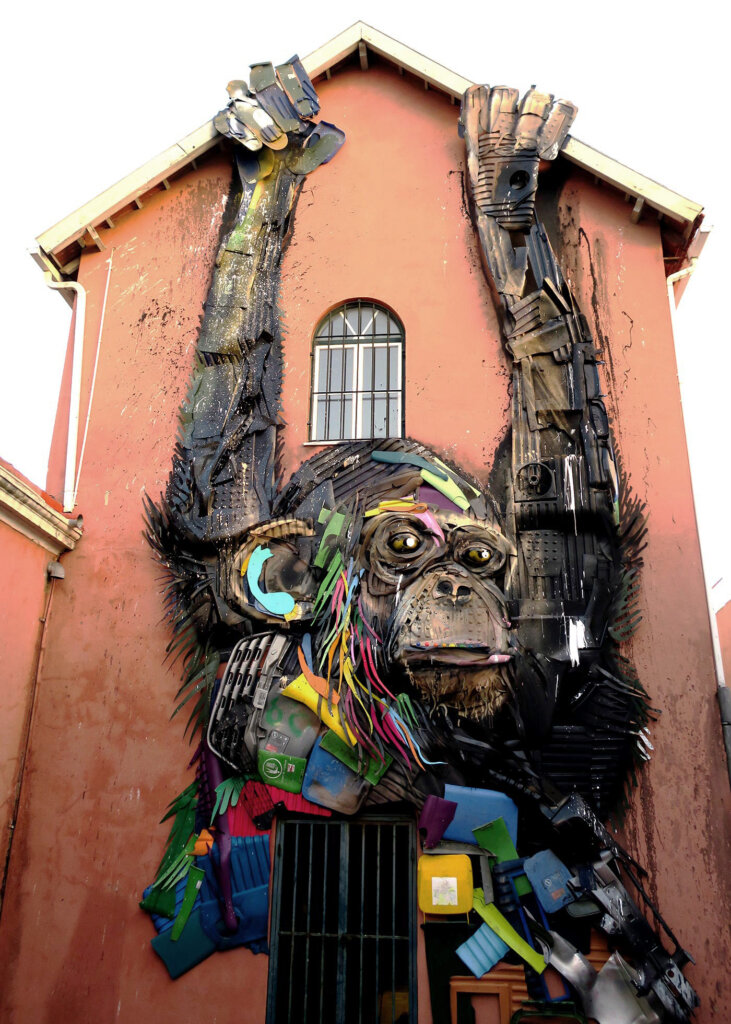
Attero became an important point in Bordalo II’s development, opening his studio to more than 27,000 visitors and presenting 41 works before the exhibition closed in December 2017. See all our images and video footage here.
Beyond Trash Animals: Light, Pixels, Wood and Material Experimentation
The breadth of Bordalo II’s current work challenges the idea that waste assemblage has settled into a fixed formula. He also extends into Lighted, Wood, Rock and Pixels, alongside Big and Small Trash Animals and Provoc.
In Lighted, the artist incorporates programmed illumination while turning the visual machinery of advertising back against consumer culture. Bordalo II’s own explanation connects the series to the persuasive language of marketing, design and artificial desire. Light, normally deployed to sell, becomes a means of intensifying a critique of the consumption that produces disposable goods and environmental damage.
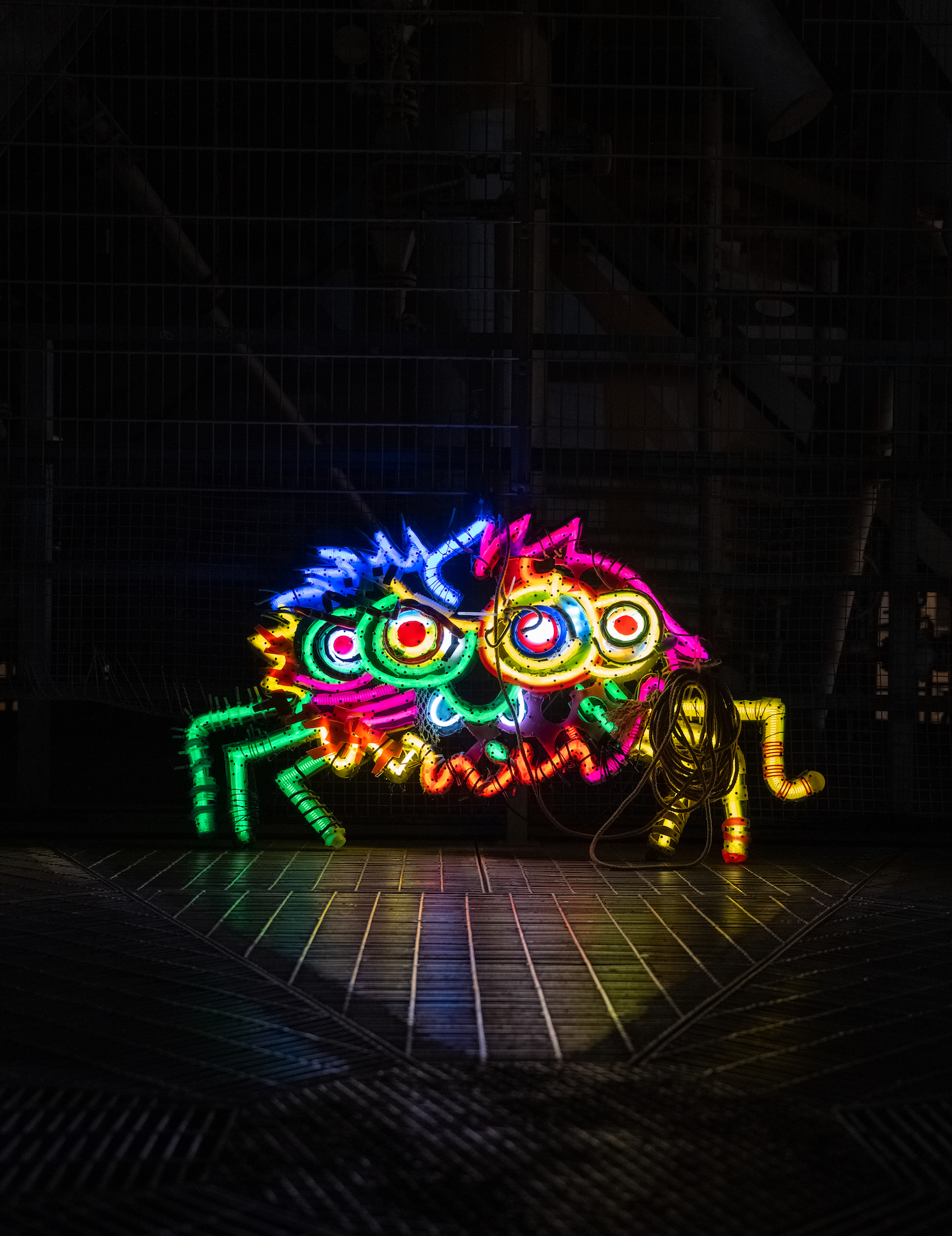
Bordalo II, Lighted Trash Animal
Pixels approaches material from another direction. Familiar discarded objects such as tyres, cigarette butts, masks, cans and bottles are repeated until they operate almost like individual pixels within a larger image. The viewer again encounters two scales simultaneously, the recognisable waste object at close range and the constructed image from farther away. Bordalo II’s official description notes that individual works address environmental questions through either the chosen material or the image it creates.
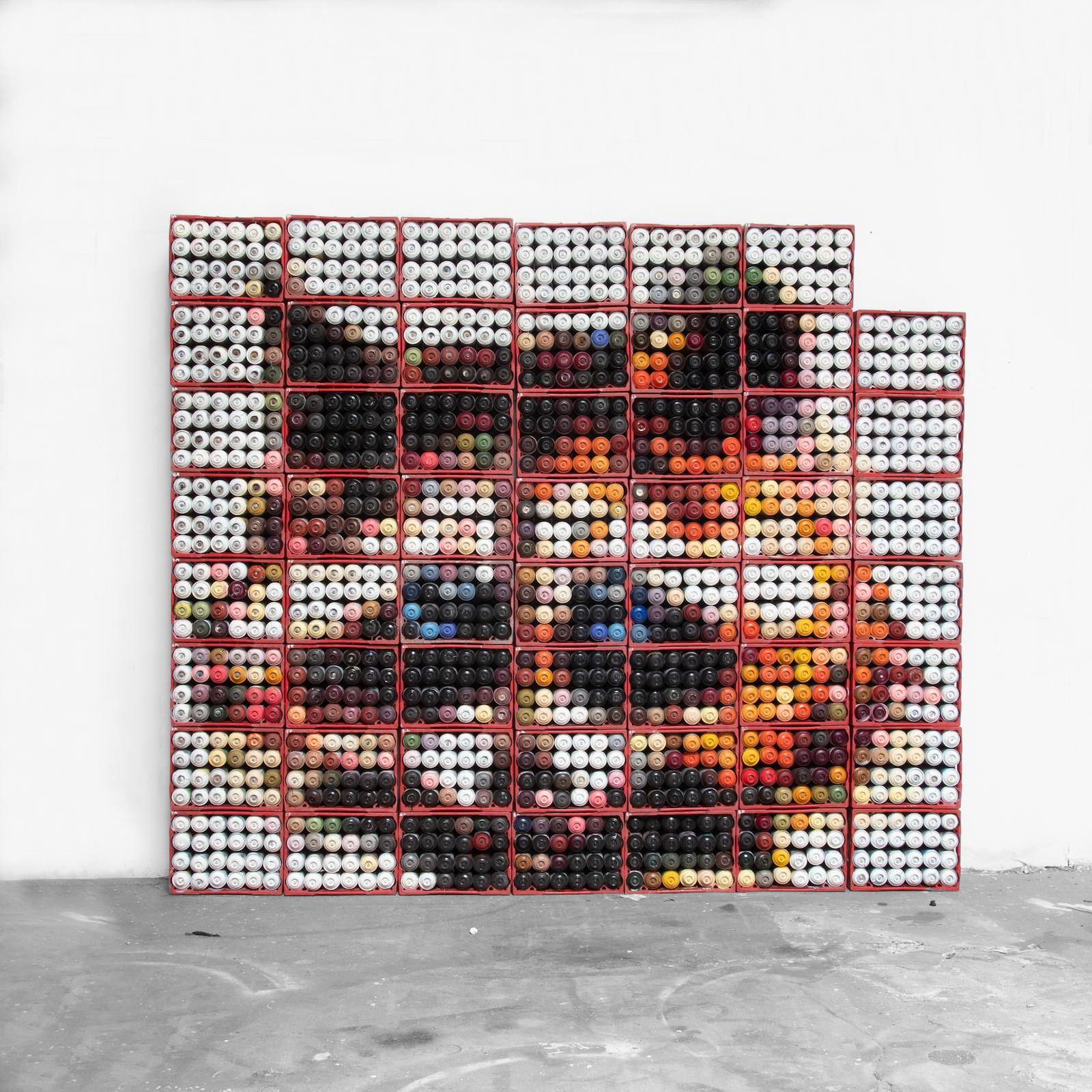
Bordalo II, Pixel Trash Animal
This expansion became particularly visible during EVILUTION, Bordalo II’s large Lisbon exhibition in 2022. The exhibition brought his established Trash Animals into dialogue with smaller works and experiments involving discarded neon, wood, spray-paint cans and other materials, while reflecting on a decade of artistic development. GraffitiStreet’s EVILUTION coverage documented an artist consciously widening the language through which his environmental ideas could be expressed.
That material exploration continued beyond the exhibition space. In 2024, Bordalo II turned his attention more decisively towards stone with Rock Owl, one of his first public sculptures created in the medium, extending his environmental language through a material associated with permanence, geology and the natural landscape.
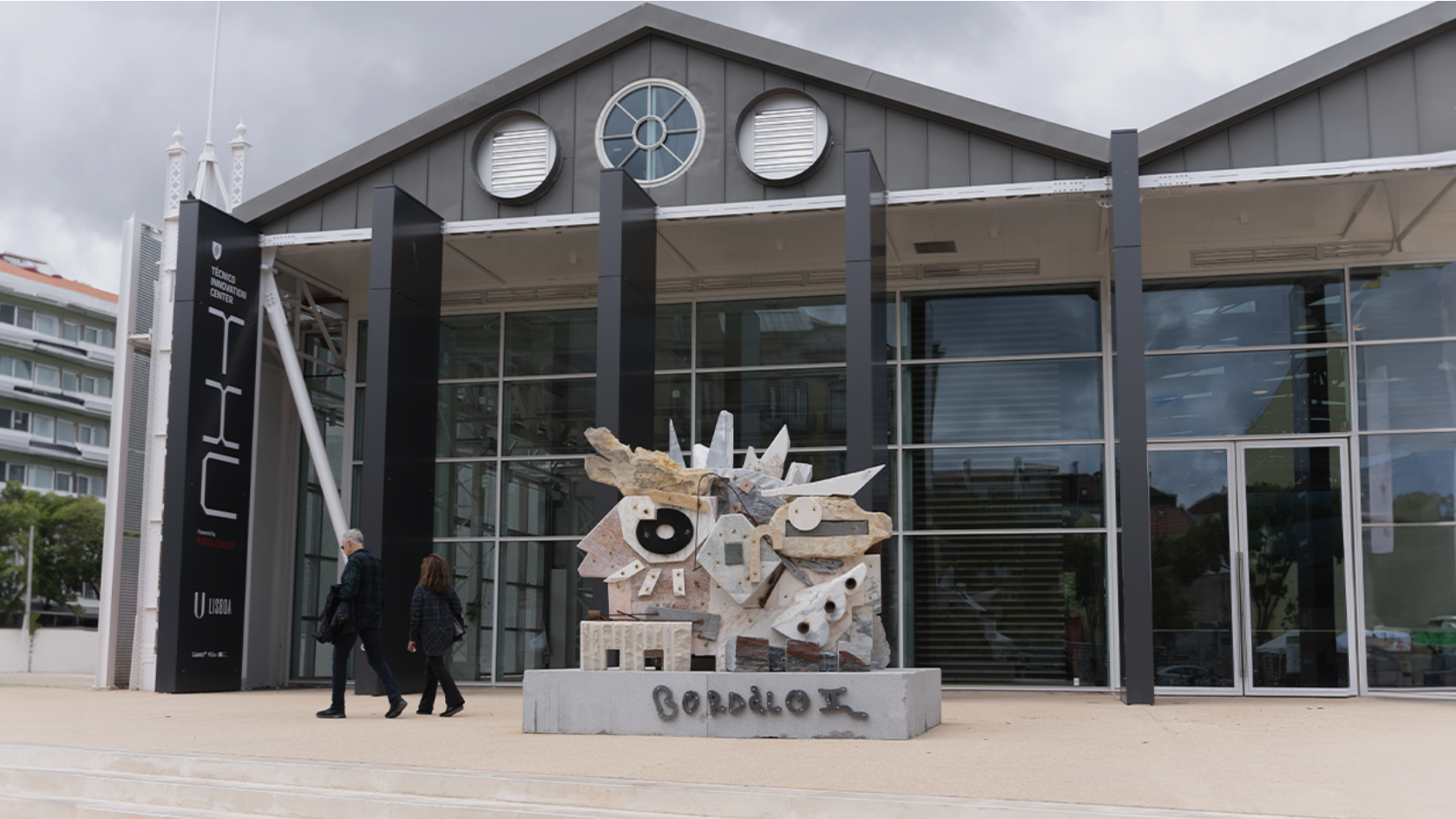
Collaboration and Evolution
Bordalo II’s material thinking also lends itself to collaboration. In 2024, he worked with fellow Portuguese artist Vhils on Evolution for Cor de Chelas, bringing a trash-built chimpanzee into dialogue with Vhils’ carved portrait of Charles Darwin. The collaboration brought two very different approaches to subtracting, recovering and reconfiguring material into the same composition, while using Darwin and the chimpanzee to reflect on evolutionary relationships between human and animal life.
Read: Bordalo II and Vhils Collaborative Mural Pays Tribute to Charles Darwin’s Theory of Evolution.
The work is revealing because both artists treat the existing material world as something that can be excavated. Vhils frequently removes material from walls to form an image. Bordalo II accumulates and rearranges material that society has already removed from use. One digs into the surface. The other builds out from its debris.
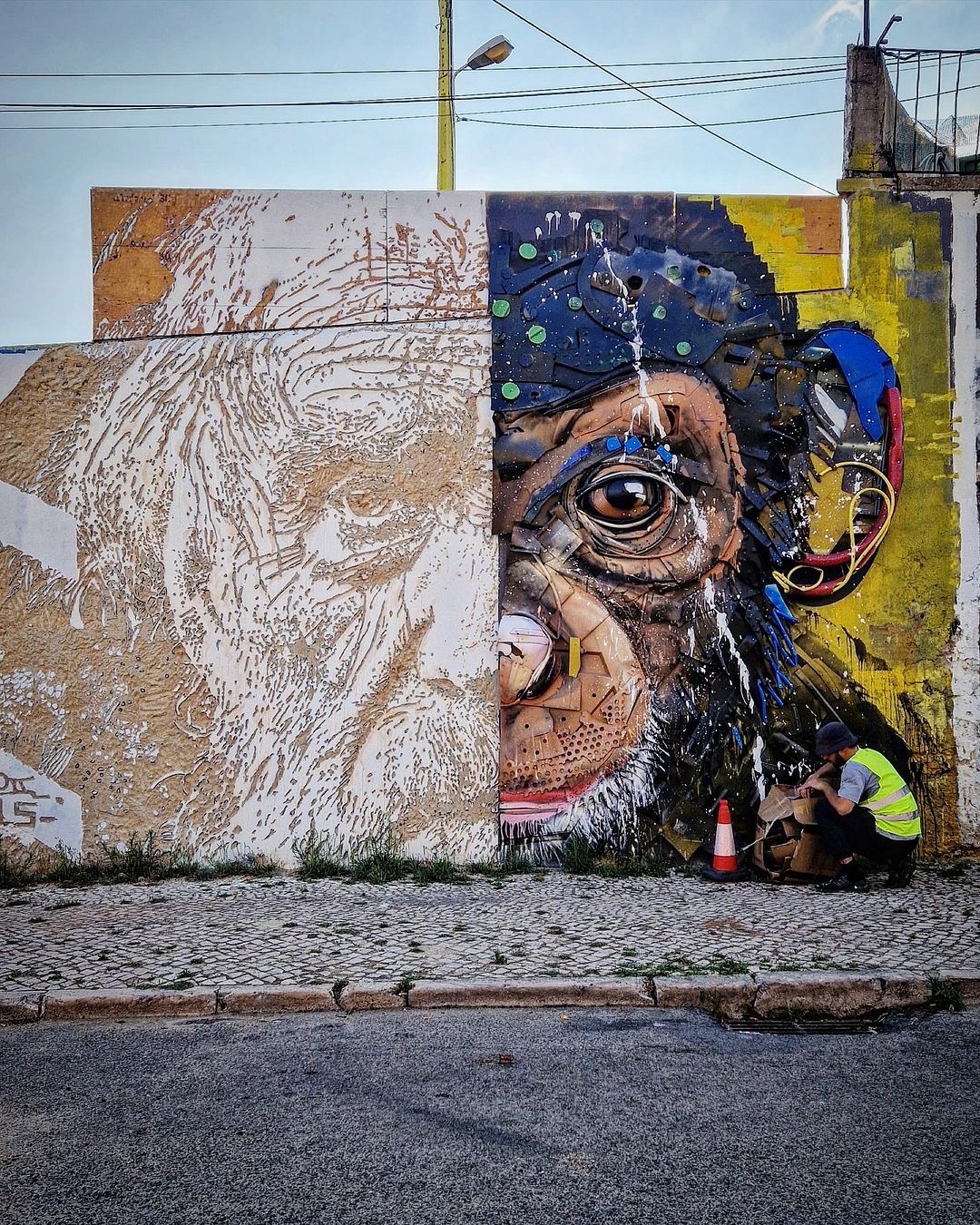
Raccoon to Re-Raccoon
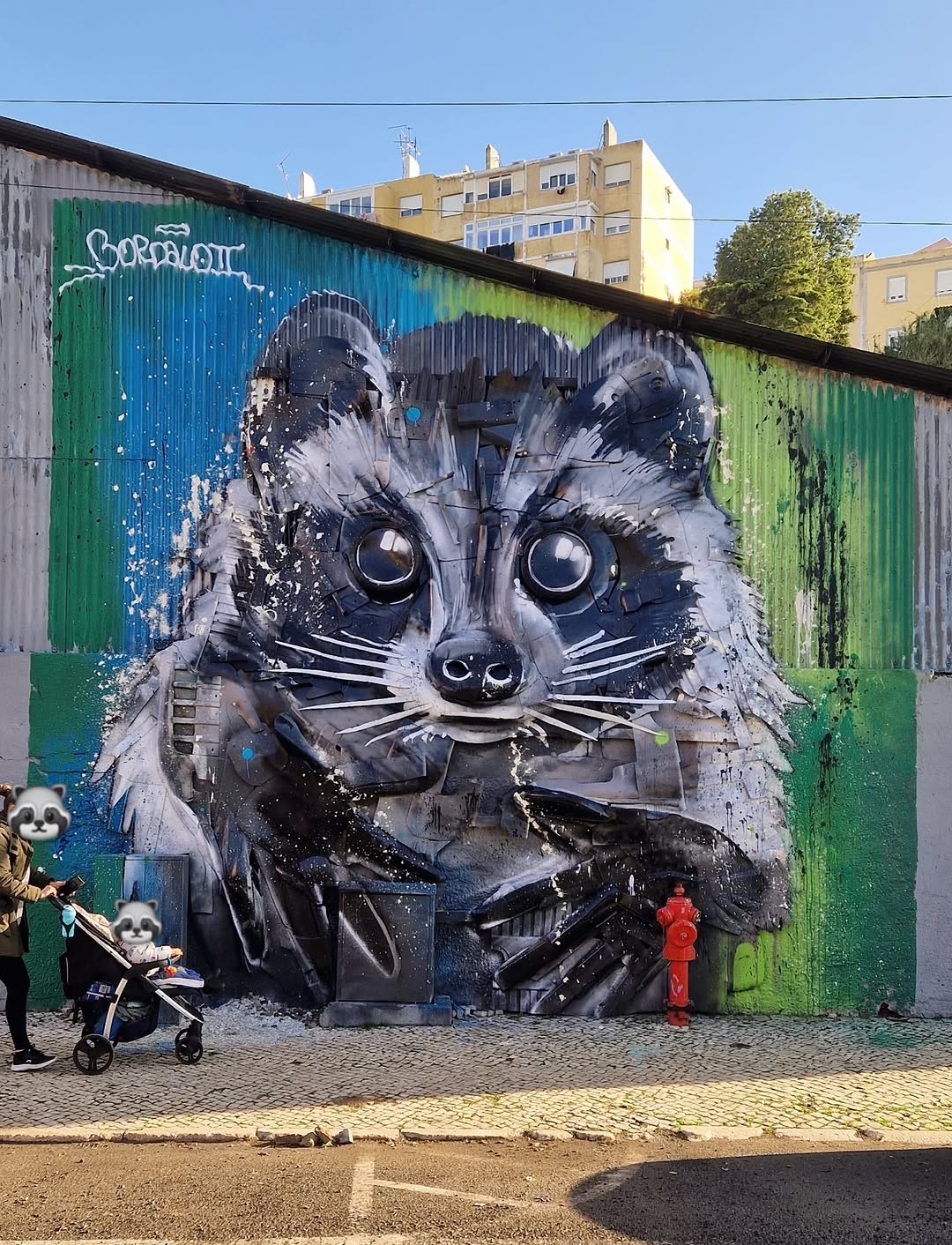
His large raccoon in Belém, Lisbon, also created in 2015, became one of the best-known early Big Trash Animals. A decade later, Bordalo II returned to the animal with Re-Raccoon, creating a newly adapted version in Chelas. GraffitiStreet’s 2025 Re-Raccoon feature traces that return and the relationship between an early landmark and a practice that has continued evolving around it. There is something fitting about revisiting an animal made from discarded materials.
Bordalo II’s entire practice is concerned with afterlives. Objects return in altered forms. Materials pass from usefulness into redundancy and then back into visibility. Recreating a significant animal ten years later extends the same logic across the artist’s own history, although you can agree not much has changed concerning waste production.
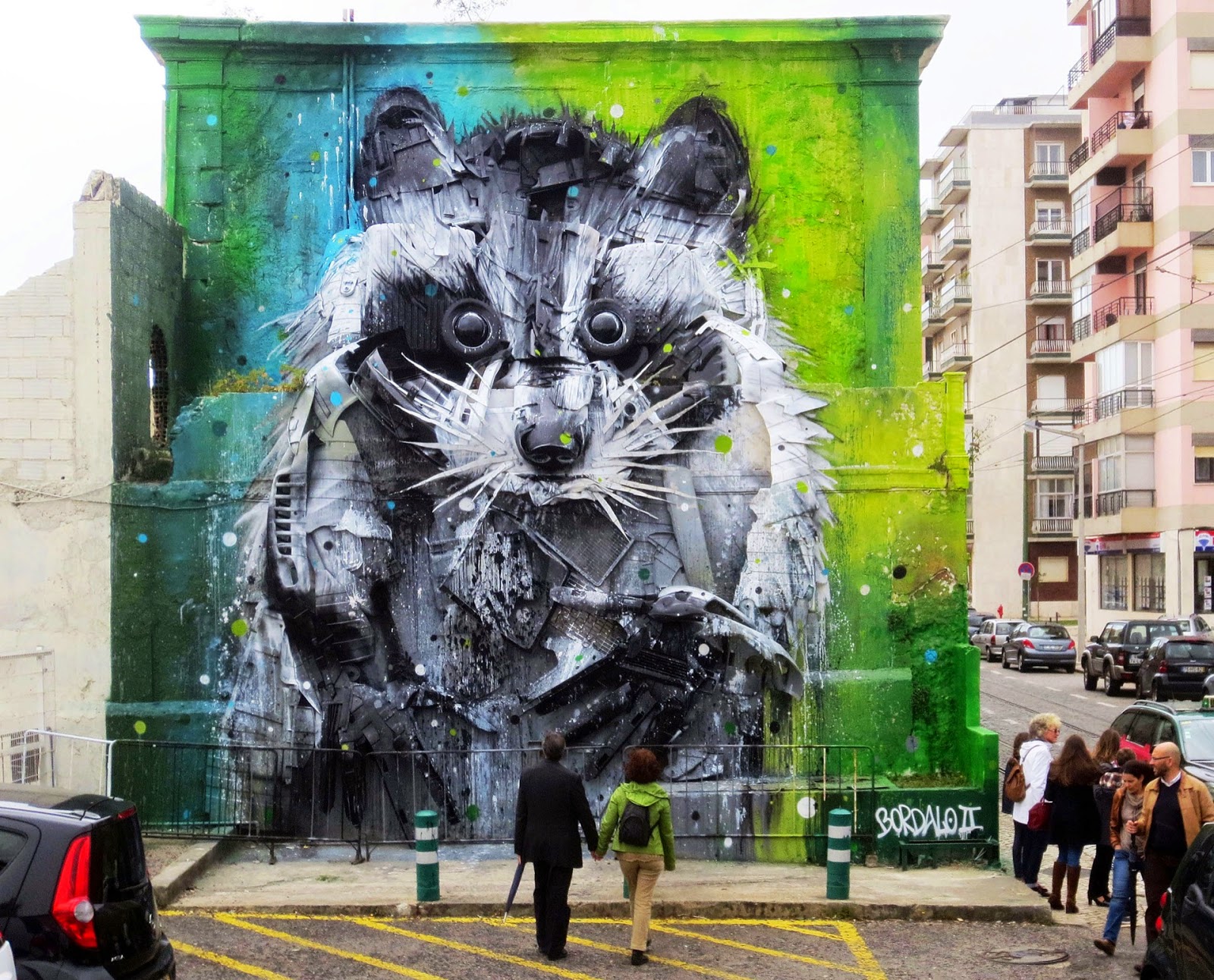
Why Bordalo II Matters in Contemporary Art
Bordalo II’s importance rests on more than an ingenious use of recycled material. His practice brings together several of the defining tensions of contemporary life: consumption and ecological consequence, digital visibility and censorship, housing and capital, spectacle and critique, beauty and waste, individual responsibility and industrial scale.
His environmental works are immediately legible without becoming exhausted by their first reading. Children can recognise the animal. A passer-by can understand the absurdity of constructing wildlife from rubbish. A closer reading reveals questions around manufacturing, disposal, habitat, value and the enormous systems connecting everyday objects to planetary consequence.
Provoc extends that critical instinct into the social body. Housing, inequality, media, war, privacy and institutional power become subjects for interventions that use the city’s own visual vocabulary to make their point.
Bordalo II can construct a monumental animal from several tonnes of recovered material, reduce another intervention to a mute symbol and blurred image, illuminate discarded plastics using the seductions of advertising, or turn a civic square into an enormous board game.
That capacity for evolution may ultimately be more important to understanding Bordalo II than any single animal or technique.
GraffitiStreet Perspective
Having followed Bordalo II’s practice since 2015, what remains compelling is the consistency of the critical intelligence beneath an increasingly diverse body of work.
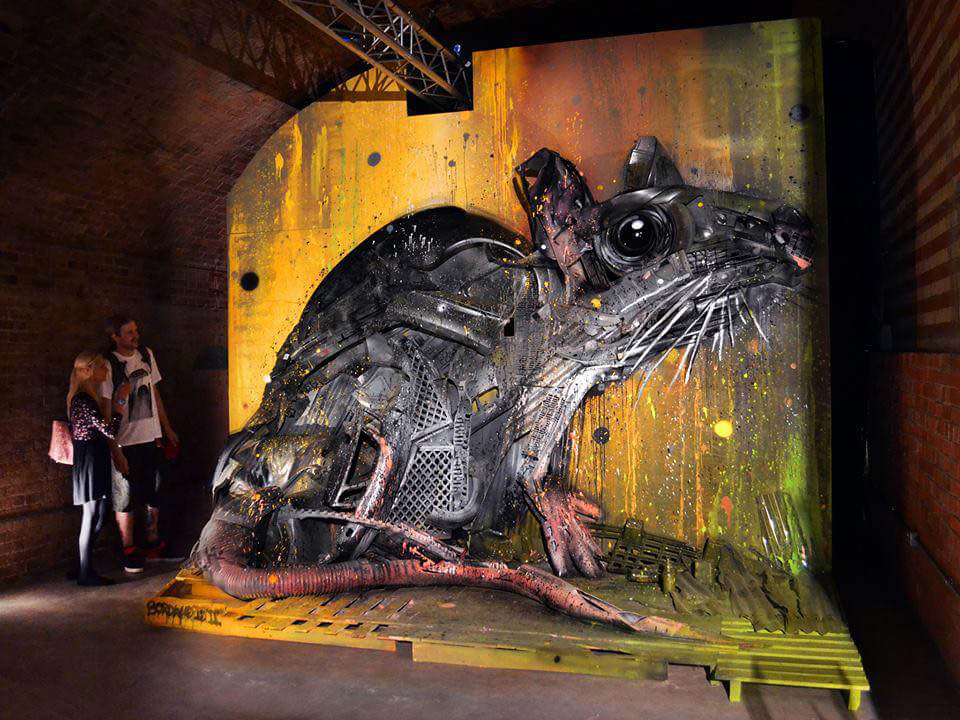
The London Rat allowed us to witness the transformation at close range: abandoned pieces of the city accumulated in a studio until something alert and strangely alive emerged from them. Years later, seeing works such as Neutral FX Panda inside GraffitiStreet Gallery offered a different encounter with the same material language, where every toy, cable, fragment and forgotten object could be examined almost archaeologically.
Yet Bordalo II’s practice has always reached beyond waste itself. Our 2015 interview already revealed an artist deeply concerned with power, information, public consciousness and art’s responsibility to retain a critical voice. That history matters when looking at the work today.
The Big Trash Animals, Provoc, Lighted, Pixels and other evolving bodies of work share an underlying insistence that contemporary life leaves evidence everywhere. Sometimes that evidence piles up physically in the form of plastic and industrial debris. Sometimes it appears within advertising, property systems, media structures or the images we are encouraged to see and ignore.Bordalo II gives those consequences form, establishing himself as one of the most compelling and distinctive artists working within contemporary urban art today.
Frequently Asked Questions
Bordalo II is the artistic name of Portuguese contemporary artist Artur Bordalo, born in Lisbon in 1987. He is internationally recognised for transforming discarded materials into sculpture and public art, particularly through his Big Trash Animals, while his wider practice includes Provoc, Lighted, Pixels, Small Trash Animals, Wood and Rock.
The name honours his grandfather, the painter Bordalo. Bordalo II’s official biography describes the name as a way of continuing that artistic legacy while allowing it to evolve into a new generation and practice.
Big Trash Animals are large sculptural depictions of animals constructed from recovered and discarded materials. The series includes approaches such as Neutral, Half-Half and Plastic, each revealing the relationship between the represented animal and the waste embedded within its form in different ways.
Provoc is a body of urban interventions through which Bordalo II examines social and political subjects. His official site identifies themes including pollution, exploitation of women, media sensationalism, connectivity and control. Recent works have also addressed inequality and housing.
His practice incorporates discarded plastics, vehicle parts, tyres, toys, electronics, fabric, nets, metal and other recovered materials, with the exact combination changing according to the work. Later bodies of work have expanded his vocabulary into discarded neon, wood, repeated single-use objects and other material experiments.
His practice crosses several fields. Bordalo II developed through graffiti and continues to work extensively in public space, while his sculptures, installations, editions and exhibition works also operate within contemporary art and gallery contexts. His current practice spans public intervention, sculpture, assemblage, environmental art and material experimentation.
GraffitiStreet works with Bordalo II artworks and editions and maintains an artist page bringing together available and previously handled works. Collectors can explore Bordalo II artworks at GraffitiStreet or contact the gallery directly regarding availability, acquisitions and private viewings.
Discover Bordalo II at GraffitiStreet
GraffitiStreet’s relationship with Bordalo II reaches back to 2015, when we invited the Portuguese artist to London for our Underground exhibition and watched his monumental London Trash Rat emerge from discarded materials collected around East London. Since then, we have continued to follow the evolution of his public works, exhibitions, environmental practice and provocative interventions while presenting Bordalo II works to collectors through GraffitiStreet gallery.
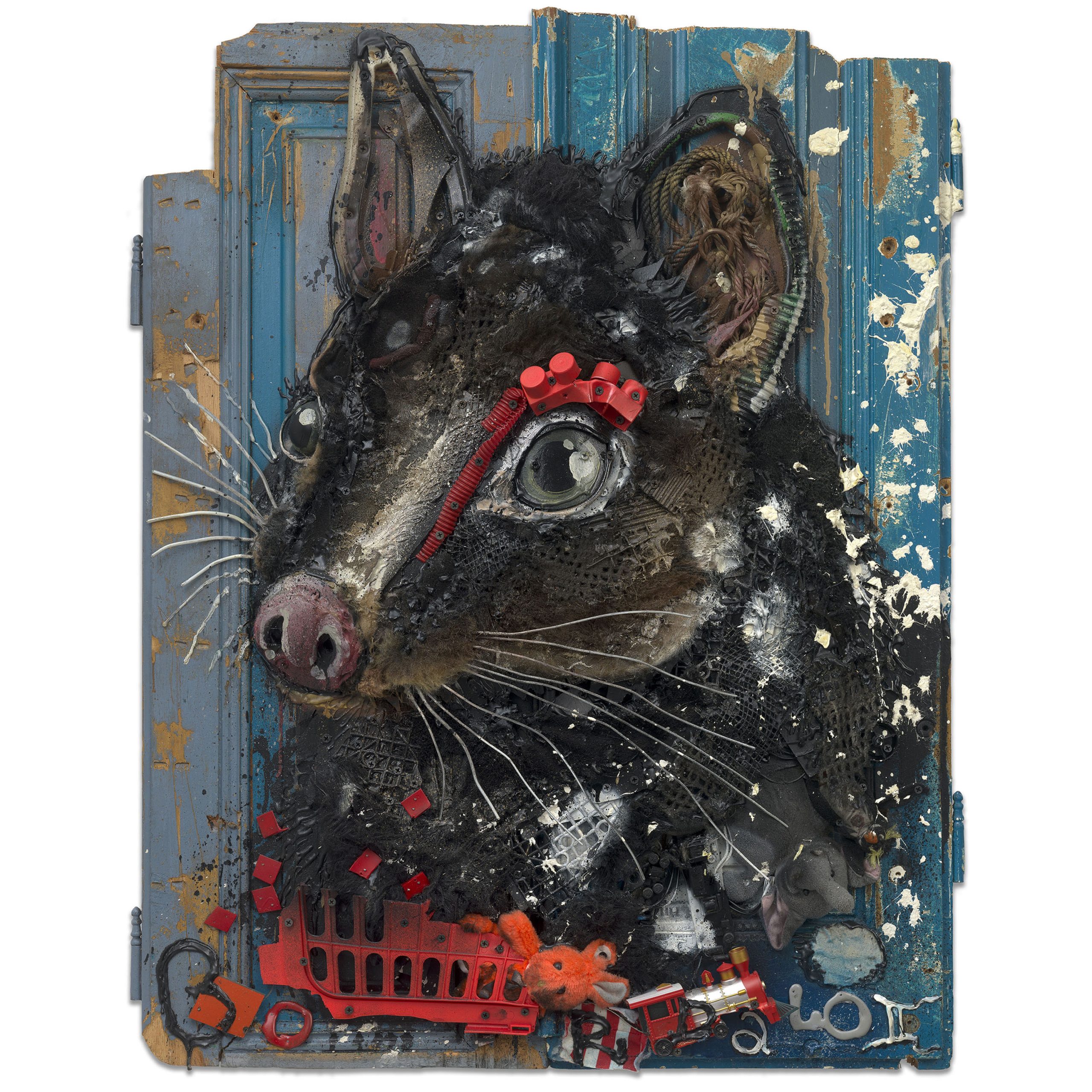
Bordalo II – Eastern Quoll FX (2025) Urban Equinox Exhibition. Available via GraffitiStreet
Today, his practice extends from monumental Big Trash Animals and unique assemblages to editions and smaller sculptural works, each carrying the material intelligence and critical spirit that have made Bordalo II one of the most distinctive voices to emerge from contemporary urban art.
For availability, acquisitions and private viewings, explore Bordalo II artworks at GraffitiStreet, contact us directly or experience works in person at:
GraffitiStreet Gallery
25A West Street
Chichester
West Sussex
England PO19 1QW